
Thumb Spica Brace vs Thumb Sleeve: Which Design Is Different?
If you are searching for thumb support, you may see thumb sleeves, compression sleeves, thumb braces, thumb spica braces, and thumb splints — and wonder whether they are basically the same thing. They are not. A thumb sleeve generally relies on flexible material and close-fitting coverage, while a thumb spica brace typically incorporates a more structured support around the thumb and may extend onto the wrist. This guide compares the two designs side by side across coverage, structure, support, movement, fastening, fit, and everyday usability.
What This Design Comparison Covers
- Quick Answer
- What Is a Thumb Spica Brace?
- What Is a Thumb Sleeve?
- The Main Design Difference
- 3D Interactive: Split-Screen Comparison
- Coverage Comparison
- Structure and Support
- Compression vs Structural Support
- Thumb Movement Comparison
- Wrist Movement
- Fastening and Adjustability
- Interactive: Compare the Design
- Fit and Comfort
- Everyday Activity Comparison
- Comfort and Bulk
- Side-by-Side Comparison Table
- Don’t Compare Only the Product Names
- Product Spotlight
- When a Thumb Sleeve May Be Considered
- When a Spica Design May Be Considered
- Common Comparison Mistakes
- Professional Guidance
- Quick Comparison Checklist
- FAQ
- Conclusion
Quick Answer: What Is the Difference Between a Thumb Spica Brace and a Thumb Sleeve?
A thumb sleeve is typically a flexible, close-fitting support that covers part or all of the thumb and may extend toward the hand or wrist. A thumb spica brace generally uses a more structured design that supports the thumb and may include wrist coverage and adjustable fastening. Exact construction varies between products.
If you want the deeper design-architecture explanation first, the reference understanding spica brace designs covers how spica braces are constructed in detail. This article focuses specifically on comparing a structured spica brace with a sleeve-style thumb support.
What Is a Thumb Spica Brace?
A thumb spica brace is a support design that incorporates the thumb into a larger support structure. This section provides a brief overview — for the full design explanation, see the reference understanding spica brace designs.
Thumb-Support Section
Contacts and positions the thumb. The thumb opening and support structure determine how the thumb sits within the design.
Hand / Palm Section
Connects the thumb support to the wrist support. Provides additional contact area and helps anchor the brace structure.
Wrist Section
Extends the support structure onto the wrist. Provides an anchor for the thumb support. Coverage varies by design.
Straps
Secure the brace during wear. Different strap systems affect how the brace fits and stays in position.
Structured Support
The support body provides positioning. May be flexible, semi-rigid, or structured depending on the design.
Varying Flexibility
Not every spica brace is rigid. Flexibility varies between designs. Some are more flexible than others.
What Is a Thumb Sleeve?
A thumb sleeve is a sleeve-style support that covers part or all of the thumb. Unlike a structured spica brace, a thumb sleeve typically relies more on flexible material and close-fitting coverage rather than on a structured support architecture.
Typical Characteristics
- Flexible fabric
- Tubular or close-fitting construction
- Compression or light support depending on product
- Minimal fastening
- Relatively low-profile design
- Thumb coverage
- Possible hand or wrist extension
Important
Don’t assume every thumb sleeve provides compression, and don’t assume every sleeve has identical coverage. Sleeve designs vary. Some may include additional support elements; others may be simpler. Always check the specific product’s specifications.
The Main Design Difference
This is the central concept of the comparison. The two designs differ primarily in their approach to support.
Thumb Sleeve
Thumb Spica Brace
Important: These are general design patterns, not absolute rules. Some sleeves may include structural elements; some spica braces may be more flexible than others. Always evaluate the specific product.
Thumb Spica Brace vs Thumb Sleeve: 3D Split Comparison
This split-screen comparison shows the design differences between the two approaches. Tap each panel to explore.
Interactive 3D: Split-Screen Comparison
Tap each panel to explore the design approach
Thumb Spica Brace
Structured support design
Thumb support, thumb base, hand support, wrist section, fastening strap, and structured architecture. May extend onto the wrist.
Structured architectureThumb Sleeve
Flexible sleeve-style design
Thumb coverage, flexible sleeve material, hand transition, possible wrist transition. Relies primarily on material and fit.
Flexible architectureThumb Spica Brace
A structured support design that incorporates the thumb into a larger support structure. It typically includes a thumb-support section, hand coverage, and often extends onto the wrist. The design may use fastening straps to maintain position. Flexibility varies between products — not every spica brace is rigid.
Different Construction → Different Support Characteristics
Coverage Comparison
Coverage is one of the most visible differences between the two designs. Different coverage patterns affect how the support functions.
Coverage Comparison
Select a design to see typical coverage patterns.
Depending on design, a thumb spica may cover:
- Thumb
- Thumb base
- Hand
- Wrist
Coverage varies by design. Some spica braces extend further onto the wrist than others.
Key takeaway: Coverage should be evaluated from the actual product rather than its name. Two products with similar names can have different coverage patterns. Check the manufacturer’s stated coverage.
Structure and Support
This is one of the strongest comparison sections. The two designs provide support through different physical mechanisms.
Spica Brace Structure
- Support body
- Thumb section
- Wrist section
- Straps
- Possibly reinforcement
- Adjustable closures
Sleeve Structure
- Stretch fabric
- Elastic material
- Tubular body
- Thumb opening
- Possibly compression zones
Important: Support can come from different physical mechanisms. A sleeve may rely primarily on its material and fit, while a structured brace may use shape, coverage, fastening, or reinforcement. The appropriate mechanism depends on the design’s intended function and the user’s requirements.
Compression vs Structural Support
This is an important distinction that is often overlooked. Compression and structural support are not the same thing.
Sleeve Support Mechanism
Spica Support Mechanism
Key distinction: Compression and structural support are not the same thing. A sleeve may provide compression through fabric tension. A spica brace may provide structural support through shape, coverage, and fastening. The exact mechanism varies by product.
Thumb Movement Comparison
Different designs influence thumb movement differently. This is not a ranking — it is a description of how the designs differ.
Thumb Spica
Depending on construction, a spica brace may limit some thumb movements through its support structure. The extent depends on the design’s coverage, rigidity, and fastening. Not every spica brace restricts movement to the same degree.
Thumb Sleeve
Flexible material may generally accommodate more natural movement, depending on the product. However, a tighter sleeve with more compression may influence movement differently from a looser one.
Important: Do not assume that a sleeve always allows better movement. The amount of movement depends on the actual construction and how much material or structure surrounds the thumb. Follow the manufacturer’s intended-use instructions.
Wrist Movement
This is a key differentiator between the two designs.
Spica Brace
Some designs extend onto the wrist and therefore interact with wrist movement. The extent of this interaction depends on how far the design extends and how structured it is.
Thumb Sleeve
Some sleeves may stop around the thumb or hand; others may extend farther. Wrist coverage varies between sleeve designs.
Check actual wrist coverage rather than relying on the product name. Some sleeves extend to the wrist; some spica braces stop at the hand. The name alone does not tell you the coverage.
Fastening and Adjustability
Fastening is another key difference between the two designs. The two approaches to fit are distinct.
Spica Brace Fastening
- Hook-and-loop straps
- Wraparound closures
- Adjustable straps
- Thumb-specific fastening
Thumb Sleeve Fastening
- Stretch material
- Fabric tension
- Close fit
- Usually no separate fastening
Fastening-based fit vs Material-based fit
Product designs vary. Some sleeves may include adjustable elements; some spica braces may rely more on wraparound construction. Always check the specific product’s fastening system.
Interactive: Compare the Design
Click each aspect to compare the two designs. This tool produces a comparison summary, not a recommendation.
Compare the Design
Click each aspect to see how the two designs differ.
- Thumb spica: May cover thumb, thumb base, hand, and wrist depending on design.
- Thumb sleeve: May cover thumb, thumb base, and part of hand or wrist depending on design.
- Key point: Coverage should be evaluated from the actual product rather than its name.
Fit and Comfort
This section covers the basics of fit. For the detailed fit guide, see the reference thumb spica splint fit guide.
Thumb Sleeve Fit
Fit usually depends heavily on:
- Correct size
- Fabric stretch
- Body shape
- Comfortable pressure
Spica Brace Fit
Fit can depend on:
- Size
- Thumb positioning
- Wrist positioning
- Straps
- Support structure
Everyday Activity Comparison
This practical comparison describes what to consider for each design during different activities. Neither design is universally appropriate — the design’s characteristics interact with the activity.
| Activity | Thumb Sleeve | Thumb Spica |
|---|---|---|
| Typing | Consider flexibility | Consider wrist and palm coverage |
| Phone use | Consider thumb mobility | Consider thumb movement restrictions |
| Writing | Consider material bulk | Consider palm structure |
| Light household tasks | Depends on design | Depends on support structure |
| Fine finger work | Usually depends on thumb coverage | Depends on thumb and finger clearance |
| Resting | Consider comfort | Consider pressure points |
| Repetitive activities | Evaluate support needs | Evaluate support and movement |
Important: Do not label either design as universally appropriate. The appropriate design depends on the specific activity, the design’s characteristics, and the user’s needs.
Comfort and Bulk
This is a strong secondary comparison point. Comfort and bulk depend on design, sizing, and individual fit.
Thumb Sleeve — Potential Characteristics
- Low profile
- Flexible
- Easier to fit under some clothing
- Less hardware
Spica Brace — Potential Characteristics
- More structural components
- Potentially greater bulk
- Broader coverage
- More fastening hardware
Important: Everything here is design-dependent. Some spica braces may be more comfortable than some sleeves, depending on sizing, materials, and individual fit.
Side-by-Side Comparison Table
This is the main comparison table for the article. It does not declare a winner — the appropriate design depends on the intended purpose.
| Feature | Thumb Spica Brace | Thumb Sleeve |
|---|---|---|
| Basic structure | Structured support design | Flexible sleeve-style design |
| Thumb coverage | Variable | Variable |
| Wrist coverage | Often possible | Design-dependent |
| Fastening | Often adjustable | Often pull-on |
| Material | Flexible to structured | Usually flexible |
| Support mechanism | Structure + fit + fastening | Material + fit |
| Movement | Design-dependent | Design-dependent |
| Adjustability | Often higher | Often lower |
| Bulk | Can be greater | Often lower |
| Fit | Size + positioning + adjustment | Primarily size + material fit |
| Everyday comfort | Design-dependent | Design-dependent |
Important: This table describes general design characteristics. Individual products vary. Always check specific product specifications.
Don’t Compare Only the Product Names
This section teaches readers how to evaluate a specific product beyond its name. Product names alone don’t tell the whole story.
What to Inspect
- 1. Coverage: What exactly does it cover?
- 2. Materials: Flexible fabric or structured material?
- 3. Fastening: Pull-on or adjustable?
- 4. Wrist extension: Does it reach the wrist?
- 5. Thumb opening: How is the thumb positioned?
- 6. Movement: Which joints remain free?
- 7. Size: What measurements does the manufacturer provide?
- 8. Intended use: What does the manufacturer actually state?
Why This Matters
Two products with similar names can have very different coverage, structure, and intended use. By examining these eight aspects, you can evaluate whether a product’s design matches your requirements — rather than relying on the name alone.
Product Spotlight: Example of a Structured Thumb-Wrist Spica Design
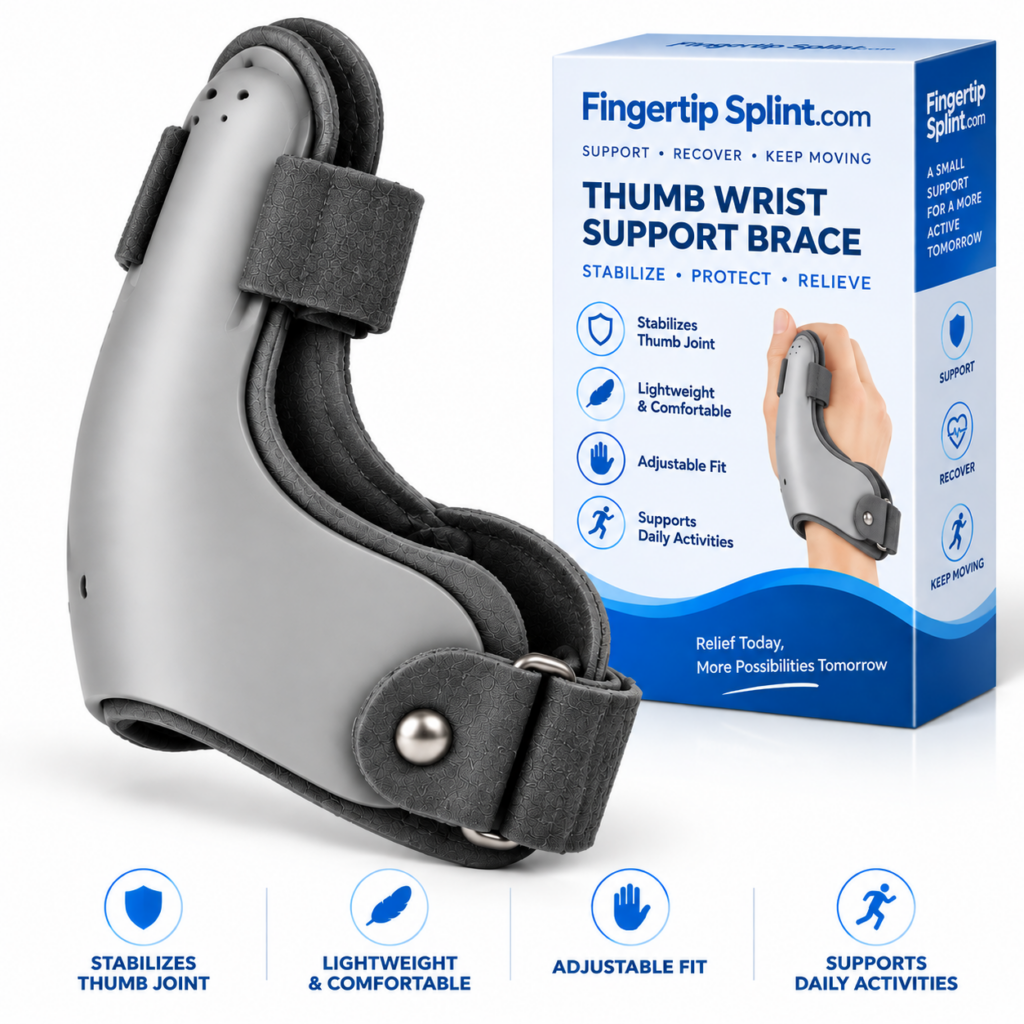
After understanding the design differences, here is a specific product to examine. The 1 Pcs Thumb Wrist Support Brace CMC Thumb Spica Splint provides an example of a structured thumb-wrist spica design. This is not a thumb sleeve — it is a more structured design with a different architecture.
Thumb Wrist Support Brace
- CMC-focused structured design
- Thumb support architecture
- Wrist support
- Fastening system
- Adjustable fit
How This Differs From a Simple Sleeve
CMC-Focused Structure
The design is oriented around the thumb-base region and the CMC joint. This provides structured support rather than relying on material compression.
Thumb Support
The design includes a structured thumb-support section. The thumb sits within the support, which may influence positioning differently from a flexible sleeve.
Wrist Support
The design extends onto the wrist. This provides a structural anchor for the thumb support, which is a characteristic of spica architecture rather than sleeve architecture.
Fastening System
The design uses a fastening system rather than relying on pull-on stretch. This allows the fit to be adjusted according to the manufacturer’s instructions.
Adjustable Fit
The adjustable components allow positioning to be modified. Adjustability supports appropriate fit but does not automatically mean better support.
Broader Support Architecture
The design incorporates a broader support structure than a sleeve. This is a design characteristic, not a universal advantage — the appropriate design depends on intended use.
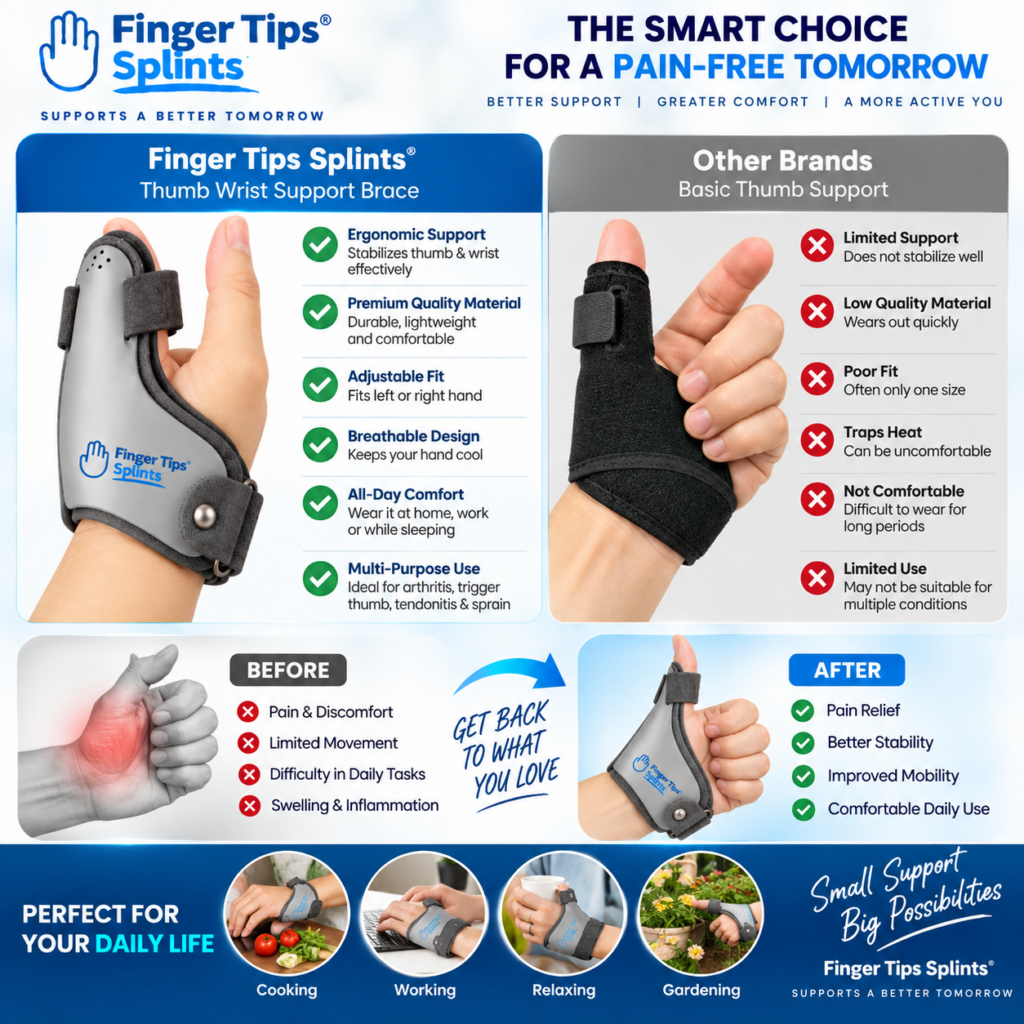
This view shows the structured support architecture of a spica design — the thumb support, wrist extension, fastening system, and support body. Compare this against the simpler sleeve-style construction. Coverage varies by product design.
When a Thumb Sleeve May Be Considered
This section is written neutrally. Someone researching a sleeve may prioritize specific design characteristics. These are design preferences, not medical recommendations.
Design Preferences for a Sleeve
- Flexible construction
- Lower profile
- Simple application
- Less structural coverage
- Everyday mobility
Important
These are design preferences, not medical recommendations. Whether a particular design is appropriate depends on the person’s circumstances and the product’s intended use. Follow professional guidance where applicable.
When a Spica Design May Be Considered
Similarly, someone researching a spica brace may prioritize specific design characteristics. Again, these are design preferences, not medical recommendations.
Design Preferences for a Spica
- Thumb-base coverage
- Wrist involvement
- Structured support
- Adjustable fastening
- More defined positioning
Important
Whether a particular design is appropriate depends on the person’s circumstances and the product’s intended use. A spica brace is not automatically the right design for every thumb or wrist problem.
Common Comparison Mistakes
These mistakes come up frequently when comparing thumb sleeves and spica braces. Avoiding them improves the comparison.
Sleeve designs vary. Some may provide significant support depending on their construction.
Check: the specific sleeve’s specifications and intended use.
Spica designs vary. Some are more flexible than others.
Check: the specific spica’s materials and structure.
Coverage is one factor among many. More coverage isn’t automatically better.
Check: whether the coverage matches the intended use.
Some sleeves extend to the wrist. Coverage varies.
Check: the actual coverage described for the specific product.
The name doesn’t tell you everything about the design.
Check: the product’s specifications and coverage.
Sizing affects fit, comfort, and function.
Check: the manufacturer’s sizing instructions.
Different designs allow different amounts of thumb movement.
Check: what movement the design is intended to allow or influence.
Coverage, structure, and intended use matter more than price alone.
Check: whether the design matches your requirements.
Compression and structural support are not interchangeable concepts.
Check: how the specific product provides support.
The manufacturer’s intended use is an important part of evaluating a product.
Check: what the manufacturer states about intended use.
Professional Guidance
This section is written with an EEAT (Experience, Expertise, Authoritativeness, Trustworthiness) perspective. Product comparison alone cannot determine whether a particular design is appropriate for an individual problem.
Significant Injury
A significant injury warrants professional assessment rather than selecting a support device based on a product description.
Visible Deformity
Visible deformity warrants professional assessment. A brace should not be used to manage a deformity without professional guidance.
Severe or Worsening Pain
Severe or worsening pain is a sign that warrants professional assessment.
Substantial Swelling
Significant swelling affects fit and may indicate an underlying problem that requires professional assessment.
Persistent Numbness or Tingling
Numbness or tingling may indicate nerve involvement and should be assessed professionally.
Major Loss of Movement
Significant loss of movement warrants professional assessment to determine the appropriate approach.
Symptoms That Don’t Improve
If symptoms are not improving, do not simply continue comparing products or adjusting the device. Seek professional guidance.
Device Causing Persistent Concerning Symptoms
A device that causes persistent concerning symptoms — such as numbness, tingling, significant discoloration, or escalating pain — should not simply be tightened or worn through. Remove the device and seek appropriate guidance.
Warning Signs That Warrant Professional Assessment
- Severe or worsening pain
- Significant swelling
- Visible deformity
- Major loss of movement
- Persistent numbness or tingling
- Concerning skin or circulation changes
- Symptoms that are not improving
For general information about thumb and hand conditions, see the Mayo Clinic overview of thumb arthritis. For broader hand anatomy and condition information, the Cleveland Clinic hand anatomy resource provides useful context. For an orthopedic perspective, the AAOS thumb arthritis library is a widely referenced resource. For general public health information, the NHS hand pain guidance offers a practical overview. Additional medical reference information is available through MedlinePlus hand injuries and disorders. For clinical and anatomy-focused context, Johns Hopkins Medicine hand conditions provides further reading. General educational context is also available through WebMD’s overview of thumb arthritis and Healthline’s thumb arthritis information. For peer-reviewed literature, NCBI PubMed Central hosts open-access research where appropriate. For a broader orthopedic reference, Orthobullets provides structured clinical summaries.
Important: This article does not provide individualized medical advice. Always consult an appropriate healthcare professional regarding your specific situation.
Quick Comparison Checklist
Use this checklist when comparing a thumb sleeve and a thumb spica brace. Click each item to mark it as reviewed.
Quick Tips
Frequently Asked Questions
A thumb sleeve is typically a flexible, close-fitting support that covers part or all of the thumb and may extend toward the hand or wrist. A thumb spica brace generally uses a more structured design that supports the thumb and may include wrist coverage and adjustable fastening. The two designs differ in coverage, structure, support mechanism, fastening, and movement characteristics. Exact construction varies between products.
It depends on what type of support is being discussed and the actual design of each product. A spica brace typically provides more structural support through its shape, coverage, and fastening. A sleeve typically provides support through material and fit. However, “more” is not automatically better — the appropriate type of support depends on the intended use and the specific situation. Some sleeves may provide meaningful support; some spica braces may be more flexible than others.
This depends on the specific sleeve design. Some sleeves stop around the thumb or hand; others may extend farther toward the wrist. Wrist coverage varies between sleeve designs. Check the specific product’s stated coverage before assuming whether the wrist is included.
Depending on construction, a spica brace may limit some thumb movements through its support structure. The extent depends on the design’s coverage, rigidity, and fastening. Support does not automatically mean complete immobilization. Some designs may allow more movement than others. The appropriate amount of movement depends on the specific design and the user’s situation.
Spica braces typically offer more adjustability because they often use straps or closures that allow the fit to be modified. Sleeves often rely on stretch and close fit rather than separate adjustment. However, product designs vary. Some sleeves may include adjustable elements; some spica braces may rely more on wraparound construction. Check the specific product’s fastening and adjustment system.
Comfort depends on design, sizing, and individual fit. A sleeve may be lower profile and more flexible, which some users find more comfortable. A spica brace may have more structural components, which could add bulk. However, comfort is highly individual — some spica braces may be more comfortable than some sleeves for particular users, depending on the design, materials, and fit. The appropriate design depends on the user’s preferences and needs.
Compare coverage (thumb, thumb base, hand, wrist), structure (flexible vs structured), fastening (pull-on vs adjustable), movement characteristics, profile (low profile vs structured), adjustability, sizing information, materials, and intended use. Read the product descriptions carefully rather than relying on names alone. Consider how each design’s characteristics match your daily activities and requirements. If you have significant symptoms or uncertainty about which type of support is appropriate, seek professional guidance.
Conclusion: Different Architecture, Different Support
A thumb sleeve and a thumb spica brace share a general purpose — supporting the thumb — but they use different architectural approaches. A sleeve typically relies on flexible material, close fit, and sometimes compression. A spica brace typically relies on structure, coverage, and fastening. Each approach has different characteristics in coverage, movement, adjustability, and everyday usability.
This guide has compared the two designs across coverage, structure, support, movement, fastening, fit, comfort, and everyday activities. The goal has been to explain how the designs differ — not to declare one universally better. The appropriate design depends on the intended use, the specific situation, and the user’s requirements.
Explore a Structured Thumb-Wrist Spica Design
Review the product’s CMC-focused structure, thumb support, wrist coverage, fastening system, and adjustability against the design framework in this guide. The 1 Pcs Thumb Wrist Support Brace CMC Thumb Spica Splint is one example of a structured spica design.
View the Thumb Wrist Support BraceNeed information about other thumb and hand support products? Explore the FingerTipSplint shop. For general questions, see the FingerTipSplint FAQ. For B2B inquiries, see the medical finger splint supplier page or request a quote.