
Your thumb starts feeling uncomfortable during sports, gym, repetitive work, or daily activities. You want something that supports the thumb, stays in place, allows appropriate movement, and does not become a distraction. But the options are confusing. This guide walks you through activity, support, fit, movement, and comfort so you can choose the right thumb support tape. For a broader view of the FingerTipSplint range, start with thumb and finger support solutions.
Table of Contents
- Why Thumb Support Requirements Change
- Tape for Sports: What Matters
- Tape for Daily Use: What Changes
- Tape vs Other Support Options
- 8 Features to Check
- Step-by-Step Selection
- Interactive Tape Selector
- How Tight Should It Be?
- 3D Thumb Support Infographic
- How to Apply Correctly
- Benefits for Active and Daily Use
- Recovery and Reassessment
- 10 Common Mistakes
- Who Should Consider It
- When Tape May Not Be Enough
- Doctor Advice
- Product Guide
- Activity-by-Activity Guide
- Maintenance and Removal
- Interactive Buyer Checklist
- 7 Quick Tips
- FAQ
The best thumb support tape for sports and daily use should match your activity, required support, thumb coverage, and preferred level of movement. Look for comfortable elasticity, secure adhesion, appropriate support, and a fit that does not create excessive pressure. The right choice depends on how and when you use your thumb rather than one universal best tape.
Why Thumb Support Requirements Change Between Sports and Daily Activities
The single biggest mistake buyers make is assuming that one tape works equally well for every situation. It does not. The demands of a basketball game are different from the demands of a full day of typing. Understanding this difference is the foundation of choosing the right thumb support tape.
Sports Require Repeated Movement
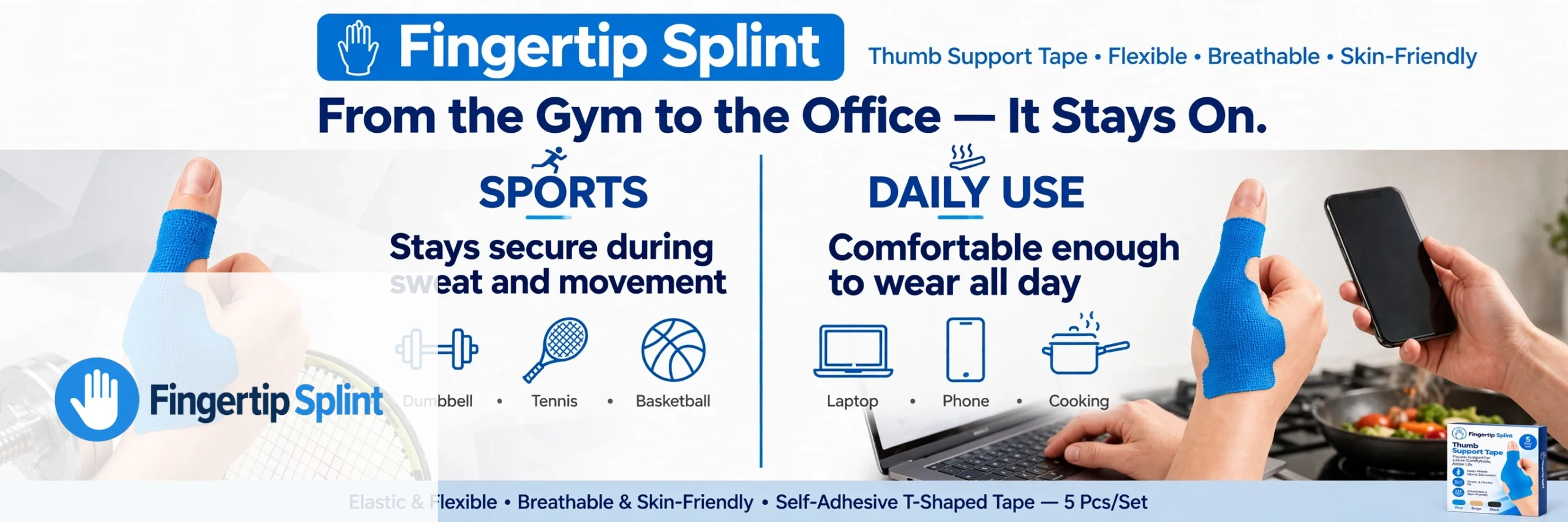
Sports involve grip, impact, quick direction changes, and repetitive thumb positioning. A tape that feels supportive during one activity may feel unnecessarily restrictive during another. Basketball demands grip and ball handling. Tennis requires repeated racquet grip. Cycling involves sustained handlebar grip. Each sport places different mechanical demands on the thumb.
Daily Activities Usually Require More Flexibility
Typing
Thumb movement for keyboard and spacebar use. A tape that restricts too much will interfere with work.
Writing
Repeated thumb positioning for grip. A tape that adds bulk may interfere with pen control.
Cooking
Grip and handling of tools. A tape that does not stay secure will become a distraction.
Phone use
Repetitive thumb movement for scrolling, tapping, and swiping.
Opening containers
Twisting and gripping motions that stress the thumb.
Household work
Cleaning, folding, and lifting all involve repeated thumb use.
Why One Support Setup May Not Suit Every Activity
Sports support is not the same as daily-use support. A tape that feels supportive during a game may feel unnecessarily restrictive during a workday. A tape that feels comfortable during typing may not stay secure during a heavy lift. The right choice depends on matching the support to the activity.
Thumb Support Tape for Sports: What Matters Most?
Grip and Hand Control
Thumb positioning interacts directly with gripping activities. When the thumb is uncomfortable, grip strength and control can be affected. A supportive tape can help maintain a more comfortable grip during sports that require repeated hand involvement.
Movement
Retaining appropriate movement matters. A tape that restricts necessary thumb motion can interfere with performance. The right tape allows the thumb to move as needed while providing support where it is needed.
Secure Application
The tape should remain appropriately positioned during activity. A tape that slides or peels will not provide consistent support and will become a distraction during play.
Comfort During Repetition
A setup that feels acceptable for five minutes may become irritating during a longer activity. Comfort during repetition is a practical requirement, not a luxury.
Thumb Support Tape for Daily Use: What Changes?
Typing and Computer Work
Prioritize comfort and movement. A low-profile tape that does not interfere with keystrokes is usually more practical than a bulky wrap. The tape should allow enough thumb mobility to type without restriction.
Writing
Consider repeated thumb and finger positioning. A tape that adds bulk may interfere with pen control. Look for a flexible, low-profile option that preserves dexterity.
Smartphone Use
Repetitive thumb movement for scrolling, tapping, and swiping. If the tape interferes with phone use, it will not be worn consistently. Choose a design that preserves thumb mobility.
Household Tasks
Consider grip and repeated handling. Cooking, cleaning, and lifting involve moisture and repeated hand use. A tape that stays secure and handles moisture is more practical.
General Everyday Support
Focus on low-profile comfort rather than maximum restriction. The right daily-use tape supports the thumb without interfering with the tasks you need to do.
Self-Adhesive Thumb Tape vs Traditional Thumb Support Options
| Option | Support | Flexibility | Adjustability | Best Consideration |
|---|---|---|---|---|
| Self-adhesive thumb tape | Moderate, varies | High, varies | Application-based | Active use |
| Elastic thumb strap | Moderate, varies | High | Often adjustable | Repetitive activity |
| Thumb sleeve | Light to moderate | High | Limited | Comfort and protection |
| Thumb brace | Moderate to high | Lower | Varies | Structured support |
Why Tape Can Be Attractive for Active Users
Self-adhesive thumb tape is low-profile, flexible, and customizable through application. It can be positioned to support the specific area that needs it, and it does not add the bulk of a structured brace. For active users who need support without interference, tape can be a practical option.
When a More Structured Device May Be More Appropriate
A more structured device may be appropriate when greater movement restriction or stabilization is needed. The Cleveland Clinic finger splint resource explains that different splints serve different purposes and that a healthcare professional can determine the appropriate type.
8 Features to Check Before Buying Thumb Support Tape
1. Elasticity
Why it matters: Elasticity affects movement, tension, comfort, application, and grip. What to look for: an elasticity level that matches your activity. Common mistake: choosing tape that is too stiff or too stretchy. Practical example: a mildly elastic tape is usually more comfortable for typing than a rigid wrap.
2. Adhesion
Why it matters: Secure positioning matters during movement. What to look for: adhesive that stays in place during activity without leaving residue. Common mistake: choosing tape that peels or slides during use.
3. Width
Why it matters: Width affects coverage and flexibility. What to look for: a width that covers the support area without excessive bulk. Common mistake: choosing a width that is too narrow to support or too wide to allow movement.
4. Length
Why it matters: Length determines how much tape you have for the intended application. What to look for: sufficient length to complete the application method you plan to use. Common mistake: running short mid-application.
5. Thumb Coverage
Why it matters: The tape should support the intended area without unnecessarily covering areas that need free movement. What to look for: coverage that matches your specific support need. Common mistake: covering too much of the thumb.
6. Comfort
Why it matters: A tape that is uncomfortable will not be worn consistently. What to look for: soft material, smooth edges, and comfortable tension. Common mistake: assuming that a tight tape is a better tape.
7. Application Method
Why it matters: The application method determines how easy the tape is to use and how well it stays in place. What to look for: a method that suits your dexterity and your activity. Common mistake: choosing a complex application method that you cannot reproduce reliably.
8. Activity Compatibility
Why it matters: The right tape for one activity may be wrong for another. What to look for: a tape that matches your primary activity. Common mistake: buying without considering what you will be doing while wearing it.
How to Choose the Right Thumb Support Tape Step by Step
Interactive Thumb Support Tape Selector
Answer four questions to see what product characteristics to compare. This is a product-selection tool, not a medical diagnosis.
Complete the four selections above to see what product characteristics to prioritize.
How Tight Should Thumb Support Tape Be?
Supportive Does Not Mean Extremely Tight
Excessive tension is not automatically better. A tape that is too tight can cause numbness, tingling, discoloration, and increasing pain. These symptoms do not indicate that the tape is working — they indicate that the tape is too tight.
Signs of Excessive Pressure
- Numbness
- Tingling
- Significant discoloration
- Increasing pain
- Coldness
- Unusual swelling
What a Comfortable Application Should Feel Like
Secure
The tape stays positioned without sliding during activity.
Supportive
Provides the intended support without unnecessary restriction.
Comfortable
No pressure points, pinching, or irritation during wear.
Appropriate movement
Allows the thumb movement you need for your activity.
3D Interactive Thumb Support Tape Infographic
The interactive 3D component explorer below shows how thumb support tape is applied and where it matters. Click each component to see what it does and why it matters.
Thumb Support Tape Component Explorer
Click a component to learn what it does and why it matters when you are choosing tape.
How to Apply Thumb Support Tape Correctly
Benefits of Using Thumb Support Tape for Active and Everyday Use
Flexible Support During Movement
Self-adhesive thumb tape provides support without the rigidity of a structured brace. This makes it a practical option for activities that require both support and movement.
Low-Profile Alternative to Bulkier Supports
A tape adds minimal bulk compared to a brace or splint. It can be worn under gloves or during activities where a bulky support would interfere.
Customizable Application
The tape can be positioned to support the specific area that needs it. This customization lets you adapt the application to your activity and your thumb.
Convenient for Repetitive Activities
For activities that involve repeated thumb movement, a tape that stays in place without restricting necessary motion can make the activity more comfortable.
Can Fit Into an Active Routine
A low-profile tape can be applied before activity and removed afterward without disrupting your routine. It is a practical option for active users.
Easy to Adjust Based on Activity
The application can be modified based on the activity. More support for sports, less for daily tasks, depending on your needs.
Recovery and Reassessment Timeline
This is a stage-based reassessment framework, not a promised recovery schedule. Duration depends on the underlying situation and your individual circumstances.
Stage 1 — Initial Use
Evaluate fit, comfort, movement, and skin response. If the tape does not fit or stay in place, address that before extended wear.
Stage 2 — Early Activity Reassessment
Ask whether the support is comfortable, whether it remains secure, whether it interferes with normal movement, and whether discomfort is improving, unchanged, or worsening.
Stage 3 — Return to Normal Activity
Gradually reassess the activity rather than assuming a fixed recovery schedule. Do not push through pain.
Stage 4 — Persistent Symptoms
If symptoms continue or worsen despite modifying activity and support, professional assessment may be appropriate. Persistent symptoms deserve attention rather than being masked with tape.
10 Common Mistakes When Using Thumb Support Tape
Excessive tension can cause numbness, tingling, or discoloration.
What to do instead: secure and comfortable, not tight.
A tape for typing may not be right for basketball.
What to do instead: match the tape to your primary activity.
Excessive coverage can restrict movement unnecessarily.
What to do instead: cover the support area without over-restricting.
Adhesive irritation can develop with certain tapes or prolonged wear.
What to do instead: test on a small area first, monitor skin during use.
More tape can mean more restriction, not better support.
What to do instead: apply the minimum needed for your activity.
A tape that feels fine when stationary may not feel fine during activity.
What to do instead: test during light movement before full activity.
Adhesive over broken skin or infection can worsen the problem.
What to do instead: seek professional advice for concerning skin.
These are warning signs, not signs that the tape is working.
What to do instead: remove the tape and reassess the application.
Pushing through pain can prolong recovery.
What to do instead: reduce or modify the activity and seek advice if symptoms persist.
Tape is a support tool, not a diagnosis or treatment.
What to do instead: seek professional evaluation for persistent or significant symptoms.
Who Should Consider Thumb Support Tape?
Recreational athletes
People who play sports and want low-profile thumb support during activity.
Gym users
Those who want support during weight training and grip-intensive exercises.
Racquet-sport players
People who need support during repeated racquet grip.
Cyclists
Those who want support during sustained handlebar grip.
People with repetitive hand activities
Those whose work or hobbies involve repeated thumb use.
People looking for flexible everyday support
Those who want support without the bulk or restriction of a brace.
Support-Seeking Users vs Those Who May Need Professional Assessment
Thumb support tape is appropriate for people who need flexible, low-profile support during activity. It is not appropriate for people with significant injuries, severe or increasing pain, major swelling, visible deformity, significant loss of thumb movement, numbness, tingling, or symptoms that persist or worsen. These situations deserve professional assessment.
When Thumb Support Tape May Not Be Enough
- Significant injury
- Severe or increasing pain
- Major swelling
- Visible deformity
- Significant loss of thumb movement
- Numbness or tingling
- Symptoms that persist or worsen
Tape can be a support option, but it should not be used to mask a potentially significant injury. If symptoms are significant or worsening, seek appropriate medical evaluation rather than continuing to apply tape.
Doctor Advice: How to Think About Thumb Support
This section is written in the tone of a practical professional checklist. It is not a diagnosis and does not replace an in-person assessment.
Match support to the activity
The right support for basketball may not be the right support for typing.
Do not confuse restriction with better support
More restriction does not automatically mean better support.
Fit and comfort matter
A tape that causes numbness or discomfort is not appropriate.
Skin condition matters
Adhesive should not be applied over broken or irritated skin.
Persistent symptoms need attention
Symptoms that persist or worsen deserve professional assessment.
Tape is not a splint
These are different product categories designed for different purposes.
Additional trusted resources include the Mayo Clinic thumb arthritis overview, the Cleveland Clinic sprained thumb resource, the AAOS OrthoInfo thumb arthritis page, the ASSH flexor tendon injury resource, the MedlinePlus thumb injuries page, the NHS hand pain guidance, the WebMD splints overview, and the Healthline thumb brace resource.
FingerTipSplint 5-Piece Self-Adhesive Thumb Support Tape: Product Guide
Use this section as a worked example of how to evaluate thumb support tape against the criteria in this guide. The product being evaluated is the 5-piece self-adhesive thumb support tape from FingerTipSplint.
5Pcs Self-Adhesive Thumb Support Tape
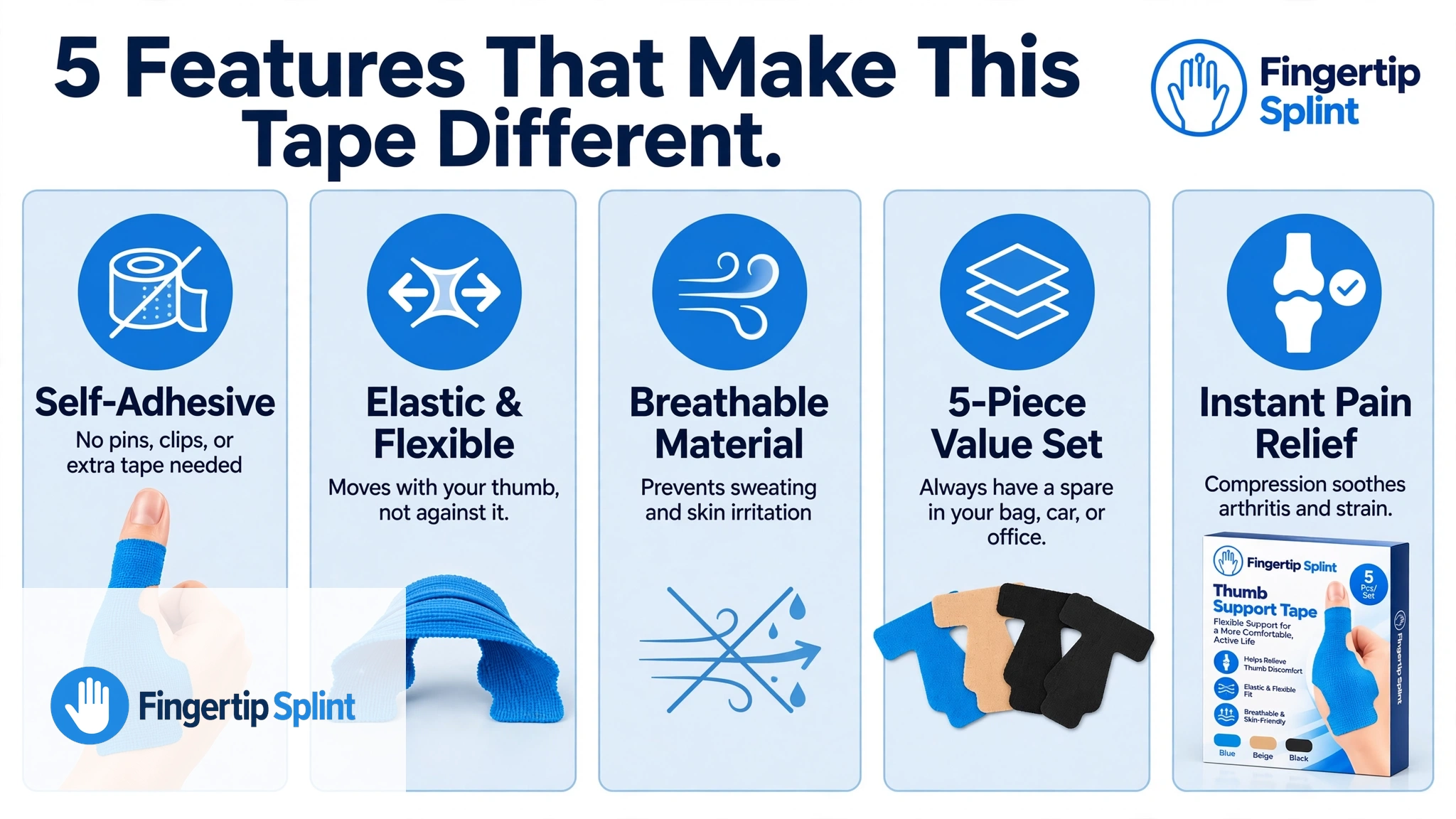
- Self-adhesive design: Convenient application without additional fasteners
- Elasticity: Designed to flex with the thumb during movement
- Thumb support: Intended for thumb support during sports and daily activities
- Application: Follow the manufacturer’s instructions for correct placement
- Multi-piece format: 5 pieces for multiple applications or replacement
- Intended use: Sports, gym, and daily support
- Low-profile: Designed to minimize interference with hand movement
What to Evaluate in This Product
Check the self-adhesive design, elasticity, thumb support area, application method, multi-piece format, and intended use. For buyers comparing different thumb support options, explore the FingerTipSplint shop.
Who May Prefer a Self-Adhesive Format?
Buyers who value convenient application
People who want a support option that is quick to apply without additional fasteners.
Buyers who want adjustable positioning
Those who want to customize the support area based on their activity.
Buyers needing activity-based support
Those who want a support that matches their sport or daily routine.
Buyers who prefer low-profile support
Those who want support without the bulk of a structured brace.
Product Fit and Application Checklist
Before using: confirm correct placement, appropriate tension, comfortable movement, checked skin condition, and that manufacturer instructions are followed. For a deeper look at how elasticity and adhesion affect fit, see our guide on the self-adhesive thumb support tape buying guide for fit and elasticity. For a comparison of tape designs and construction, see our article on elastic thumb support straps and how to choose the right tape.
Best Thumb Support Tape for Sports: Activity-by-Activity Guide
Basketball
Movement: grip, ball handling, catching, and repeated thumb movement. Thumb demand: opposition and stabilization during ball contact. Desired tape characteristics: flexible with secure adhesion. Fit consideration: should not restrict ball handling or shooting grip.
Tennis
Movement: racquet grip and repetitive hand loading. Thumb demand: stabilization during grip and stroke. Desired tape characteristics: moderate support with flexibility for grip changes. Fit consideration: should not interfere with racquet handle contact.
Badminton
Movement: fast grip changes and repeated wrist and hand movement. Thumb demand: quick positioning and grip control. Desired tape characteristics: low-profile with secure adhesion. Fit consideration: should not restrict rapid hand movement.
Gym and Weight Training
Movement: bar and grip contact with repetitive loading. Thumb demand: stabilization during grip and lift. Desired tape characteristics: secure adhesion with moderate support. Fit consideration: should stay in place during heavy loads.
Cycling
Movement: sustained handlebar grip and vibration. Thumb demand: sustained positioning and grip. Desired tape characteristics: comfortable for extended wear with secure adhesion. Fit consideration: should not interfere with brake or gear controls.
Hiking
Movement: pole and strap handling with repeated hand use. Thumb demand: grip and positioning. Desired tape characteristics: durable with secure adhesion. Fit consideration: should handle moisture and repeated movement.
How to Maintain and Remove Thumb Support Tape
Skin Preparation
Clean and dry the skin before applying tape. Avoid applying over lotions, oils, or broken skin.
Removal
Remove the tape gently, following the direction of hair growth. Support the skin with one hand while peeling the tape with the other. If the tape is difficult to remove, consider using a medical adhesive remover.
Skin Inspection
After removing the tape, inspect the skin for redness, irritation, or pressure marks. Allow the skin to recover between applications if irritation develops.
Cleaning and Replacement
Thumb support tape is generally designed for single use. Follow the manufacturer’s guidance on replacement. The 5-piece format provides multiple applications or replacement pieces.
When to Stop Using It
Stop using the tape if you experience numbness, tingling, significant discoloration, increasing pain, skin irritation, or worsening symptoms. These are warning signs that the tape may not be appropriate for your situation.
Interactive Buyer Checklist
Click each item to confirm. Aim to check all 8 before buying.
7 Quick Tips for Choosing Thumb Support Tape
Frequently Asked Questions
There is no universal best option. Activity, support level, fit, elasticity, and movement requirements determine suitability. A tape that works well for basketball may not be ideal for tennis or cycling. Match the tape to your specific sport and your individual needs.
For a deeper look at elasticity and fit, see our guide on the self-adhesive thumb support tape buying guide for fit and elasticity.
Daily use depends on the product, your skin tolerance, your activity, and the manufacturer’s instructions. A low-profile tape may be comfortable for daily use, but regular skin checks are important. Allow the skin to recover between applications if irritation develops.
If you notice redness, itching, numbness, or discomfort, remove the tape and reassess. Persistent skin irritation may require a different product or professional advice.
It should be secure and comfortable, not excessively tight. You should be able to wear it without numbness, tingling, significant discoloration, or increasing pain. Excessive tightness does not improve support — it creates new problems.
If concerning symptoms occur, remove the tape and reassess the application rather than tightening it further.
Yes, provided the tape is appropriate for the activity and applied correctly. Test the application during light activity before using it in a game or intense session. Check that the tape stays in place, does not restrict necessary movement, and does not cause discomfort.
Follow applicable league or facility rules concerning protective equipment, and seek professional advice on return to play after any significant injury.
It depends on the tape design, the application method, and the tension. A flexible tape applied with appropriate tension allows more movement than a rigid wrap applied tightly. Match the tape and application to the movement you need for your activity.
If the tape restricts necessary thumb movement, it is either the wrong tape or the wrong application for your situation.
Thumb tape offers flexible, low-profile support with customizable application. A thumb brace offers more structured support and movement restriction. The right choice depends on the level of support you need, the activity you are doing, and whether movement restriction is helpful or hindering.
For a comparison of tape and strap designs, see our article on elastic thumb support straps and how to choose the right tape.
Stop using the tape if you experience numbness, tingling, significant discoloration, increasing pain, skin irritation, or worsening symptoms. These are warning signs that the tape may not be appropriate for your situation or that the application needs adjustment.
If symptoms persist after removing the tape, seek professional assessment. Persistent or significant symptoms deserve attention rather than being masked with tape.
Choose Thumb Support Based on Your Activity
Do not choose thumb tape simply because it looks supportive. Choose it because its fit, elasticity, adhesion, and coverage make sense for the way you actually use your hand. Evaluate the 5Pcs Self-Adhesive Thumb Support Tape against these criteria before deciding.
Explore the FingerTipSplint shop for other support options, check the FingerTipSplint FAQ, or use the request-a-quote page for bulk or business purchasing. For medical finger splint supply, see the medical finger splint supplier page.
View the Product Explore Thumb SupportFinal Takeaway: The Best Tape Balances Support, Movement, and Fit
The best thumb support tape is not necessarily the strongest tape. It is the option that appropriately balances support, movement, fit, adhesion, comfort, and activity. Before you buy, identify your main activity, decide how much movement you need, choose appropriate elasticity, check the adhesive method, and test the application during light movement before full activity.
If symptoms persist, worsen, or involve significant injury, severe pain, major swelling, deformity, numbness, or loss of function, do not simply cover the area with tape. Seek appropriate medical evaluation. For medical finger splint supply and distribution, see the medical finger splint supplier page and the finger splint distributor page. For the full FingerTipSplint range, visit the FingerTipSplint homepage.