
Elastic thumb support straps can look very similar online, but their width, stretch, fastening method, coverage, and construction can create very different wearing experiences. This guide helps you choose the right format based on material, elasticity, width, coverage, fastening, adjustability, and comfort. For a broader view of the FingerTipSplint range, start with thumb and finger support solutions.
Table of Contents
- What Are Elastic Thumb Support Straps?
- 7 Things to Check Before Buying
- Elasticity: The Most Important Characteristic?
- Materials: What to Look For
- Thumb Strap Width: Narrow vs Wide
- How Thumb Strap Length Affects Fit
- Self-Adhesive vs Adjustable
- How Fastening Changes the Experience
- How Much Support?
- Interactive Strap Selector
- 3D Strap Construction Infographic
- Step-by-Step Selection
- How Tight Should It Be?
- Sports vs Everyday Use
- Strap vs Sleeve vs Brace
- 10 Common Buying Mistakes
- How to Test Before Full Use
- Product Guide
- Fit, Elasticity, and Adhesion
- When a Strap May Not Be Enough
- Doctor Advice
- Buyer Checklist
- 7 Quick Tips
- FAQ
Choose an elastic thumb support strap by comparing its material, stretch, width, coverage, fastening method, adjustability, and intended use. The right design should provide the level of support you need without unnecessary pressure or restriction. Always compare the manufacturer’s dimensions and instructions rather than assuming every elastic thumb strap fits or functions the same way.
Updated for 2026: What Are Elastic Thumb Support Straps?
What Is a Thumb Support Strap?
A thumb support strap is a flexible band designed to wrap around the thumb or thumb base to provide support during movement. It is typically made from elastic material and may use self-adhesive, hook-and-loop, or wraparound fastening to stay positioned.
Why Elasticity Is Used
Elastic materials accommodate thumb movement while providing a supportive feel. Instead of rigidly holding the thumb in one position, an elastic strap flexes with movement, which can make it more comfortable and more practical for activities that require hand mobility.
Strap vs Tape
“Strap” and “tape” are sometimes used interchangeably, but the products can differ in attachment, adjustability, reusability, width, length, tension control, and application method. A strap usually has a fastening system, while tape may rely on adhesive or application-based positioning.
Why Product Names Can Be Confusing
Terms like thumb support strap, elastic thumb tape, thumb support tape, thumb wrap, thumb brace, and thumb band are used loosely online. Buyers should examine actual product construction rather than relying only on the name. The Cleveland Clinic finger splint resource explains that different support products serve different purposes.
The 7 Things to Check Before Buying an Elastic Thumb Strap
1. Elasticity
How much does it stretch? Elasticity affects movement and comfort.
2. Material
What is it made from? Material affects skin contact and durability.
3. Width
How much of the thumb or hand does it cover? Width affects coverage and bulk.
4. Length
Does it provide enough coverage without excessive wrapping?
5. Fastening Method
Self-adhesive, hook-and-loop, buckle, or wraparound?
6. Adjustability
Can tension be changed easily? Adjustability affects fit control.
7. Intended Use
Sports, daily use, repetitive activities, or general support?
Elasticity: The Most Important Characteristic of a Thumb Strap?
What Elasticity Actually Means
Elasticity refers to the material’s ability to stretch and recover its original shape. In practical terms, it determines how the strap responds to thumb movement and how much give it provides.
Low-Elasticity Straps
Potential characteristics: more consistent tension, less stretch, may feel more restrictive. Low-elasticity straps can be useful when you want consistent support without much give.
Moderate-Elasticity Straps
Potential balance between support, movement, and comfort. Moderate elasticity is often the most versatile option.
High-Elasticity Straps
Potentially more accommodating during movement, but application tension still matters. A highly elastic strap that is applied too tightly will still feel too tight.
Why Maximum Stretch Isn’t Automatically Better
Elastic Thumb Strap Materials: What Should You Look For?
Elastic Fabric
Elastic fabric provides flexibility and comfort. It stretches with movement and returns to its original shape. The specific fabric blend affects how the strap feels and how durable it is.
Breathability
Useful for longer periods of wear. A breathable material allows some airflow through the strap, reducing heat buildup and moisture retention.
Skin Contact
Consider softness and irritation potential. A strap that feels rough or scratchy will not be worn consistently.
Durability
Repeated stretching can affect long-term usability depending on the construction. A strap that loses elasticity quickly will not provide consistent support over time.
Material Thickness
Thicker is not automatically better. Thicker material may add bulk and reduce flexibility. The right thickness depends on your activity and comfort preference.
Thumb Strap Width: Narrow vs Wide
| Narrow Strap | Wider Strap |
|---|---|
| More localized coverage | Broader coverage |
| Less material | More material |
| Potentially lower bulk | Potentially more bulk |
| May suit targeted support | May suit broader wrapping |
When a Narrow Strap May Be Practical
When you need targeted support in a specific area without adding bulk to the rest of the thumb.
When Broader Coverage May Be Useful
When you need support across a larger area or when wrapping around the thumb and hand.
Why Width Should Match the Intended Application
The right width depends on what you are doing. A narrow strap may be better for typing, while a wider strap may be better for gripping activities.
How Thumb Strap Length Affects Fit
Short Straps
Potential advantages: lower bulk, targeted support. Potential limitations: may not provide enough coverage for broader wrapping.
Longer Straps
Potential advantages: more coverage, more wrapping options. Potential limitations: may add bulk and require more complex application.
Adjustable-Length Designs
Adjustability can make fitting easier because you can modify the length to suit your thumb and your intended application.
Why You Should Check Product Dimensions
Do not assume one size fits all. Use actual manufacturer specifications to confirm the strap will work for your thumb.
Self-Adhesive vs Adjustable Elastic Thumb Straps
| Feature | Self-Adhesive Tape | Adjustable Elastic Strap |
|---|---|---|
| Application | Wrap or application based | Usually fastening based |
| Tension | Controlled during application | Often adjustable |
| Repositioning | Product-dependent | Often easier |
| Reusability | Product-dependent | Often designed for repeated use |
| Bulk | Usually low | Low to moderate |
| Fit control | Application dependent | Often more adjustable |
Who May Prefer Self-Adhesive Tape?
Buyers who want a low-profile, application-based option with customizable positioning.
Who May Prefer an Adjustable Strap?
Buyers who want easy repositioning, tension adjustment, and reusability.
Why Neither Format Is Automatically Better
Each format has trade-offs. The right choice depends on your activity, your thumb, and your preferences.
How the Fastening Method Changes the User Experience
Self-Adhesive Design
How it works: the tape adheres to itself or the skin. Potential advantage: low profile, customizable positioning. Possible limitation: adhesion may weaken with moisture or reuse. Who may prefer it: buyers who want a lightweight, single-application option.
Hook-and-Loop Fastening
How it works: a hook-and-loop closure secures the strap. Potential advantage: easy adjustment and repositioning. Possible limitation: may add slight bulk. Who may prefer it: buyers who want adjustable tension.
Wraparound Designs
How it works: the strap wraps around the thumb without a separate fastener. Potential advantage: simple application. Possible limitation: less adjustable tension. Who may prefer it: buyers who want a quick, simple solution.
Buckle or Other Fastening Systems
How it works: a buckle or similar mechanism secures the strap. Potential advantage: secure positioning. Possible limitation: may be more complex to apply. Who may prefer it: buyers who need a very secure fit.
How Much Support Should an Elastic Thumb Strap Provide?
Light Support
Focus on flexibility and everyday usability. Light support is appropriate for mild discomfort or general support during daily activities.
Moderate Support
Balance support and movement. Moderate support is often appropriate for repetitive activities or mild sports use.
More Structured Support
Some situations may require a more structured brace or splint rather than a flexible strap. The AAOS OrthoInfo thumb arthritis page notes that different support designs serve different purposes. For more structured support, see the medical finger splint supplier page.
Interactive Elastic Thumb Strap Selector
Answer four questions to see what strap characteristics to compare. This is a buyer selector, not a medical recommendation.
Complete the four selections above to see what strap characteristics to prioritize.
3D Interactive Elastic Thumb Strap Infographic
The interactive 3D component explorer below shows how an elastic thumb support strap is constructed. Click each component to see what it does and why it matters.
Elastic Thumb Strap Construction Explorer
Click a component to learn what it does and why it matters when you are choosing a strap.
How to Choose the Right Elastic Thumb Strap Step by Step
How Tight Should an Elastic Thumb Support Strap Be?
Secure vs Tight
Secure means the strap stays positioned without sliding. Tight means it creates persistent pressure. These are not the same thing.
Signs of Excessive Tightness
- Numbness
- Tingling
- Significant discoloration
- Increasing discomfort
- Coldness
- Excessive restriction
Signs It May Be Too Loose
- Sliding
- Repeated repositioning
- Folding
- Poor positioning
The Practical Goal
Secure, comfortable, and appropriate movement. If the strap does not feel right, adjust it rather than simply tightening it further.
Elastic Thumb Straps for Sports vs Everyday Use
Sports
Focus on secure positioning, movement, grip, and repetitive activity. A strap that shifts during play becomes a distraction. For a full activity-by-activity guide, see our article on the best thumb support tape for sports and daily use.
Daily Use
Focus on comfort, low bulk, flexibility, and ease of use. A strap that interferes with typing or daily tasks will not be worn consistently.
Why Activity Should Influence Strap Selection
The right strap for one activity may be wrong for another. Match the strap design to your primary activity.
Elastic Thumb Strap vs Thumb Sleeve vs Thumb Brace
| Feature | Elastic Strap | Thumb Sleeve | Structured Thumb Brace |
|---|---|---|---|
| Flexibility | Usually high | High | Lower, varies |
| Adjustability | Often high | Low | Varies |
| Coverage | Targeted, variable | Broader | Targeted, structured |
| Bulk | Low to moderate | Low | Moderate |
| Movement | Generally flexible | Flexible | More restricted |
| Main consideration | Strap design and tension | Comfort and coverage | Structured support |
Why Choosing the Format First Can Simplify Buying
Deciding between strap, sleeve, or brace narrows your options before you compare specific products.
10 Common Elastic Thumb Strap Buying Mistakes
Price does not tell you whether the strap fits or provides the right support.
What to do instead: check dimensions, elasticity, and fastening.
Elasticity is one factor, not the whole decision.
What to do instead: match elasticity to your movement needs.
Width affects coverage and bulk.
What to do instead: match width to the area that needs support.
Length determines whether the strap can complete the intended application.
What to do instead: check product dimensions before buying.
Different fastening styles suit different dexterity and activity needs.
What to do instead: consider how you will apply and adjust the strap.
Rough material or rough edges can cause irritation.
What to do instead: check material softness and edge finishing.
Excessive tightness does not improve support.
What to do instead: secure and comfortable, not tight.
A strap that restricts necessary movement will not be worn consistently.
What to do instead: test movement after application.
Thumb size and shape vary.
What to do instead: measure and compare with the specific product’s guidance.
A flexible strap is not appropriate for every situation.
What to do instead: consider structured support or professional assessment when needed.
How to Test an Elastic Thumb Strap Before Full Use
Check the initial fit
Confirm the strap stays positioned and does not create pressure points.
Move the thumb normally
Bend, straighten, and grip. Check that the strap allows necessary movement.
Check the fastening
Confirm the fastening holds its position during light movement.
Check the skin
Look for redness, pressure marks, or irritation after a short wear period.
Perform a short activity test
Use a light version of your activity. Check comfort, positioning, and stability.
Reassess after removing it
Check for lingering marks, irritation, or changes in sensation.
FingerTipSplint 5-Piece Self-Adhesive Thumb Support Tape
Use this section as a worked example of how to evaluate thumb support against the criteria in this guide. The product being evaluated is the 5-piece self-adhesive thumb support tape from FingerTipSplint.
5Pcs Self-Adhesive Thumb Support Tape
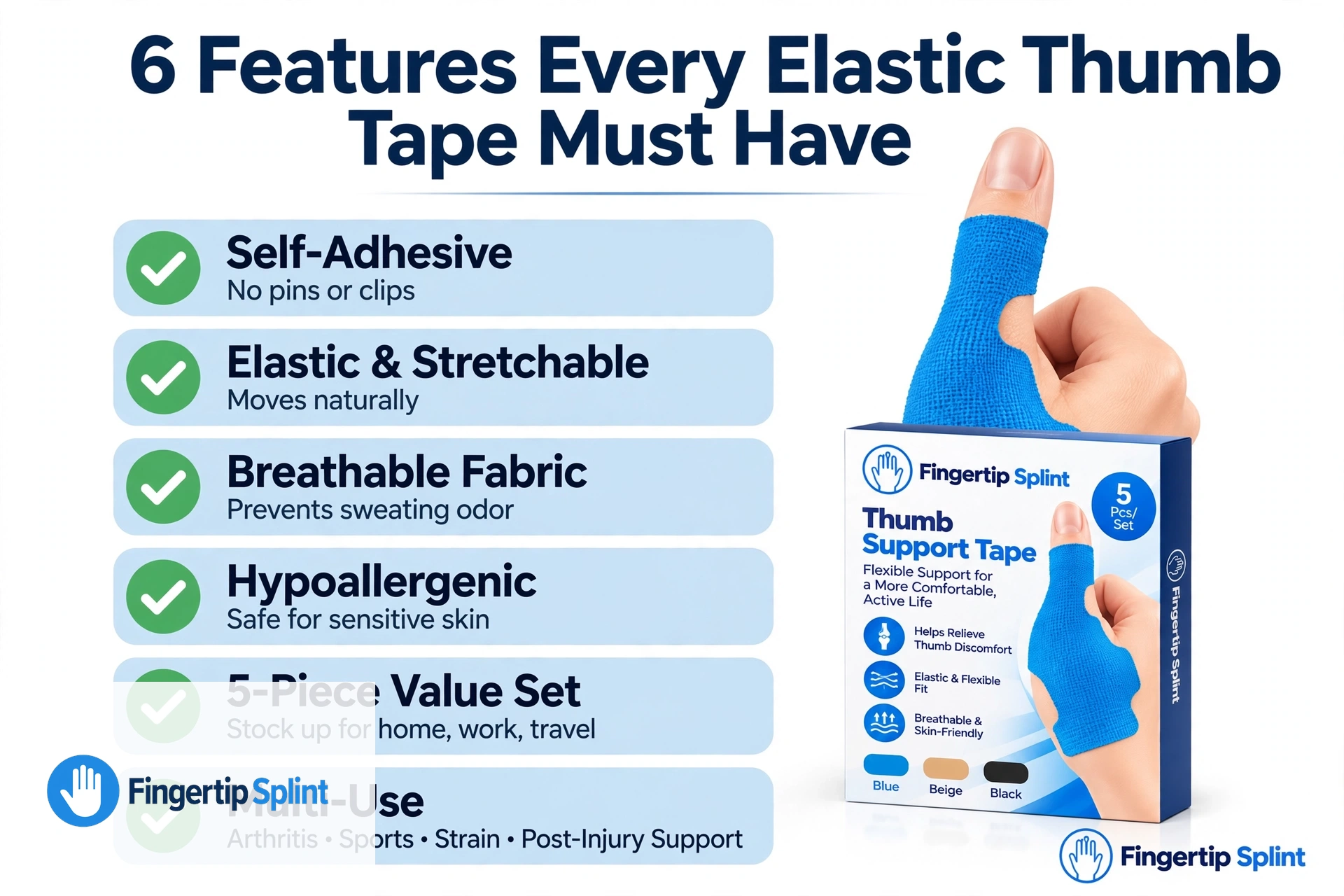
- Self-adhesive format: Designed for convenient application without additional fasteners
- Elastic support: Designed to flex with the thumb during movement
- Thumb application: Intended for thumb support during sports and daily activities
- Multi-piece package: 5 pieces for multiple applications or replacement
- Positioning: Follow the manufacturer’s instructions for correct placement
- Intended use: Sports, gym, and daily support
Why a Self-Adhesive Format Belongs in an Elastic Strap Comparison
A self-adhesive tape is one format within the broader elastic thumb support category. It differs from an adjustable strap in application, tension control, and reusability. Both formats can provide flexible support; the right choice depends on your preference and needs.
What to Evaluate
Focus on self-adhesive format, elastic support, thumb application, multi-piece package, positioning, and intended use. For buyers comparing different thumb support options, explore the FingerTipSplint shop. For a fit-focused guide on self-adhesive tape, see our article on the self-adhesive thumb support tape buying guide for fit and elasticity.
Who May Prefer This Format?
Buyers looking for a compact, application-based support option. People who want customizable positioning without a separate fastening system. Those who prefer a low-profile support format.
Fit, Elasticity and Adhesion: How the Three Work Together
Fit Determines Position
Fit determines where the strap sits and what area it supports.
Elasticity Determines Stretch
Elasticity determines how the strap responds to movement and how much give it provides.
Adhesion or Fastening Determines Stability
The fastening method determines how securely the strap stays in position.
Tension Connects All Three
Tension is the practical outcome of fit, elasticity, and fastening. Getting tension right is what makes the strap comfortable and functional.
When an Elastic Thumb Strap May Not Be Enough
- Significant injury
- Visible deformity
- Major swelling
- Severe or increasing pain
- Major loss of movement
- Persistent numbness or tingling
- Symptoms that persist or worsen
A flexible support strap is not automatically appropriate for every thumb problem. If symptoms are significant or worsening, seek appropriate medical evaluation rather than continuing to self-treat with a strap.
Doctor Advice: Choosing Support Based on the Situation
This section is written in the tone of a practical professional checklist. It is not a diagnosis and does not replace an in-person assessment.
Don’t choose support based only on maximum restriction
More restriction is not automatically better support.
Match support to activity
The right support for one activity may not be right for another.
Consider comfort and skin tolerance
A strap that causes irritation will not be worn consistently.
Follow product instructions
The manufacturer’s guidance should take priority over generic advice.
Seek appropriate assessment for concerning symptoms
Persistent or worsening symptoms deserve professional evaluation.
Understand the difference between strap, tape, and splint
These are different product categories designed for different purposes.
Additional trusted resources include the Mayo Clinic thumb arthritis overview, the Cleveland Clinic sprained thumb resource, the ASSH flexor tendon injury resource, the MedlinePlus thumb injuries page, the NHS hand pain guidance, the WebMD splints overview, and the Healthline thumb brace resource.
Elastic Thumb Support Strap Buyer Checklist
Click each item to confirm. Aim to check all 10 before buying.
7 Quick Tips for Choosing the Right Elastic Thumb Strap
Frequently Asked Questions
An elastic thumb support strap is a flexible band designed to wrap around the thumb or thumb base to provide support during movement. It is typically made from elastic material and may use self-adhesive, hook-and-loop, or wraparound fastening.
It provides flexible support rather than rigid immobilization. The right design depends on your activity and your thumb’s needs.
Compare elasticity, material, width, length, fastening method, adjustability, and intended use. Match the strap to your activity and your thumb size. Follow the manufacturer’s sizing and application instructions.
For a deeper look at fit and elasticity, see our article on the self-adhesive thumb support tape buying guide for fit and elasticity.
Not automatically. Elasticity is one part of the decision. A highly elastic strap can still be a poor choice if it slips, is incorrectly positioned, or does not provide the desired support level.
Match the elasticity to your movement needs rather than assuming more is always better.
Width depends on the area that needs support. Narrower straps provide more localized coverage, while wider straps provide broader coverage. Match the width to the support area and your activity.
A strap that is too narrow may not cover the support area effectively. A strap that is too wide may add unnecessary bulk.
It should be secure and comfortable, not excessively tight. You should be able to wear it without numbness, tingling, significant discoloration, or increasing pain.
If concerning symptoms occur, remove the strap and reassess the fit rather than tightening it further.
Neither format is automatically better. Self-adhesive tape offers a low-profile, application-based option. An adjustable strap offers easier repositioning and tension adjustment.
The right choice depends on your preference, your activity, and your support needs. For an activity-focused guide, see our article on the best thumb support tape for sports and daily use.
A thumb brace provides more structured support and movement restriction than an elastic strap. If you need more stabilization than a flexible strap can provide, a brace may be more appropriate.
For structured support options, see the medical finger splint supplier page. If symptoms are significant or worsening, seek professional assessment.
Choose the Right Strap Design, Not Just the Tightest Fit
Elastic thumb support straps are not all the same. The right design balances material, elasticity, width, length, fastening, coverage, and comfort for your specific needs. Evaluate the 5Pcs Self-Adhesive Thumb Support Tape against these criteria before deciding.
Explore the FingerTipSplint shop for other support options, check the FingerTipSplint FAQ, or use the request-a-quote page for bulk or business purchasing. For medical finger splint supply, see the medical finger splint supplier page.
View the Product Explore Thumb SupportFinal Takeaway: Strap Design Determines Wearing Experience
Elastic thumb support straps can look almost identical online, but their width, stretch, fastening, coverage, and construction determine how they actually perform. The right strap is not the most elastic, the widest, or the cheapest. It is the one whose design characteristics match your activity, your thumb, and your support needs.
Before you buy, check the material, elasticity, width, length, fastening method, adjustability, and intended use. Test the fit before extended wear. If symptoms persist, worsen, or involve significant injury, severe pain, major swelling, deformity, numbness, or loss of function, seek appropriate medical evaluation. For medical finger splint supply and distribution, see the medical finger splint supplier page and the finger splint distributor page. For the full FingerTipSplint range, visit the FingerTipSplint homepage.