
If you spend your day typing, texting, cooking, writing, or doing household tasks, your thumbs and wrists are working constantly. When discomfort starts to interfere with those everyday activities, a gel thumb wrist support can offer convenient, comfortable support. This guide explains how to choose the best gel thumb wrist support for daily comfort, what features to check before buying, and when a brace may be appropriate. For a broader view of hand support and splint options, start with FingerTipSplint.
Table of Contents
- Why Everyday Thumb and Wrist Comfort Matters
- What Makes a Gel Thumb Wrist Support Comfortable?
- Everyday Activities Where Support May Help
- Gel Support vs. Other Thumb and Wrist Braces
- How to Choose the Best Gel Thumb Wrist Support
- Introducing the Gel Thumb Wrist Support Brace
- Potential Benefits of a Comfortable Brace
- How to Wear and Care for Your Support
- Common Mistakes When Choosing a Thumb Support
- Who May Benefit From a Gel Thumb Wrist Support?
- When Should You Ask a Healthcare Professional?
- How Long Should You Wear a Thumb Wrist Brace?
- Is This the Right Support for Your Daily Routine?
- Frequently Asked Questions
The best gel thumb wrist support for daily comfort should fit securely without excessive pressure, allow comfortable movement where appropriate, and suit the activities you perform. Before choosing a brace, check its material, coverage, sizing, care instructions, and whether its support level is appropriate for your needs.
Why Everyday Thumb and Wrist Comfort Matters
Think about the last time you held your phone for an hour, typed a long email, or opened a stubborn jar. Your thumb and wrist were involved in every one of those movements. Now imagine doing them with a dull ache that never quite goes away. That is the reality for millions of adults who live with everyday thumb and wrist discomfort.
According to NHS guidance on joint pain, persistent discomfort in the hands and wrists is one of the most common reasons adults seek medical advice. The challenge is that many people do not seek help until the pain starts limiting their daily activities. They push through, adapt, and gradually do less — without realizing that a simple support option might have made a difference.
This is not to say that every ache requires a brace. Far from it. Many thumb and wrist aches resolve on their own with rest and activity modification. But when discomfort becomes recurring, when it appears during predictable activities, and when it starts to affect how you live your day, a gel thumb wrist support may be worth considering.
The NIAMS notes that arthritis and related musculoskeletal conditions affect millions of adults, and that conservative measures — including supportive devices — are often part of a comprehensive management approach. If you are exploring hand support options, browsing available support products can help you understand what is available.
What Makes a Gel Thumb Wrist Support Comfortable?
Comfort is not a single feature. It is the result of several design elements working together. When evaluating a gel thumb wrist support for daily comfort, consider these factors:
Material Softness and Skin Compatibility
Gel is a popular material for daily-wear supports because it is soft, conforming, and generally well-tolerated by the skin. Unlike rigid plastic or stiff fabric, gel distributes pressure evenly across the contact area, reducing the risk of focal pressure points. If you have sensitive skin, gel is often a better choice than neoprene or adhesive-based supports.
Thumb and Wrist Coverage
Some supports cover only the thumb. Others cover the thumb and wrist together. Still others extend up the forearm. The right coverage depends on where you feel discomfort and what activities you want to perform. A support that covers too little may not provide adequate stability. One that covers too much may restrict movement unnecessarily.
Flexibility and Movement
A comfortable support should allow the natural range of motion you need for daily activities while limiting movements that provoke discomfort. Gel supports are generally more flexible than rigid splints, which makes them better suited for tasks that require some hand movement, such as typing or cooking.
Ease of Putting It On
If a support is difficult to put on, you are less likely to wear it consistently. Look for designs that are easy to slip on, adjust, and remove — especially if you plan to wear the support during different activities throughout the day.
Cleaning and Maintenance
Daily-wear supports need regular cleaning. Check the manufacturer’s care instructions before purchasing. Most gel supports can be washed with mild soap and warm water, then air-dried. Avoid supports that require special cleaning products or complicated maintenance routines.
If you want a deeper look at how fit, cooling, and protection features compare across products, the gel thumb brace buying guide covers these considerations in detail.
Everyday Activities Where Thumb and Wrist Support May Help
A gel thumb wrist support is not designed for every situation. It is most useful during light daily tasks where some support and comfort can make a meaningful difference. Here are common activities where a support may help:
- Desk work: Typing, using a mouse, writing, or holding a phone for extended periods.
- Light household activities: Cooking, folding laundry, gardening, or cleaning.
- Repetitive hand use: Crafting, sewing, or assembling tasks.
- Gripping and holding: Carrying shopping bags, opening containers, or holding a book.
- Short periods of physical activity: Light exercise, stretching, or walking.
The appropriate support depends on the cause of your symptoms and the design of the brace. A support that works well for typing may not be suitable for lifting. A support designed for light activity may not provide enough stability for more demanding tasks.
Gel Thumb Support vs. Other Thumb and Wrist Braces
Gel supports are one option among many. Understanding how they compare to other designs can help you choose the right one for your needs.
| Feature | Gel Support | Adjustable Brace | Rigid Splint | Thumb Spica |
|---|---|---|---|---|
| Flexibility | High | Moderate | Low | Low |
| Movement restriction | Minimal | Moderate | High | High |
| Adjustability | Limited | High | Limited | Limited |
| Best for | Daily comfort, light activity | Variable support needs | Acute injury, post-surgical | Thumb instability, severe pain |
| Ease of use | Very easy | Easy | Moderate | Moderate |
No single design is universally best. A gel support may be ideal for someone who wants comfortable, low-profile support during daily activities. An adjustable brace may suit someone who needs variable support for different tasks. A rigid splint or thumb spica is typically reserved for more significant instability, acute injury, or post-surgical recovery.
Explore the Comfort Checklist
Select a factor below to see what to consider for each.
How to Choose the Best Gel Thumb Wrist Support for Daily Comfort
Choosing the right gel thumb wrist support requires matching the product to your needs, not just picking the one with the best marketing. Here are the key factors to evaluate:
Check the Size and Fit Instructions
Measure your wrist and thumb according to the manufacturer’s sizing guide. A support that is too small can compress nerves and blood vessels. One that is too large will not provide effective support. When in doubt, follow the size guide rather than guessing.
Consider Thumb and Wrist Coverage
Decide whether you need thumb-only support or thumb and wrist support. If your discomfort is primarily at the base of the thumb, a thumb-only support may be sufficient. If you also experience wrist discomfort, a combined support may be more appropriate.
Look for Secure Positioning Without Excessive Tightness
The support should stay in place during your activities without requiring constant readjustment. It should not leave deep marks on your skin, cause numbness, or restrict circulation. If you feel pressure points, the fit is wrong.
Check Material, Cleaning Requirements, and Skin Compatibility
Gel is generally the most comfortable material for daily wear. Check the cleaning instructions and consider whether the material is compatible with your skin. If you have known sensitivities, look for hypoallergenic options.
Match the Support Style to Your Activities
Think about what you will be doing while wearing the support. A low-profile gel support may be ideal for typing and desk work. A more structured support may be better for tasks that require more stability.
Review the Manufacturer’s Specifications Before Buying
Product listings vary in detail. Read the specifications carefully, including materials, sizing, care instructions, and intended use. If a claim is not clearly stated, do not assume it is true.
Introducing the Gel Thumb Wrist Support Brace
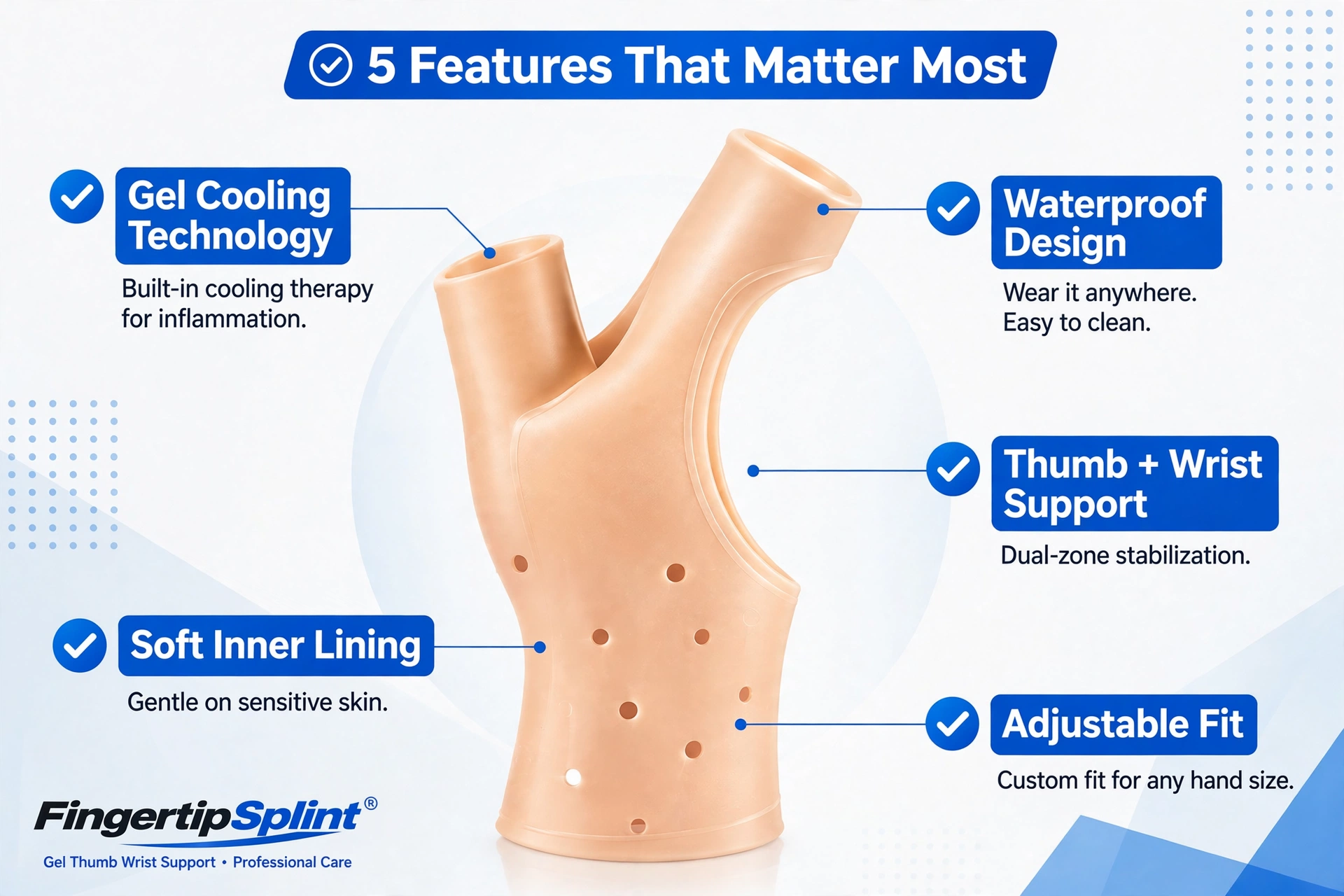
If you are looking for a gel-based option to evaluate for daily comfort, the 1Pc Gel Thumb Wrist Support – Waterproof Wrist Brace from FingerTipSplint is one product to consider. This guide does not claim that it treats arthritis, heals tendons, or is suitable for all conditions. What it offers is a gel-based design intended to provide comfortable support during daily activities.
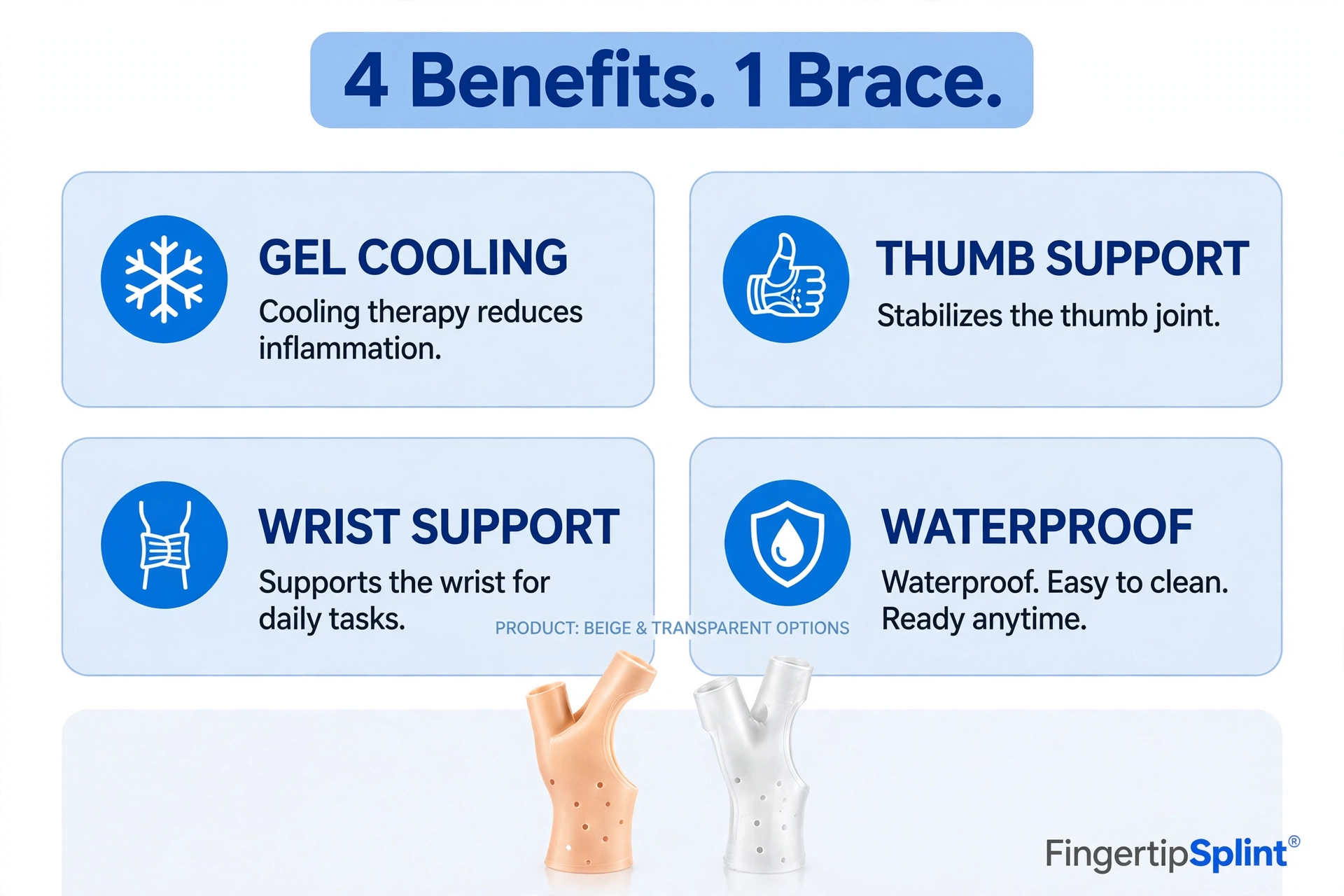
Before purchasing, review the product listing for:
- Materials and construction
- Sizing and fit guidance
- Coverage (thumb only or thumb and wrist)
- Care and cleaning requirements
- Intended use and any limitations
For readers who want to explore related products and support options, the FingerTipSplint shop provides a full overview. If you have questions about waterproof claims or condition-specific use, the article on waterproof thumb wrist brace for arthritis and tendon support covers those topics in detail.
Potential Benefits of a Comfortable Thumb and Wrist Brace
A well-fitted gel thumb wrist support can offer several practical benefits for daily comfort. It is important to distinguish these from treatment or cure — a support is a tool, not a therapy.
Convenient Wear
Gel supports are typically lightweight and low-profile, making them easy to wear during daily activities. Unlike bulky rigid splints, a gel support can often be worn under or over clothing without drawing attention.
Support During Selected Activities
A gel support can provide gentle stability during activities that require repetitive hand movement. This may help reduce the discomfort that builds up over the course of a day.
Reduced Unwanted Movement
When the design is intended for that purpose, a gel support can limit certain movements that provoke discomfort. This is not the same as immobilization — it is about providing support without completely restricting motion.
How to Wear and Care for Your Thumb Wrist Support
Proper wear and care are essential for comfort and safety. Follow these steps based on the product’s design and the manufacturer’s instructions.
Step 1: Read the product instructions. Before putting on the support, read the manufacturer’s instructions. This will tell you how to position the support, how tight to make it, and how to care for it.
Step 2: Position the thumb and wrist correctly. Follow the design of the support. If it is a thumb-only support, position it at the base of the thumb. If it covers the wrist, ensure it sits comfortably around the wrist joint.
Step 3: Secure without restricting circulation. The support should feel secure but not tight. You should be able to move your fingers freely. If you feel numbness, tingling, or throbbing, loosen or remove the support.
Step 4: Check for pressure points and irritation. After wearing the support for a short period, check your skin for redness, indentations, or irritation. If you notice any of these, adjust the fit or discontinue use.
Step 5: Clean and dry as instructed. Follow the manufacturer’s cleaning instructions. Most gel supports can be washed with mild soap and warm water, then air-dried completely before reuse.
Common Mistakes When Choosing a Thumb Support
Many people choose a thumb support without understanding what to look for. Here are the most common mistakes and how to avoid them.
A support that is too small can compress nerves and blood vessels. One that is too large will not provide effective support.
Solution: Measure according to the manufacturer’s size guide.
Tighter is not better. Excessive pressure can cause numbness, tingling, and skin irritation.
Solution: Aim for secure but comfortable, not tight.
Redness, itching, or irritation are signs that something is wrong. Ignoring them can lead to more serious skin problems.
Solution: Stop using the support and reassess if irritation occurs.
A support should not prevent you from performing necessary activities safely. If it does, it is not the right support for that task.
Solution: Match the support to the activity.
A support can mask symptoms, but it does not address the underlying cause. Persistent pain needs professional assessment.
Solution: Seek medical advice for ongoing symptoms.
A brace is a tool, not a treatment. It does not cure conditions or replace appropriate medical care.
Solution: Use a brace as part of a broader management plan.
Who May Benefit From a Gel Thumb Wrist Support?
A gel thumb wrist support may be suitable for adults who want convenient, comfortable support during selected everyday activities. It is not a one-size-fits-all solution, and suitability varies depending on the underlying condition.
People who may find a gel support helpful include:
- Adults who experience occasional thumb or wrist discomfort during daily tasks
- People who want low-profile support during desk work, cooking, or light household activities
- People who are looking for a comfortable alternative to rigid splints for mild symptoms
- People who have been advised to use a support as part of a broader management plan
Suitability varies for people with arthritis, tendon problems, sprains, or other conditions. According to the Cleveland Clinic, conditions like De Quervain’s tenosynovitis may benefit from activity modification and supportive devices, but the specific type of support should be matched to the diagnosis. Diagnosis-specific advice from a healthcare professional is important.
When Should You Ask a Healthcare Professional?
A gel thumb wrist support is not a substitute for medical assessment. Seek professional advice if you experience:
- Persistent or worsening pain
- Significant swelling
- Pain after an injury
- Reduced hand function that affects daily activities
- Numbness or tingling
- Uncertainty about the cause of your symptoms
Seek urgent medical evaluation for:
- Severe pain
- Deformity after injury
- A cold, pale, or blue hand
- Signs of impaired circulation
- Fever with joint pain and swelling
How Long Should You Wear a Thumb Wrist Brace?
There is no single answer to this question. Wearing time depends on the condition, the brace design, and clinical guidance. Some people wear a support only during activities that provoke symptoms. Others wear it for a specified period during recovery. Still others use it intermittently for long-term management.
Avoid universal wear-time recommendations. What works for one person may not work for another. If you are unsure how long to wear your support, ask your healthcare provider. They can provide guidance based on your specific situation.
Is This the Right Support for Your Daily Routine?
To decide whether a gel thumb wrist support is right for you, consider these questions:
- Do you experience thumb or wrist discomfort during daily activities?
- Do you want a comfortable, low-profile support that does not restrict movement excessively?
- Have you checked the product’s sizing, materials, and care instructions?
- Is the support level appropriate for your needs?
- Have you considered whether you need professional guidance for your symptoms?
If you are looking for a practical thumb and wrist support for your everyday routine, review the brace’s fit, material, and usage details to decide whether it matches your needs. You can view product details, explore the full range of support products, or review the frequently asked questions for additional guidance.
Looking for a Practical Thumb and Wrist Support for Your Everyday Routine?
Review the FingerTipSplint Gel Thumb Wrist Support Brace, check its fit, material, and usage details, and decide whether it matches your needs.
View Gel Thumb Wrist Support Browse All ProductsFrequently Asked Questions
The best option depends on fit, coverage, material, intended use, and the person’s condition. There is no universal winner. Look for a support that fits securely without excessive pressure, allows comfortable movement, and suits the activities you perform. Review the product’s specifications before buying.
This depends on the brace design and the task. The support should not create pressure, interfere with safe movement, or worsen symptoms. A low-profile gel support is often suitable for light desk work, but check the manufacturer’s instructions and test it during short periods first.
Some people may be advised to use a suitable support, but brace design and fit should be matched to their needs with professional guidance where appropriate. Arthritis affects different joints in different ways, so the right support depends on the specific diagnosis and affected area.
Wearing time depends on the condition and product instructions. Some supports are designed for extended wear, while others are intended for specific activities. If prolonged use is needed, seek professional guidance to ensure the support remains appropriate for your needs.
Distinguish a product marketed as waterproof from confirmed care and wear instructions. Check the manufacturer’s exact wording before wearing the brace in water. If the listing does not explicitly state that the brace is suitable for immersion, assume it is not.
It should be secure but not cause numbness, tingling, increasing pain, swelling, or changes in hand colour or temperature. If you experience any of these warning signs, stop use and seek advice.
Seek assessment for persistent pain, worsening symptoms, injury, swelling, or loss of function. Severe symptoms — including severe pain, deformity, or a cold, pale, or blue hand — require urgent medical evaluation.
Conclusion: Comfort and Support for Your Daily Routine
Choosing the best gel thumb wrist support for daily comfort is about matching the product to your needs. A support that fits well, feels comfortable, and suits your activities can make a meaningful difference in how you manage everyday tasks.
Remember that a gel support is a tool, not a treatment. It can provide comfort and support, but it does not replace appropriate medical assessment for persistent or worsening symptoms. If you are unsure whether a support is right for you, seek professional guidance.
For readers who want to explore support options, the FingerTipSplint shop offers a range of products. For personalized assistance, you can request a quote or review the frequently asked questions.
Your hands are involved in almost everything you do. Choosing the right support is an investment in your daily comfort.