
CMC Thumb Spica Splint: A Complete Guide for Buyers
CMC thumb spica splints can look similar at first glance, but differences in coverage, construction, fastening, flexibility, fit, and intended use can make them function differently. This complete guide walks through the buyer journey: understanding the CMC area, evaluating spica design, comparing coverage, assessing support and movement, checking fit, reviewing materials and adjustability, and reading product specifications before purchasing.
What This Complete Buyer Guide Covers
- Quick Answer
- What Is a CMC Thumb Spica Splint?
- Understanding the CMC Area
- What Does “Spica” Mean?
- The 10-Point CMC Splint Buyer Framework
- 3D Interactive: 10 Things Buyers Should Check
- Coverage: What Should Buyers Look At?
- Support Structure
- Movement: Support vs Mobility
- Interactive: Movement Check
- Fit and Sizing
- Materials and Comfort
- Adjustability and Fastening
- Different CMC Thumb Spica Designs
- “CMC” vs “Thumb Spica” vs “Thumb Wrist Brace”
- Product Comparison Table
- How to Read a Product Listing
- Product Spotlight
- Common Buying Mistakes
- Interactive: CMC Splint Buyer Checklist
- 5-Minute Product Comparison
- When Should Buyers Ask a Professional?
- Quick Buyer Tips
- FAQ
- Conclusion
Quick Answer: What Is a CMC Thumb Spica Splint?
A CMC thumb spica splint is a support device designed around the thumb and wrist, with coverage that may include the thumb base and CMC region. Buyers should compare its coverage, structure, flexibility, fit, fastening, materials, adjustability, and intended use rather than choosing solely by the product name.
If you want the deeper mechanism first, the reference how a CMC thumb spica splint works covers the anatomy and mechanism in detail. This article is the broad commercial pillar that brings together the major buying questions.
What Is a CMC Thumb Spica Splint?
This is a foundational section. For the full mechanism explanation, see the reference linked above.
CMC = Carpometacarpal
The joint at the base of the thumb where the first metacarpal connects with the wrist-side structure of the hand.
Thumb Base
The area of the thumb near the CMC joint. Many CMC-focused designs concentrate support around this region.
First Metacarpal
The bone of the thumb that connects to the CMC joint. Part of the thumb’s mechanical structure.
Wrist Relationship
The CMC joint sits near the wrist. CMC-focused designs often extend onto the wrist for structural anchoring.
Meaning of “Spica”
A design configuration that incorporates the thumb and extends onto the hand or wrist area. Describes a structural approach, not a specific rigidity.
Thumb + Wrist Support Structure
The connected structure that supports the thumb while extending onto the wrist. Coverage varies between designs.
The CMC Area: What Buyers Should Understand
Understanding the CMC area helps clarify why coverage matters. The CMC joint is at the base of the thumb, where the thumb’s first metacarpal connects with the wrist-side part of the hand.
Key buying question: Does the support design actually cover the area it is intended to support? This is the foundation for evaluating any CMC-focused brace.
What Does “Spica” Mean?
A buyer-friendly explanation of the spica design. “Spica” generally describes a support design that incorporates the thumb while extending into the hand or wrist region.
What Spica Designs Typically Include
- Thumb coverage
- Hand section
- Wrist section
- Support structure
- Fastening
- Movement zone
Important
“Spica” is not a guarantee of a particular rigidity level. Designs differ. Some spica braces are flexible; others are more structured. The design approach describes the coverage configuration, not the specific materials or rigidity.
The 10-Point CMC Splint Buyer Framework
This is the central framework of the entire article. The ten points below are the foundation for evaluating any CMC thumb spica splint before purchasing.
1. Target Area
Does the design correspond to the area you are trying to support?
2. Coverage
How much of the thumb, hand, and wrist does it cover?
3. Structure
Is it flexible, semi-rigid, or otherwise structured?
4. Movement
Which thumb and wrist movements remain available?
5. Fit
Does the sizing system match your measurements?
6. Adjustability
Can the fit be adjusted appropriately?
7. Materials
What materials contact the skin?
8. Fastening
How does the splint stay in position?
9. Intended Use
Is the product designed for the type of use you’re considering?
10. Product Specifications
Are dimensions, size options, materials, and care instructions clearly provided?
CMC Thumb Spica Splint: 10 Things Buyers Should Check — 3D Interactive
This interactive shows the ten checkpoints from the framework. Tap each to see what to check.
Interactive 3D: 10 Things Buyers Should Check
Tap each checkpoint to see what to check
01 — CMC Area
Does the design correspond to the area you are trying to support? The CMC joint sits at the base of the thumb. Check whether the brace’s support is genuinely oriented around this region — not just the thumb shaft or tip.
Understand → Identify → Compare → Evaluate → Measure → Fit → Adjust → Use → Inspect → Purchase
Coverage: What Should Buyers Look At?
Coverage varies between CMC thumb spica designs. Understanding what each type of coverage means helps you evaluate a specific product.
Thumb Coverage
Does the brace surround or support the thumb base? Some designs cover the thumb base; others extend along the thumb.
CMC Coverage
Does the construction extend around the relevant CMC region? This is the anatomical focus of a CMC-focused splint.
Hand Coverage
How much of the palm or hand is incorporated? The hand coverage connects the thumb support to the wrist support.
Wrist Coverage
Does the design extend onto the wrist? The wrist section can act as a structural anchor. Coverage varies.
Finger Freedom
Are the fingers intentionally left free? Many designs leave most fingers open while supporting the thumb and wrist.
Important Principle
More coverage does not automatically mean a better choice. Coverage should correspond to the intended support area and your requirements.
Key buyer education point: More coverage does not automatically mean a better choice. Evaluate coverage against what you need to support and how you intend to use the splint.
This view shows how the support structure wraps around the thumb base and extends onto the wrist. Notice the coverage area, the transition through the hand, and the fastening system. Coverage varies by product design.
Support Structure
The support structure of a CMC thumb spica splint can vary considerably. Understanding the options helps you evaluate a specific product.
| Design Characteristic | What Buyers Should Ask |
|---|---|
| Flexible | How much movement does it allow? |
| Structured | Where does the support come from? |
| Semi-rigid | What areas are reinforced? |
| Extended | How far does coverage continue? |
| Adjustable | What can actually be adjusted? |
Important: Don’t label any structure as universally superior. Different structures create different movement and support characteristics. The appropriate structure depends on the intended use.
Movement: Support vs Mobility
This is an important distinction for buyers. Support does not equal complete immobilization. Depending on construction, a CMC thumb spica may influence thumb bending, thumb opposition, pinching, gripping, wrist movement, and finger movement.
Thumb Bending
Flexion and extension. Different designs allow different ranges of movement.
Thumb Opposition
Bringing the thumb across the palm to meet the fingers. Used in gripping and holding objects.
Pinching
Pressing the thumb against a finger. Used in fine tasks.
Gripping
Wrapping the thumb and fingers around an object. Used in many daily activities.
Wrist Movement
Flexion, extension, and rotation. Longer wrist coverage may interact with wrist movement differently from shorter designs.
Finger Movement
Many designs leave most fingers free, but coverage varies. Check the specific design’s intended coverage.
Interactive: Movement Check
Select a movement to see what to inspect. This is an educational tool, not a medical recommendation.
Movement Check
Choose a movement to see what to inspect.
- Coverage: Check how much of the thumb the splint covers.
- Structure: Consider whether the structure allows or restricts thumb movement.
- Fastening: Consider whether the strap system influences thumb positioning.
- Movement zones: Check what thumb movements remain available.
- Intended use: Consider whether the movement characteristics match your intended activities.
Fit and Sizing
Fit and sizing determine whether the splint is correctly positioned. This section answers the question: what should a buyer check before ordering?
What to Check Before Ordering
- Measurement method
- Size chart
- Left/right-hand options
- Adjustable fastening
- Thumb opening
- Wrist circumference where applicable
- Product dimensions
Important
Follow the manufacturer’s sizing instructions. Sizing systems differ between products. Do not assume that a size from one brand will correspond to a size from another. Compare your measurements against the specific product’s sizing chart.
For a detailed look at fit and coverage, the reference thumb spica splint fit guide covers the topic in more detail.
Materials and Comfort
Materials affect how the splint feels, how it functions, and how it should be cared for. This section explains what buyers should inspect.
What to Inspect
- Fabric type
- Skin-contact surfaces
- Breathability
- Padding
- Seams
- Edges
- Thickness
- Moisture management
- Cleaning instructions
Important Distinction
Comfort is individual and cannot be guaranteed solely from a material description. Two people may find the same splint comfortable or uncomfortable depending on fit, hand shape, and wear duration.
Adjustability and Fastening
Adjustability and fastening determine how the splint stays in position. Different fastening approaches provide different benefits and limitations.
Hook-and-Loop Straps
Adjustable straps that allow the fit to be modified. Common in many designs.
Adjustable Closures
Closures that allow the fit to be customized. Different designs use different closure systems.
Elastic Components
Elastic materials that allow some stretch and movement. May provide different fit characteristics.
Fixed Construction
Designs with limited adjustability. Depend more heavily on correct sizing.
Multiple Adjustment Points
Designs with multiple straps or closures. Allow the fit to be fine-tuned according to the manufacturer’s instructions.
Key question: What exactly can be adjusted? That’s more useful than simply saying “adjustable.” Check the specific product’s fastening and adjustment system.
Different CMC Thumb Spica Designs
This neutral comparison describes common design configurations. Actual products can combine several characteristics.
| Design | Typical Characteristic | Buyer Consideration |
|---|---|---|
| Compact spica | Smaller overall footprint | Coverage vs mobility |
| Thumb + wrist | Connects thumb support with wrist area | Overall coverage |
| Extended wrist | More wrist-area coverage | Bulk and wrist movement |
| Flexible fabric | More adaptable construction | Structure and fit |
| Structured / semi-rigid | Greater structural support | Mobility and comfort |
| Adjustable | Closure can be modified | Correct adjustment |
“CMC” vs “Thumb Spica” vs “Thumb Wrist Brace”
This section clarifies why product titles can be confusing. The three terms describe different aspects of a product.
CMC Support
Describes the anatomical target — the carpometacarpal region at the base of the thumb.
Thumb Spica
Describes a design/coverage approach — a support that incorporates the thumb and extends onto the hand or wrist.
Thumb Wrist Brace
Describes a broader product category involving thumb and wrist support.
A product can overlap all three descriptions
For a comparison of how CMC-focused support differs from regular thumb splints, the reference CMC thumb support vs regular thumb splints covers the differences in more detail.
Product Comparison Table
This buyer-focused table summarizes what to check for each feature. It is not a ranking — it is a structured way to compare products.
| Feature | What to Check | Why It Matters |
|---|---|---|
| CMC coverage | Location of support | Target-area understanding |
| Thumb coverage | Base and thumb structure | Movement and support relationship |
| Wrist coverage | Short or extended | Coverage and mobility |
| Structure | Flexible or semi-rigid | Support characteristics |
| Movement | Thumb, finger, wrist zones | Activity compatibility |
| Fit | Size chart | Correct positioning |
| Adjustment | Closure system | Fit control |
| Material | Skin-contact construction | Comfort considerations |
| Fastening | Strap or closure | Stability and convenience |
| Care | Washing instructions | Maintenance |
| Intended use | Product description | Appropriate expectations |
How to Read a Product Listing
Product listings can answer many questions about a CMC thumb spica splint. This section explains what to inspect when reading a product page.
What to Inspect
- Product Name: Doesn’t tell you everything.
- Images: Look for actual coverage.
- Size Chart: Check measurements.
- Materials: Look beyond marketing adjectives.
- Specifications: Check dimensions and construction.
- Adjustment: Identify what can actually be changed.
- Intended Use: Read the manufacturer’s description.
- Care Instructions: Important for long-term usability.
- Return/Exchange Information: Especially relevant when sizing is involved.
Why This Matters
A product listing provides information that a product name alone cannot. By reading the listing carefully, you can evaluate whether a product’s design matches your requirements. If the listing is missing key information — such as sizing, materials, or coverage — that itself is useful information for your decision.
Product Spotlight: How to Evaluate a CMC Thumb Spica Splint
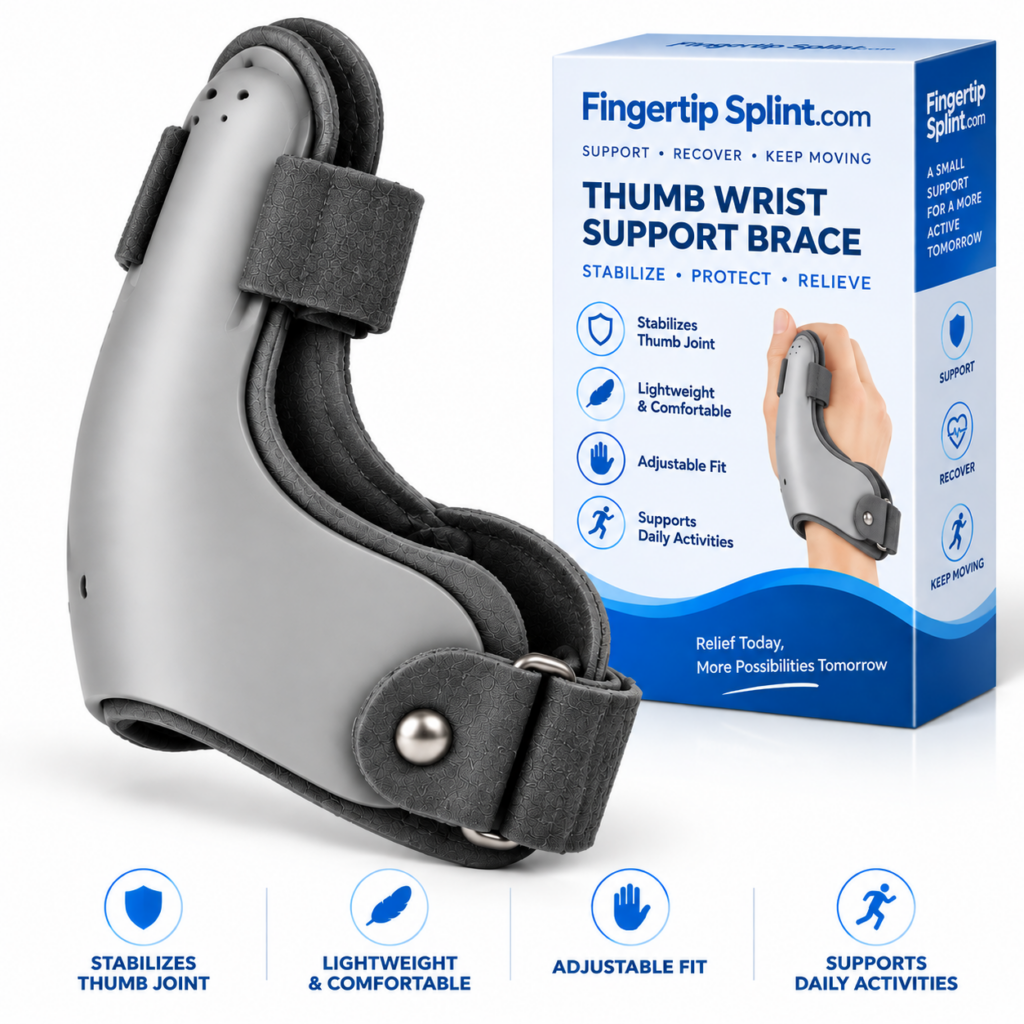
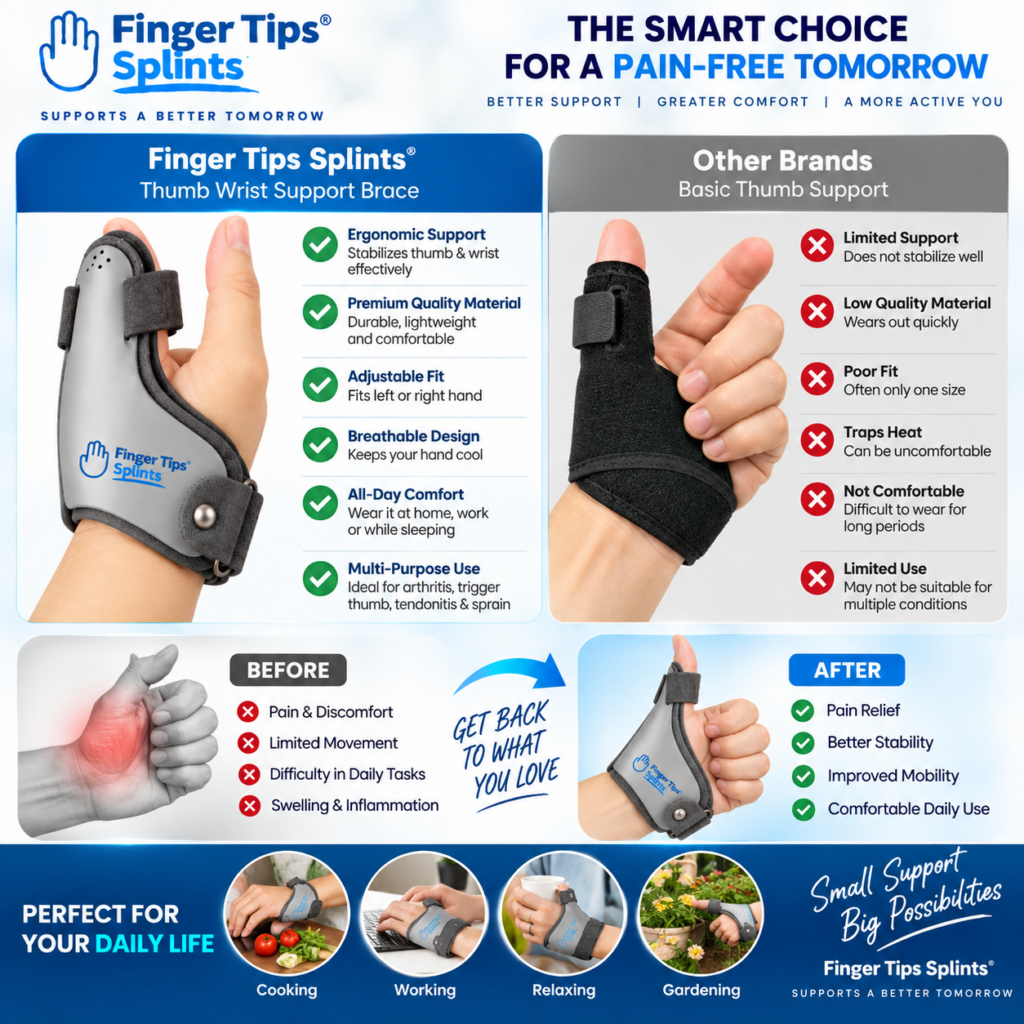
After understanding the buyer framework, here is a specific product to examine. The 1 Pcs Thumb Wrist Support Brace CMC Thumb Spica Splint is one example of a CMC-focused thumb-wrist splint. Evaluate it using the 10-point framework covered in this guide.
Thumb Wrist Support Brace
- CMC-focused positioning
- Thumb coverage
- Wrist involvement
- Adjustable fastening
- Everyday-use considerations
Applying the 10-Point Framework to This Product
CMC-Focused Positioning
The design is oriented around the thumb base and CMC region. Compare this against your intended support area.
Thumb Coverage
Review the thumb coverage characteristics on the product page. Consider whether the coverage matches your needs.
Wrist Involvement
Review how far the design extends onto the wrist. Consider whether this matches your requirements.
Construction
Review the support structure described. Check whether it appears flexible, semi-rigid, or more structured.
Fastening and Fit
Review the fastening system and sizing information. Check what can be adjusted and follow the manufacturer’s sizing instructions.
Everyday-Use Considerations and Care
Consider whether the design matches your daily activities. Review care instructions and product specifications.
Common Buying Mistakes
These mistakes come up frequently when buyers choose CMC thumb spica splints. Avoiding them improves the outcome.
“CMC” doesn’t tell you every design characteristic.
Check: the product’s actual specifications and coverage.
A support device can be poorly positioned if the sizing is wrong.
Check: the manufacturer’s sizing instructions.
Coverage should be evaluated against intended use and movement needs.
Check: whether the coverage matches your requirements.
Structure and mobility involve different considerations.
Check: whether the structure matches your intended use.
The wrist section can materially change the overall design.
Check: how far the design extends onto the wrist.
Ask what thumb and wrist movements remain possible.
Check: the movement characteristics described.
Images alone don’t provide all product information.
Check: the product’s full description and specifications.
Adjustability has limits.
Check: whether the adjustment range matches your measurements.
Material and construction may require specific cleaning.
Check: the manufacturer’s care instructions.
A product description cannot determine what device an unexplained injury or condition requires.
Check: whether professional assessment is appropriate.
Interactive: CMC Splint Buyer Checklist
Use this interactive checklist to prepare for purchasing a CMC thumb spica splint. Click each item as you review it.
CMC Splint Buyer Checklist
Click each item to check it off.
Your checklist is complete — now compare the product details against your actual requirements.
5-Minute Product Comparison
Compare Any CMC Splint in 5 Minutes
- Minute 1 — Check the target area. Does the design correspond to the area you are trying to support?
- Minute 2 — Check coverage. How much of the thumb, hand, and wrist does it cover?
- Minute 3 — Check structure and movement. Is it flexible, semi-rigid, or structured? What movements remain available?
- Minute 4 — Check sizing and adjustability. Does the sizing system match your measurements? What can be adjusted?
- Minute 5 — Check specifications, care, and intended use. Are materials, dimensions, care instructions, and intended use clearly described?
When Should Buyers Ask a Professional?
This section is written with an EEAT (Experience, Expertise, Authoritativeness, Trustworthiness) perspective. Product research is useful, but it doesn’t replace professional evaluation when appropriate.
Significant Injury
A significant injury warrants professional assessment rather than selecting a support device based on a product description.
Visible Deformity
Visible deformity warrants professional assessment. A splint should not be used to manage a deformity without professional guidance.
Severe or Worsening Pain
Severe or worsening pain is a sign that warrants professional assessment.
Major Swelling
Significant swelling affects fit and may indicate an underlying problem that requires professional assessment.
Persistent Numbness or Tingling
Numbness or tingling may indicate nerve involvement and should be assessed professionally.
Significant Loss of Movement
Significant loss of movement warrants professional assessment to determine the appropriate approach.
Symptoms That Aren’t Improving
If symptoms are not improving, do not simply choose a different product. Seek professional guidance.
Uncertainty About Whether a Splint Is Appropriate
If you are unsure whether a splint is appropriate, professional assessment can help determine the right approach.
Concern That a Device Is Causing Symptoms
If you are concerned that a device is causing symptoms — such as numbness, tingling, significant discoloration, or escalating pain — remove the device and seek appropriate guidance.
Warning Signs That Warrant Professional Assessment
- Severe or worsening pain
- Significant swelling
- Visible deformity
- Major loss of movement
- Persistent numbness or tingling
- Concerning skin or circulation changes
- Symptoms that are not improving
For general information about thumb and hand conditions, see the Mayo Clinic overview of thumb arthritis. For broader hand anatomy and condition information, the Cleveland Clinic hand anatomy resource provides useful context. For an orthopedic perspective, the AAOS thumb arthritis library is a widely referenced resource. For general public health information, the NHS hand pain guidance offers a practical overview. Additional medical reference information is available through MedlinePlus hand injuries and disorders. For clinical and anatomy-focused context, Johns Hopkins Medicine hand conditions provides further reading. General educational context is also available through WebMD’s overview of thumb arthritis and Healthline’s thumb arthritis information. For peer-reviewed literature, NCBI PubMed Central hosts open-access research where appropriate. For a broader orthopedic reference, Orthobullets provides structured clinical summaries.
Important: This article does not provide individualized medical advice. Always consult an appropriate healthcare professional regarding your specific situation.
Quick Buyer Tips
1. Identify the Support Area
Don’t start with the product name. Start with what you need to support.
2. Check Coverage
Look at actual product images and specifications. Coverage determines where the support contacts the hand.
3. Understand Movement
Know what areas remain mobile. Different designs allow different amounts of movement.
4. Measure Properly
Use the manufacturer’s sizing method. Sizing systems differ between products.
5. Check Adjustment
Understand exactly what the straps modify. Adjustability has limits.
6. Read Materials and Care Instructions
Don’t rely only on “comfortable” marketing language. Look for specific material and care information.
7. Match the Device to Its Intended Use
Don’t assume every splint is suitable for every activity. Read the manufacturer’s intended-use description.
Frequently Asked Questions
A CMC thumb spica splint is a support device designed around the thumb and wrist, with coverage that may include the thumb base and CMC region. The CMC joint is the carpometacarpal joint at the base of the thumb. A spica design incorporates the thumb and may extend onto the hand or wrist. The exact construction varies between products — coverage, materials, structure, and fastening all differ.
Compare the target area, coverage (thumb, hand, wrist), structure (flexible, semi-rigid, or structured), movement characteristics, fit and sizing, adjustability, materials, fastening system, and intended use. Also check product specifications, care instructions, and return policies where relevant. Read the product description carefully rather than relying on the product name alone.
This depends on the specific design and your intended use. Some CMC thumb spica splints extend further onto the wrist; others are more focused on the thumb and hand. The wrist section can provide a structural anchor for the thumb support. Check the product’s stated coverage and consider whether it matches your requirements. There is no universal answer — the appropriate coverage depends on the design and the situation.
Not necessarily. Different CMC thumb spica designs allow different amounts of thumb movement. Some designs are more flexible and allow more movement; others are more structured and restrict movement more substantially. Support does not automatically mean complete immobilization. The appropriate amount of movement depends on the specific design and the user’s situation. Check the product’s intended-use description for guidance.
Always use the manufacturer’s sizing instructions because sizing systems differ between products. Sizing may involve hand circumference, wrist measurement, thumb dimensions, or device-specific measurements. Check the specific product’s sizing chart and compare your measurements against it. Do not assume that a size from one brand will correspond to a size from another. Do not choose a size simply because it usually fits you in other products.
Not automatically. Adjustability is a feature that allows the fit to be modified. It can help accommodate different hand dimensions and positioning requirements. However, adjustable doesn’t automatically mean better. A well-fitted simpler design can be more useful than a poorly-fitted adjustable one for its intended purpose. The appropriate design depends on the specific situation and the product’s intended use.
Ask a healthcare professional if there is a significant injury, visible deformity, severe or worsening pain, major swelling, persistent numbness or tingling, significant loss of movement, or symptoms that are not improving. Also seek guidance if you are uncertain whether a splint is appropriate, if you are concerned that a device is causing symptoms, or if you are unsure which type of support is appropriate. A product description cannot determine what device a specific medical situation requires.
Conclusion: Compare Before You Buy
Buying a CMC thumb spica splint starts with understanding the buyer journey. The 10-point framework covered in this guide — target area, coverage, structure, movement, fit, adjustability, materials, fastening, intended use, and product specifications — provides a structured way to evaluate any CMC thumb spica splint before purchasing.
This complete buyer guide has brought together the major buying questions for the CMC cluster. The goal has been to help you compare products effectively rather than declare one product universally better. Apply the framework to the specific products you are considering, and evaluate each one against your requirements.
Evaluate a CMC Thumb Spica Splint Using the 10-Point Framework
Review the product’s target area, coverage, structure, movement characteristics, fit, adjustability, materials, fastening, intended use, and product specifications against the framework in this guide. The 1 Pcs Thumb Wrist Support Brace CMC Thumb Spica Splint is one example of a CMC-focused thumb-wrist splint.
View the Thumb Wrist Support BraceNeed information about other thumb and hand support products? Explore the FingerTipSplint shop. For general questions, see the FingerTipSplint FAQ. For B2B inquiries, see the medical finger splint supplier page or request a quote.