
You play sports or use your hands a lot, and your thumb needs support — but you do not want a bulky brace slowing you down. This guide explains what features to check, how a breathable thumb support patch should fit, and how it differs from a traditional thumb brace. It also clarifies when a lightweight patch is the right choice and when a more structured splint or professional assessment is needed.
If you are still comparing different self-adhesive options for everyday use, see our self-adhesive thumb splint buying guide before deciding which format fits your routine.
Table of Contents
- Patch vs Splint vs Brace
- Quick Answer
- 8 Features That Matter
- Breathable Patch vs Traditional Brace
- How to Choose the Right Fit
- Interactive Fit Checker
- Sports Protection — What It Can Do
- 3D Anatomy During Activity
- Sport-by-Sport Guide
- Interactive Sports Selector
- When Protection Is Not Enough
- Recovery Framework
- 10 Common Mistakes
- Doctor Advice
- Product Guide
- Daily Maintenance
- Buyer Checklist
- 7 Quick Tips
- FAQ
Updated for 2026 — What Makes a Thumb Support Patch Different?
Not every product that supports the thumb is designed for the same purpose. Understanding the difference between a support patch, a thumb splint, and a thumb brace helps you choose the right format for your situation.
Patch vs Splint vs Brace
Support Patch
Generally lighter and less bulky, designed around targeted support or protection. Typically preserves more thumb movement than a structured splint.
Thumb Splint
Typically intended to restrict or control movement more substantially. Designed for specific positional or stabilization goals.
Thumb Brace
Can range from lightweight support to structured immobilization, depending on the design and intended use.
The Cleveland Clinic finger splint resource notes that finger and thumb splints come in different designs and materials, and the appropriate type depends on the injury and intended stabilization.
Why the Difference Matters for Sports
A sports user may need support plus movement plus comfort — not maximum immobilization. But someone with a significant injury may need stability, restricted movement, and professional guidance. That distinction runs throughout this guide.
Look for breathable construction, correct thumb coverage, a secure fit, appropriate support for your activity, comfortable skin contact, freedom of necessary movement, activity compatibility, and easy application. The right support depends on your activity and the reason support is needed — a lightweight patch is not a substitute for medical immobilization when a significant injury is suspected.
8 Features That Matter in a Breathable Thumb Support Patch
1. Breathable Material
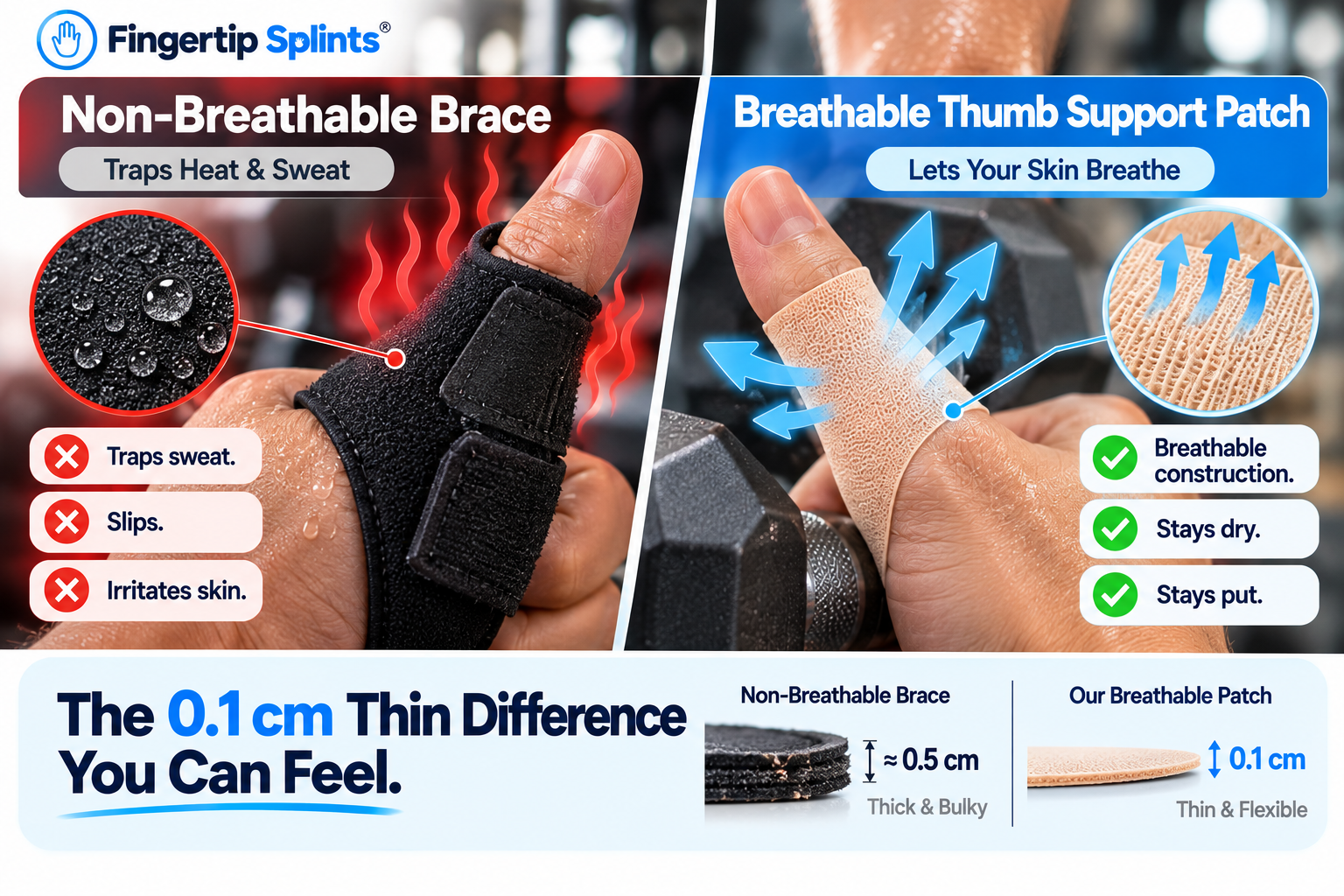
Breathability comes from airflow, material thickness, and how the design manages heat and moisture. A breathable patch allows some air circulation through the construction, which can reduce heat buildup and improve comfort during activity.
Why Breathability Matters During Sports
Sports increase sweating, friction, and heat. A material that manages moisture and feels comfortable can be more practical during active use. But do not assume that breathable automatically prevents skin problems. Monitor your skin during and after wear, and remove the support if irritation develops.
2. Secure Support
A sports support should remain appropriately positioned during its intended activity. Consider the adhesive or self-fastening mechanism, grip, wrapping, movement, potential shifting, and correct application. Secure does not mean extremely tight. Do not tighten a support excessively simply because you are exercising.
3. Correct Thumb Coverage
Ask which part of the thumb the patch actually supports or protects. Thumb tip, IP joint, MCP joint, thumb base, thumb-side hand, or web space. Two products that both say “thumb support” can behave very differently depending on where they provide coverage.
4. Appropriate Mobility
Different activities require different thumb movements. Basketball involves gripping and catching. Tennis involves racket grip. Cycling involves handlebar grip. Gym involves weights and grip. Gaming involves repeated thumb movement. The support should not be evaluated only by how restrictive it is.
5. Low-Profile Design
A compact support can mean less bulk, easier wear under clothing or gloves where compatible, less interference with equipment, and easier movement. Do not assume compatibility with every glove, racket, or piece of sports equipment.
6. Skin Contact
Look for smooth contact, comfortable material, no excessive pressure, no rough edges, and proper fit. Watch for signs that the support should be reassessed: numbness, tingling, significant discoloration, increasing pain, or significant irritation. The Cleveland Clinic finger splint resource lists altered sensation, discoloration, and worsening symptoms among reasons to seek medical attention.
7. Application Method
Clean or prepare the skin, position the patch, secure it, check the fit, move gently, and reassess. Do not assume every adhesive product uses the same application method. Follow the specific manufacturer’s instructions.
8. Activity Compatibility
| Activity | Main Consideration |
|---|---|
| Basketball | Grip and movement |
| Tennis | Racket grip |
| Badminton | Repeated gripping |
| Gym | Load and secure positioning |
| Cycling | Handlebar grip |
| Hiking | Pole and grip use |
| Gaming | Repetitive thumb movement |
| Daily work | Comfort and mobility |
Breathable Thumb Support Patch vs Traditional Thumb Brace
| Feature | Breathable Support Patch | Traditional Thumb Brace |
|---|---|---|
| Profile | Usually lower-profile | Can be bulkier |
| Breathability | Material-dependent | Material-dependent |
| Mobility | Often allows more movement | Depends on design |
| Support level | Usually product-specific | Can range from light to rigid |
| Application | Patch or wrap style | Strap, Velcro, or other |
| Sports convenience | Potentially convenient | Depends on design |
| Immobilization | Usually less restrictive | Some designs provide substantial immobilization |
When a More Structured Brace May Be Necessary
Some injuries require greater immobilization. The Cleveland Clinic sprained thumb resource notes that moderate thumb sprains may require a thumb-spica splint, while more severe injuries can require surgical treatment. A lightweight patch is not designed for that level of stabilization.
How to Choose the Right Fit for a Thumb Support Patch
Step 1 — Identify the Support Area
Do not start by choosing a size. First identify where you need support. The thumb joint is different from the thumb base, which is different from the thumb tip, which is different from the thumb-side wrist. This prevents the mistake of assuming every thumb patch supports the same anatomy.
Step 2 — Follow the Manufacturer’s Sizing Method
Do not estimate. Do not copy another person’s size. Use the actual product instructions. Compare your measurements with the manufacturer’s chart.
Step 3 — Apply Without Excessive Tension
The goal is secure, comfortable, and correctly positioned — not as tight as possible. Excessive tension creates pressure points, numbness, and skin irritation without improving support.
Step 4 — Test Normal Movement
If the product is intended for active use, check whether you can perform the movements relevant to your activity. Grip, catch, twist, or lift as appropriate. If the support interferes with necessary movement, it will not be worn consistently.
Step 5 — Recheck After Activity
Look for slipping, skin irritation, excessive moisture, pressure, numbness, tingling, or discoloration. If any of these occur, reassess the fit or remove the support rather than tightening it further.
Interactive Fit Checker — How Does Your Thumb Support Fit?
Click each item to check your fit. If you cannot confirm most of these, the fit needs adjustment.
Sports Protection — What Can a Thumb Support Patch Actually Do?
This section needs careful wording because the difference between support and treatment matters.
Support During Repetitive Grip
Repetitive gripping can place stress on the thumb and wrist. The Mayo Clinic de Quervain’s treatment guidance notes that repetitive thumb movements can contribute to de Quervain’s symptoms and that management can include reducing aggravating movements and using a splint or brace when appropriate.
Support During Hand-Based Activities
Rackets, balls, gym equipment, cycling, and tools all place different demands on the thumb. A breathable support patch can provide a layer of positioning support during these activities, but it does not change the underlying mechanics of the movement.
Protection vs Injury Treatment
3D Interactive Infographic — How a Thumb Support Patch Works During Activity
The interactive 3D component explorer below shows how a thumb support patch interacts with the thumb during activity. Click each component to see what it does and why it matters.
Thumb Support Patch Component Explorer
Click a component to learn what it does during active use.
Sport-by-Sport Guide to Thumb Support
Basketball
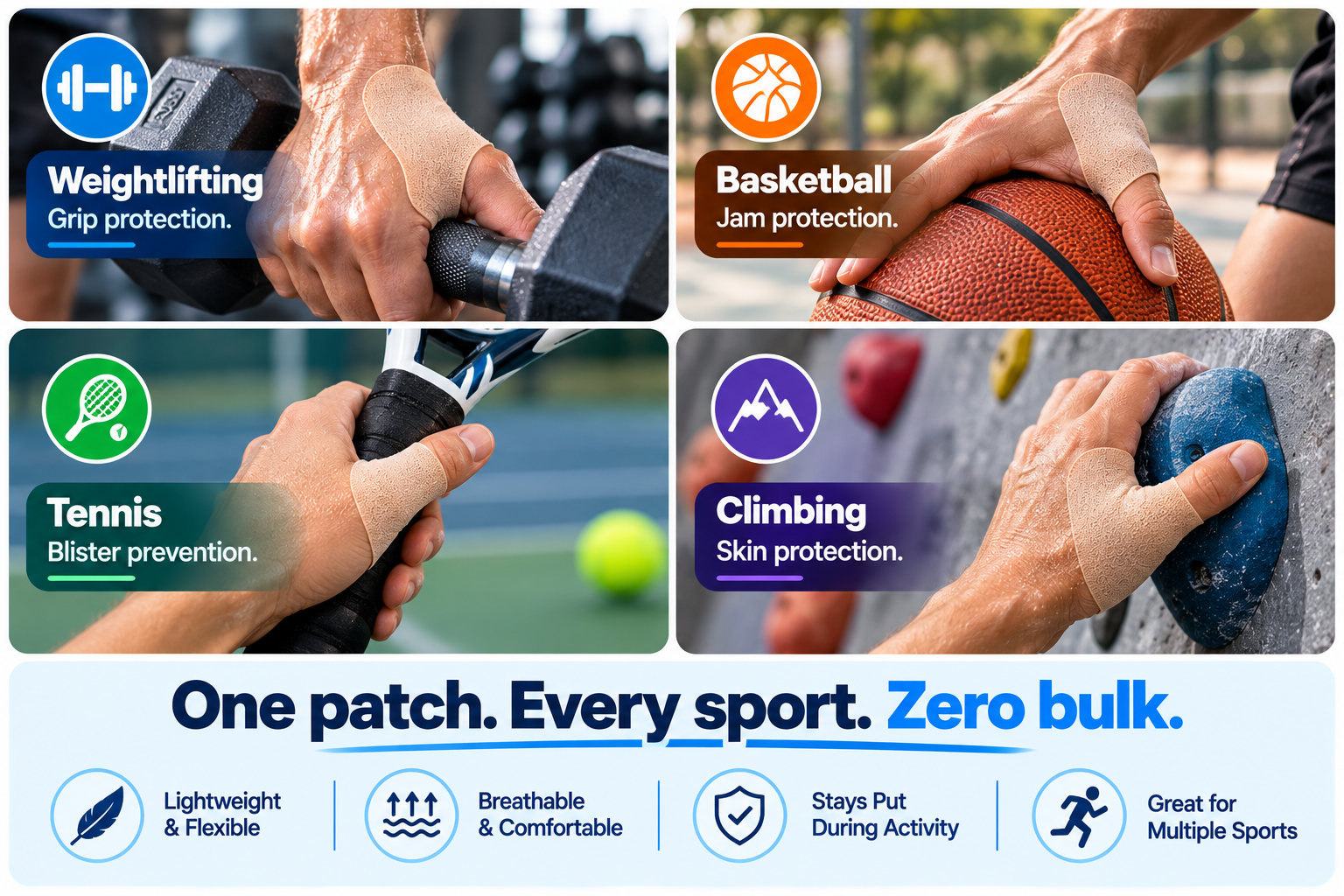
Catching, ball contact, grip, and thumb movement all matter. A support that interferes with your shot or grip will be removed during play. Look for low-profile construction with secure positioning.
Volleyball
Ball impact, setting, blocking, and repetitive hand contact place specific demands on the thumb. A support that stays in place during repeated impact and preserves hand positioning is usually more practical.
Tennis
Racket grip, repetitive thumb positioning, and equipment compatibility matter. The support should not interfere with grip or stroke mechanics.
Badminton
Racket grip and repeated wrist and thumb movement. A low-profile design with secure positioning is usually more practical than a bulky brace.
Gym and Weight Training
Bar grip, dumbbells, pull exercises, and lifting loads all stress the thumb. A lightweight thumb patch should not be presented as a substitute for appropriate injury management during heavy lifting.
Cycling
Handlebar grip, vibration, and repeated hand position. Look for a design that stays secure without creating pressure points during long rides.
Hiking and Trekking
Trekking poles, grip, and repeated hand use. A breathable design helps manage heat during extended outdoor activity.
Interactive Sports Activity Selector
Select your activity and we will show you what to check. This tool helps compare product features; it does not determine whether an injury is safe to play through.
- Grip and catching require finger and thumb mobility
- Ball contact requires a design that does not create new pressure points
- Preserved movement for shooting and passing
- Secure positioning during repeated hand movement
- Warning signs to monitor: numbness, tingling, or pain that worsens during play
When Sports Protection Is Not Enough
Signs That Need Professional Assessment
- Significant injury
- Thumb deformity
- Major swelling
- Severe pain
- Persistent pain
- Thumb instability
- Inability to grip normally
- Loss of movement
- Numbness
- Significant bruising
- Symptoms that continue to worsen
The Cleveland Clinic sprained thumb resource notes that it can be difficult to distinguish a sprain from a fracture from the outside and that evaluation and imaging may be needed in some cases.
Why This Matters for Athletes
An athlete may be tempted to play through discomfort. Without appropriate assessment, a more significant injury may be masked by a support product and worsen over time. This is not a fear tactic — it is a practical reality that professional athletes and their medical teams take seriously.
Recovery Timeline — From Support to Return to Activity
This is an activity-based framework, not a promised week-by-week healing schedule. The Cleveland Clinic sprained thumb resource notes that recovery from a thumb sprain varies substantially with severity, with more serious injuries requiring much longer treatment.
Stage 1 — Protect and Assess
If an injury occurred, reduce aggravating activity and determine whether professional assessment is needed. Do not continue playing on a suspected significant injury.
Stage 2 — Support and Monitor
Use appropriate support according to the injury, product, or clinical instructions. Track symptoms, comfort, and skin condition.
Stage 3 — Restore Comfortable Movement
Movement should return according to the underlying condition and professional guidance. Do not force painful movement.
Stage 4 — Gradual Activity Return
Return to sport should depend on pain, stability, movement, strength, injury type, and professional guidance. Comfort does not equal recovery.
10 Common Mistakes When Buying a Thumb Support Patch
A sleek product is not automatically appropriate. Look at the support area and construction.
Breathability is one factor, not the entire decision. Support level and coverage matter equally.
Excessive pressure does not improve support. It creates new problems.
A patch may not cover the joint you need supported. Check the coverage carefully.
A support that works for one activity may interfere with another. Match the design to your sport.
Fit affects comfort and positioning. Follow the specific product’s sizing instructions.
Do not ignore altered sensation. Remove the support and reassess.
A support product is not a universal treatment. It does not diagnose or heal.
Especially after a significant injury. Follow professional guidance on return-to-play.
This is the most important medical distinction. A patch is not a substitute for structured immobilization when that is required.
Doctor Advice — What Matters More Than the Product Name?
This section is written in the tone of a practical professional checklist. It is not a diagnosis and does not replace an in-person assessment.
Location of Symptoms
Where is the discomfort? Base of the thumb, thumb joint, thumb-side wrist, or fingertip? The location determines the appropriate support area.
Mechanism of Injury
Did it happen suddenly during a fall or ball contact? Or gradually through repetitive use? The mechanism changes the evaluation and the treatment plan.
Stability
Does the thumb feel unstable? Instability may indicate a ligament injury that requires assessment and potentially more structured support.
Movement
Can you move it normally? Significant loss of movement is a red flag that warrants professional assessment.
Activity Demands
What does your sport require? Mayo Clinic sports medicine emphasizes matching brace and support choice to the activity level and situation rather than assuming one type suits everyone, as noted in the Mayo Clinic Q and A on bracing. Additional resources include the Mayo Clinic thumb arthritis overview, the AAOS OrthoInfo thumb arthritis page, the MedlinePlus thumb injuries resource, the NHS hand pain guidance, the WebMD splints overview, and the Healthline thumb brace guide.
Product Guide — Evaluating the FingerTipSplint Breathable Thumb Support Patch
Use this section as a worked example of how to evaluate a breathable thumb support patch against the criteria in this guide. The product being evaluated is the breathable thumb support patch from FingerTipSplint.
Fingertip Splint Thumb Breathable Support Patch
- Breathable construction: Material intended for airflow and moisture management during activity
- Support area: Check the product page for specific thumb coverage details
- Self-adhesive format: Designed to stay positioned without traditional straps
- Fit: Check the product page for sizing and application guidance
- Coverage: Support intended for thumb and fingertip applications
- Mobility: Low-profile design intended to preserve useful thumb movement
- Comfort: Skin-contact surface designed for daily and activity use
- Sports-use practicality: Low-bulk design intended to reduce interference with grip and movement
Who May Find This Product Format Appealing?
Active users wanting a lower-profile option
People who need support during sports or exercise but do not want the bulk of a traditional brace.
People comparing adhesive support formats
Buyers who want to understand how a patch compares to a strap-based or wrap-based design.
Buyers prioritizing breathable construction
People who value moisture management and comfort during extended wear.
General buyers seeking compact support
People with mild or intermittent needs who want a simple, targeted support option.
Who Should Consider a More Structured Option?
Users with suspected significant injuries may need professional assessment and potentially a more structured splint. A lightweight patch is not designed for immobilization. For buyers comparing different finger and thumb support solutions, explore the medical finger splint supplier resources for a broader overview. Our guide on how to choose the right self-adhesive finger protector covers finger-specific selection in more detail.
Daily Maintenance and Skin Care
Keep the Skin Dry
Especially after sports. Moisture under the support can lead to irritation and reduce adhesion. Dry the skin thoroughly before reapplying.
Inspect the Patch
Look for wear, damage, loss of adhesion, or material changes. A worn patch may not stay positioned properly or provide the same support.
Follow Manufacturer Care Instructions
Do not invent a washing or reuse schedule unless the product documentation confirms it. Follow the manufacturer’s guidance for cleaning and replacement.
Give the Skin Attention
If persistent irritation develops, stop and reassess rather than simply adding more adhesive or tension. Skin health matters for consistent wear.
Breathable Thumb Support Patch Buyer Checklist
Click each item to confirm. Aim to check all 10 before buying.
7 Quick Tips for Athletes and Active Users
Frequently Asked Questions
A breathable thumb support patch is a low-profile support product designed to provide targeted support or protection to the thumb while allowing some airflow through the material. It is typically less bulky than a traditional thumb brace and is often used during daily activities or sports where a lighter support format is preferred. It is not designed to immobilize the thumb in the way a structured thumb-spica splint would.
The breathable construction helps manage heat and moisture during extended wear. However, breathable does not automatically prevent skin problems, and the support still needs to fit correctly and be monitored during use. A lightweight patch is not a substitute for professional assessment when a significant injury is suspected.
It can be suitable for certain sports and activities, depending on the injury and the demands of the sport. A breathable patch may work well for activities involving light to moderate grip, repeated hand movement, or protective coverage. It is generally not designed for sports that require substantial thumb stabilization after a significant injury.
Activity compatibility depends on the product’s coverage, the movement it preserves, whether it stays positioned during play, and whether it interferes with grip or equipment. Check the fit before intense activity, monitor skin and sensation, and do not assume that wearing a support makes an injured thumb safe to play on.
It should be secure and comfortable, not excessively tight. You should be able to wear it for the intended period without numbness, tingling, significant discoloration, or increasing pain. A support that creates excessive pressure is not providing better support — it is creating new problems.
If concerning symptoms occur, remove the support and seek appropriate advice rather than simply tightening or continuing to wear it. The Cleveland Clinic finger splint resource lists altered sensation, discoloration, and worsening symptoms among reasons to seek medical attention when using a splint.
Compatibility depends on the activity, the product design, and the reason you need support. A low-profile patch may be compatible with basketball or tennis if it does not interfere with grip, catching, or racket handling. A more structured support may be necessary for certain injuries, and a lightweight patch may not be appropriate.
Before relying on a support during sport, test it during practice and check whether it stays in position, whether it preserves the thumb movement you need, and whether it creates pressure points. Follow applicable league or facility rules concerning protective equipment, and seek professional guidance on return to play after any significant injury.
Breathability comes from the material and construction of the patch. A breathable material allows some airflow through the product, which can reduce heat buildup and help manage moisture from sweat. Factors that affect breathability include the material itself, its thickness, whether the design includes ventilation openings, and the surface that contacts the skin.
However, breathable material does not automatically prevent skin irritation. Material and ventilation can influence comfort, but skin still needs to be monitored. If you notice redness, itching, numbness, tingling, or other changes, remove the support and seek appropriate advice.
It depends on the injury type and severity. A lightweight support patch is not designed to immobilize the thumb in the way a structured thumb-spica splint or brace would. The Cleveland Clinic sprained thumb resource notes that moderate thumb sprains may require a thumb-spica splint, while more severe injuries can require surgical treatment.
If you have sustained a significant injury, seek professional assessment before deciding on a support product. A support patch may be appropriate as part of a broader management plan once the injury has been evaluated, but it should not be used as a substitute for the level of immobilization a clinician recommends.
Seek professional advice if you have significant trauma, thumb deformity, major swelling, severe pain, persistent pain, thumb instability, inability to grip normally, loss of movement, numbness, significant bruising, or symptoms that continue to worsen. These are red flags that should not be managed by buying a support product online.
The Cleveland Clinic sprained thumb resource notes that it can be difficult to distinguish a sprain from a fracture from the outside and that evaluation and imaging may be needed in some cases. Proper assessment matters for both treatment and return-to-activity decisions.
From Confusion to Clarity to Confidence
You want to stay active, but your thumb needs support. Should you choose a patch, wrap, brace, or rigid splint? Start with the activity, support area, mobility, and fit. Then evaluate the Fingertip Splint Thumb Breathable Support Patch against those criteria.
If the product matches your intended use, review the specifications and fit before ordering. Explore FingerTipSplint’s thumb and finger support range, check the FingerTipSplint FAQ, or use the request-a-quote page for wholesale or business inquiries.
View the Product Explore Thumb SupportConclusion: Match the Patch to the Activity, Not the Other Way Around
The right breathable thumb support patch is the one that fits your thumb, supports the intended area, stays comfortable during your activity, and preserves the movement you need. A low-profile breathable design can be an excellent option for active users, provided you understand what it is designed to do and what it is not designed to replace. Before you buy, identify the support area, check the sizing and application instructions, confirm breathability, and verify that the design matches your routine.
If symptoms persist, worsen, or involve significant trauma, deformity, severe pain, numbness, or loss of function, do not simply buy a stronger product. Seek appropriate medical evaluation. For medical finger splint supply and distribution, see the medical finger splint supplier page and the finger splint distributor page. For the full FingerTipSplint range, visit the FingerTipSplint homepage.