
Finger Splint for Trigger & Mallet Finger: What to Look For
A finger splint may look like a simple support, but different finger problems require different positioning and support. Before buying one, understand whether you are looking at trigger-finger support or a mallet-finger injury. This guide compares both conditions and explains what to look for in each.
If you have not yet decided which type of support you need, start with our guide on how to choose the right trigger finger splint. This article focuses on the differences between trigger and mallet finger support.
Important: Splints Are Not One-Size-Fits-All
A splint is a support device, not a way to determine what is wrong with the finger. Hand specialists may use different orthoses depending on whether the goal is stabilization, restricting movement, or supporting a specific joint. The American Society for Surgery of the Hand orthoses resource notes that orthoses can serve different purposes and are selected according to the underlying problem and desired positioning.
Trigger finger commonly involves clicking, catching, or locking during finger movement. Mallet finger is associated with an injury affecting the fingertip or extensor mechanism and is generally managed by keeping the end joint straight during healing. The ASSH trigger finger resource and the ASSH mallet finger resource both describe distinct symptoms and splinting goals for each condition. For medical finger splint supply information, see FingerTipSplint’s medical finger splint supplier page.
First distinguish the condition and identify the joint needing support. For trigger finger, look at support position, adjustability, fit, and comfort. For mallet finger, the critical consideration is appropriate support of the fingertip and end joint, with continuous wear when prescribed. A suspected mallet finger after injury should be assessed professionally before relying on an off-the-shelf splint.
Table of Contents
- Splints Are Not One-Size-Fits-All
- Trigger Finger vs Mallet Finger: Why It Matters
- 3D Anatomy Comparison
- Which Finger Problem Are You Supporting?
- What to Look For in a Trigger Finger Splint
- What to Look For in a Mallet Finger Splint
- Can One Splint Work for Both?
- Feature Comparison Table
- How Should a Finger Splint Fit?
- Buying Checklist
- Product Spotlight
- When a Generic Splint May Not Be Enough
- 10 Mistakes to Avoid
- Daytime vs Nighttime Use
- What to Expect After Starting Support
- What a Hand Specialist Would Look At
- FAQ
Trigger Finger vs Mallet Finger: Why the Difference Matters
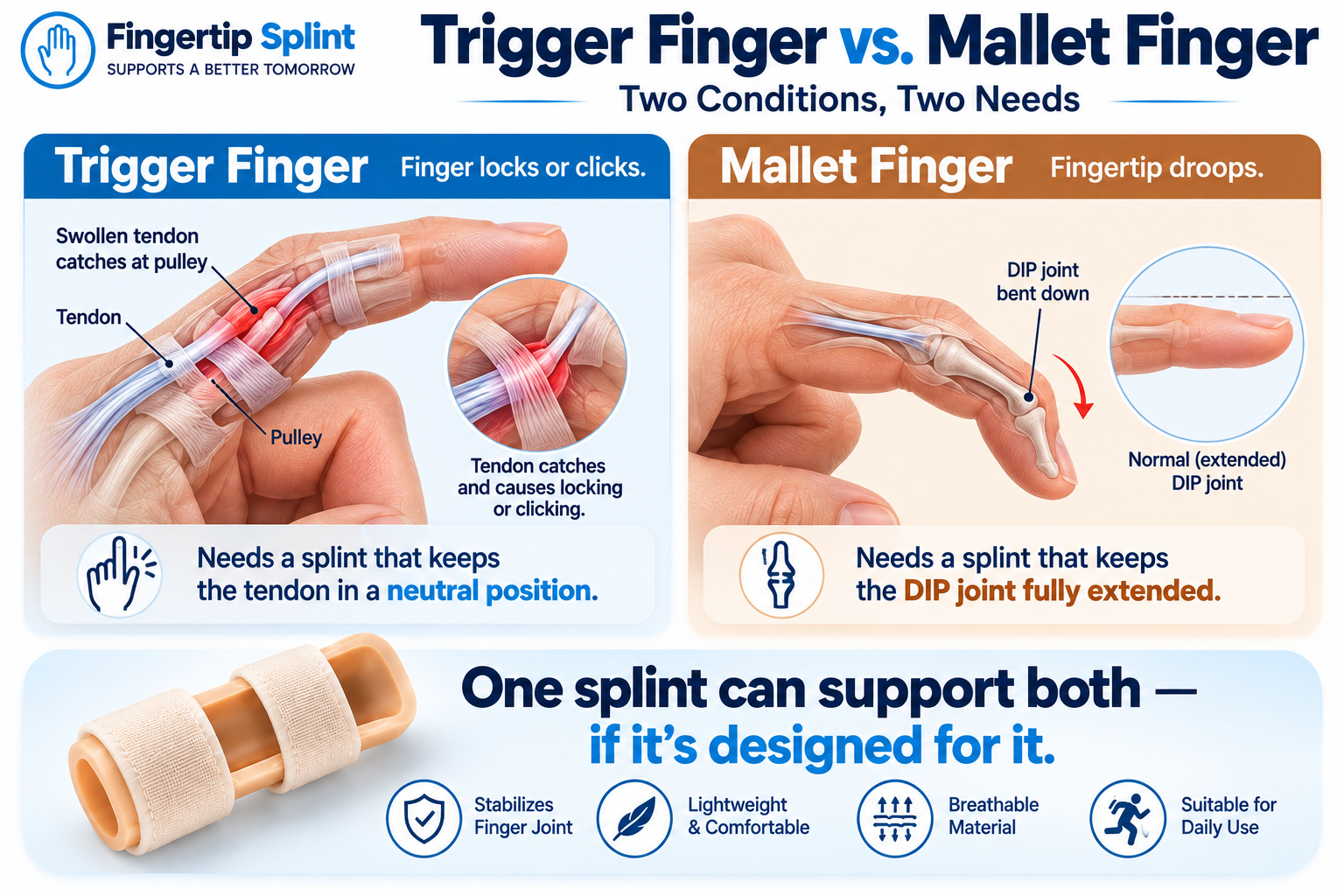
A splint for trigger finger and a splint for mallet finger are not automatically interchangeable. The location and purpose of support differ, and using the wrong design will not address the underlying problem.
Trigger Finger
Trigger finger commonly produces clicking, popping, catching, locking, stiffness, difficulty moving smoothly, and tenderness around the affected area. The ASSH trigger finger resource describes trigger finger as causing mechanical symptoms such as popping, catching, and locking. The problem is typically at the tendon and pulley region near the base of the finger, and splinting is usually aimed at limiting aggravating movement or supporting the finger in an appropriate position.
Mallet Finger
Mallet finger is usually associated with an injury. The fingertip may droop, and the problem involves the end joint and the extensor mechanism. Splinting aims to keep the end joint straight during healing. The ASSH mallet finger resource notes that mallet finger commonly presents as a drooped or crooked fingertip and that splinting is used to maintain the end joint in a straight position.
3D Interactive Finger Anatomy Comparison
Before you evaluate any splint, it helps to see where each condition occurs. The interactive 3D anatomy explorer below compares trigger finger and mallet finger support zones. Click each component to see what it does and where support fits.
Trigger Finger vs Mallet Finger Anatomy Explorer
Click a component to learn where each condition occurs and where support is applied.
Which Finger Problem Are You Trying to Support?
Select the option that best matches your situation to see what to look for. This is not a diagnostic tool.
- Support position at the base of the finger
- Adjustability for controlled fit
- Comfortable contact areas
- Appropriate mobility for daily activities
- Day or night use based on your situation
These answers cannot diagnose a finger condition. They only explain why different support designs may be used.
What to Look For in a Trigger Finger Splint
If your situation involves clicking, catching, or locking, focus on these six selection criteria.
1. Correct Finger Compatibility
Make sure the device is designed for the affected finger. A splint sized for the index finger may not fit the pinky comfortably, and a finger splint will not substitute for a thumb splint.
2. Correct Support Position
Positioning is more important than simply having a rigid-looking device. The splint should support the region that corresponds to your symptoms, typically the base of the finger on the palm side.
3. Adjustability
Useful where the product allows controlled fitting. An adjustable closure lets you modify the fit, but the closure still needs to hold that fit during movement.
4. Comfortable Contact Areas
Avoid excessive pressure. Check the padding, edges, and seams before extended wear. A splint that is uncomfortable after twenty minutes will not be worn consistently.
5. Appropriate Mobility
A splint that restricts movement unnecessarily may not suit every situation. The appropriate balance depends on the purpose of the splint and your daily activities.
6. Day vs Night Use
The ASSH trigger finger resource notes that night splinting may be used for trigger finger in some cases, with the aim of keeping the finger straight during sleep. The appropriate wearing schedule depends on your situation and clinical guidance.
For a deeper look at the full pre-purchase checklist, see our trigger finger splint buying guide.
What to Look For in a Mallet Finger Splint
Mallet finger support has different priorities. Focus on these factors.
Correct Fingertip and End-Joint Coverage
The splint must support the fingertip and the end joint (DIP joint). A splint designed for the base of the finger will not maintain the end joint in the required position.
Maintaining the Appropriate Position
The ASSH mallet finger resource emphasizes that mallet finger treatment commonly requires maintaining the end joint in a straight position, and that even brief bending during the splinting period can interfere with healing.
Secure Fit
The splint must stay in position during daily activities. A splint that slides or shifts will not maintain the required end-joint position.
Skin Comfort
Continuous wear means the contact surface matters. Check for padding, smooth edges, and breathable materials.
Consistency of Positioning
The ability to maintain the appropriate position consistently is more important than adjustability for its own sake.
Following the Prescribed Wearing Schedule
Mallet finger wearing instructions are more structured and condition-specific than trigger finger. Follow the treating clinician’s instructions rather than adjusting the schedule on your own.
Can One Finger Splint Work for Both Trigger and Mallet Finger?
Not necessarily. The issue is not simply whether a product fits the finger. The important questions are:
Which joint does it support?
A splint designed for the base of the finger will not maintain the end joint in position, and vice versa.
What movement does it restrict?
Trigger finger and mallet finger require different movement control.
Where does it apply pressure?
Pressure must be appropriate for the condition and the area being supported.
Does it maintain the intended position?
Continuous positioning matters more in mallet finger support than in trigger finger support.
Is it designed for the specific condition?
A product designed for trigger finger will not necessarily meet mallet finger requirements.
Is it appropriate for the user’s situation?
Individual factors, including injury severity, matter for both conditions.
Feature Comparison: Trigger Finger vs Mallet Finger Support
| Feature | Trigger Finger Support | Mallet Finger Support |
|---|---|---|
| Main concern | Catching or locking | Drooping fingertip |
| Typical cause or context | Tendon or pulley irritation | Often injury |
| Key area | Finger base, palm-side region | Fingertip and end joint |
| Main support objective | Control aggravating movement | Maintain end-joint position |
| Adjustability | Can be useful | Must not compromise required positioning |
| Mobility | May be desirable depending on use | End joint generally needs controlled immobilization during healing |
| Wearing schedule | Depends on plan | Often structured or continuous when prescribed |
| Professional assessment | Recommended when symptoms persist or seem severe | Particularly important after acute injury |
How Should a Finger Splint Fit?
Fit determines both comfort and function. Use the three states below to evaluate any splint before extended wear.
Too Loose
- Moves around
- Does not maintain intended position
- May rub against the skin
Appropriately Fitted
- Secure
- Comfortable
- Maintains intended position
- Does not create concerning pressure
Too Tight
- Numbness or tingling
- Significant discoloration
- Increasing pain
- Excessive pressure
The ASSH orthoses resource identifies problems such as pressure-related injury and altered sensation as reasons to reassess a splint and seek appropriate care.
Buying Checklist: Trigger Finger vs Mallet Finger Splint
Click each item to confirm. If you cannot answer most of these, the splint may not be right for your situation.
Evaluating a Trigger & Mallet Finger Splint Before You Buy
Use this section as a worked example of how to evaluate a finger splint against the criteria in this guide. The product being evaluated is the 1PCS Finger Splints Trigger Finger Splint Mallet from FingerTipSplint.
1PCS Finger Splints Trigger Finger Splint Mallet
- Finger compatibility: Designed for finger support with options for trigger and mallet finger applications
- Support structure: Support frame intended to maintain the intended finger position
- Adjustability: Adjustable closure for fine fit tuning
- Closure: Secure fastening intended to hold the fit during movement
- Coverage: Check the product page for the specific coverage details
- Mobility: Designed to preserve useful finger movement where appropriate
- Comfort: Cushioned contact surface intended for extended wear
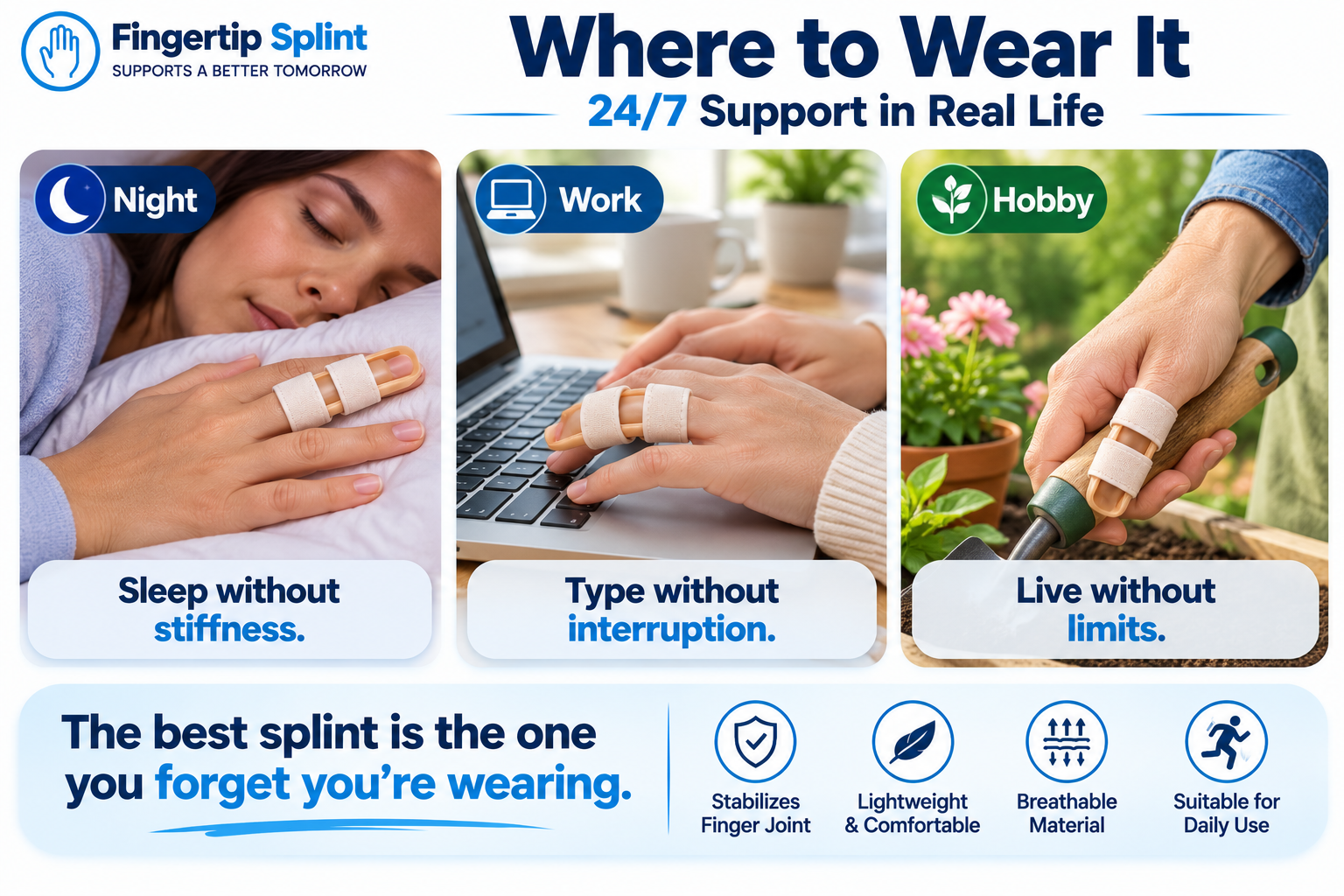
- Intended use: Daily and nighttime support as recommended
- Sizing: Check the product page for the specific size chart
Rather than judging a splint by appearance alone, compare its actual construction, adjustment system, fit, support, and intended use against the criteria in this guide. For additional questions, visit the FingerTipSplint FAQ, and for wholesale inquiries, use the request-a-quote page.
When a Generic Finger Splint May Not Be Enough
A generic consumer splint should not automatically replace assessment when certain signs are present. The ASSH mallet finger resource notes that certain injuries involving an open wound, nail injury, or significant bone fragment or joint alignment issues may require surgical consideration rather than simple splinting.
- Significant trauma
- Visible deformity
- Sudden inability to move the finger
- Severe or worsening pain
- Major swelling
- Numbness or altered sensation
- Open wound
- Nail injury
- Persistent symptoms
- A fingertip that remains drooped after injury
Additional trusted resources include the Mayo Clinic trigger finger diagnosis and treatment page, the Cleveland Clinic finger splint overview, and the MedlinePlus trigger finger resource.
10 Mistakes to Avoid When Choosing a Finger Splint
A splint can look supportive without matching the joint or condition you need supported.
Different splints serve different purposes. A trigger finger splint is not the same as a mallet finger splint.
These are different conditions with different support requirements. See our comparison table above.
A splint designed for the base of the finger will not stabilize the end joint, and vice versa.
A splint that moves around cannot provide stable support. Sizing varies by brand and finger.
Excessive pressure can cause numbness, tingling, or discoloration. It does not improve support.
These are warning signs, not signs that the splint is working.
A design intended for one condition will not address another.
Sizing, wearing, and care instructions matter. If the product page does not clearly explain these, ask before buying.
Significant injuries require assessment, not just a splint purchase.
Daytime vs Nighttime Use for Each Condition
Trigger Finger — Night
- May be considered in some cases
- Focus on maintaining an appropriate position during sleep
- Follow your clinician’s advice on wearing schedule
Trigger Finger — Day
- Comfort and functional movement become more important
- Activities involving repetitive or forceful gripping may need modification
- Choose a design that suits your daily tasks
Mallet Finger — Structured Schedule
- Wearing instructions are more structured and condition-specific
- Continuous wear is often required when prescribed
- Do not adjust the schedule on your own
Mallet Finger — Position Consistency
- The end joint must be maintained in a straight position
- Even brief bending during the splinting period can interfere with healing
- Follow your clinician’s instructions
What Should You Expect After Starting Splint Support?
This is a reassessment framework, not a promised week-by-week healing schedule. Use these stages to monitor progress.
Stage 1 — Fit and Skin Check
Is the device comfortable and correctly positioned? Check the skin for pressure points, redness, or irritation.
Stage 2 — Symptom Monitoring
Are symptoms stable, improving, or worsening? Track clicking, catching, locking, morning stiffness, tenderness, and range of motion.
Stage 3 — Reassessment
Does the planned support still make sense? If symptoms are unchanged or worsening, seek professional guidance rather than adjusting the splint on your own.
Stage 4 — Gradual Return to Normal Use
Only according to the underlying condition and professional guidance. Do not assume that comfort equals recovery.
For mallet finger, the ASSH mallet finger resource describes prolonged splinting followed by a period of reduced or nighttime use in many cases, but the exact plan should follow the treating clinician’s instructions.
What Would a Hand Specialist Look At?
This section is written in the tone of a practical professional checklist. It is not a diagnosis and does not replace an in-person assessment.
Which joint is affected
The location of the problem determines the appropriate support.
Active vs passive movement
Can the finger move on its own, or only with assistance?
Mechanism of injury
How the injury happened changes the evaluation.
Duration
How long have symptoms been present? Recent onset differs from chronic.
Swelling
Significant swelling may indicate a more serious injury.
Deformity
A visibly deformed finger requires professional assessment.
Tendon function
Which tendon is involved, and how is its function affected?
Whether imaging is needed
Some injuries require imaging before treatment decisions can be made.
Additional trusted resources include the AAOS OrthoInfo trigger finger page, the NHS trigger finger page, the WebMD trigger finger overview, and the Healthline trigger finger resource.
Frequently Asked Questions
They support different areas and address different problems. A trigger finger splint typically supports the base of the finger and limits aggravating movement related to tendon gliding. A mallet finger splint supports the fingertip and end joint, maintaining the end joint in a straight position during healing. Using the wrong design will not address the underlying condition.
Not necessarily. The issue is not simply whether the splint fits the finger. You need to consider which joint it supports, what movement it restricts, where it applies pressure, whether it maintains the intended position, and whether it is designed for the specific condition. A splint designed for one purpose may not meet the requirements for another.
Look for correct fingertip and end-joint coverage, the ability to maintain the end joint in a straight position, a secure fit that does not slide, comfortable skin contact for continuous wear, consistency of positioning, and the ability to follow the prescribed wearing schedule. Suspected mallet finger after an injury should be assessed professionally before relying on an off-the-shelf splint.
Look for correct finger compatibility, appropriate support position (typically at the base of the finger), adjustability for controlled fit, comfortable contact areas, appropriate mobility for your activities, and a wearing schedule that matches your situation and clinical guidance.
It should be secure and comfortable, not excessively tight. You should be able to wear it for the intended period without numbness, tingling, significant discoloration, or increasing pain. If concerning symptoms occur, remove the splint and seek appropriate advice rather than simply tightening or continuing to wear it.
The ASSH trigger finger resource notes that night splinting may be used in some cases, with the aim of keeping the finger straight during sleep. The appropriate wearing schedule depends on your situation and clinical guidance. Follow your healthcare professional’s advice rather than assuming a universal schedule.
Seek medical advice if you have significant trauma, visible deformity, sudden inability to move the finger, severe or worsening pain, major swelling, numbness or altered sensation, an open wound, a nail injury, persistent symptoms, or a fingertip that remains drooped after injury. The ASSH mallet finger resource notes that certain injuries may require surgical consideration rather than simple splinting.
Looking for a Finger Support Option?
Before ordering, review the product specifications, fit, intended support, size, and adjustability against the criteria in this guide. Evaluate the 1PCS Finger Splints Trigger Finger Splint Mallet against those requirements before deciding.
For more buying guidance, revisit the broader trigger finger support guide, check the trigger finger splint buying guide, or explore finger splint options. For wholesale or business inquiries, use the request-a-quote page.
View the Product Explore Finger SupportConclusion: Match the Splint to the Condition
The right finger splint is the one that supports the correct area, fits securely, and matches the condition you are addressing. Trigger finger and mallet finger are different problems with different support requirements. A splint designed for one will not necessarily work for the other. Before you buy, confirm which joint is affected, check the manufacturer’s sizing and wearing guidance, and verify that the splint maintains the position it is designed to maintain.
If symptoms persist, worsen, or involve deformity, severe pain, numbness, or loss of function, do not simply buy a stronger splint. Seek appropriate medical evaluation. For medical finger splint supply and distribution, see the medical finger splint supplier page and the finger splint distributor page. For the full FingerTipSplint range, visit the FingerTipSplint homepage.