
Looking for the best CMC thumb wrist protector can become confusing quickly. Different products offer different levels of thumb stabilization, wrist coverage, compression, adjustability, and mobility. The right choice is not necessarily the tightest or most rigid option — it is the one that provides appropriate support while fitting securely and allowing the movement you still need. For a broader view of the FingerTipSplint range, start with CMC thumb and wrist support solutions.
Table of Contents
- What Is a CMC Thumb Wrist Protector?
- Which Protector Is Right for You?
- 3D CMC Anatomy Infographic
- How to Choose the Best Protector
- Support vs Protection vs Compression
- CMC Protector Comparison
- Product Spotlight
- How Should It Fit?
- How to Wear It Correctly
- Recovery Timeline
- 10 Common Mistakes
- Who May Benefit
- Doctor Advice
- Buyer Decision Matrix
- Build a Practical Setup
- 7 Quick Tips
- FAQ
The best CMC thumb wrist protector is one that provides the level of thumb-base and wrist support appropriate for your needs while fitting securely, remaining comfortable during intended activities, and preserving useful movement. Look for adjustable fit, appropriate coverage, comfortable materials, and clear usage instructions rather than choosing based only on tightness or rigidity.
What Is a CMC Thumb Wrist Protector?
Where Is the CMC Joint?
CMC stands for carpometacarpal joint. It is located at the base of the thumb, where the thumb meets the wrist. This joint allows the thumb to move in multiple directions — a critical function for gripping, pinching, and opposition. The Mayo Clinic thumb arthritis overview explains that thumb arthritis commonly affects this joint and can cause pain with gripping or pinching.
Why Does CMC Support Matter?
The thumb is used constantly for gripping, pinching, opening containers, holding phones, writing, lifting objects, and sports activities. When the CMC joint is uncomfortable or unstable, these daily actions become difficult. A protector should support the relevant area without unnecessarily restricting every thumb or wrist movement.
CMC Protector vs Thumb Splint vs Wrist Brace
| Support | Main Coverage | Typical Purpose |
|---|---|---|
| CMC thumb protector | Thumb base and surrounding wrist/hand area | Targeted thumb-base support |
| Thumb splint | Thumb with varying wrist coverage | Greater stabilization |
| Wrist brace | Wrist-focused | Wrist support |
| Compression sleeve | Soft compression | Light support and comfort |
This comparison helps explain why products that look similar can function differently. For a broader look at features and everyday use, see our guide on the CMC thumb support buying guide.
Which CMC Thumb Wrist Protector Is Right for You?
Select what matters most to you and we will show you what to look for. This is a decision aid, not a medical diagnosis.
Consider a more structured CMC protector that provides firm support around the thumb base and wrist area. Confirm the coverage matches your support need and that the design allows the movement you still require.
Understand the CMC Thumb Wrist Protector Before You Buy
The interactive 3D component explorer below shows the anatomy and product features that matter when choosing a CMC thumb wrist protector. Click each component to see what it does and why it matters.
CMC Thumb Wrist Protector Explorer
Click a component to learn what it does and why it matters when you are buying.

How to Choose the Best CMC Thumb Wrist Protector
1. Start With the Area You Need to Support
Identify whether the support requirement is primarily the thumb base, the thumb, the wrist, or the thumb and wrist combined. Do not assume the underlying cause — but do match the coverage to the area where you need support.
2. Check the Coverage
Too little coverage may not provide the intended support. Excessive coverage can interfere with movement and daily tasks. Look at exactly what the product physically covers and confirm it matches your need.
3. Look for Adjustable Fit
Adjustable fastening is useful for different hand sizes, changing comfort throughout the day, easier application, and more controlled fit. A protector that cannot be adjusted may not fit consistently.
4. Consider Thumb Mobility
You may want support but still need to type, write, hold a phone, grip lightweight objects, and perform household tasks. The trade-off between stabilization and mobility matters. A protector that restricts too much will not be worn consistently.
5. Evaluate Material and Comfort
Breathability
Reduces heat buildup during extended wear.
Skin contact
Soft materials reduce the risk of irritation.
Seams and edges
Smooth edges prevent pressure points.
Moisture and heat
Consider how the material handles sweat.
Bulk
A low-profile design interferes less with daily tasks.
Durability
Repeated stretching can affect long-term usability.
6. Consider Your Intended Activity
Separate everyday use, sports and recreational activities, and rest or nighttime use. Do not assume one protector is automatically appropriate for every situation. For sports-specific selection, see our guide on the sports thumb wrist protector buying guide.
Support, Protection and Compression: What Is the Difference?
Support
Support refers to mechanical stabilization — the protector helps maintain the thumb base and wrist in a more stable position.
Protection
Protection can mean reducing unwanted movement or providing physical coverage. It does not mean protection from every injury or hazard. A protector is a support tool, not a guarantee of safety.
Compression
Compression is different from rigid stabilization. Compression involves pressure around the joint. It does not provide the same level of structural support as a more rigid design.
Why More Compression Isn’t Always Better
CMC Thumb Wrist Protector Comparison
| Feature | Flexible Protector | Thumb Splint | Wrist Brace | Rigid Thumb-Spica |
|---|---|---|---|---|
| Thumb support | Moderate | High | Low to moderate | High |
| Wrist support | Moderate | Moderate to high | High | High |
| Mobility | Higher | Moderate | Moderate | Lower |
| Adjustability | Depends on design | Often | Often | Depends |
| Everyday use | Often suitable | Situation-dependent | Often suitable | Situation-dependent |
| Restriction | Lower | Moderate | Moderate | Higher |
These are general design characteristics, not universal medical classifications. The right choice depends on your situation and needs.
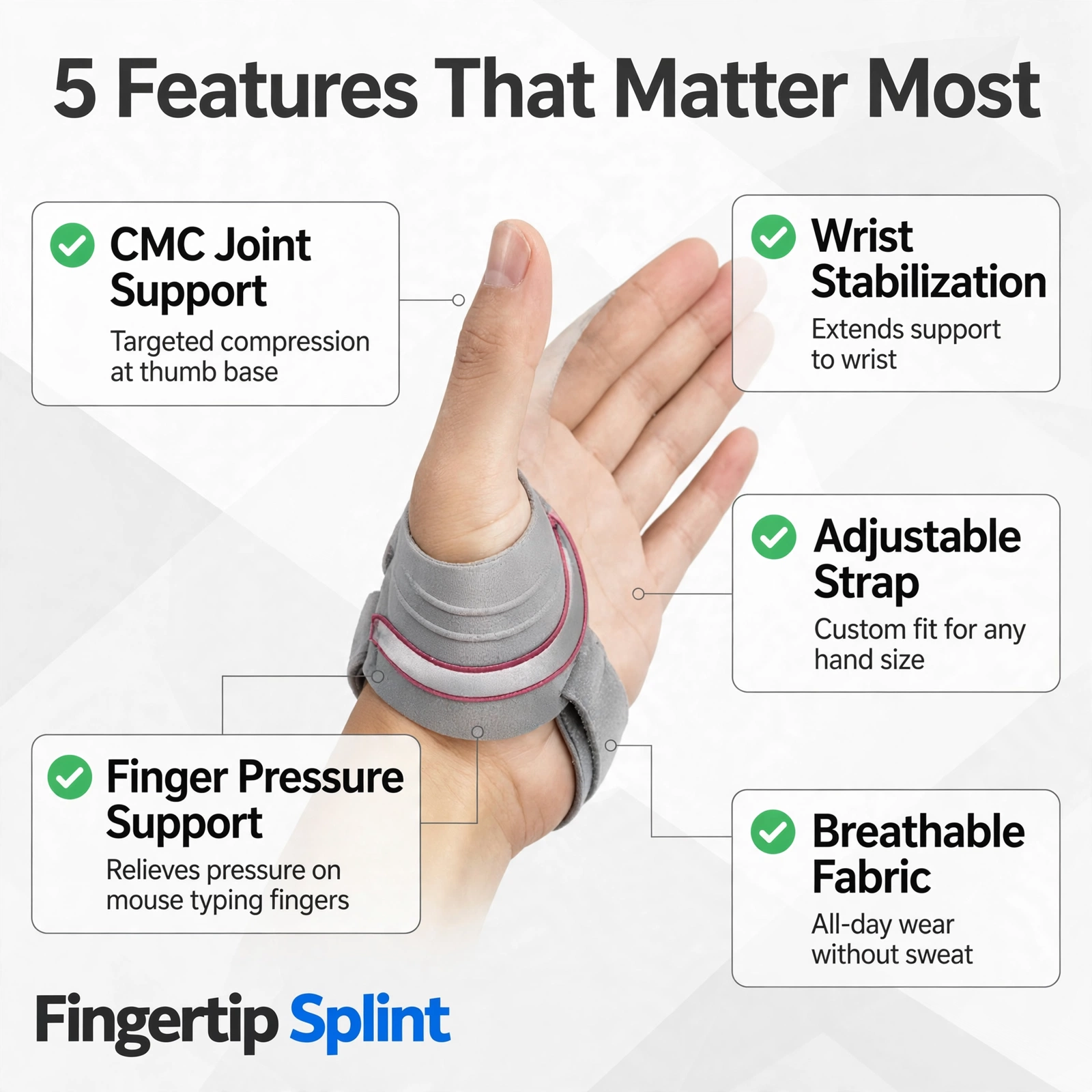
Product Spotlight: Sports CMC Thumb Wrist Protector
Use this section as a worked example of how to evaluate a CMC thumb wrist protector against the criteria in this guide. The product being evaluated is the Sports CMC Thumb Wrist Protector from FingerTipSplint.
Sports CMC Thumb Wrist Protector
- CMC and thumb-base coverage: Designed to support the thumb base area
- Wrist support: Provides wrist coverage as part of the design
- Adjustable fit: Check the product page for adjustment details
- Sports and activity positioning: Intended for sports and activity-related support
- Thumb movement: Designed to preserve useful thumb function
- Comfort: Intended for use during activity
- Protection-oriented design: Provides a layer of support and coverage
What Makes This Product Relevant?
For buyers comparing CMC-focused support options, this product is a relevant option to evaluate because it combines thumb-base coverage with wrist support in a design intended for sports and activity use. Only verified product characteristics should be relied on when comparing it against your specific needs.
What to Check Before Ordering
Check the sizing guidance, product dimensions, materials, fastening, intended use, and care instructions. For buyers comparing different CMC support options, explore the finger splint and support products in the shop.
How Should a CMC Thumb Wrist Protector Fit?
Signs of a Good Fit
Secure without excessive pressure
The protector should stay in place without causing pain or pressure points.
No obvious slipping
The protector should not slide or rotate during normal activity.
Thumb in intended position
The thumb base should be aligned with the support zone.
Useful movement remains available
You should still be able to perform daily tasks.
No persistent numbness or tingling
Normal sensation should be maintained.
Skin remains comfortable
No redness, irritation, or pressure marks.
Signs It Is Too Tight
- Numbness
- Tingling
- Significant discoloration
- Increasing discomfort
- Pressure points
- Skin irritation
Signs It Is Too Loose
- Sliding
- Rotation
- Poor positioning
- Repeated readjustment
- Support changing during movement
The Two-Minute Fit Check
How to Wear a CMC Thumb Wrist Protector Correctly
CMC Thumb Recovery Timeline: What Should You Expect?
Recovery depends on the underlying cause and severity. This is a reassessment framework, not a promised healing schedule.
Early Stage — Protection and Reassessment
Focus on reducing aggravating activity, appropriate support, monitoring symptoms, and following professional advice when needed. If symptoms are significant, seek professional assessment before relying on a protector.
Progression Stage — Gradual Return to Activity
Discuss gradual activity rather than a fixed number of days. Progression depends on symptom response and professional guidance.
Longer-Term Stage — Preventing Repeated Irritation
Focus on activity modification, proper fit, technique, appropriate support, and reassessment if symptoms persist.
10 Common CMC Thumb Wrist Protector Mistakes
Price does not tell you whether the protector fits or supports the right area.
What to do instead: check coverage, fit, and support level.
Excessive pressure can cause numbness, tingling, or discoloration.
What to do instead: secure and comfortable, not tight.
A protector that is too loose or too tight will not provide consistent support.
What to do instead: measure and compare with the product’s chart.
More restriction is not automatically better support.
What to do instead: match the support to your activity.
A protector that restricts necessary movement will not be worn consistently.
What to do instead: test thumb movement after fitting.
Skin irritation can develop without immediate awareness.
What to do instead: inspect skin after each wear.
A protector for rest may not be right for sports or typing.
What to do instead: match the protector to the activity.
Symptoms that persist or worsen deserve professional evaluation.
What to do instead: do not simply change protectors repeatedly.
Pushing through pain can prolong recovery.
What to do instead: reduce or modify the activity and seek advice if symptoms persist.
A protector is a support tool, not a diagnostic device or treatment.
What to do instead: seek professional assessment for significant symptoms.
Who May Benefit From a CMC Thumb Wrist Protector?
A CMC thumb wrist protector may be relevant for people wanting thumb-base support, people looking for activity-related support, buyers who need adjustable positioning, people seeking a lower-profile alternative to more restrictive support where appropriate, and people comparing sports or activity thumb protection options.
When Should You Talk to a Doctor?
- Severe or worsening pain
- Significant swelling
- Visible deformity
- Major loss of movement
- Persistent numbness or tingling
- Significant discoloration
- Symptoms after a significant injury
- Symptoms that are not improving
- Difficulty using the thumb or hand normally
Different injuries and conditions can require different levels of stabilization and treatment. Additional trusted resources include the Cleveland Clinic thumb arthritis page, the Cleveland Clinic sprained thumb resource, the AAOS OrthoInfo thumb arthritis page, the NHS thumb pain guidance, and the MedlinePlus thumb injuries page.
Which CMC Thumb Wrist Protector Features Matter Most?
| Your Priority | Feature to Prioritize | What to Avoid |
|---|---|---|
| Everyday comfort | Breathability and soft edges | Rough edges and heavy material |
| Adjustable fit | Secure fastening | Fixed size with no adjustment |
| Thumb-base support | Appropriate coverage | Coverage that misses the thumb base |
| Mobility | Flexible construction | Excessive rigidity |
| Activity use | Secure positioning | A design that slips during movement |
| Longer wear | Comfort and correct fit | Pressure points and poor fit |
| Easy application | Simple fastening | Complex closure systems |
Build a Practical Thumb Support Setup
Effective thumb support is about using the right combination of support, information, and guidance — not buying multiple products unnecessarily.
Everyday support
A CMC protector matched to your daily activities, plus appropriate activity modification.
Sports and activity
A CMC protector designed for the relevant activity, plus appropriate sports technique and equipment.
Replacement or backup
A second support can be useful if the first needs washing or is unavailable, provided the products are appropriate for the same intended use.
Professional guidance
For persistent symptoms, see the medical finger splint resources or seek clinical assessment.
7 Quick Tips Before Buying
Frequently Asked Questions
There is no universal best option. The right protector depends on the area you need supported, the level of support required, your activity, and your comfort preferences. Focus on fit, coverage, adjustability, and appropriate support rather than choosing based only on tightness or rigidity.
For a comparison of specific features, see our guide on the best CMC thumb wrist protector support and fit guide.
A CMC thumb protector can provide support to the thumb base and wrist area. It may help maintain the thumb in a more comfortable position during activity. However, it does not diagnose or treat the underlying condition.
If symptoms are persistent or worsening, seek professional assessment.
It should be secure and comfortable, not excessively tight. You should be able to move your thumb and fingers without numbness, tingling, significant discoloration, or increasing discomfort.
If concerning symptoms occur, remove the protector and reassess the fit.
It depends on the design and your work activities. A low-profile protector that preserves thumb and finger movement may be compatible with typing, writing, and phone use. A more structured protector may limit the movement you need for work tasks.
Test the protector during a light version of your work activity before relying on it for extended periods.
Sports use depends on product design, activity, and safety. Some protectors are designed for sports and preserve movement; others are intended for rest or recovery. Check applicable league or facility rules concerning protective equipment.
For sports-specific guidance, see our article on the sports thumb wrist protector buying guide.
It depends on the purpose. Some designs provide more restriction for greater stabilization, while others preserve more movement for daily tasks. More restriction is not automatically better — the right balance depends on your needs and activity.
Match the support and mobility level to your situation rather than assuming maximum restriction is best.
There is no universal wearing schedule. Duration depends on the purpose, the product instructions, and your individual circumstances. Follow the manufacturer’s guidance and reassess whether the protector remains appropriate.
Do not assume that longer wear is automatically better.
Seek professional assessment if you have severe or worsening pain, significant swelling, visible deformity, major loss of movement, persistent numbness or tingling, significant discoloration, symptoms after a significant injury, or symptoms that are not improving.
A protector is a support tool, not a diagnosis or cure.
Ready to Choose Your CMC Thumb Wrist Protector?
Check the coverage. Check the fit. Check the mobility. Check the intended activity. Then choose the product that matches those needs. If you are comparing CMC-focused options, explore the Sports CMC Thumb Wrist Protector and review its product details, sizing information, and intended use before ordering.
Explore shop CMC and finger support products, check the frequently asked questions about finger and thumb support, or use the request-a-quote page for wholesale or business inquiries. For medical finger splint resources, see the medical finger splint supplier page.
View the Product Explore Thumb SupportFinal Takeaway: The Right CMC Thumb Wrist Protector Starts With the Right Fit
The best CMC thumb wrist protector is not automatically the tightest or most rigid option. The right choice is one whose design and fit match your intended use and support needs — appropriate support, secure fit, practical coverage, and preserved mobility. Before you buy, identify the area you need supported, check the sizing guidance, confirm the coverage, and test the fit during a light version of your intended activity.
If symptoms persist, worsen, or involve significant injury, severe pain, major swelling, deformity, numbness, or loss of function, do not simply change protectors. Seek appropriate medical evaluation. For medical finger splint supply and distribution, see the medical finger splint supplier page and the finger splint distributor page. For the full FingerTipSplint range, visit the CMC thumb and wrist support solutions.