
Finger Support Sleeve Buying Guide: Fit, Design and Comfort
Many buyers focus only on price, appearance, “adjustable,” “supportive,” or “comfortable.” Those words don’t tell the whole story. A useful buying decision requires looking at fit, construction, coverage, movement, comfort, and intended activity together. This guide walks through the complete pre-purchase process so you can compare products with evidence instead of marketing language.
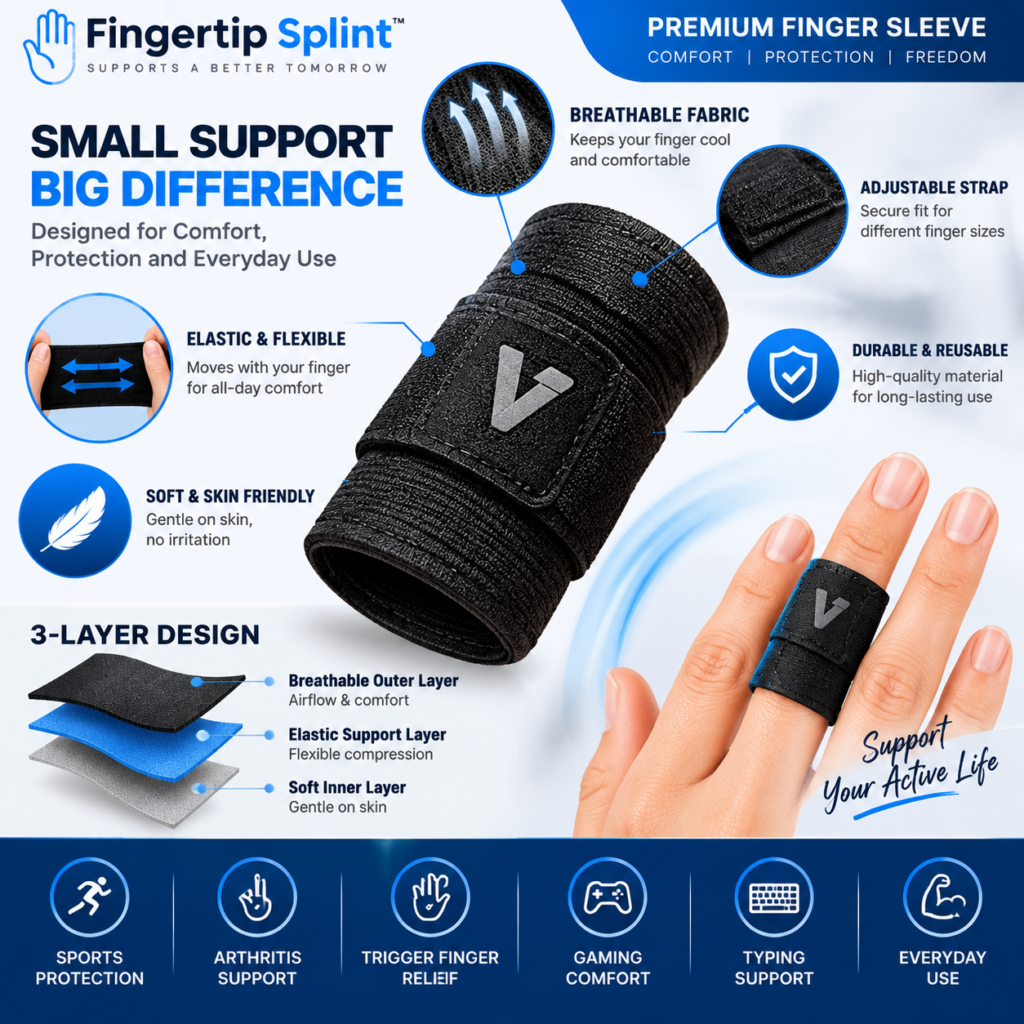
What This Buying Guide Covers
- Quick Answer
- The 10-Point Buying Checklist
- Step 1 — Identify Your Purpose
- Step 2 — Check Finger and Coverage
- Step 3 — Get the Right Size
- Step 4 — Understand Fit
- Step 5 — Evaluate the Design
- Step 6 — Coverage vs Movement
- Step 7 — Evaluate Comfort
- Step 8 — Check Adjustability
- Step 9 — Match to Activity
- Step 10 — Inspect the Product Listing
- Marketing Claims vs Product Facts
- What Does “Protection” Actually Mean?
- Price vs Value
- Interactive: Build Your Buying Checklist
- 3D Interactive: Sleeve Anatomy
- The Buyer Inspection
- Common Buying Mistakes
- When to Look Beyond a General Sleeve
- Product Spotlight
- Quick Tips
- FAQ
- Conclusion
Quick Answer: How Do You Choose a Finger Support Sleeve?
When buying a finger support sleeve, start with its intended use and then evaluate sizing, fit, coverage, material, flexibility, adjustability, comfort, construction, and everyday usability. A suitable sleeve should fit securely without excessive pressure and provide the coverage and movement characteristics appropriate for its design. Always check the manufacturer’s sizing and care instructions before purchasing.
If you are still at the stage of understanding the basic product category, the reference Adjustable Finger Support Sleeve: What Is It and How Does It Work? provides the foundational context. This guide assumes you already understand the product category and now want a structured pre-purchase process.
The buying process has a logical sequence. Start with purpose. Then check coverage, sizing, and fit. Then inspect design, material, and construction. Then consider adjustability, activity match, and the quality of the product listing. By the end, you should be able to evaluate any specific product against a consistent framework rather than comparing marketing language.
The 10-Point Buying Checklist
This framework organizes the entire buying decision into ten sequential steps. Each step is expanded later in this guide. Use it as a summary to return to as you compare products.
Step 1 — Identify Why You Want a Finger Support Sleeve
Don’t start with products. Start with intended use. The purpose shapes every subsequent decision — coverage, sizing, movement, comfort, and value all depend on what you want the sleeve to do.
Ask Yourself
- What activity will I perform?
- Which finger is involved?
- What area needs coverage?
- How much movement do I need?
- Do I need adjustability?
- Is portability important?
- Is everyday comfort a priority?
Common Purposes
- Flexible everyday coverage
- Fingertip protection during tasks
- Support during repetitive activities
- Coverage under other tasks
- Adjustable positioning flexibility
- General comfort during hand use
Why This Comes First
Purpose acts as a filter. A product with impressive features but the wrong purpose will not serve you — no matter how well-made it is. Starting with purpose prevents over-valuing features that do not apply.
What Matters Most to You?
Select the priority that matters most. This is educational guidance for product comparison, not a medical recommendation.
Select a priority to see which characteristics to investigate.
Step 2 — Check the Finger and Coverage Area
The word “finger sleeve” doesn’t necessarily tell you exactly how much of the finger is covered. Two products with the same name can cover very different areas. Coverage is a physical property set by the product’s design, not something that adjustment can change.
Finger length
Finger circumference
Tip coverage
Joint-area coverage
Base coverage
Side coverage
Important: More coverage is not automatically better. More material can potentially affect movement, dexterity, grip, or comfort. Match coverage to purpose rather than maximizing it.
If you are still working out which coverage area you need, the reference Finger Brace Fit Guide: Understanding Adjustability and Coverage covers coverage types in more depth. For this step, the key is to identify the specific area before comparing products.
Step 3 — Get the Right Size
Sizing is where most buying mistakes happen. The most common error is assuming that size labels are consistent across manufacturers. They are not. A “medium” from one brand may correspond to a “small” or “large” from another.
What to Look For
- Manufacturer sizing chart
- Measurement instructions
- Available sizes
- Measurement units (mm, cm, inches)
- Recommended finger dimensions
- Adjustment range if applicable
What to Avoid
- “I normally wear medium, so I’ll choose medium”
- Guessing based on appearance
- Assuming adjustable means universal
- Ignoring the sizing chart because it looks complicated
- Relying on size labels without measurements
If the manufacturer’s sizing chart is missing or unclear, contact the seller before purchase. A responsive seller is a positive sign. A seller who cannot provide sizing information is not — that is a limitation worth noting.
Step 4 — Understand Fit
Fit is what you evaluate after receiving the product. It is the difference between a sleeve that works and one that doesn’t, even when the size label is correct. Fit is not the same as size — a correctly sized sleeve can still fit poorly if it is positioned incorrectly or adjusted badly.
Interactive: The Three Fit Zones
Tap each zone to see what to watch for
TOO LOOSE
Slipping and rotating
APPROPRIATE
Stable and comfortable
TOO TIGHT
Excessive pressure
Appropriate Fit
Stable positioning during intended movement. Intended coverage maintained. Comfortable contact with the skin. Movement consistent with the product’s design. This is the target — not the tightest fit, but the fit that works.
Important: A secure sleeve does not need to feel excessively tight. If you experience numbness, tingling, significant discoloration, or persistent discomfort, loosen or remove the sleeve and seek appropriate advice if symptoms persist.
Step 5 — Evaluate the Design
Design determines how the sleeve behaves in practice. Two products with the same purpose and coverage can feel completely different depending on material, construction, profile, and flexibility. These characteristics are verifiable — unlike marketing words like “comfortable” or “supportive.”
Material
- Fabric composition
- Elasticity
- Surface texture
- Skin-contact characteristics
- Moisture behavior
Construction
- Seams (flat, reinforced, or finished)
- Edges
- Stitching quality
- Fasteners
- Adjustment components
Profile
Is the design bulky or relatively low-profile? Profile affects how the sleeve integrates with fine-motor activities like typing, writing, and phone use.
Flexibility
Does the design bend naturally with the intended movement? Flexibility depends on material, thickness, coverage, and structure — not just on whether the sleeve is adjustable.
Do not assume a feature exists on every product. Verify each characteristic in the product listing. If a listing does not describe material, construction, or profile, that is a limitation — not a neutral absence.
Step 6 — Understand Coverage vs Movement
Coverage and movement are in tension. Choosing one often means accepting a trade-off on the other. Understanding the trade-off helps you match the sleeve to your needs.
More Coverage Can Affect
- Dexterity during fine tasks
- Grip and handling
- Typing comfort
- Writing comfort
- Phone use
Less Coverage Can Offer
- Greater freedom of movement
- Lower profile
- Easier interaction with objects
- Less interference with grip
- More natural finger feel
The appropriate balance depends on the product and the intended use. A sleeve designed for fingertip coverage may offer less overall coverage but more movement. A sleeve designed for broader coverage may offer more coverage but more restriction. Neither is universally better.
Step 7 — Evaluate Comfort Before Buying
“Comfortable” is a marketing claim. Fit and construction are things you can actually investigate. Breaking comfort into specific design characteristics makes it much easier to evaluate a product before purchase.
Comfort Checklist
Tap each item to confirm it for the product you are considering.
Step 8 — Check Adjustability
An adjustable sleeve can offer fine-tuning, positioning, fit customization, repositioning, and different fit preferences. It is a useful design feature — but it has limits that are worth understanding before purchase.
What Adjustability Can Offer
- Fine-tuning the fit
- Positioning coverage
- Fit customization
- Repositioning during the day
- Accommodation of small fit changes
What Adjustability Is Not
- Not universal sizing
- Not unlimited adjustment
- Not automatically better
- Not a substitute for correct size
- Not a substitute for structure
What to Check
- Adjustment mechanism
- Adjustment range
- Stability during movement
- Ease of repeated use
- Compatibility with intended activity
The selection framework Choosing an Adjustable Finger Support: What Should You Consider? covers this in more detail.
Step 9 — Match the Sleeve to Your Activity
Activity determines which characteristics matter most. This table summarizes the primary check for each activity.
| Activity | What to Check |
|---|---|
| Typing | Movement and profile |
| Writing | Grip compatibility and flexibility |
| Smartphone use | Dexterity and fingertip coverage |
| Studying | Comfort over repeated movements |
| Office work | Stability and movement through the day |
| Travel | Portability and easy adjustment |
| Light household tasks | Fit and intended coverage |
The activity-focused article Finger Protector Sleeves for Everyday Activities: What to Know covers each activity in more depth.
Step 10 — Inspect the Product Listing Before Buying
The product listing is the primary evidence you have when buying online. A strong listing gives you enough information to evaluate the product against your requirements. A weak listing leaves gaps that only become clear after purchase.
Look For in a Listing
- Clear product title
- Multiple product images (front, back, side, adjustment, coverage)
- Material description
- Size chart with measurements
- Adjustment mechanism description
- Intended use description
- Care instructions
- Package contents
- Return and exchange information
Red Flags
- “Perfect for everyone” without sizing
- “Universal size” without dimensions
- No material information
- Only lifestyle images, no product close-ups
- No coverage measurements
- No care instructions
- No adjustment explanation
- No package contents listed
Practical rule: If you can’t visualize how you would use the product from the description and images, the listing has not done its job. That is a strong signal to keep comparing.
Marketing Claims vs Product Facts
One of the most useful buying skills is translating marketing language into the specific facts you should verify. Marketing phrases are not lies — they are generalized statements that feel meaningful without committing to a specific measurement.
| Marketing Phrase | What to Verify |
|---|---|
| “Perfect fit” | Actual sizing chart and adjustment range |
| “Maximum support” | Construction details and intended design |
| “All-day comfort” | Material, fit, edges, and care instructions |
| “Universal fit” | Actual size range and adjustment range |
| “Protection” | What type of protection is specified |
| “Adjustable” | What exactly adjusts and by how much |
| “Breathable” | What material or construction supports the claim |
What Does “Protection” Actually Mean?
Because some products use “finger protector” language, a safety distinction is necessary. A standard support sleeve should not automatically be considered protection against hazards.
A standard finger support sleeve should not automatically be considered protection against: heat, flames, chemicals, sharp tools, heavy impact, or industrial hazards — unless the product is specifically designed and rated for those conditions.
Everyday Coverage
A sleeve may cover a portion of the finger and reduce ordinary contact or friction depending on construction. This is the everyday use case.
Certified Protective Equipment
This is a different category requiring specific design and rating. A general sleeve is not in this category unless specifically stated.
Price vs Value
Price alone does not tell you whether a product is a good value. Value comes from how well the product’s characteristics match your needs. Comparing products by price without comparing by features leads to two predictable mistakes: buying an unsuitable product because it was cheap, and paying extra for features you will never use.
Price
Construction
Fit information
Adjustability usefulness
Durability indicators
Intended use match
Interactive: Build Your Buying Checklist
Answer three questions to see a personalized buying checklist. This is educational guidance for product comparison, not a medical recommendation.
Build Your Buying Checklist
Answer all three questions to see your buying checklist.
Sleeve Anatomy: 3D Interactive
This interactive shows the six key zones of a finger support sleeve. Tap each zone to see what to inspect before buying.
Interactive 3D: Anatomy of a Finger Support Sleeve
Tap each zone to see what to inspect before buying
Material
Check the listed material composition, elasticity, surface texture, and moisture behavior. Material determines how the sleeve feels against the skin, how it moves with the finger, and how it holds up over time. Listings that name specific materials are easier to evaluate than listings that describe material only in general terms.
All zones contribute to how the sleeve performs. A product that performs well on most zones but poorly on one may still be the wrong choice for your situation.
The Buyer Inspection: What to Look for in a Listing
This section compresses the inspection process into a practical routine. Tap each element to see what to check.
Interactive: Product Listing Inspection
Tap each element to see what to check in the listing
SIZE CHART
Measurement guidance
MATERIAL
Composition details
ADJUSTMENT
Mechanism and range
COVERAGE
Dimensions and area
PHOTOS
Multiple angles
CARE
Cleaning instructions
PACKAGE
What’s included
SELLER
Manufacturer info
Size Chart
Check whether the listing provides a sizing chart with actual measurements, not just size labels. Measurement instructions should be clear enough for you to measure your finger. If the chart is missing or unclear, contact the seller or look for a product with more complete information.
Common Buying Mistakes to Avoid
These mistakes come up repeatedly when people buy finger support sleeves online. Avoiding them makes the selection process much more reliable.
Price does not tell you about fit, construction, or durability.
Check: compare features against your requirements.
Correct size is the foundation of good fit.
Check: measure your finger and compare to the chart.
Adjustment works within a range built around a base size.
Check: the adjustment range and base size before relying on adjustment.
Product photos are styled; they do not show how the product behaves.
Check: specifications and construction details, not just images.
A product may fit your finger but cover the wrong area.
Check: coverage dimensions against the area you need covered.
Movement affects how well the sleeve works during your activity.
Check: how the sleeve behaves during the movement you need.
More structure may restrict movement you need.
Check: whether the support characteristics match your activity.
Comfort depends on material, edges, seams, and fit — not on the word itself.
Check: the specific construction details.
Care requirements affect how practical the product is over time.
Check: whether care instructions are provided and practical.
A general sleeve is not protective equipment against hazards.
Check: the manufacturer’s stated intended use and any ratings.
Package contents matter for value assessment.
Check: what exactly is included in the purchase.
Activity determines which characteristics matter most.
Check: how the product performs during the activity you do most.
When to Look Beyond a General Finger Sleeve
A general buying guide is not enough for every situation. Some circumstances require professional assessment rather than product selection.
Seek professional assessment rather than relying on a consumer product if you have: significant or worsening pain, visible deformity, major swelling, substantial loss of movement, persistent numbness or tingling, significant discoloration, or symptoms that are not improving.
If a healthcare professional has prescribed a specific type of support, follow that guidance. A consumer sleeve is not a substitute for prescribed medical support.
For general information about hand and finger conditions, the following authoritative resources are useful:
- Mayo Clinic for condition overviews and patient education.
- AAOS OrthoInfo for musculoskeletal guidance from orthopedic specialists.
- MedlinePlus hand injuries and disorders for a broad reference library.
- NHS guide on hand pain for UK-based clinical guidance.
- Cleveland Clinic for clear patient-oriented explanations.
- Johns Hopkins Medicine for clinical and research-based perspectives.
- FDA for regulatory context on medical devices.
- NIH for research-based health information.
- WebMD for general overviews.
- Healthline for practical wellness information.
These resources provide general information and do not replace individualized advice from a qualified healthcare professional.
Product Spotlight: An Adjustable Option to Compare Against Your Checklist
To make the buying framework concrete, here is how it applies to a specific product. The Adjustable Finger Support Sleeve is one option to compare against the checklist taught in this guide.
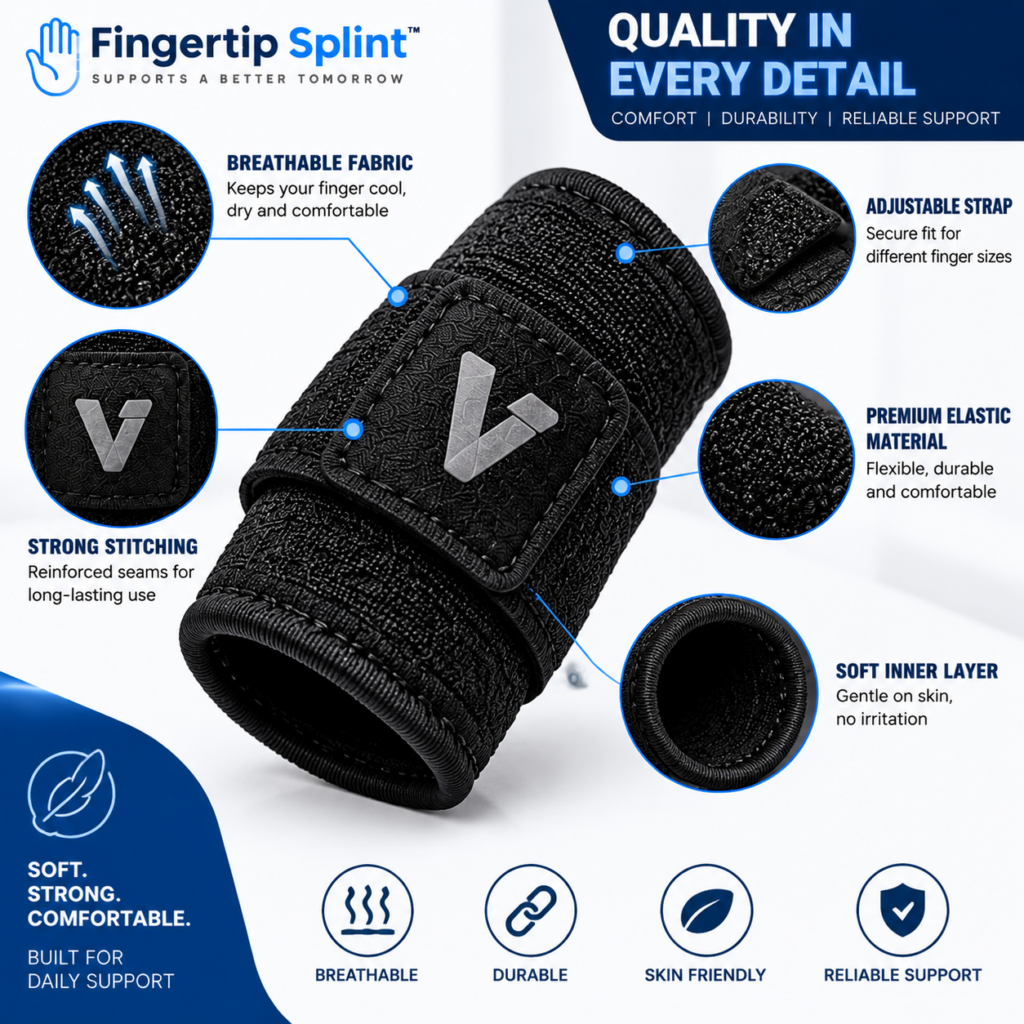
Adjustable Finger Support Sleeve
- Adjustable design for customizable fit
- Flexible sleeve-style construction
- Designed for finger coverage and positioning
- Full product specifications available on the product page
Applying the Checklist to the Product
Fit and Design
Review sizing information, adjustment mechanism, and construction details on the product page. Check how the adjustment works and whether it stays secure during movement.
Coverage and Material
Confirm the coverage area matches your needs and that the material characteristics suit your comfort and activity requirements.
Movement and Activity
Consider how the sleeve behaves during the activity you do most. Check that the movement allowed matches what you need.
Comfort and Care
Review care instructions and any comfort-related details. Confirm the product’s specifications align with your daily wear needs.
Value
Compare the product’s characteristics against your checklist. Value is determined by how well the product matches your intended use, not by price alone.
Quick Tips for Buying a Finger Support Sleeve
Frequently Asked Questions
Start with your purpose, then work through the buying checklist: finger and coverage area, size, fit, design, material, flexibility, comfort, quality of construction, and value. Compare the product’s specifications against your intended use rather than relying on marketing language. Manufacturer sizing charts and care instructions should guide your final decision.
A finger support sleeve should fit securely enough to stay in its intended position without creating excessive pressure or unnecessarily restricting movement. It should maintain the intended coverage, feel comfortable against the skin, and allow the movement appropriate to its design. Tightness is not a measure of support. If concerning symptoms occur, loosen or remove the sleeve and seek appropriate advice if symptoms persist.
Look at material composition, elasticity, surface texture, seams, edges, stitching, fasteners, profile, and flexibility. Verify these details in the product listing rather than assuming they exist. Listings that provide specific information about material and construction are easier to evaluate than listings that rely on general descriptions.
Not automatically. Adjustable sleeves offer fit flexibility within their adjustment range, which can be useful for users whose finger dimensions fall between standard sizes or whose needs change across activities. However, adjustment does not replace correct sizing. A fixed sleeve that matches your finger measurement well may fit better than an adjustable sleeve that requires extreme adjustment to fit. The right choice depends on your specific requirements.
The appropriate coverage depends on your purpose. Coverage types include fingertip, joint-area, and extended coverage. More coverage is not automatically better — it can affect movement, dexterity, grip, and comfort. Match coverage to the area you need and the activity you will perform rather than maximizing it.
Comfort depends on material feel, fit, pressure distribution, edge construction, seam placement, bunching tendency, heat and moisture behavior, movement, and adjustment usability. Break “comfortable” into these specific characteristics and check them in the product listing. Comfort that holds up during activity is a better signal than comfort at first touch.
Check the sizing chart, material description, adjustment mechanism, coverage dimensions, product photos, care instructions, package contents, and return policy. Look for specific measurements and construction details rather than marketing phrases. If the listing lacks key information, contact the seller or consider a product with more complete specifications.
Buy by Design, Not by Marketing Language
The right finger support sleeve is the one whose design and fit match how you intend to use it. Start with purpose, check sizing and coverage, evaluate design and comfort, inspect the listing, and compare value against your requirements. Purpose → Size → Fit → Design → Coverage → Movement → Comfort → Adjustability → Quality → Value
The Bottom Line on Buying a Finger Support Sleeve
Buying a finger support sleeve is a structured process, not a single decision. Start with purpose, check coverage and sizing, evaluate fit and design, consider comfort and adjustability, match the sleeve to your activity, inspect the product listing, and compare value against your requirements. Each step narrows the field and makes the final decision easier.
The most common buying mistake is skipping ahead — choosing by price, appearance, or marketing language. These are easy to evaluate but do not tell you how the sleeve will actually perform. Design, sizing, coverage, and construction are harder to evaluate but far more informative. The buying process rewards the effort.
If you want to continue exploring within this cluster, the selection framework Choosing an Adjustable Finger Support: What Should You Consider? covers selection criteria systematically, and the fit-focused reference Finger Brace Fit Guide: Understanding Adjustability and Coverage covers fit in detail. For a wider reference, explore the full FingertipSplint blog library.
This article is for general information only and is not a substitute for professional medical advice. Always consult a qualified healthcare provider for diagnosis and treatment of any medical condition.