
Adjustable Finger Rehabilitation Splint: How Does It Work?
The term “finger rehabilitation splint” can be confusing. Readers see products described as finger rehabilitation splints, finger extension splints, dynamic finger splints, adjustable finger supports, and finger therapy splints. These terms can describe different designs. An adjustable finger rehabilitation splint uses a combination of positioning, structural support, and adjustable components to interact with the finger according to the device’s design and intended purpose. This guide explains how it actually works — from positioning and adjustment to movement and reassessment.
What This Guide Covers
- Quick Answer
- What Is a Finger Rehabilitation Splint?
- What Makes It Adjustable?
- 3D Interactive: How It Works
- How Does the Splint Actually Work?
- Rehabilitation vs Simple Support
- Interactive: Splint Mechanism Explorer
- The Role of Finger Positioning
- How Adjustment Changes Support
- Movement and Rehabilitation
- Dynamic vs Static Rehabilitation Support
- Finger Anatomy
- How to Fit an Adjustable Rehabilitation Splint
- Interactive: How Does It Work?
- Common Mistakes
- Recovery and Reassessment
- Product Spotlight
- Who Might Research a Rehabilitation Splint?
- What Should You Know Before Using One?
- Quick Tips
- FAQ
- Conclusion
Quick Answer: How Does an Adjustable Finger Rehabilitation Splint Work?
An adjustable finger rehabilitation splint supports the finger through a combination of positioning, structural support, and adjustable components. Depending on the design, it may help maintain a particular position, provide directional support, or interact with movement. Its actual function depends on the device, fit, intended use, and individual circumstances.
If you want the foundational mechanism explanation first, the reference Dynamic Finger Extension Splint: What Is It and How Does It Work? covers that in detail. This article focuses specifically on the rehabilitation-oriented mechanism and how adjustment fits into rehabilitation support.
What Is a Finger Rehabilitation Splint?
A finger rehabilitation splint is a device designed to provide support or positioning during a rehabilitation process, depending on its construction and intended application. The term “rehabilitation” describes the intended role — not a guarantee of recovery.
What the Term Describes
A device designed to provide support or positioning during a rehabilitation process. It is a support tool that may be used as part of a broader management or rehabilitation approach.
What It Does Not Mean
Rehabilitation does not equal guaranteed recovery. A splint can be one component of a broader rehabilitation plan. It is not a diagnosis and does not replace professional assessment.
The term “rehabilitation splint” describes an intended role — it does not mean every device follows the same rehabilitation protocol or that every device is appropriate for every situation. Different designs serve different purposes. Understanding what a specific device is designed to do helps evaluate whether it matches the intended use.
What Makes It Adjustable?
Adjustability is one of the key features of an adjustable finger rehabilitation splint. Understanding which components make a splint adjustable helps clarify how the device can be modified for different fingers and situations.
Adjustable Components
- Straps
- Hook-and-loop closures
- Tension components
- Positioning points
- Elastic elements
- Spring mechanisms
- Modular support components
What Adjustment Can Influence
Adjustment changes how the device sits and interacts with the finger. It can influence fit, position, contact, and support. But it does not change the underlying anatomy.
Important: Adjustment changes how the device sits and interacts with the finger; it does not change the underlying anatomy. Adjustable does not automatically mean suitable for every injury, every finger, or safe at any tension.
How an Adjustable Finger Rehabilitation Splint Works: 3D Interactive
This interactive shows the four-step process of how an adjustable splint works. Tap each step to see what happens.
Interactive 3D: The Four-Step Process
Tap each step to explore the process
1. Position
The finger is placed in the intended supported position according to the device’s fitting instructions. The starting position determines how the support structure contacts the finger and how the mechanism will function.
Exact function varies by splint design.
How Does the Splint Actually Work?
This is the article’s core section. The mechanism can be described step by step, though the exact behavior depends on the specific device. The sequence below describes the general concept.
Important: Different products use different mechanisms. The sequence above illustrates the general concept, not a universal mechanism. For a deeper explanation of the dynamic mechanism, the reference Dynamic Finger Extension Splint: What Is It and How Does It Work? covers the topic in detail.
Rehabilitation vs Simple Support
This is an important conceptual distinction. Understanding the difference helps clarify what “rehabilitation splint” actually means.
Simple Support
Primarily focuses on stability and positioning. The device provides structural support or holds a position without necessarily being designed around a broader rehabilitation process.
Rehabilitation-Oriented Support
May be designed around positioning, movement, and gradual functional use. The device is intended to support a rehabilitation process, though the specific role depends on the design and the plan.
Important: “Rehabilitation splint” describes an intended role; it does not mean every device follows the same rehabilitation protocol. Do not assume that a rehabilitation splint provides progressive rehabilitation for every situation.
Interactive: Splint Mechanism Explorer
Click each component to understand what it contributes. This is an educational tool, not a medical recommendation.
Splint Mechanism Explorer
Click each component to reveal an explanation.
The Role of Finger Positioning
Positioning is central to how a splint functions. Understanding why positioning matters helps clarify how the device interacts with the finger.
Elements of Positioning
- Starting position
- Supported position
- Joint alignment
- Device orientation
- Strap placement
Why It Matters
A splint’s mechanical behavior depends partly on where its support components contact and anchor around the finger. Incorrect positioning can alter how the mechanism interacts with movement.
This adds a slightly technical element while remaining understandable. The goal is not to overwhelm readers with anatomy but to help them understand why positioning matters when using an adjustable splint.
How Adjustment Changes Support
Adjustment is not about finding a universal “correct” level. It is about achieving appropriate positioning and support according to the device instructions. The three scenarios below illustrate the concept.
Too Loose
Movement of device leads to unstable positioning. The support may not function as intended. The device may slip or shift during use.
Appropriate Fit
Secure positioning leads to intended support. The device stays in place and the mechanism functions as designed.
Too Tight
Excessive pressure can lead to discomfort or risk of circulation or nerve-related symptoms. This is not automatically better support.
Key principle: The goal is not maximum tightness. The goal is appropriate positioning and support according to the device instructions. A specific adjustment level is not appropriate for everyone.
Movement and Rehabilitation
Movement in a rehabilitation context involves several concepts that are not interchangeable. Understanding the differences helps clarify how a splint may fit into a rehabilitation process.
Passive Positioning
The device helps maintain a position. The finger is positioned and supported without active movement on the user’s part.
Active Movement
The user moves the finger. The splint may allow, support, or limit this movement depending on the design.
Dynamic Interaction
A device may mechanically interact with movement. The mechanism responds to changes in finger position according to its design.
These concepts are not interchangeable. A device that provides passive positioning is different from one that allows active movement, and both are different from one that dynamically interacts with movement. The appropriate role depends on the device design and the specific situation.
For a deeper look at how adjustment and movement interact, the reference How an Adjustable Finger Extension Splint Supports Finger Movement covers the topic in detail.
Dynamic vs Static Rehabilitation Support
This is a short comparison. For the full comparison, see the dedicated article linked below.
| Characteristic | Dynamic | Static |
|---|---|---|
| Movement interaction | May interact with movement | Generally holds position |
| Mechanical component | May include tension, spring, or elastic system | Often simpler |
| Positioning | Can provide directional support | Relatively fixed |
| Adjustment | Varies by design | Varies by design |
| Rehabilitation role | Depends on intended use | Depends on intended use |
For a detailed comparison, the reference Dynamic vs Static Finger Splints: What’s the Difference? covers the trade-offs in more depth.
Finger Anatomy
Only the anatomy necessary to understand the mechanism is covered here. This is a practical overview, not a medical textbook.
Bones
Provide structure. They give the finger its shape and serve as attachment points for tendons and ligaments.
Joints
Allow movement. The joints are the pivot points where finger movement occurs.
Tendons
Transmit forces for movement. Tendons connect muscles to bones and play a central role in finger movement.
Ligaments
Support joint stability. They guide movement and prevent unwanted motion.
Muscles
Generate movement. They work in coordinated groups to produce flexion and extension. The splint modifies the mechanical environment around the finger; it does not replace the structures that produce movement.
For general information about hand and finger anatomy, the Cleveland Clinic hand anatomy resource provides a clear starting point. For a broader orthopedic perspective, the AAOS hand and wrist conditions library covers hand and finger conditions in detail.
How to Fit an Adjustable Rehabilitation Splint
This is a practical step-by-step section. The exact fitting procedure depends on the specific product, so always follow the manufacturer’s instructions. The steps below describe the general process.

Correct fit involves appropriate positioning, secure fastening without excessive tightness, and comfort during intended use. Always follow the manufacturer’s sizing and adjustment instructions for the specific product.
Interactive: How Does It Work?
Click each stage of the sequence to see what happens. This is an educational visualization.
The Rehabilitation Splint Sequence
Common Mistakes
These mistakes come up frequently when people use adjustable finger rehabilitation splints. Avoiding them improves the experience.
Different fingers and situations can require different support. Adjustable does not mean suitable for everyone.
Check: whether the device is designed for your specific finger and use.
More pressure is not automatically better. Excessive tightness can cause discomfort and reduce tolerance.
Check: follow the manufacturer’s adjustment instructions.
A poorly positioned device can interact differently with the finger than intended.
Check: positioning and alignment after adjustment.
Dynamic support can still guide or limit movement. The amount and direction depend on the design.
Check: what movement the specific device is designed to support or restrict.
Avoid unsupported recovery promises. Healing time depends on the underlying problem and individual circumstances.
Check: whether professional guidance is appropriate.
Do not modify springs, straps, or structural components unless manufacturer instructions specifically allow it.
Check: the manufacturer’s instructions before making any modifications.
Persistent or concerning symptoms deserve appropriate professional attention.
Check: remove the splint and seek appropriate guidance if symptoms persist.
Different mechanisms behave differently. “Rehabilitation splint” describes an intended role, not a universal design.
Check: the specific product’s design and documentation.
Recovery and Reassessment
Because recovery depends on the underlying problem, this section provides a staged reassessment framework rather than a week-by-week healing timeline. There is no universal recovery timeline for everyone using an adjustable finger rehabilitation splint.
Stage 1 — Initial Assessment
Determine what type of support is appropriate. Follow the manufacturer’s fitting instructions and confirm the splint is positioned correctly.
Stage 2 — Initial Fit
Check positioning and comfort. Monitor how the finger and device interact.
Stage 3 — Intended Use
Follow the prescribed or manufacturer-directed use. Note any changes in comfort or positioning.
Stage 4 — Functional Reassessment
Consider how the finger responds during relevant activities. Review movement, symptoms, and device fit.
Stage 5 — Adjustment or Professional Review
Modify the approach only according to appropriate guidance. Determine whether continued use remains appropriate.
Remember: Recovery depends on the underlying issue, severity, treatment plan, and individual response. There is no universal week-by-week timeline for everyone using an adjustable finger rehabilitation splint.
Product Spotlight: An Adjustable Dynamic Finger Rehabilitation Design
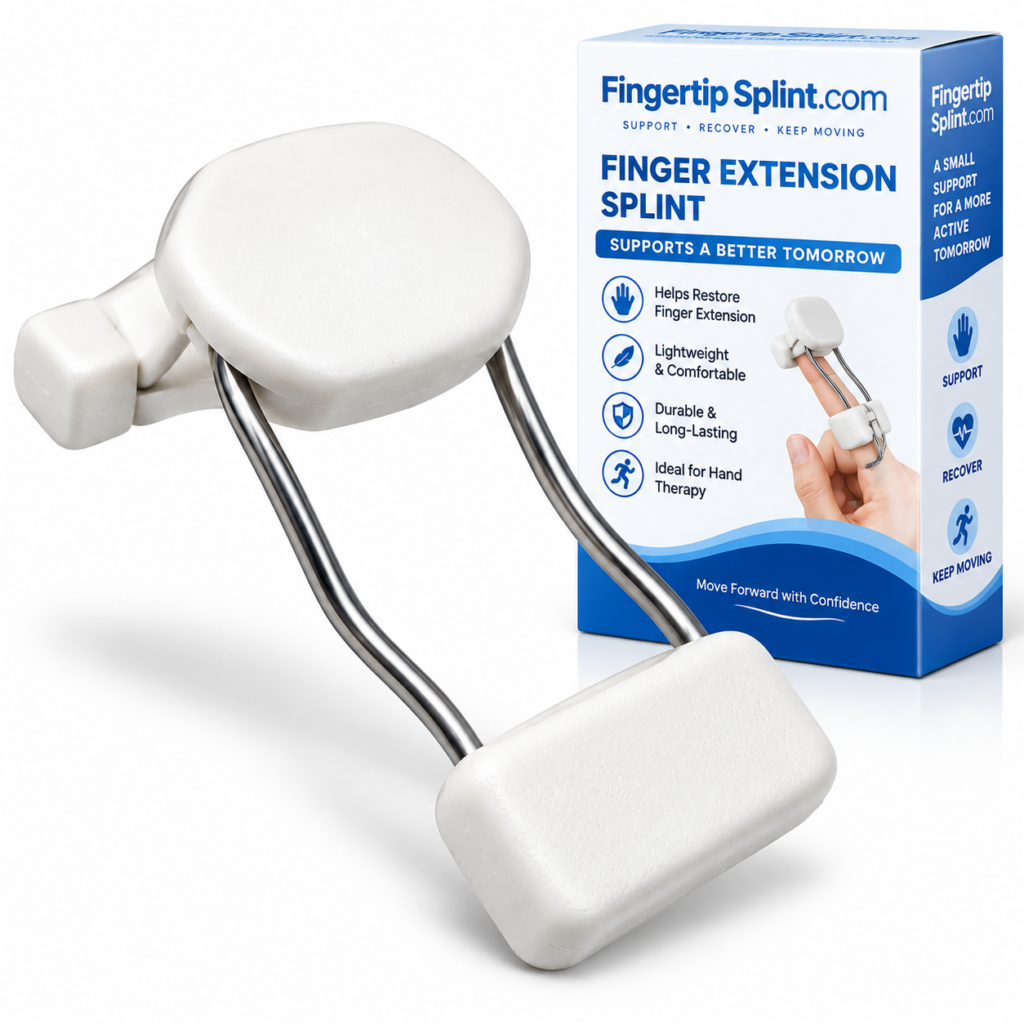
After understanding how an adjustable finger rehabilitation splint works, here is a specific product to examine. The Dynamic Finger Extension Splint – Adjustable Finger Rehabilitation Trainer for Joint Support is one example of an adjustable dynamic finger rehabilitation-oriented design.
Dynamic Finger Extension Splint
- Adjustable construction
- Extension-oriented support
- Dynamic design
- Finger positioning and support
- Fit considerations on product page
Evaluating the Product Using the Rehabilitation Framework
Adjustable Construction
The adjustable construction allows positioning or tension to be modified according to the product’s instructions. Note: adjustability is a separate characteristic from dynamic vs static.
Extension-Oriented Support
The product is designed around finger-extension support. The exact support characteristics depend on the device construction.
Dynamic Design
The dynamic design is built around interacting with movement. This places it in the dynamic-support category.
Finger Positioning
Review the positioning and contact characteristics described on the product page. Correct positioning is essential for the mechanism to function as intended.
Fit Considerations
Review the sizing and fit information provided. Compare your measurements against any stated range before relying on adjustment.
For a buyer-focused guide, the reference What to Consider When Choosing a Dynamic Finger Splint covers selection criteria in more detail.
Who Might Research a Rehabilitation Splint?
This section is informational rather than diagnostic. Different people come to this topic for different reasons, and suitability depends on individual circumstances.
People Researching Finger Rehabilitation Equipment
Some people are researching rehabilitation-oriented finger support products and want to understand how they work.
People Comparing Dynamic and Static Support
Others are trying to understand the difference between dynamic and static rehabilitation support.
People Looking for Adjustable Finger Positioning
Some readers specifically want a device that can be adjusted for positioning or fit.
People Following a Rehabilitation Plan
Some people arrive at this topic after a healthcare professional has recommended a finger support device.
People Researching Finger Extension Support
Others are interested in extension-support designs and want to understand how they interact with movement.
Buyers Comparing Splint Designs
General buyers may want product information before making a decision. This article provides general education, not individualized medical advice.
Important: This article does not claim a particular diagnosis automatically means the reader should use this product. Specific suitability should be determined by an appropriate healthcare professional when a medical problem is involved.
What Should You Know Before Using a Finger Rehabilitation Splint?
This section is written with an EEAT (Experience, Expertise, Authoritativeness, Trustworthiness) perspective. It does not provide individualized medical advice, but it does explain what a healthcare professional may consider.
Underlying Problem
A rehabilitation splint should be considered within the context of the problem it is intended to support, rather than as a universal treatment for finger problems.
Affected Finger or Joint
The specific finger and joint affect the appropriate design and fit. Different fingers and joints have different movement characteristics.
Desired Movement
What movement is intended? Maintain position, restrict movement, permit some movement, or provide directional support?
Required Restriction
What movement needs to be restricted? The level of restriction affects whether a dynamic or static design may be appropriate.
Swelling
Significant swelling can affect fit and may warrant professional assessment.
Pain
Severe or worsening pain warrants professional assessment. A splint should not be used to mask significant symptoms.
Sensation
Numbness or tingling may indicate nerve involvement and should be assessed professionally.
Fit
Fit affects positioning, comfort, and how the device interacts with the finger. A poorly fitting device may not function as intended.
Duration of Use
The duration of use depends on the underlying problem and the treatment plan.
Rehabilitation Instructions
Professional guidance can help determine how the splint should be used within a broader rehabilitation plan. A rehabilitation splint should be considered within the context of the problem it is intended to support.
Warning Signs That Warrant Professional Assessment
- Severe or worsening pain
- Significant swelling
- Visible deformity
- Major loss of movement
- Persistent numbness or tingling
- Concerning skin or circulation changes
- Symptoms that are not improving
For general information about finger injuries and hand conditions, see the Mayo Clinic overview of finger injuries. For broader hand anatomy and condition information, the Cleveland Clinic hand anatomy resource provides useful context. For an orthopedic perspective, the AAOS hand and wrist conditions library is a widely referenced resource. For general public health information, the NHS hand pain guidance offers a practical overview. Additional medical reference information is available through MedlinePlus hand injuries and disorders. For clinical and anatomy-focused context, Johns Hopkins Medicine hand conditions provides further reading. General educational context is also available through WebMD’s overview of finger injuries and Healthline’s general finger injury information. For peer-reviewed literature, NCBI PubMed Central hosts open-access research where appropriate. For a broader orthopedic reference, Orthobullets provides structured clinical summaries.
Important: This article does not provide individualized medical advice. Always consult an appropriate healthcare professional regarding your specific situation.
Quick Tips
Quick Fit Checklist
Before using an adjustable finger rehabilitation splint, check the following. Click each item to mark it as reviewed.
Frequently Asked Questions
An adjustable finger rehabilitation splint supports the finger through a combination of positioning, structural support, and adjustable components. The splint contacts the finger, establishes positioning, and secures the device through adjustable components. Depending on the design, it may help maintain a particular position, provide directional support, or interact with movement. Its actual function depends on the device, fit, intended use, and individual circumstances.
A splint is described as suitable for rehabilitation based on its intended role — providing support or positioning during a rehabilitation process. However, “rehabilitation splint” describes an intended role; it does not mean every device follows the same rehabilitation protocol. The appropriate device depends on the underlying problem, the finger or joint involved, the desired movement or restriction, and professional recommendations where applicable.
It depends on the specific design. An adjustable splint allows positioning or tension to be modified according to the device’s instructions. Some designs may allow or support movement; others may restrict movement more substantially. “Dynamic” describes how the support interacts with movement — it does not mean normal movement is guaranteed. The appropriate amount of movement depends on the device design and the specific situation.
Some dynamic finger splints are designed with rehabilitation-oriented positioning. However, whether a dynamic splint is appropriate for a specific rehabilitation situation depends on the underlying problem, the desired movement or restriction, and professional guidance where applicable. A dynamic splint should be considered within the context of the problem it is intended to support, rather than as a universal solution.
A splint should be secure but not excessively tight. The goal is not maximum tightness — the goal is appropriate positioning and support according to the device instructions. Excessive tightness can cause discomfort, pressure, rubbing, and poor tolerance. It may also risk circulation or nerve-related symptoms. A specific adjustment level is not appropriate for everyone. Follow the manufacturer’s adjustment instructions carefully.
A correctly fitted splint should be secure without being excessively tight, positioned according to the manufacturer’s instructions, and comfortable enough to wear as intended. Look for signs of poor fit: numbness, tingling, significant discoloration, persistent pain, excessive pressure, or substantial swelling. If any of these occur, reassess the fit or seek appropriate guidance. Do not simply tighten or readjust repeatedly.
Speak with a healthcare professional if the underlying problem is not known, if you are unsure whether this type of support is appropriate, if the device does not fit correctly, if you are unsure about adjustment, or if symptoms are not improving. Also seek professional assessment for severe or worsening pain, significant swelling, visible deformity, major loss of movement, persistent numbness or tingling, or concerning skin or circulation changes. A rehabilitation splint is a support device, not a diagnosis.
Conclusion: Positioning, Adjustment, and Reassessment Work Together
An adjustable finger rehabilitation splint works through a combination of positioning, structural support, and adjustable components. The finger is positioned, the device is secured through adjustment, the support interacts with the finger, and the user reassesses comfort and fit. The exact behavior depends on the device design, the fit, and the intended use.
Understanding how the mechanism works helps buyers and users evaluate specific products, use them appropriately, and recognize when professional guidance may be appropriate. A rehabilitation splint should be considered within the context of the problem it is intended to support — not as a universal solution for every finger problem.
Explore Adjustable Finger Rehabilitation Support
If you are researching adjustable finger rehabilitation splints, compare the product’s design, adjustment system, intended use, fit requirements, and support characteristics before deciding whether it matches your needs. The Dynamic Finger Extension Splint – Adjustable Finger Rehabilitation Trainer for Joint Support is one example of an adjustable dynamic finger rehabilitation-oriented design.
View the Dynamic Finger Extension SplintNeed information about other finger support products? Explore the FingerTipSplint shop. For general questions, see the FingerTipSplint FAQ. For B2B inquiries, see the medical finger splint supplier page or request a quote.