
Choosing a CMC Support Brace: Features Buyers Should Understand
A product may be labeled CMC brace, CMC thumb support, thumb spica, thumb wrist brace, or thumb splint — but the name doesn’t tell the buyer everything. A CMC support brace should be evaluated by its actual construction, coverage, fit, adjustability, and intended use. This guide explains the ten features buyers should understand before purchasing a CMC-focused brace.
What This CMC Buyer Guide Covers
- Quick Answer
- What Is a CMC Support Brace?
- Why CMC-Focused Design Matters
- 3D Interactive: The 10-Point Buying Framework
- Feature 1 — CMC Coverage
- Feature 2 — Thumb Coverage
- Feature 3 — Wrist Coverage
- Feature 4 — Support Structure
- Interactive: CMC Brace Feature Explorer
- Feature 5 — Thumb Movement
- Feature 6 — Fit and Sizing
- Feature 7 — Adjustability
- Feature 8 — Materials
- Feature 9 — Comfort and Profile
- Feature 10 — Intended Use
- How to Read a CMC Brace Product Listing
- Comparison Table — CMC Brace Features
- CMC Support Brace vs General Thumb Brace
- Product Spotlight
- What Matters More Than the Product Name?
- Buyer Mistakes
- 5-Minute CMC Brace Buying Checklist
- When Product Research Shouldn’t Replace Professional Advice
- FAQ
- Conclusion
Quick Answer: What Should I Look for in a CMC Support Brace?
When comparing a CMC support brace, examine its coverage around the thumb base, overall structure, wrist involvement, flexibility, movement allowance, sizing, adjustability, materials, fastening system, and intended use. Product specifications should be checked alongside manufacturer sizing and instructions rather than relying only on labels such as “CMC” or “thumb spica.”
If you want the deeper CMC mechanism first, the reference CMC thumb spica splint: what is it and how does it work covers the anatomy and mechanism in detail. This article focuses specifically on the features buyers should understand before purchasing.
What Is a CMC Support Brace?
A CMC support brace is a brace designed with support focused around the carpometacarpal region at the base of the thumb. CMC support designs can vary considerably — some are thumb-focused, some combine thumb and wrist support, some use flexible materials, and others use more structured construction.
CMC = Carpometacarpal Region
Located at the base of the thumb, where the first metacarpal connects with the wrist-side structure of the hand. “CMC” describes the anatomical target area of the support.
Designs Vary
Different CMC-focused braces use different coverage patterns, structures, and fastening systems. The label “CMC” does not by itself determine the brace’s construction.
Why CMC-Focused Design Matters
There is a difference between “thumb support” and “CMC-focused thumb support.” Understanding this distinction helps buyers evaluate whether a product is actually designed around the area they need to support.
General Thumb Support
A general thumb brace may cover the thumb without being specifically designed around the thumb-base or CMC region. The support is not necessarily focused on any specific joint.
CMC-Focused Thumb Support
A CMC-focused design may incorporate thumb-base coverage, thumb positioning, surrounding hand support, and possibly wrist support. The support is oriented around the CMC region.
Important: Do not assume that every CMC-labeled brace has the same anatomy or support pattern. CMC-focused describes a target area — actual construction still varies between products.
The 10-Point CMC Brace Buying Framework: 3D Interactive
This interactive shows the ten features buyers should evaluate. Tap each feature to see what to check.
Interactive 3D: The 10-Point Buying Framework
Tap each feature to see what to check
1. CMC Coverage
Where does the brace actually provide contact and support around the thumb base? Look at the thumb base, CMC region, thumb side, palm, and wrist. A product photo is often more informative than a generic product name when evaluating coverage.
Compare Specifications → Check Fit → Consider Intended Use
Feature 1 — CMC Coverage
This is the first major feature. CMC coverage refers to where the brace actually provides contact and support around the base of the thumb.
What to Look For
- Thumb base coverage
- CMC region coverage
- Thumb side contact
- Palm contact
- Wrist contact
How to Evaluate
Look at the product photos and the manufacturer’s stated coverage. A photo showing the brace on a hand often communicates coverage better than a generic product name. Check whether the design is genuinely focused around the thumb base rather than only covering the thumb shaft or tip.
Key question: Where does the brace actually provide contact/support? If the answer is not clear from the product page, that itself is useful information for your decision.
This view shows how the support structure concentrates around the thumb base and CMC region. Notice where the brace contacts the thumb, how it transitions through the hand area, and how far it extends onto the wrist. Coverage varies by product design.
Feature 2 — Thumb Coverage
Thumb coverage describes how far the support extends along the thumb. Different designs cover different portions of the thumb.
Thumb Opening
The opening through which the thumb passes. Size and shape affect positioning and comfort.
Thumb Base
Coverage around the base of the thumb. Many CMC-focused designs concentrate support here.
Thumb Shaft
Coverage along the length of the thumb. Varies between designs.
Thumb-Side Support
Side structure that contacts the thumb. Provides positioning and influence on movement.
Thumb Movement Zone
The area where the thumb can still move. Different designs allow different amounts of movement.
Important buyer lesson: More thumb coverage isn’t automatically better. The relevant question is whether the coverage matches the intended support area and still provides a practical fit. Follow the manufacturer’s intended-use guidance.
Feature 3 — Wrist Coverage
Wrist coverage is an important differentiator among CMC brace designs. Buyers should inspect whether the brace stops near the hand, reaches the wrist, or extends farther along the wrist or forearm.
Wrist Coverage Can Influence
- Support architecture
- Movement
- Bulk
- Comfort
- Everyday activities
How to Check
Look at how far the brace extends in the product photos. Check the stated coverage in the description. Wrist coverage varies between CMC braces — some are more focused on the thumb and hand, others extend further onto the wrist.
For a deeper explanation of how wrist coverage affects the overall design, the reference thumb and wrist support: understanding spica brace designs covers the topic in detail.
Feature 4 — Support Structure
Support structure refers to how the brace is physically constructed. CMC braces exist on a spectrum from flexible to more rigid.
Flexible
More easily bends with the hand. May allow more movement. Often lower profile.
Semi-Structured
Provides a more defined shape while retaining some flexibility. Balances structure with comfort.
More Rigid
Uses firmer structural elements. May provide more defined positioning. Different movement characteristics.
Important: Do not assume that rigid means better or that flexible means better. Different structures create different movement and support characteristics. The appropriate structure depends on the intended use.
Interactive: CMC Brace Feature Explorer
Click each feature to see what to check. This tool produces a feature checklist, not a recommendation.
CMC Brace Feature Explorer
Click each feature to see what to check.
- Where does the brace provide contact around the thumb base?
- Does it concentrate support around the CMC region?
- How does the coverage transition through the hand area?
- Is the coverage clear from the product photos and description?
Feature 5 — Thumb Movement
Buyers should understand that support does not always mean complete immobilization. Different CMC brace designs allow different amounts of thumb movement.
What Varies
- Thumb movement allowed by the design
- Thumb opening size and shape
- Structured sections that influence movement
- Flexible sections that accommodate movement
Why It Matters
Some designs permit more movement than others. Consider what movements you need for your daily activities and whether the design’s characteristics match those needs. Follow the manufacturer’s intended-use guidance.
For a deeper explanation of how thumb and wrist support interact, the reference how a thumb spica brace supports the thumb and wrist together covers the topic in detail.
Feature 6 — Fit and Sizing
Fit is essential because positioning and comfort depend on appropriate fit. Buyers should check specific measurements before purchasing.
What to Check
- Hand circumference
- Wrist measurement
- Thumb dimensions where applicable
- Left/right orientation
- Manufacturer’s sizing chart
Common Fit Ranges
Too loose: may shift or lose alignment.
Too tight: may create uncomfortable pressure.
Correctly positioned: should sit according to the manufacturer’s design and instructions.
For a detailed look at fit and coverage, the reference thumb spica splint fit guide covers the topic in more detail.
Feature 7 — Adjustability
Adjustability refers to the brace’s ability to be modified in fit. Buyers should inspect the straps, closures, and fastening system.
What to Inspect
- Number of straps
- Strap location
- Fastening direction
- Range of adjustment
- Ease of putting it on
- Ease of removing it
Important
An adjustable brace isn’t automatically better. Adjustment is useful only when it allows the device to be positioned appropriately and comfortably. Follow the manufacturer’s adjustment instructions.
Feature 8 — Materials
Materials affect how the brace feels, how it functions, and how it should be cared for. This section provides a buyer-friendly breakdown.
Fabric
Consider softness, flexibility, breathability, and skin contact. Look for specific material information on the product page.
Reinforcement
Check whether the design contains structured inserts, supportive panels, or additional reinforcement. These affect how the brace positions the hand.
Fastening Material
Check whether the fastening uses hook-and-loop, elastic, buckle, or another closure system. Different materials provide different fit and comfort characteristics.
Important: Avoid making unsupported medical claims about any particular material. Materials affect feel, function, and care — but their appropriateness depends on the design’s intended use.
Feature 9 — Comfort and Profile
Comfort is not just about soft fabric. A brace can have soft material but still be uncomfortable if it doesn’t fit, if straps press into the skin, if the support body sits awkwardly, or if it shifts during movement.
What to Look At
- Thickness
- Edges
- Seams
- Straps
- Palm coverage
- Wrist coverage
- Overall bulk
Comfort Considerations
Comfort depends on the interaction of fit, materials, positioning, and adjustment. A well-fitted brace with appropriate materials is more likely to be comfortable during wear than a poorly fitted one — regardless of material softness.
Feature 10 — Intended Use
This is one of the most important buyer lessons. Buyers should ask: “What does the manufacturer actually say this brace is designed for?”
Do not assume that: CMC label = same purpose; thumb spica = same function; wrist coverage = same level of support. Product descriptions, instructions, and sizing information should be read together to understand what a specific product is designed to do.
How to Read a CMC Brace Product Listing
This is a strong practical section. Reading a product listing carefully helps buyers evaluate whether a specific product matches their requirements.
What to Inspect in a Product Listing
- Product title: What does it claim to be? Does it use CMC, thumb spica, or another term?
- Product images: What areas does it actually cover? Look at how the brace sits on the hand.
- Specifications: What materials and dimensions are stated? Are they complete?
- Size chart: What measurements are required? Is the sizing system clear?
- Fastening: How is the brace secured? What adjustment does it offer?
- Intended use: What does the manufacturer state about what the product is designed for?
- Care instructions: How should it be cleaned and stored?
Comparison Table — CMC Brace Features
This table summarizes the ten features buyers should evaluate. It is not a ranking — it is a structured way to review a product.
| Feature | What Buyers Should Check | Why It Matters |
|---|---|---|
| CMC coverage | Thumb-base area | Identifies anatomical focus |
| Thumb coverage | How far support extends | Influences movement and contact |
| Wrist coverage | Length and position | Affects overall support structure |
| Structure | Flexible or structured | Influences movement |
| Fit | Sizing measurements | Helps positioning |
| Adjustability | Strap or closure range | Allows fastening adjustment |
| Material | Fabric and support components | Affects feel and bulk |
| Movement | Thumb, finger, wrist clearance | Affects function |
| Fastening | Closure type | Affects usability |
| Intended use | Manufacturer description | Clarifies product purpose |
CMC Support Brace vs General Thumb Brace
This is a concise comparison between CMC-focused braces and general thumb braces. It is not a ranking.
| CMC-Focused Brace | General Thumb Brace |
|---|---|
| Designed around CMC / thumb-base area | Broader thumb-support category |
| May include wrist coverage | Wrist coverage varies |
| CMC terminology may appear in product description | May use general thumb-support terminology |
| Structure varies | Structure varies |
| Fit remains important | Fit remains important |
Key takeaway: “CMC” describes the target area; it doesn’t by itself define the entire construction. Two braces can both be labeled “CMC” while having different coverage and structure.
Product Spotlight: Evaluating a CMC Thumb-Wrist Support Design
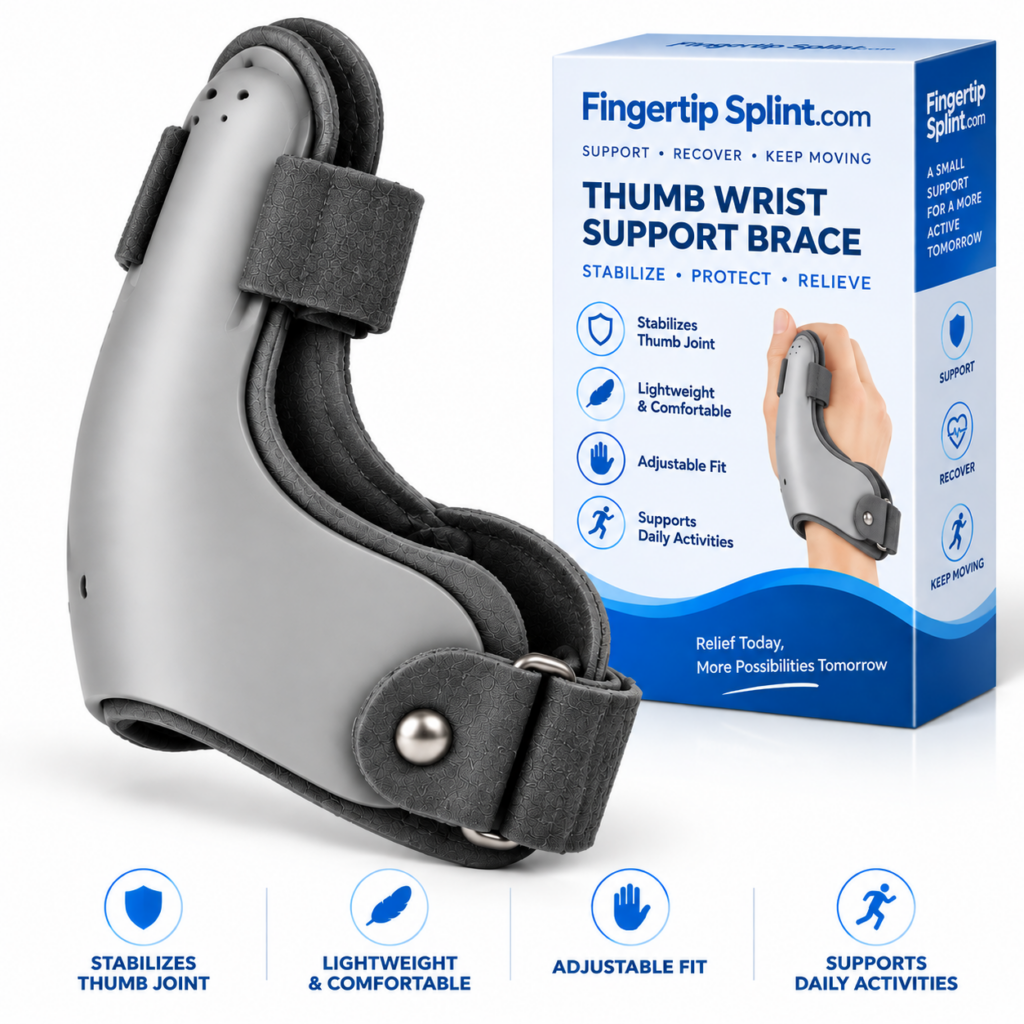
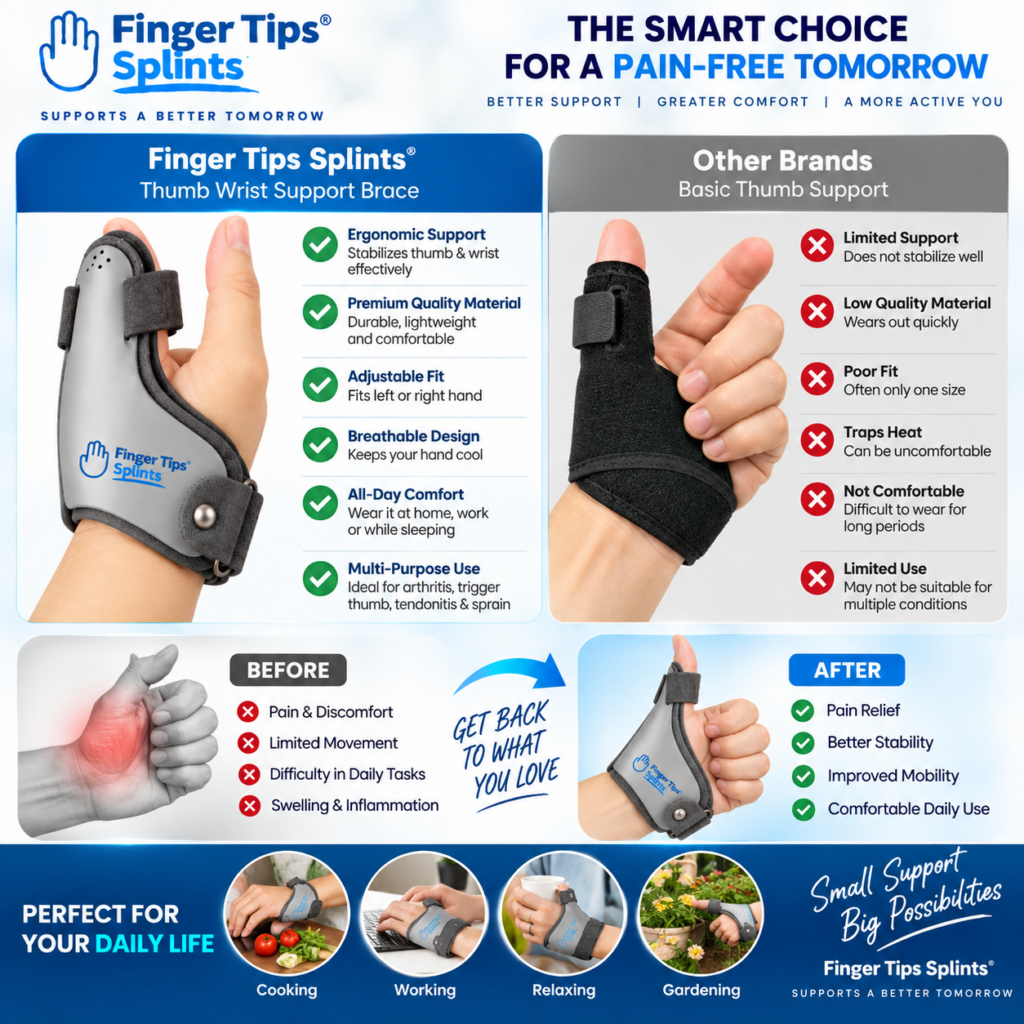
After understanding the buying framework, here is a specific product to examine. The 1 Pcs Thumb Wrist Support Brace CMC Thumb Spica Splint is one example of a CMC-focused thumb-wrist support design. Let’s walk through the same checklist covered in this guide.
Thumb Wrist Support Brace
- CMC-focused design
- Thumb coverage
- Wrist coverage
- Support structure
- Fastening and adjustability
Applying the 10-Point Framework to This Product
CMC Coverage
The design is oriented around the thumb-base and CMC region. Compare the stated coverage against your intended support area.
Thumb Coverage
Review the thumb coverage characteristics on the product page. Consider whether the coverage matches your needs.
Wrist Coverage
Review how far the design extends onto the wrist. Consider whether this matches your requirements.
Structure
Review the support structure described. Check whether it appears flexible, semi-structured, or more rigid.
Fastening and Adjustability
Review the fastening system and adjustability described. Check what can be adjusted and how.
Fit and Intended Use
Review the sizing information and intended use described. Compare the manufacturer’s sizing instructions against your measurements.
For a broader buyer framework, the reference what to consider when choosing a thumb wrist support brace covers selection criteria in more detail.
What Matters More Than the Product Name?
This section reinforces the buyer-education angle. Buyers should prioritize actual specifications over marketing terminology.
Don’t Only Search
“CMC thumb brace” — the name alone doesn’t tell you what the product actually does. Product titles are marketing descriptions, not specifications.
Also Inspect
- Coverage
- Size
- Materials
- Support structure
- Movement
- Fastening
- Wrist extension
- Manufacturer instructions
Buyer Mistakes
These mistakes come up frequently when people choose CMC support braces. Avoiding them improves the outcome.
The name doesn’t tell you the actual construction or coverage.
Check: the product’s actual specifications and coverage.
Sizing affects fit, positioning, and comfort.
Check: the manufacturer’s sizing instructions.
More coverage isn’t automatically better.
Check: whether coverage matches your intended use.
Rigidity is a design characteristic, not a quality ranking.
Check: whether the structure matches your needs.
Wrist coverage affects the overall design and function.
Check: how far the brace extends onto the wrist.
Different designs allow different amounts of movement.
Check: what movements you need for your daily activities.
Photos don’t always tell the full story about materials and structure.
Check: the product specifications and description.
The fastening system affects fit and usability.
Check: how the brace is secured and adjusted.
Return policies matter if the brace doesn’t fit as expected.
Check: the seller’s return and exchange policies.
A brace is a support device, not a diagnosis.
Check: whether professional assessment is appropriate.
5-Minute CMC Brace Buying Checklist
Before Purchasing, Check:
- Identify the target area. Is the design actually focused around the CMC/thumb base?
- Check coverage. Thumb? Hand? Wrist?
- Check structure. Flexible? Structured? Reinforced?
- Check movement. What can the thumb, fingers, and wrist still move?
- Check sizing. Does the manufacturer provide measurements?
- Check adjustment. Can the brace be secured appropriately?
- Check materials. Are the materials suitable for the intended wearing conditions?
- Check specifications. Read the full product description.
When Product Research Shouldn’t Replace Professional Advice
This section is written with an EEAT (Experience, Expertise, Authoritativeness, Trustworthiness) perspective. Product research is useful, but it doesn’t replace professional evaluation when appropriate.
Significant Injury
A significant injury warrants professional assessment rather than selecting a support device based on a product description.
Visible Deformity
Visible deformity warrants professional assessment. A brace should not be used to manage a deformity without professional guidance.
Severe or Worsening Pain
Severe or worsening pain is a sign that warrants professional assessment.
Substantial Swelling
Significant swelling affects fit and may indicate an underlying problem that requires professional assessment.
Persistent Numbness or Tingling
Numbness or tingling may indicate nerve involvement and should be assessed professionally.
Major Loss of Thumb or Hand Movement
Significant loss of movement warrants professional assessment to determine the appropriate approach.
Symptoms That Don’t Improve
If symptoms are not improving, do not simply continue comparing products. Seek professional guidance. A product’s marketing description isn’t a medical diagnosis.
Warning Signs That Warrant Professional Assessment
- Severe or worsening pain
- Significant swelling
- Visible deformity
- Major loss of movement
- Persistent numbness or tingling
- Concerning skin or circulation changes
- Symptoms that are not improving
For general information about thumb and hand conditions, see the Mayo Clinic overview of thumb arthritis. For broader hand anatomy and condition information, the Cleveland Clinic hand anatomy resource provides useful context. For an orthopedic perspective, the AAOS thumb arthritis library is a widely referenced resource. For general public health information, the NHS hand pain guidance offers a practical overview. Additional medical reference information is available through MedlinePlus hand injuries and disorders. For clinical and anatomy-focused context, Johns Hopkins Medicine hand conditions provides further reading. General educational context is also available through WebMD’s overview of thumb arthritis and Healthline’s thumb arthritis information. For peer-reviewed literature, NCBI PubMed Central hosts open-access research where appropriate. For a broader orthopedic reference, Orthobullets provides structured clinical summaries.
Important: This article does not provide individualized medical advice. Always consult an appropriate healthcare professional regarding your specific situation.
Frequently Asked Questions
Look for CMC coverage around the thumb base, thumb coverage, wrist coverage, support structure, flexibility, movement allowance, fit and sizing, adjustability, materials, fastening system, and intended use. Compare these features against your specific requirements. Read the product description carefully rather than relying only on the product name.
A CMC support brace is designed around the carpometacarpal region at the base of the thumb, while a general thumb brace may cover the thumb without being specifically focused on the CMC region. A CMC-focused design may include thumb-base coverage, thumb positioning, surrounding hand support, and possibly wrist support. However, “CMC” describes the target area — actual construction still varies between products.
This depends on the specific design. Some CMC-focused braces extend onto the wrist to provide a structural anchor for the thumb support. Others are more focused on the thumb and hand area. Wrist coverage is one feature to evaluate based on your intended use and the manufacturer’s stated design. Follow the manufacturer’s guidance.
Sizing is essential because positioning and comfort depend on appropriate fit. Always follow the manufacturer’s specific sizing instructions because sizing systems differ between products. Check the measurements provided (such as hand circumference, wrist measurement, or thumb dimensions) and compare them against the size chart. Do not assume that a size from one brand will correspond to a size from another.
No. CMC braces exist on a spectrum from flexible to more rigid. Different structures create different movement and support characteristics. The appropriate level of structure depends on the intended use and the specific situation. Don’t assume that rigid automatically means better or that flexible automatically means better.
Check the product title, product images (what areas does the brace actually cover?), specifications (materials and dimensions), size chart (what measurements are required?), fastening system, intended use (what does the manufacturer say the product is designed for?), and care instructions. Reading the description carefully helps you evaluate whether a product matches your requirements before purchasing.
Compare CMC coverage, thumb coverage, wrist coverage, support structure (flexible vs structured), movement characteristics, fit and sizing, adjustability, materials, fastening, and intended use. Read product descriptions carefully rather than relying on names alone. Consider how each design’s characteristics match your daily activities and requirements. If you have significant symptoms or uncertainty about which type of support is appropriate, seek professional guidance.
Conclusion: Compare Features, Not Just Names
Choosing a CMC support brace is about evaluating features — not just labels. The product name may say “CMC” or “thumb spica,” but the actual construction, coverage, structure, movement characteristics, and intended use determine what the brace does. Understanding the ten features covered in this guide helps you compare products intelligently before purchasing.
This CMC-specific buyer guide has provided a structured framework for evaluating CMC support braces. The goal has been to help you compare products effectively — not to declare one design universally better. Apply the framework to the specific products you are considering, and evaluate each one against your requirements.
Evaluate a CMC Thumb-Wrist Support Design
Review the product’s CMC coverage, thumb coverage, wrist coverage, support structure, fastening system, adjustability, sizing information, and intended use against the 10-point framework in this guide. The 1 Pcs Thumb Wrist Support Brace CMC Thumb Spica Splint is one CMC-focused design to evaluate.
View the Thumb Wrist Support BraceNeed information about other thumb and hand support products? Explore the FingerTipSplint shop. For general questions, see the FingerTipSplint FAQ. For B2B inquiries, see the medical finger splint supplier page or request a quote.