
How a Thumb Spica Brace Supports the Thumb and Wrist Together
If the support need is around the thumb, why does a thumb spica brace extend onto the wrist? That is one of the most common questions about this design. The answer lies in how the brace combines thumb support with a hand or wrist-based structure to create a connected support system. This guide explains why the brace travels from the thumb to the wrist, how the two sections work together, and how the connected structure influences positioning and movement.
What This Guide Covers
- Quick Answer
- Why Does a Thumb Spica Include the Wrist?
- Thumb and Wrist Anatomy Connection
- 3D Interactive: How They Work Together
- How the Wrist Section Helps the Thumb Section
- Interactive: Follow the Support Path
- Interactive: Support Path Animation
- How Does This Affect Thumb Movement?
- Does the Wrist Need to Be Completely Immobilized?
- Thumb Support vs Wrist Support
- Why a Larger Support Area Can Matter
- Fit and Alignment
- Interactive: Is the Support Structure Sitting Correctly?
- Everyday Thumb-Wrist Movement
- Product Spotlight
- Thumb Spica vs Thumb Sleeve
- Common Mistakes
- When a Thumb-Wrist Support May Not Be Enough
- Quick Tips
- FAQ
- Conclusion
Quick Answer: How Does a Thumb Spica Brace Support the Thumb and Wrist Together?
A thumb spica brace supports the thumb through a structure that also extends onto the hand or wrist. The wrist section can act as an anchor for the thumb-support portion, helping the brace maintain its position and influence selected thumb movements. The exact amount of support and movement restriction depends on the brace’s design and fit.
If you want the CMC anatomy first, the reference CMC thumb spica mechanism guide covers the joint and terminology in detail. If you want the product features, the reference thumb wrist support brace features guide covers fit and uses. This article focuses on the relationship between the thumb and wrist support sections.
Why Does a Thumb Spica Include the Wrist?
This is the first major educational section. The basic design logic explains why a thumb-spica brace extends beyond the thumb onto the hand and wrist.
Instead of a design where the thumb is supported in isolation — thumb → isolated support — a thumb-spica design follows a connected path: thumb → hand → wrist → support base. The wrist and hand section provides a larger area from which the thumb-support structure can be positioned and stabilized.
The brace needs a stable structure against which its thumb-support component can act. A thumb-support section alone would need to rely on a small contact area around the thumb. By extending onto the hand and wrist, the brace gains a larger base of support — this larger base helps maintain the position of the thumb-support section during wear and movement.
Key concept: Anchor + support + positioning. The wrist and hand area acts as an anchor, the structure connects upward to the thumb, and the thumb-support section provides positioning for the thumb. All three work together.
For a broader explanation of the thumb-wrist relationship within spica designs, the reference understanding spica brace designs covers the topic in more detail.
Thumb and Wrist Anatomy Connection
The thumb is mechanically connected to the hand, and the wrist forms an important structural region of the forearm-hand complex. Understanding this connection helps clarify why a thumb-spica design extends from one area to the other.
Thumb
The primary supported area. The thumb includes multiple joints and the first metacarpal bone, which connects to the hand at the CMC joint.
First Metacarpal
The bone of the thumb that connects to the CMC joint. It is part of the thumb’s mechanical structure and connects to the rest of the hand.
Base of Thumb
The area at the base of the thumb where the CMC joint is located. A thumb-spica design typically provides support around this area.
Hand
The hand provides the connecting structure between the thumb and wrist. The hand area of a thumb-spica brace helps link the thumb support to the wrist support.
Wrist
The wrist forms an important structural region of the forearm-hand complex. In a thumb-spica brace, the wrist section can provide an anchor for the support structure.
Important: This article does not claim that every thumb problem requires wrist immobilization. The wrist section of a thumb-spica brace serves a structural role — it provides a base for the thumb support. The appropriate design depends on the specific situation and professional recommendations where applicable.
For general hand and wrist anatomy, the Cleveland Clinic hand anatomy resource provides a clear starting point.
How Thumb and Wrist Support Work Together: 3D Interactive
This interactive shows how the thumb-support and wrist-support sections connect. Tap each callout to see what it contributes.
Interactive 3D: How Thumb and Wrist Support Work Together
Tap each callout to explore its role
1. Thumb Support
Supports and positions the thumb depending on design. The thumb-support section is where the brace interacts with the thumb to provide positioning and influence selected movements.
Wrist anchor → Hand structure → Thumb support → Controlled/limited movement
How the Wrist Section Helps the Thumb Section
This is the core mechanism section. Understanding the sequence helps clarify how the wrist and hand sections of the brace support the thumb section.
Important: The exact effect depends on the construction, rigidity, straps, coverage, and intended purpose of the individual brace. Not every thumb-spica works identically. The connected structure is a design principle, not a universal mechanism.
Interactive: Follow the Support Path
Click each stage to follow the support path from the wrist to the thumb. This is an educational tool, not a medical diagram.
Follow the Support Path
Click each stage to see its role in the connected structure.
Interactive: Support Path Animation
Toggle between “Without Support” and “With Thumb-Spica Structure” to see how the connected support structure travels from the wrist to the thumb. This is a conceptual visualization, not a medical simulation.
Support Path Animation
Compare the two states.
How Does This Affect Thumb Movement?
To understand how a thumb-spica brace influences movement, it helps to know the common thumb movements. The thumb is unique in its ability to move in multiple directions.
Bending
Flexion — bending the thumb toward the palm.
Straightening
Extension — straightening the thumb away from the palm.
Moving Away
Abduction — moving the thumb away from the index finger, out to the side.
Moving Toward
Adduction — moving the thumb toward the index finger.
Opposition
Bringing the thumb across the palm to meet the other fingers. This is the movement that allows precise grip.
Key message: A thumb spica does not necessarily eliminate all thumb movement. Some designs may permit movement while influencing specific directions or positions. The support structure can influence movement depending on where it contacts the thumb and hand.
Does the Wrist Need to Be Completely Immobilized?
Not necessarily. A thumb-spica design may incorporate the wrist for structural support without every design providing the same degree of wrist restriction.
| Design | Possible Characteristics |
|---|---|
| Flexible thumb-wrist support | More flexibility |
| Semi-rigid spica | Greater structural support |
| Rigid spica | More movement restriction |
| Short thumb support | Less wrist coverage |
| Extended thumb-wrist design | More extensive coverage |
Important: These are design differences, not a hierarchy. The appropriate design depends on the specific situation and professional recommendations where applicable.
Thumb Support vs Wrist Support
This section explains what each section of the brace contributes. Together, they form a connected support structure.
Thumb Section
Potential role:
- Thumb positioning
- Support around the thumb
- Influencing selected thumb movements
Wrist Section
Potential role:
- Anchoring
- Maintaining brace position
- Extending support structure
- Influencing wrist movement depending on design
Thumb support + Wrist support = Connected support structure
Why a Larger Support Area Can Matter
A support structure that extends onto the hand and wrist can distribute contact across a larger area rather than relying only on a small thumb contact point. This can help the brace maintain its position and provide support across a connected region.
However, this is a design principle — not a universal rule. Larger coverage is not automatically better. The appropriate design depends on the intended purpose, fit, and the user’s circumstances. Some situations may benefit from more extensive coverage; others may not.
Important: Larger coverage isn’t automatically better. The appropriate design depends on the intended purpose, fit, and user’s circumstances. This article explains the design principle, not a recommendation for any specific situation.
Fit and Alignment
This section explains why fit matters specifically to the thumb-wrist relationship. It is not another full fit guide. For the full fit guide, see the reference linked below.
Correct Positioning
Poor Positioning
If the wrist portion shifts, the connected thumb section can shift. If the thumb section is incorrectly positioned, the intended support relationship may not be maintained. This is why fit matters specifically to the thumb-wrist relationship — the two sections are connected, so a change in one can affect the other.
For a detailed look at fit and coverage, the reference thumb spica splint fit guide covers the topic in more detail.
Interactive: Is the Support Structure Sitting Correctly?
Select a state to understand what each might indicate. This is an educational tool, not a diagnostic test.
Alignment Checker
Select a state to see what it might indicate.
Everyday Thumb-Wrist Movement
This section shows how the combined support structure interacts with common movements. It does not claim the brace makes these activities safe or pain-free. The brace may change how these movements feel or how freely they can be performed, depending on the design.
Gripping
Thumb and hand work together to grip an object. A brace may influence how the thumb and hand coordinate during grip.
Pinching
Thumb position becomes particularly important. A brace may support or influence the thumb during pinch movements.
Writing
Thumb position and wrist posture interact during writing. A brace may influence how these two areas coordinate.
Typing
Thumb movement occurs alongside wrist positioning. A brace may influence how the thumb moves relative to the wrist.
Phone Use
Repeated thumb movement can occur with a relatively fixed wrist posture. A brace may influence how the thumb moves during this activity.
Important: The brace may change how these movements feel or how freely they can be performed, depending on the design. It does not guarantee pain-free or unrestricted activity. For a discussion of daily activities, the reference thumb wrist brace for daily activities covers the topic in detail.
Product Spotlight: Example of a Connected Thumb-Wrist Support Design
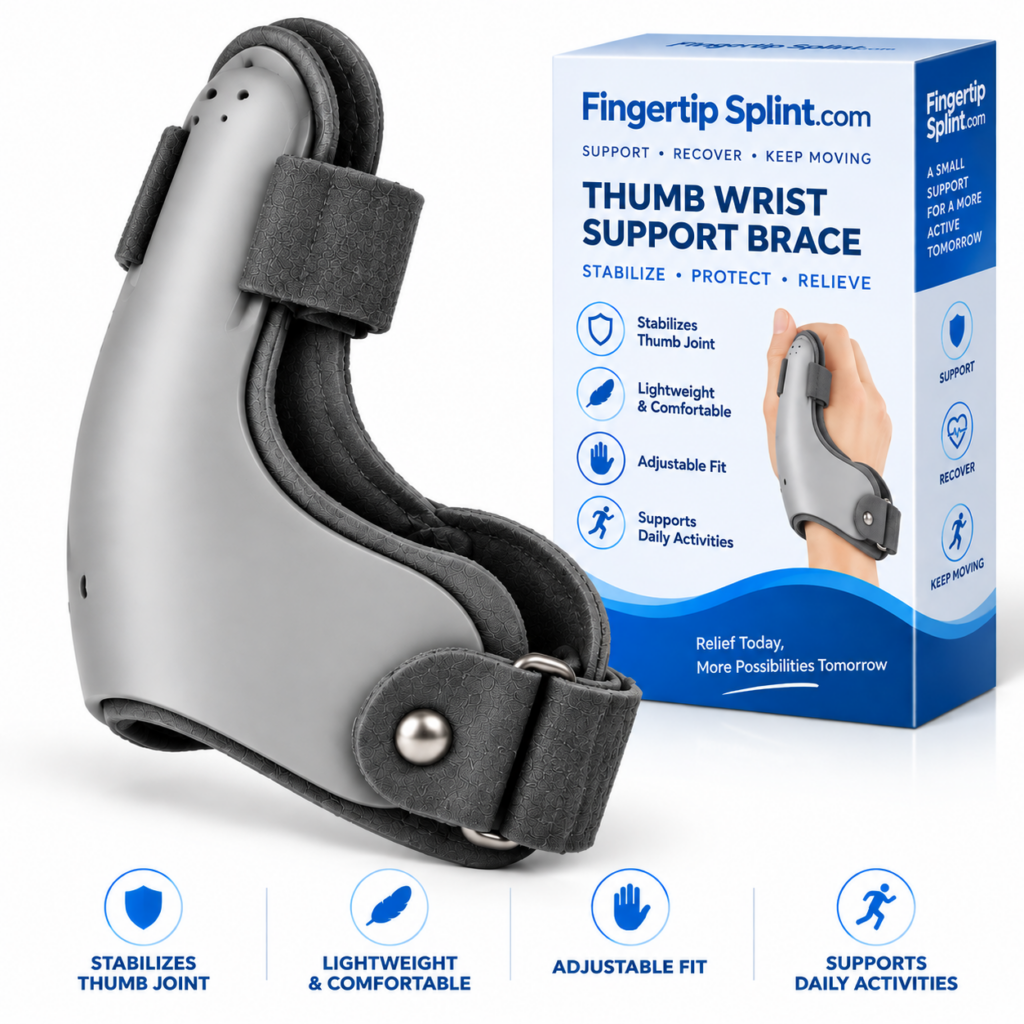
After understanding how the thumb-support and wrist-support sections connect, here is a specific product to examine. The 1 Pcs Thumb Wrist Support Brace CMC Thumb Spica Splint provides an example of a connected thumb-wrist support design. It illustrates the thumb-support and wrist-support concept covered in this guide.
Thumb Wrist Support Brace
- Thumb support section
- Wrist extension
- Connected support structure
- Adjustment system
- Coverage across the thumb and wrist
How This Design Embodies the Thumb + Wrist Support Concept
Thumb Support
The design includes a thumb-support section. This is the area where the brace interacts with the thumb to provide positioning and support.
Wrist Extension
The design extends onto the wrist. This provides the structural anchor described in the mechanism section above.
Connected Structure
The thumb support and wrist extension are connected. This allows the brace to maintain positioning across the entire support area.
Adjustment System
The adjustment system allows the fit to be modified according to the manufacturer’s instructions. This helps maintain the intended support relationship.
Coverage
The coverage spans the thumb and wrist areas. Review the stated coverage on the product page and compare it against your requirements.

This view shows how the support structure connects the thumb-support section to the wrist-support section. Coverage varies by product design. Always follow the manufacturer’s sizing and adjustment instructions for the specific product.
For a buyer-focused guide, the reference what to consider when choosing a thumb wrist support brace covers selection criteria in more detail.
Comparison: Is a Thumb Spica Different From a Simple Thumb Sleeve?
This comparison clarifies the difference between a thumb spica and a simpler thumb sleeve. It is not the article’s main comparison — for a full comparison, see the reference linked below.
| Characteristic | Thumb Sleeve | Thumb Spica |
|---|---|---|
| Thumb coverage | Usually primary | Primary |
| Wrist extension | May be limited or absent | Often incorporated |
| Structure | Often flexible | Varies from flexible to rigid |
| Positioning | Varies | Often more structured |
| Movement | Generally more freedom | May restrict selected movements |
For a detailed comparison, the reference thumb spica brace vs thumb sleeve covers the differences in more detail.
Common Mistakes
These mistakes come up frequently when people use thumb spica braces. Avoiding them improves the experience.
The wrist section provides structural support for the thumb-support section.
Check: how the wrist section contributes to the brace’s overall support.
Designs differ in how much wrist restriction they provide.
Check: the specific product’s design characteristics.
The wrist and hand portion also affects overall positioning.
Check: how the wrist and hand coverage affects the thumb support.
More pressure isn’t automatically better. Excessive tightness can cause discomfort and concerning symptoms.
Check: follow the manufacturer’s adjustment instructions.
A rotating brace may not maintain its intended position. This can affect the thumb-wrist support relationship.
Check: whether the brace stays positioned during movement.
Different conditions and injuries can require different approaches.
Check: whether professional assessment is appropriate.
Numbness, tingling, significant discoloration, increasing pain, or substantial swelling should not be ignored.
Check: remove the brace and seek appropriate advice if symptoms persist.
The manufacturer’s instructions are specific to the product.
Check: the product documentation before use.
When a Thumb-Wrist Support May Not Be Enough
This section is written with an EEAT (Experience, Expertise, Authoritativeness, Trustworthiness) perspective. It does not diagnose the reader from symptoms, but it does explain situations where professional assessment may be appropriate.
Significant Trauma
Significant trauma warrants professional assessment rather than selecting a support device based on a product description.
Visible Deformity
Visible deformity warrants professional assessment. A brace should not be used to manage a deformity without professional guidance.
Severe or Worsening Pain
Severe or worsening pain is a sign that warrants professional assessment rather than self-selecting a support device.
Major Swelling
Significant swelling affects fit and may indicate an underlying problem that requires professional assessment.
Substantial Loss of Movement
Significant loss of movement warrants professional assessment to determine the appropriate approach.
Persistent Numbness or Tingling
Numbness or tingling may indicate nerve involvement and should be assessed professionally.
Symptoms That Don’t Improve
If symptoms are not improving or are worsening, do not simply choose a different product. Seek professional guidance.
Uncertainty About What Type of Support Is Appropriate
If you are unsure whether a thumb-wrist support is appropriate, professional assessment can help determine the right approach.
Prescribed or Professionally Fitted Devices
Prescribed or professionally fitted devices may have requirements that differ from general consumer support products. Follow the specific instructions provided by the prescribing professional.
Warning Signs That Warrant Professional Assessment
- Severe or worsening pain
- Significant swelling
- Visible deformity
- Major loss of movement
- Persistent numbness or tingling
- Concerning skin or circulation changes
- Symptoms that are not improving
For general information about thumb and hand conditions, see the Mayo Clinic overview of thumb arthritis. For broader hand anatomy and condition information, the Cleveland Clinic hand anatomy resource provides useful context. For an orthopedic perspective, the AAOS thumb arthritis library is a widely referenced resource. For general public health information, the NHS hand pain guidance offers a practical overview. Additional medical reference information is available through MedlinePlus hand injuries and disorders. For clinical and anatomy-focused context, Johns Hopkins Medicine hand conditions provides further reading. General educational context is also available through WebMD’s overview of thumb arthritis and Healthline’s thumb arthritis information. For peer-reviewed literature, NCBI PubMed Central hosts open-access research where appropriate. For a broader orthopedic reference, Orthobullets provides structured clinical summaries.
Important: This article does not provide individualized medical advice. Always consult an appropriate healthcare professional regarding your specific situation.
Thumb-Spica Support: 7 Things to Remember
Quick Fit Checklist
Before using a thumb spica brace, check the following. Click each item to mark it as reviewed.
Frequently Asked Questions
The wrist section can act as an anchor and structural base for the brace. By extending onto the hand and wrist, the brace gains a larger base of support from which the thumb-support section can be positioned. The wrist section isn’t simply “extra material” — it forms part of the structural foundation that helps the thumb-support section maintain its position.
Not necessarily. The degree of restriction varies by design. Some thumb-spica designs are flexible and allow selected movement; others are semi-rigid or more rigid and restrict movement more substantially. A thumb-spica design may incorporate the wrist for structural support without every design providing the same degree of wrist restriction. The appropriate design depends on the specific situation and professional recommendations where applicable.
The wrist section helps support the thumb by providing a structural anchor. The brace contacts the wrist or hand area, then the support structure connects upward toward the thumb. Because the thumb support is connected to the hand and wrist portion, the brace can influence selected thumb movements. The exact effect depends on the construction, rigidity, straps, coverage, and intended purpose of the individual brace.
Movement depends on the design and intended use of the specific brace. A thumb spica does not necessarily eliminate all thumb movement. Some designs may permit movement while influencing specific directions or positions. The support structure can influence movement depending on where it contacts the thumb and hand. Follow the manufacturer’s instructions and professional guidance where applicable.
No. A thumb spica includes the thumb in its support structure while extending onto the hand or wrist area. A wrist brace typically focuses on the wrist without incorporating the thumb in the same way. The two designs have different coverage and different structural purposes. That said, terminology overlaps between products, so always evaluate the specific product’s specifications.
No. Coverage alone doesn’t determine suitability or effectiveness. A larger support area can distribute contact across a broader region and provide an anchor for the support structure, but larger coverage isn’t automatically better. The appropriate design depends on the intended purpose, fit, and the user’s circumstances. Some situations may benefit from more extensive coverage; others may not.
Seek professional advice if there is significant trauma, visible deformity, severe or worsening pain, major swelling, substantial loss of movement, persistent numbness or tingling, or symptoms that don’t improve. Also seek guidance if you are uncertain about what type of support is appropriate. A thumb-wrist support brace is a support device, not a diagnosis. Professional assessment can help determine the appropriate approach.
Conclusion: The Wrist Section Supports the Thumb Section
A thumb spica brace supports the thumb through a connected structure that extends onto the hand and wrist. The wrist section can act as an anchor and structural base for the thumb-support section, helping the brace maintain its position and influence selected thumb movements. The two sections work together as a connected support system.
This guide has explained why a thumb spica includes the wrist, how the thumb and wrist are connected, how the wrist section helps the thumb section, how the brace influences thumb movement, and how fit and alignment affect the connected structure. The goal has been to clarify the relationship between the thumb-support and wrist-support sections — not to recommend a universal design.
Explore a Connected Thumb-Wrist Support Design
Review the thumb coverage, wrist coverage, support structure, adjustment system, and product specifications against your requirements. The 1 Pcs Thumb Wrist Support Brace CMC Thumb Spica Splint is one example of a connected thumb-wrist support design.
View the Thumb Wrist Support BraceNeed information about other thumb and hand support products? Explore the FingerTipSplint shop. For general questions, see the FingerTipSplint FAQ. For B2B inquiries, see the medical finger splint supplier page or request a quote.