
How a Cordless EMS Wrist Brace Works and Why Choose One?
You put on the wristband, position the contact areas, turn it on, choose a setting, and electrical stimulation is delivered according to the device’s design. But what actually happens at each stage — and why would someone choose a cordless format instead of a conventional wired or non-electronic option? This guide explains the mechanism behind a cordless EMS wrist brace: the electrical system, the contact pathway, the user controls, the cordless architecture, and the practical reasons someone might choose this design.
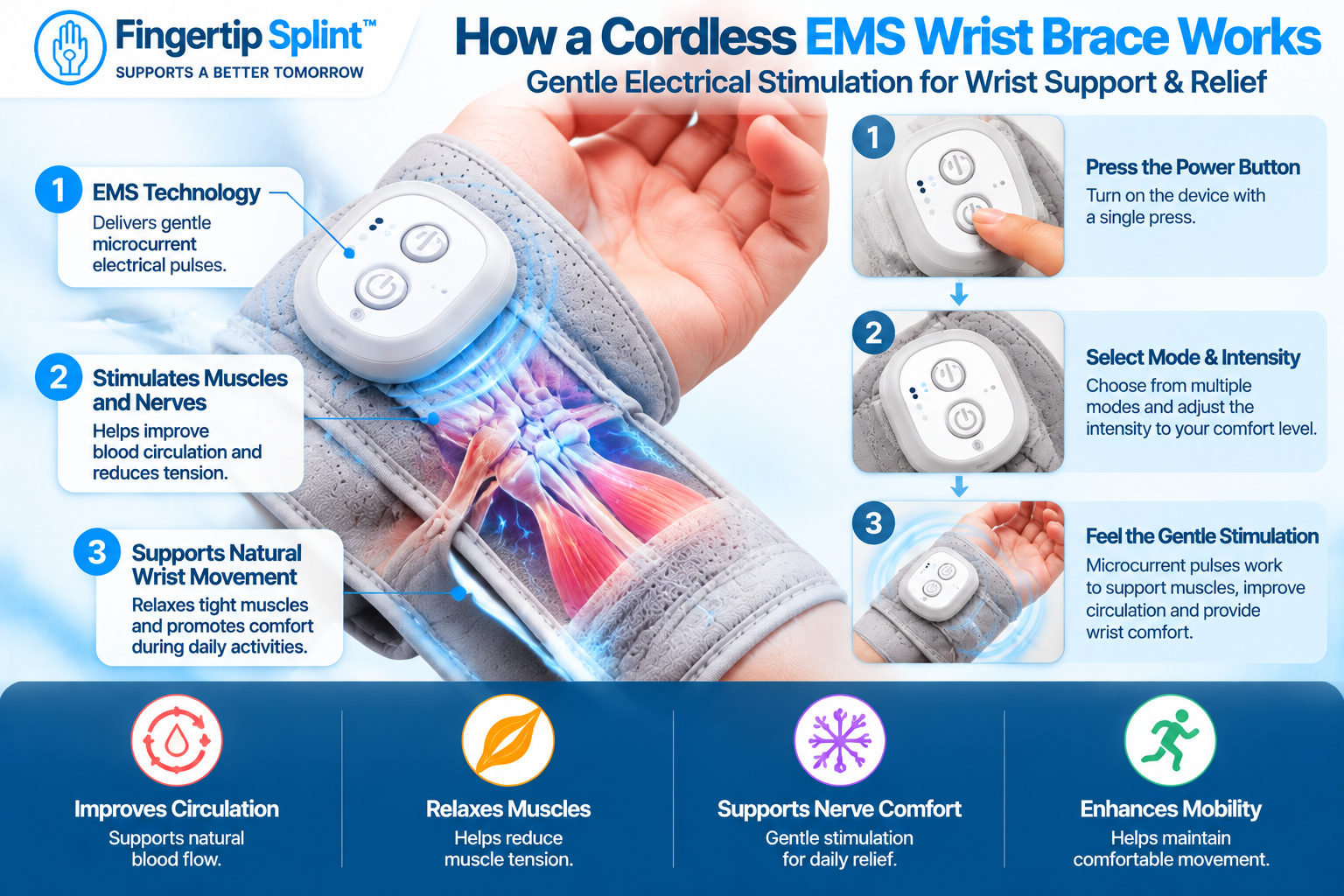
Power → Control → Contact → Stimulation: the electrical pathway inside a cordless EMS wrist brace
What This Mechanism Guide Covers
- Quick Answer
- What Is a Cordless EMS Wrist Brace?
- What Does EMS Actually Mean?
- EMS vs Microcurrent vs TENS
- 3D Interactive: How a Cordless EMS Wrist Brace Works
- What Happens When You Turn It On?
- Interactive: Follow the Electrical Path
- Understanding Electrodes and Contact
- Why Fit Matters to the Mechanism
- What Makes an EMS Wrist Brace Cordless?
- Why Choose a Cordless EMS Wrist Brace?
- Cordless vs Wired EMS Devices
- EMS Wrist Brace vs Traditional Wrist Brace
- Does the Brace Actually Support the Wrist?
- Interactive: Which Wrist Device Concept Are You Comparing?
- Everyday Use and Practical Considerations
- What Does It Feel Like?
- Intensity: Why Stronger Isn’t Automatically Better
- Safety and Limitations
- Common Mistakes
- Product Evaluation
- What Would a Professional Want You to Know?
- Interactive: Before You Use an EMS Wrist Device
- Quick Tips
- FAQ
- Conclusion
Quick Answer: How Does a Cordless EMS Wrist Brace Work?
A cordless EMS wrist brace combines a wearable wristband with an electronic stimulation system. When positioned according to the manufacturer’s instructions, the device uses its power source and control system to deliver electrical stimulation through designated contact areas. The cordless format integrates these components into a portable wearable design.
If you want the basic setup and operation first, the reference how to use a cordless EMS wristband covers positioning, setup, and control steps in detail. This article focuses specifically on how the mechanism works and why the cordless format matters.
What Is a Cordless EMS Wrist Brace?
This is a brief foundational section. For a deeper product definition, see the reference linked above.
Cordless
The device doesn’t require an external cable during normal operation. The electronics are integrated into the wearable format.
EMS
Electrical muscle stimulation — electrical impulses used to stimulate muscles, according to the specific device’s design.
Wrist Brace / Wristband
The wearable structure that holds the system around the wrist. The construction varies between designs.
Important buyer insight: The word “brace” does not necessarily mean the device provides the same physical immobilization or structural support as a conventional rigid wrist brace. Some wearable stimulation devices function primarily as platforms for electronic stimulation rather than as rigid wrist immobilizers. Check the physical construction of the specific product.
What Does EMS Actually Mean?
Electrical muscle stimulation uses controlled electrical pulses delivered through appropriate contact points. For an EMS device, the intended stimulation is associated with muscle activation. The exact waveform, frequency, pulse characteristics, and intended use vary by device.
The FDA’s recognized standards include nerve and muscle stimulators, including EMS and TENS-related technologies. This means the category has regulatory context, but the specific device you’re considering has its own specifications and intended use.
Key takeaway: EMS describes an electrical stimulation category. It does not describe one universal output or one universal intended use. Always check the specific device’s documented specifications rather than assuming that similar marketing terms mean identical technology.
EMS vs Microcurrent vs TENS
This is a common source of buyer confusion. These terms describe different electrical stimulation concepts — they are not automatically interchangeable.
| Technology / Term | General Concept | Don’t Assume |
|---|---|---|
| EMS | Electrical stimulation associated with muscle activation | Every EMS device has the same output |
| Microcurrent | Very low-level electrical current | Every “microcurrent” device is an EMS device |
| TENS | Electrical nerve stimulation commonly associated with pain-management devices | TENS and EMS are interchangeable |
| Conventional brace | Physical support | It provides electrical stimulation |
Key takeaway: Always evaluate the actual device specifications rather than assuming that similar marketing terms mean identical technology. For a deeper look at how these features apply in practice, the reference EMS microcurrent wrist brace features and everyday-use considerations covers the topic in detail.
How a Cordless EMS Wrist Brace Works: 3D Interactive
This interactive shows the layered architecture of a cordless EMS wrist brace. Tap each layer to see what it contributes.
Interactive 3D: How a Cordless EMS Wrist Brace Works
Tap each layer to explore its role
Layer 1 — Power
The battery or power system supplies the energy required by the electronics. Cordless operation means the power source is integrated into the wearable device. Check the product specifications for the specific power system.
Power → Control → Output → Contact → User
The Main Mechanism: What Happens When You Turn It On?
This is the article’s biggest section. Understanding the sequence helps clarify what happens at each stage of using the device.
Important: The exact operating sequence depends on the specific device. Always follow the manufacturer’s instructions. This six-step sequence illustrates the general concept, not a universal operating procedure.
Interactive: Follow the Electrical Path
Click each stage of the pathway to see what happens. This is an educational tool — always follow the specific device’s instructions.
Follow the Electrical Path
Click each stage to see what happens.
- Where does the energy come from? The battery or power system integrated into the wearable device.
- Cordless operation means the power source is part of the device rather than an external unit.
- Check the product specifications for how the device is powered or charged.
- Power affects session preparation and storage — follow the manufacturer’s instructions.
Understanding Electrodes and Contact
Contact and electrode placement matter for how the device functions. The stimulation is delivered through designated contact areas, and their position affects how the device interacts with the wrist.
What to Consider
- Position of contact areas
- Skin contact quality
- Product-specific electrode arrangement
- Correct placement per instructions
- Skin condition
- Device instructions
Important Buyer Insight
A device cannot simply be repositioned anywhere on the wrist because the user thinks another location might work better. The FDA’s powered muscle stimulator guidance discusses electrode placement and recommends using the electrodes and leads specified by the manufacturer.
Follow the manufacturer’s placement instructions. Contact placement is part of how the device is designed to function, not a user-adjustable variable.
Why Fit Matters to the Mechanism
Fit and electrical function are connected. Correct fit supports correct positioning, which supports appropriate contact, which supports the intended operation of the device.
Do not claim that fit guarantees therapeutic effectiveness. Fit affects how the device functions and how it feels during wear. It does not guarantee a specific outcome.
Too Loose
- Device movement
- Contact changes
- Reduced comfort
Too Tight
- Pressure
- Skin irritation
- Discomfort
Correctly Positioned
- Used according to intended configuration
- Secure without excessive pressure
- Comfortable skin contact
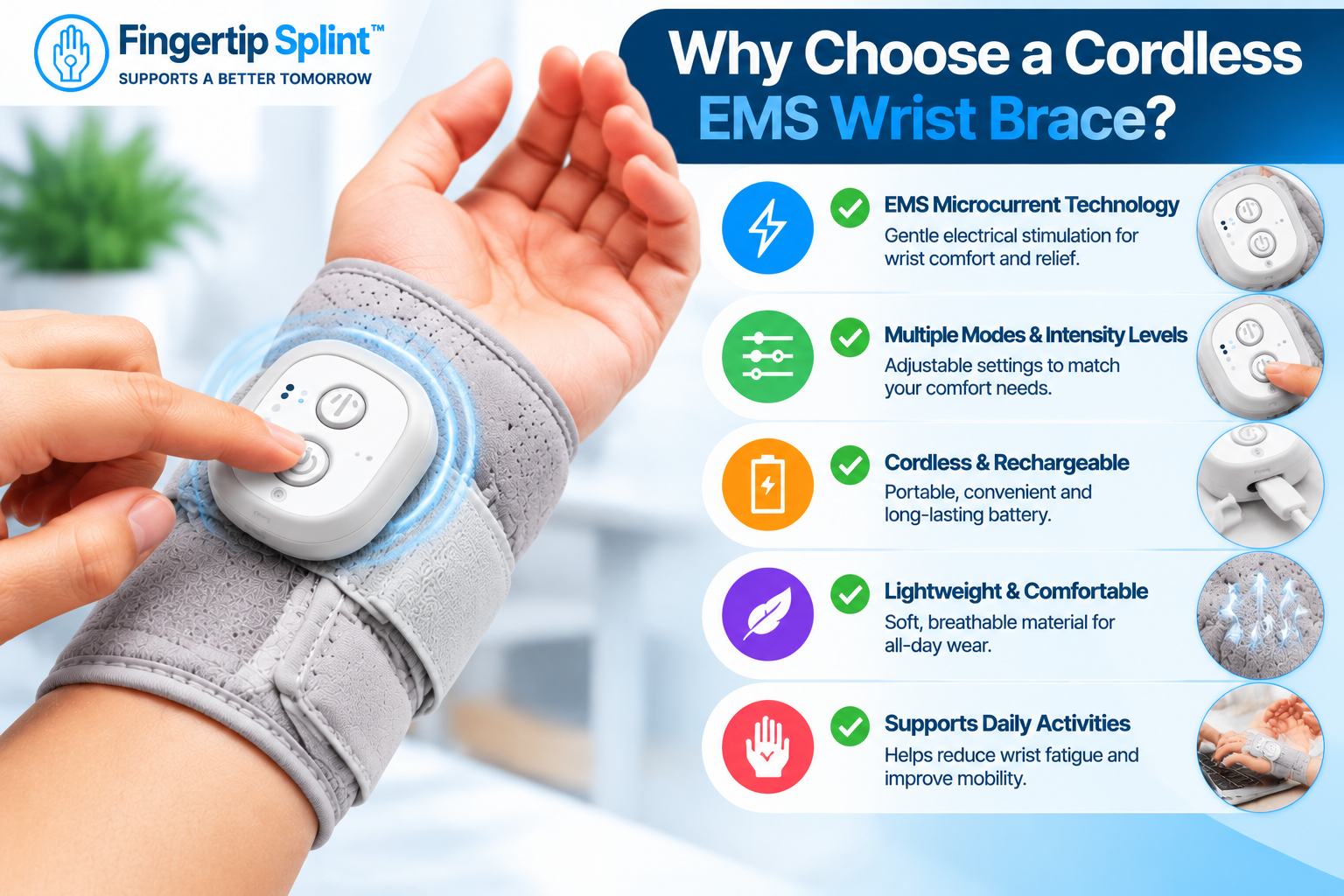
Cordless architecture: integrated power, control, and stimulation system in a wearable wristband
What Makes an EMS Wrist Brace Cordless?
Cordless architecture generally means components that would otherwise be connected externally are integrated into the wearable device. This creates a more compact, self-contained format.
Integrated Components
- Battery or power source
- Controller or control module
- Stimulation electronics
- Contact or electrode system
- Control buttons or interface
Practical Result
The result is a more compact wearable format that doesn’t require an external cable during normal operation. This affects portability, setup, and how the device is managed during use.
Why Choose a Cordless EMS Wrist Brace?
This addresses the “why choose one?” part of the title. The reasons are practical — not medical claims. Cordless describes the format; it does not automatically mean more effective.
Reason 1 — Portability
A cordless design can reduce cable management. Someone moving between rooms may find a compact wearable format easier to transport than a wired system.
Reason 2 — Less Cable Dependence
No external cable can make the setup less cumbersome. However, cordless doesn’t mean cable-free forever — the device may still require charging.
Reason 3 — Wearable Convenience
The electronics can be integrated into the wristband. This means the device stays in position without requiring the user to hold or manage a separate unit.
Reason 4 — Compact Storage
An integrated device may require fewer separate components, making storage simpler than systems with separate controllers and cables.
Reason 5 — Easier Setup
Depending on the product design, the user may have fewer components to connect. This can simplify the setup process compared to wired systems.
Reason 6 — Mobility
The absence of an external cable may reduce snagging or cable-management issues during use.
Important: Cordless convenience does not mean the device can be safely used during every physical activity. Always follow the manufacturer’s intended-use instructions.
Cordless vs Wired EMS Devices
This comparison shows the practical trade-offs between cordless and wired designs. Neither is universally better — the appropriate choice depends on the device specifications and intended use.
| Characteristic | Cordless EMS | Wired EMS |
|---|---|---|
| External cable | Usually minimized or absent during use | Present |
| Portability | Potentially convenient | Depends on system |
| Battery | Usually required | Device-dependent |
| Setup | Potentially simpler | May involve cable connection |
| Movement around environment | Less cable management | Cable may require management |
| Charging | Usually relevant | Depends on system |
| Storage | Potentially compact | May involve separate components |
| Controls | Integrated or wearable | May be external |
Key conclusion: Cordless and wired designs involve different practical trade-offs, and the appropriate choice depends on the device specifications and intended use. Cordless is not automatically better — it is a different design approach with its own characteristics.
EMS Wrist Brace vs Traditional Wrist Brace
This comparison clarifies how the two approaches differ. The goal is to prevent the reader from assuming an EMS wristband is simply a traditional brace with a battery.
| Feature | Traditional Wrist Brace | Cordless EMS Wrist Device |
|---|---|---|
| Physical support | Design-dependent | Design-dependent |
| Electrical stimulation | No | Yes, if specified |
| Battery | No | Yes |
| Controls | Usually none | Usually present |
| Contact areas | Fabric or support surface | Device-specific |
| Mobility | Depends on structure | Depends on wristband design |
| Setup | Usually simple | Electrical setup required |
| Safety considerations | Fit and material | Fit plus electrical use |
Does the Brace Actually Support the Wrist?
This is a highly valuable buyer question. The word “brace” can refer to different physical constructions, and buyers should check what a specific product actually provides.
What to Check
- Physical structure
- Wrist coverage
- Compression
- Reinforcement
- Material
- Intended use
Important
Some wearable stimulation devices may primarily function as platforms for electronic stimulation rather than rigid wrist immobilizers. Check the specific product’s construction before assuming the level of physical support it provides.
Interactive: Which Wrist Device Concept Are You Comparing?
Select a device concept to see its key characteristics. This tool provides a comparison framework — not a recommendation.
Which Wrist Device Concept Are You Comparing?
Select a concept to see its key characteristics.
Everyday Use and Practical Considerations
This section is shorter than the previous “Features, Benefits and Everyday Use” article because this article is primarily about mechanism and cordless architecture. The considerations below are practical.
At Home
Portability and setup. Consider where the device is stored, how it is charged, and whether it is convenient to use at home.
At a Desk
Potential convenience, but check whether controls and device placement interfere with work. Follow the manufacturer’s intended-use guidance.
During Travel
Charging and storage. Check whether the device requires a specific storage method for travel.
During Rest
Only according to instructions. Do not assume overnight use is appropriate unless explicitly instructed.
During Physical Activity
Don’t assume suitability. Follow the manufacturer’s intended-use instructions for what activities are appropriate.
Driving
Powered muscle stimulators should not be used while driving or operating machinery where involuntary muscle contractions could create injury risk, consistent with FDA guidance.
What Does It Feel Like?
Electrical stimulation can produce sensations that vary depending on several factors. There is no universal description of what the sensation “should” feel like.
What Affects Sensation
- Device technology
- Setting or intensity level
- Contact quality with the skin
- Skin characteristics
- Individual sensitivity
Important
Do not assume “you should feel a gentle vibration.” Follow the device instructions and don’t continue a setting that causes pain or concerning symptoms. Stop using the device and seek appropriate advice if unexpected or concerning sensations occur.
Intensity: Why Stronger Isn’t Automatically Better
This deserves special emphasis. Higher intensity changes the stimulation experience — but that doesn’t mean it produces a better outcome.
Do not assume: “Maximum intensity = maximum benefit.” Higher intensity changes the stimulation experience, but stronger doesn’t automatically mean better. Comfort matters. Device instructions matter. Individual sensitivity differs. Strong discomfort isn’t a sign that the device is “working better.”
What to Keep in Mind
- Start according to manufacturer instructions
- Increase only as directed
- Don’t use settings simply because they feel stronger
- Keep track of what setting was comfortable
- Follow the manufacturer’s session guidance
Why This Matters
Intensity is a setting, not a measure of effectiveness. The purpose of adjustable settings is to allow the device to be used comfortably and appropriately for the user — not to determine how “powerful” the session is.
Safety and Limitations
This is a serious section, not a small disclaimer. Electrical stimulation devices have specific safety considerations, and understanding them is part of understanding the technology.
Skin Irritation
Electrical stimulation may cause skin irritation or hypersensitivity in some users. FDA materials identify possible skin irritation and burns among reported risks with certain EMS devices. Stop using the device if skin irritation develops and seek appropriate guidance if it persists.
Implanted Electronic Devices
Users with pacemakers or other implanted electronic devices should follow professional and device guidance. Electrical stimulation may not be appropriate in these situations.
Pregnancy
Don’t assume suitability. Professional guidance may be appropriate before using an electrical stimulation device during pregnancy.
Epilepsy
Professional and device guidance may be necessary. Follow the manufacturer’s contraindications.
Reduced Sensation
Users may not accurately detect discomfort. This affects how the device should be used and monitored.
Recent Surgery or Injury
Professional advice may be appropriate before using an electrical stimulation device after recent surgery or injury.
Important: This section uses current authoritative guidance rather than creating an unsupported universal contraindication list. Always follow the specific device’s current instructions and obtain professional advice where appropriate.
Common Mistakes
These mistakes come up frequently when people use cordless EMS wrist braces. Avoiding them improves the experience and reduces risk.
No electrical device is automatically risk-free because it lacks a cable.
Check: follow the manufacturer’s safety instructions.
They have different terminology and intended uses.
Check: the specific device’s technology specifications.
Check the physical construction of the specific product.
Check: the product’s physical structure and intended use.
Follow the manufacturer’s placement instructions.
Check: the specific contact placement guidance.
Stronger isn’t automatically better.
Check: start at the manufacturer’s recommended setting.
Electrical functionality doesn’t remove normal fit considerations.
Check: secure fit without excessive pressure.
Don’t — powered muscle stimulators should not be used during driving.
Check: the manufacturer’s activity restrictions.
Check the product’s instructions and rating.
Check: whether the device is designed for use around water.
Stop and reassess concerning irritation.
Check: skin condition before and after use.
A wearable device doesn’t explain the cause of persistent or worsening symptoms.
Check: whether professional assessment is appropriate.
Product Evaluation: How to Apply the Mechanism Framework
After understanding how the mechanism works, here is a specific product to examine. The Cordless Wristband EMS Microcurrent Brace is one example of a cordless EMS wristband. Evaluate it using the mechanism framework above.
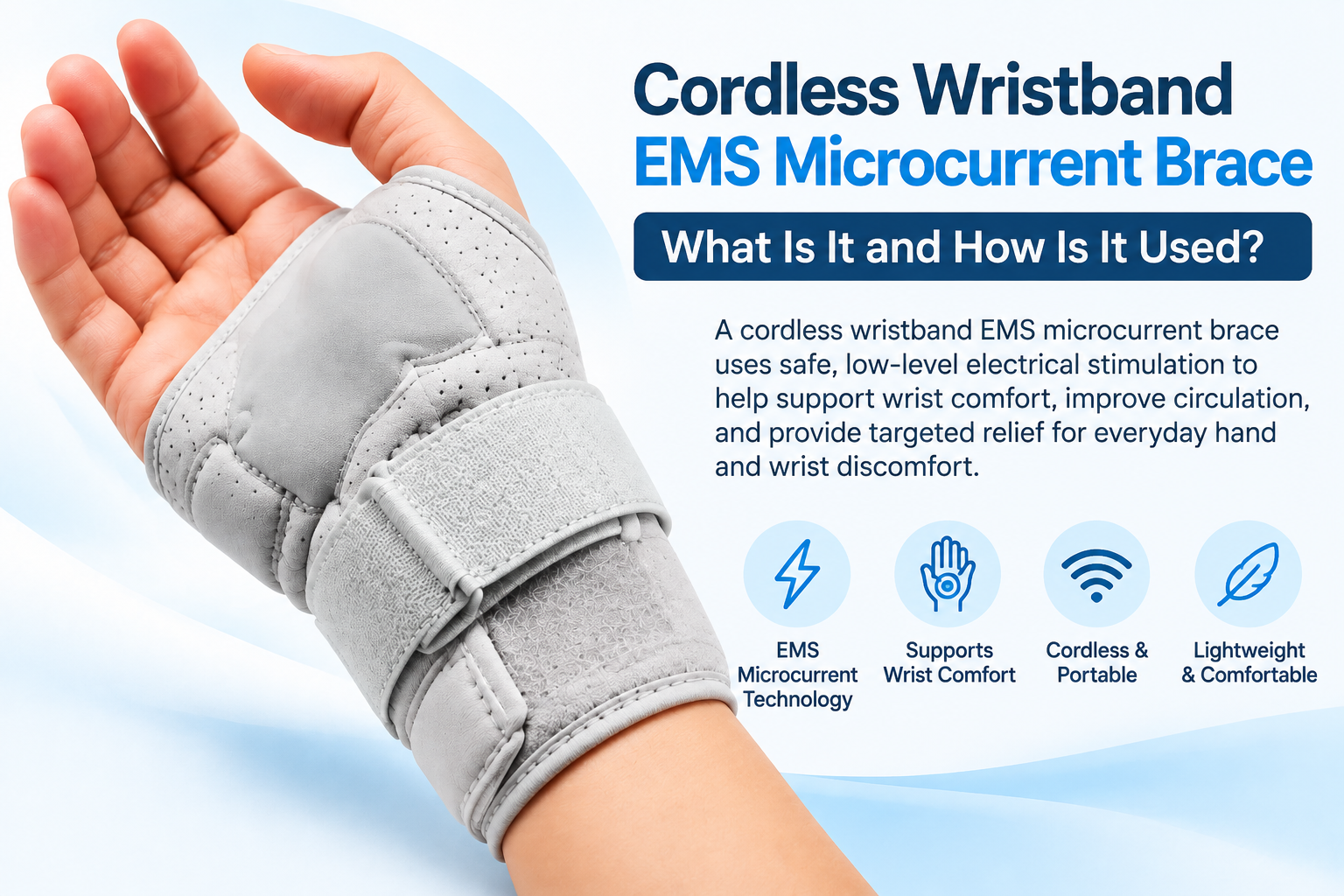
Cordless Wristband EMS Microcurrent Brace
- Cordless wearable format
- Integrated power and control
- Contact-based stimulation delivery
- Adjustable fit
- Compact and portable
10-Point Product Evaluation Framework
1. Technology
What type of electrical stimulation does the product actually specify? Check the product page for specific information.
2. Output
What technical information is provided? Check the documented specifications.
3. Contact
Where are the electrodes or contact areas? Check the product page for placement information.
4. Controls
What can the user adjust? Check what settings are documented.
5. Power
How is the device powered? Check the product specifications for the power system.
6. Fit
What wrist sizes are supported? Follow the manufacturer’s sizing instructions.
7. Physical Construction
Does the wristband provide actual support? Check the physical structure and intended use.
8. Safety Instructions
Are warnings clearly provided? Check the product page for contraindications and warnings.
9. Care
How is the device maintained? Check the manufacturer’s care instructions.
10. Intended Use
What does the manufacturer say the device is designed for? Compare against your intended use.
What Would a Professional Want You to Know?
This section is written with an EEAT (Experience, Expertise, Authoritativeness, Trustworthiness) perspective. It does not provide individualized medical advice, but it explains what a healthcare professional might want you to consider.
1. What Are You Trying to Address?
Understanding the reason for considering a device helps clarify whether it is appropriate.
2. Has the Underlying Issue Been Evaluated?
A device should not substitute for understanding the underlying issue.
3. Is Electrical Stimulation Appropriate?
A professional can help determine whether electrical stimulation is appropriate for a specific situation.
4. Are There Contraindications or Precautions?
Some people may not be appropriate candidates for electrical stimulation devices. Follow the specific device’s current instructions.
5. Does the Device’s Intended Use Match Your Situation?
Check whether the device’s intended use matches the reason you are considering it.
6. Are You Using It Exactly as Instructed?
Following the manufacturer’s setup, placement, and session instructions is essential.
Important: This section provides professional-style buyer education, not diagnosis. The decision about whether electrical stimulation is appropriate for a specific situation should follow the specific device’s current instructions and professional advice where appropriate.
Warning Signs That Warrant Professional Assessment
- Unexpected or persistent pain during or after use
- Skin injury or marked irritation
- Unusual swelling
- Concerning numbness or tingling
- Device malfunction
- Symptoms that are not improving
- Symptoms that worsen with use
For general information about wrist and hand conditions, see the Mayo Clinic overview of carpal tunnel syndrome. For broader hand anatomy information, the Cleveland Clinic hand anatomy resource provides useful context. For an orthopedic perspective, the AAOS hand and wrist conditions library is widely referenced. For general public health information about wrist and hand symptoms, the NHS hand pain guidance offers a practical overview. Additional medical reference information is available through MedlinePlus hand injuries and disorders. For clinical and anatomy-focused context, Johns Hopkins Medicine hand conditions provides further reading. General educational context is also available through WebMD’s overview of carpal tunnel syndrome and Healthline’s general wrist and hand information. For peer-reviewed literature, NCBI PubMed Central hosts open-access research where appropriate. For regulatory information about medical devices, see the FDA medical devices overview.
Important: This article does not provide individualized medical advice. Always consult an appropriate healthcare professional regarding your specific situation, and always follow the manufacturer’s contraindications and instructions.
Interactive: Before You Use an EMS Wrist Device
Use this checklist to review what you should know before using a cordless EMS wrist device. Click each item as you confirm it.
Before You Use an EMS Wrist Device
7 Things to Remember
Frequently Asked Questions
A cordless EMS wrist brace works through a sequence: the battery or power system supplies energy, the user selects a setting via the control interface, the device generates electrical stimulation according to its design, the stimulation is delivered through the designated contact or electrode areas, and the user experiences the resulting sensation. The exact sequence and behavior depend on the specific device. Always follow the manufacturer’s instructions for setup and use.
No — they approach wrist support differently. A traditional wrist brace primarily works through physical structure, coverage, compression, positioning, and movement control. An EMS wrist device adds electronic stimulation, contact areas, controls, and a power source. Some EMS devices may also provide physical support, but the level depends on the specific construction. The word “brace” does not necessarily mean the device provides the same physical immobilization as a conventional rigid wrist brace.
Cordless architecture means components that would otherwise be connected externally are integrated into the wearable device. These components typically include the battery or power source, the controller or control module, the stimulation electronics, the contact or electrode system, and the control buttons or interface. This integration creates a more compact, self-contained wearable format that doesn’t require an external cable during normal operation. However, the device may still require charging, and cordless doesn’t mean cable-free forever.
No — stronger stimulation is not automatically better. Higher intensity changes the stimulation experience, but it does not guarantee a better outcome. Comfort matters, device instructions matter, and individual sensitivity differs. Strong discomfort is not a sign that the device is “working better.” Follow the manufacturer’s guidance for appropriate settings. If the sensation is uncomfortable, painful, or concerning, reduce the setting or stop using the device according to the manufacturer’s instructions.
Follow the manufacturer’s placement instructions. Contact and electrode placement matters for how the device functions. A device cannot simply be repositioned anywhere on the wrist because the user thinks another location might work better. The FDA’s powered muscle stimulator guidance discusses electrode placement and recommends using the electrodes and leads specified by the manufacturer. Always follow the product-specific placement guidance.
Suitability depends on the product’s instructions, the activity, and the individual situation. Some activities may be compatible; others may not. FDA guidance for powered muscle stimulators specifically warns against use while driving, operating machinery, or during activities where involuntary muscle contractions could create injury risk. Follow the manufacturer’s intended-use instructions for what activities are appropriate. Do not assume the device is suitable for every activity.
Consider asking a healthcare professional before using an EMS device if you have an implanted electronic device such as a pacemaker, certain heart conditions, epilepsy, are pregnant, have reduced skin sensation, have had recent surgery or injury, or have inflamed or infected skin. Also seek professional advice if you are unsure whether electrical stimulation is appropriate for your situation or if you have a specific medical condition. The final decision should follow the specific device’s current instructions and professional advice where appropriate.
Conclusion: Understand the Technology Before You Choose
The main difference between a conventional wrist brace and a cordless EMS wrist device isn’t simply the presence of a battery. It is the combination of wearable design, electronic controls, stimulation components, and contact areas. Understanding how those pieces work together allows buyers to evaluate the device based on documented characteristics rather than marketing terminology alone.
This guide has covered what a cordless EMS wrist brace is, what EMS actually means, the difference between EMS, microcurrent, and TENS, the layered architecture of the device, what happens when you turn it on, the electrical pathway, electrode and contact considerations, why fit matters to the mechanism, what makes the device cordless, why cordless matters, cordless vs wired comparisons, EMS vs traditional brace comparisons, everyday use, safety limitations, common mistakes, and what a healthcare professional might want you to consider. The goal has been to explain the mechanism and design rationale — not to make medical claims.
Understand the Technology Before You Choose
A cordless EMS wrist brace can look simple from the outside, but its value depends on understanding the technology, contact system, controls, fit, power source, and intended use. The Cordless Wristband EMS Microcurrent Brace is one example to evaluate using the mechanism framework in this guide.
Explore the Cordless Wristband EMS Microcurrent BraceFor business or wholesale inquiries, you can request a product quote. For broader product questions, see the FingerTipSplint FAQ, and for additional educational content, explore the FingerTipSplint blog.