
Best Trigger Finger Splint: How to Choose the Right Support
You searched for the best trigger finger splint and immediately saw finger sleeves, rigid splints, adjustable braces, night splints, trigger finger supports, mallet finger splints, and thumb braces. The problem is not finding a splint. The problem is figuring out which design actually matches the problem you are trying to address. This guide walks you through types, support levels, fit, positioning, comfort, daily use, and when professional assessment matters.
For a deeper look at FingerTipSplint’s range, browse FingerTipSplint’s finger support resources, or start with the featured answer below if you need a quick decision.
What a Trigger Finger Splint Can—and Cannot—Do
A trigger finger splint can be part of conservative management. It does not establish a diagnosis. Not every finger-locking problem is trigger finger, and different injuries and tendon problems can require different splint designs. A device that feels more rigid is not automatically the correct device.
The Mayo Clinic trigger finger diagnosis and treatment guidance explains that diagnosis involves a physical examination and assessment of finger movement, pain, and locking. Cleveland Clinic’s finger splint overview notes that different splints serve different purposes and that a healthcare professional can determine the appropriate type. For medical finger splint supply information, see FingerTipSplint’s medical finger splint supplier page.
The best trigger finger splint is not necessarily the most rigid option. Look for a design that matches the affected finger, provides appropriate positioning or support, fits securely without excessive pressure, and suits your daily routine. Trigger finger splinting can be part of conservative care, but persistent locking or significant symptoms should be evaluated by a healthcare professional.
Table of Contents
- What a Splint Can and Cannot Do
- What Is a Trigger Finger Splint?
- 3D Anatomy: How Trigger Finger Affects Movement
- Types of Trigger Finger Splints
- Which Support Should I Consider?
- How to Choose the Right Support
- Fit and Sizing Guide
- Daytime vs Night-Time Use
- Recovery & Reassessment Timeline
- 10 Common Mistakes
- Trigger Finger vs Mallet Finger
- Product Evaluation
- Is This the Right Product for Me?
- Doctor Advice
- Who Should Consider a Splint?
- 7 Quick Tips
- FAQ
What Is a Trigger Finger Splint?
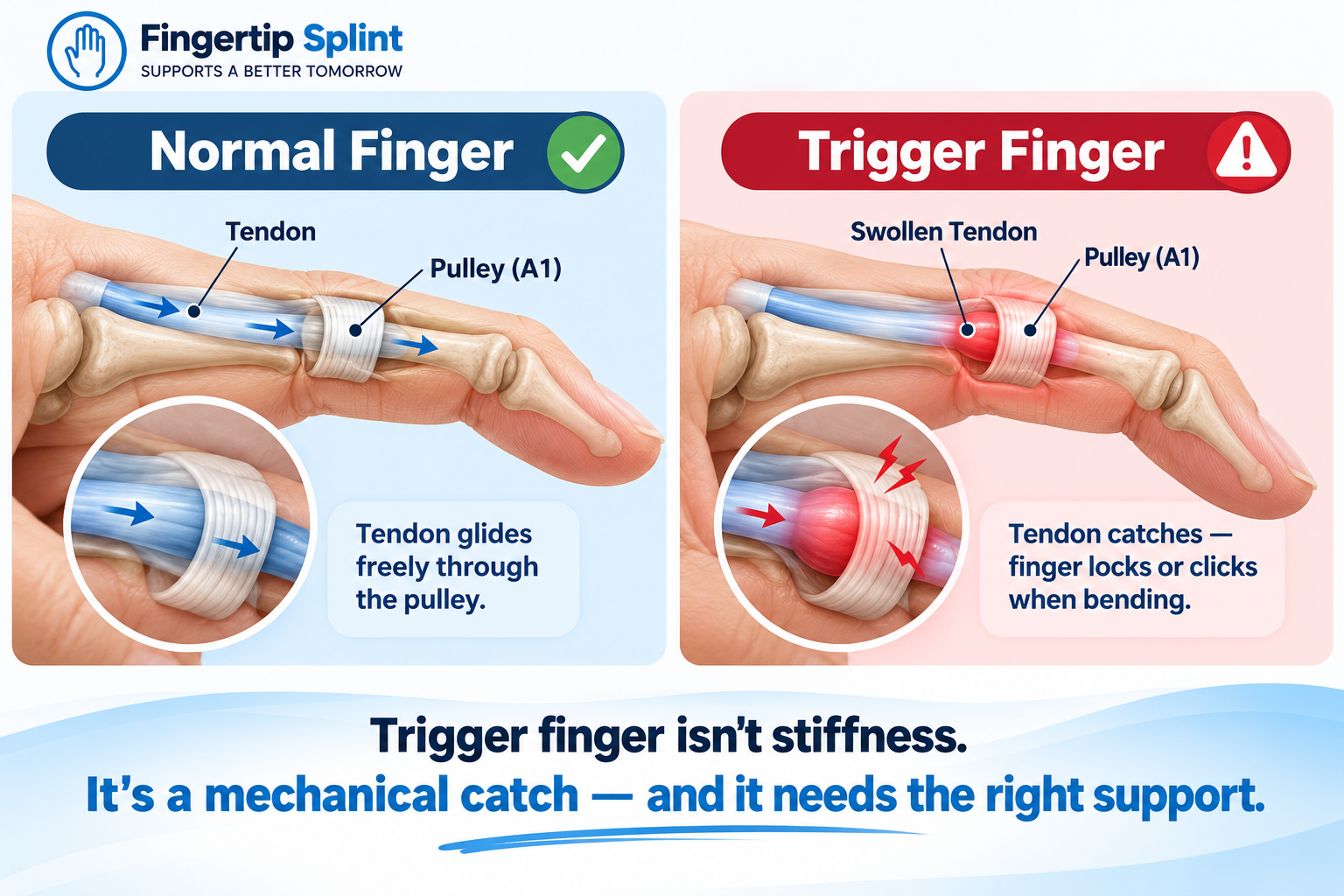
Trigger finger occurs when the tendon cannot glide smoothly through its surrounding sheath because of swelling or thickening. The Mayo Clinic trigger finger symptoms and causes page describes symptoms including stiffness, clicking or popping, tenderness at the base of the finger, catching, and locking.
A trigger finger splint is a support device designed to rest the tendon, limit aggravating movement, or provide positioning during recovery. The Cleveland Clinic trigger finger overview notes that splinting can be part of conservative care. But a splint does not open the pulley, cure the condition, or replace professional assessment.
If you want a detailed purchasing checklist, our companion article Trigger Finger Splint Buying Guide: Fit, Features & Support covers sizing and feature comparison in greater depth.
3D Anatomy: How Trigger Finger Affects Finger Movement
Before you evaluate any splint, it helps to understand what is happening inside the finger. The interactive 3D component explorer below breaks down the anatomy of trigger finger. Click each component to see what it does and where support fits.
Trigger Finger Anatomy Explorer
Click a component to learn what it does and how it relates to splint support.
Splint positioning: a trigger finger splint is designed to support the finger and reduce aggravating movement — not to physically open the pulley or permanently fix the condition.
How Trigger Finger Splinting Fits Into Conservative Care
Splinting is one conservative approach, not the only one. The Mayo Clinic trigger finger treatment guidance lists activity modification, splinting, and stretching among conservative approaches, with injections or surgery considered depending on severity and response.
Conservative approaches
- Activity modification
- Rest
- Splinting
- Stretching or therapy when appropriate
Medical management
- Medication under appropriate guidance
- Injections
- Procedures when necessary
What a splint does
- Rests the tendon
- Limits aggravating movement
- Provides positioning support
- Does not cure or diagnose
Types of Trigger Finger Splints
Not every trigger finger splint is designed for the same job. Use the comparison below to identify which category matches your situation, then evaluate specific products within that category.
Type 1 — Adjustable Finger Splint
Adjustable positioning, customizable fit, ease of use, sizing options, closure design, and comfort are the key factors. An adjustable splint lets you fine-tune the fit within the manufacturer’s intended range. This is often the most practical starting point for people who need support during daily activities.
Type 2 — Rigid / Structured Splint
Greater restriction, stronger positioning, potential bulk, and a need for professional guidance in some cases. A rigid splint may be appropriate when more significant movement limitation is recommended, but it is not automatically better than a less restrictive design.
Type 3 — Night-Time Support
Nighttime use is sometimes discussed in trigger-finger care. The Mayo Clinic guidance notes that a splint can help rest the tendon, while the Cleveland Clinic trigger finger overview notes that providers commonly recommend nighttime splinting in trigger finger management.
Type 4 — Flexible Finger Support
Comfort, mobility, lighter support, and limitations compared with structured devices. A flexible sleeve may be useful for mild symptoms or as a supplement to other support, but it will not provide the same positional control as a structured splint.
Type 5 — Trigger Thumb Support
Trigger thumb is related but involves the thumb. A normal finger splint is not necessarily interchangeable with thumb support. Confirm that the product is designed for the thumb if that is the affected digit.
Which Support Should I Consider?
Answer a few questions to narrow down the type of support worth investigating. This is a shopping decision tool, not a diagnosis.
Answer the questions above to see what product characteristics to investigate. This tool does not diagnose.
How to Choose the Right Trigger Finger Splint
This is the core commercial section. Eight selection factors determine whether a splint is right for your situation.
Factor 1 — Correct Finger
Do not buy a generic product simply because it says “finger splint.” Check whether it is designed for your specific finger, the thumb if applicable, and the intended positioning. A splint designed for the index finger may not fit the pinky, and a finger splint will not substitute for a thumb splint.
Factor 2 — Support Position
Where does the splint actually support the finger? Different splints stabilize different portions of the finger. A splint designed for the base of the finger will not stabilize the tip, and vice versa. Confirm that the support area matches the area you need supported.
Factor 3 — Support Level
Flexible
Light support with high mobility. Suitable for mild symptoms or as a supplement.
Moderate
Balanced support and movement. Often appropriate for daily use with adjustable fit.
Structured
Greater restriction and positioning. May require professional guidance depending on the situation.
More restriction is not automatically better. The goal is appropriate support, not maximum immobilization.
Factor 4 — Adjustability
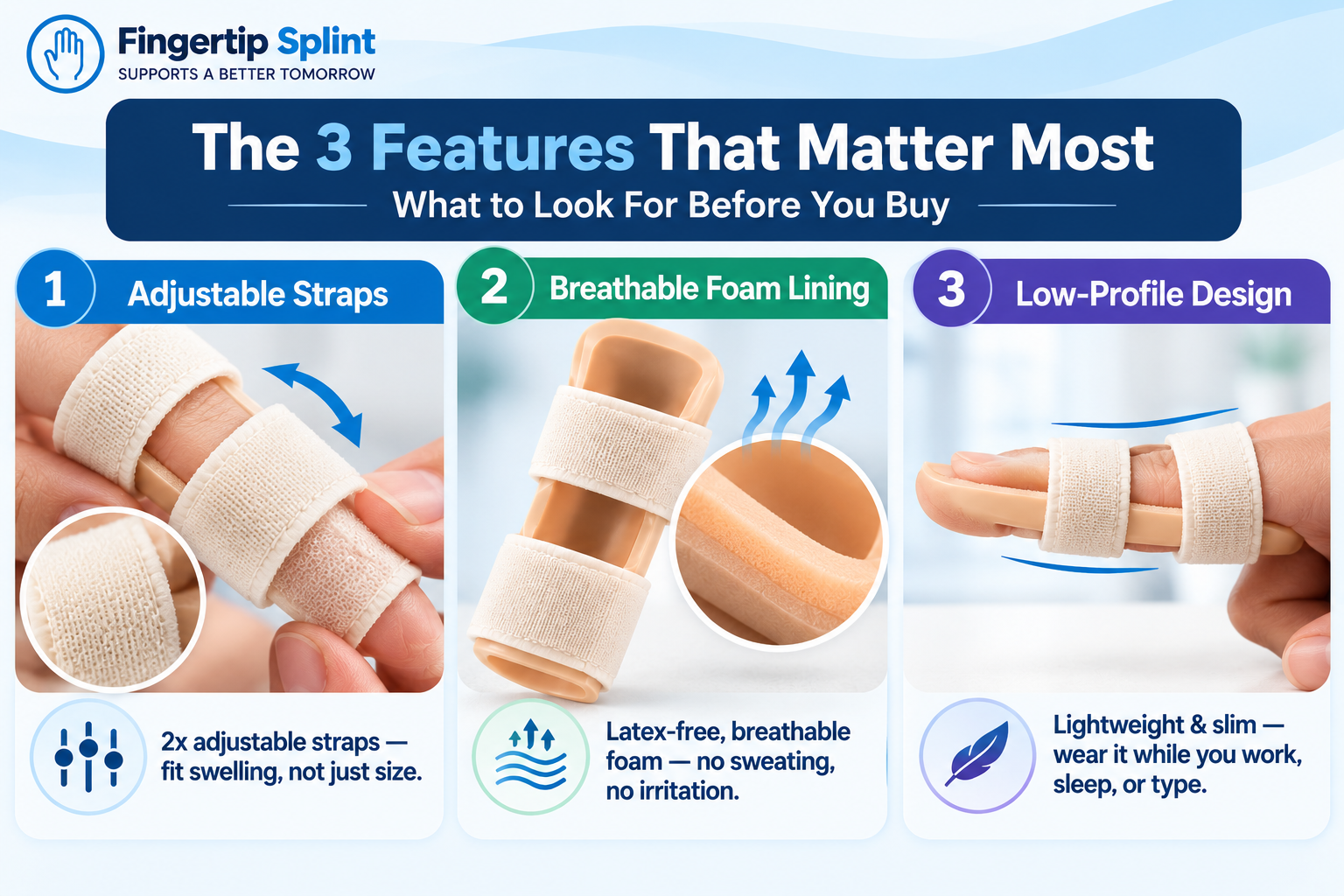
Evaluate strap design, closure mechanism, adjustment range, ease of application, and ability to maintain positioning. An adjustable splint lets you modify the fit, but the closure still needs to hold that fit during movement.
Factor 5 — Fit
A correct size should be secure, comfortable, stable, and not excessively tight. Too loose means the splint slides and loses positioning. Too tight creates pressure points, numbness, or discoloration. For a detailed sizing method, see the trigger finger splint buying guide.
Factor 6 — Comfort
Consider padding, material, edges, seams, pressure points, sweat and moisture, and extended wear. A splint that is uncomfortable after twenty minutes will not be worn consistently, which defeats its purpose. The Cleveland Clinic finger splint resource notes that finger splints can cause complications such as pressure sores or nerve impingement when improperly used.
Factor 7 — Daily Routine
Office worker / computer user
Low-profile design with finger freedom for typing and mouse use.
Mechanic / tradesperson
Durable construction with secure positioning during grip and tool use.
Gardener / craft worker
Comfort during repetitive hand movement and resistance to moisture and dirt.
Musician
Preserved finger mobility for instrument-specific movement patterns.
Parent / caregiver
Ease of application and removal throughout the day.
Nighttime user
Comfort during sleep with secure positioning that does not shift.
Factor 8 — Manufacturer Instructions
Check the sizing chart, wearing instructions, cleaning instructions, material information, limitations, and recommended use. If the product page does not clearly explain these, ask before buying. Clear instructions are a sign of a well-developed product.
Fit and Sizing Guide
Fit is the single most common source of buyer frustration. Follow these seven steps and compare your measurement against the specific product’s size guidance.
Step 1 — Identify the correct finger
Index, middle, ring, little, or thumb. Each has a different circumference.
Step 2 — Read the manufacturer’s measuring method
Some ask for the base of the finger; others ask for the middle joint. The measurement point matters.
Step 3 — Measure exactly as instructed
Use a flexible tape. Do not guess based on glove size or ring size.
Step 4 — Compare with the product size chart
Each brand’s chart is different. If you are between sizes, follow the manufacturer’s guidance.
Step 5 — Apply the splint according to instructions
Positioning affects both comfort and support. Follow the product’s placement guidance.
Step 6 — Check comfort and positioning
Look for pressure points, pinching, or edge irritation before extended wear.
Step 7 — Reassess after movement
A splint can feel fine when stationary but uncomfortable during activity. Recheck after using your hand.
Daytime vs Night-Time Use
When you wear a trigger finger splint affects how you evaluate it. Daytime use prioritizes function, while nighttime use prioritizes comfort and stable positioning.
| Consideration | Daytime | Night-time |
|---|---|---|
| Movement | More important | Usually less important |
| Comfort | Critical | Critical |
| Bulk | Can interfere with tasks | May matter less |
| Adjustment | Convenient | Secure positioning |
| Activity | Work / hobbies | Rest / sleep |
| Instructions | Follow product / clinical guidance | Follow product / clinical guidance |
Trigger Finger Splint Recovery & Reassessment Timeline
This is a reassessment framework, not a promised week-by-week healing schedule. The Cleveland Clinic trigger finger overview notes that recovery can range from weeks to months depending on the situation and treatment.
Stage 1 — Starting Support
Focus on correct fit, appropriate positioning, and reducing aggravating activity. If you have persistent locking or significant pain, seek professional assessment before relying on a splint alone.
Stage 2 — Monitoring Symptoms
Track morning stiffness, clicking, catching, locking, tenderness, and movement. Patterns matter more than single moments.
Stage 3 — Reassessment
Ask whether symptoms are improving, unchanged, or worsening. Improvement should be meaningful, not imagined.
Stage 4 — Professional Follow-Up
If symptoms remain significant or worsen, seek assessment rather than simply increasing splint tightness or wear time.
Stage 5 — Return to Normal Activity
Only according to symptom improvement and appropriate professional or product guidance. Comfort does not equal recovery.
10 Common Trigger Finger Splint Mistakes
Price does not tell you whether a splint matches your finger, joint, or support needs.
More restriction is not automatically better. Match the support to the situation.
A splint that moves around cannot provide stable support. Sizing varies by brand and finger.
Excessive pressure can cause numbness, tingling, or discoloration. It does not improve support.
These are different conditions with different support designs. For a comparison, see our finger splint guide for trigger and mallet finger.
A finger splint is not interchangeable with a thumb splint. Confirm the intended digit.
A splint that interferes with your work or hobbies will not be worn consistently.
Not every finger-locking problem is trigger finger. Different injuries can produce similar symptoms.
Persistent symptoms deserve evaluation, not endless self-treatment.
Deformity, severe pain, numbness, or significant loss of movement require professional assessment.
Trigger Finger vs Mallet Finger
These two conditions are sometimes confused, but they involve different mechanisms and different support designs. Buying the wrong type of splint will not address the underlying problem.
| Feature | Trigger Finger | Mallet Finger |
|---|---|---|
| Main problem | Tendon gliding / catching | Extensor mechanism injury |
| Typical issue | Clicking, catching, locking | Difficulty straightening fingertip |
| Location | Often base / palm-side region | Distal finger |
| Support goal | Depends on treatment plan | Often requires specific positioning |
| Splint design | Different | Different |
If you are not sure which condition applies to your situation, see our detailed finger splint for trigger and mallet finger guide, and consider professional assessment before buying.
Product Evaluation: 1PCS Finger Splints Trigger Finger Splint Mallet
Use this section as a worked example of how to evaluate a trigger finger splint against the criteria in this guide. The product being evaluated is the adjustable trigger finger splint from FingerTipSplint.
1PCS Finger Splints Trigger Finger Splint Mallet
- Finger compatibility: Designed for finger support with options for trigger and mallet finger applications
- Positioning: Support structure intended to help maintain the intended finger position
- Adjustability: Adjustable closure for fine fit tuning
- Closure: Secure fastening intended to hold the fit during movement
- Comfort: Cushioned contact surface intended for extended wear
- Mobility: Designed to preserve useful finger movement where appropriate
- Sizing: Check the product page for the specific size chart
- Care: Follow the manufacturer’s cleaning instructions
Rather than judging a splint by appearance alone, compare its actual construction, adjustment system, fit, support, and intended use against the criteria in this guide. For additional questions, visit the FingerTipSplint FAQ, and for wholesale inquiries, use the request-a-quote page.
| Buying Factor | What the Buyer Should Check |
|---|---|
| Finger compatibility | Is it designed for the intended digit? |
| Positioning | Does it support the intended position? |
| Adjustability | Can the fit be customized? |
| Closure | Does it stay securely positioned? |
| Comfort | Are pressure and contact areas acceptable? |
| Mobility | What movement remains possible? |
| Sizing | Are clear size instructions provided? |
| Care | Can the device be maintained according to instructions? |
Is This the Right Product for Me?
Select the option that best matches your situation to see what to look for.
- Adjustable closure with a secure hold
- Correct sizing for the intended finger
- Comfortable contact surface
- Appropriate support level for your daily activities
- Clear manufacturer instructions
What a Hand Specialist Would Consider Before Recommending a Trigger Finger Splint
This section is written in the tone of a practical professional checklist. It is not a diagnosis and does not replace an in-person assessment.
Exact finger affected
Different fingers have different sizing and functional demands.
Severity
Mild, moderate, or significant. Severity influences the appropriate approach.
Locking frequency
How often does the finger lock, and does it resolve on its own?
Ability to straighten
Can the finger be straightened fully, or is it stuck?
Duration
How long have symptoms been present? Recent onset differs from chronic.
Work and activity demands
What does the person need to do with their hands day to day?
Tenderness
Where exactly is the tenderness located?
Previous treatment
Has the person tried other approaches already?
Other hand conditions
Other conditions can influence the appropriate support.
Whether symptoms fit trigger finger
Not every finger-locking problem is trigger finger.
The Mayo Clinic diagnosis and treatment guidance notes that diagnosis involves physical examination and observing how the finger opens and closes, pain, smoothness of motion, and locking. Additional trusted resources include the AAOS OrthoInfo trigger finger page, the MedlinePlus trigger finger resource, the NHS trigger finger page, the WebMD trigger finger overview, and the Healthline trigger finger resource.
Who Should Consider a Trigger Finger Splint?
A trigger finger splint may be relevant for people who have already been assessed for trigger finger, have been advised to use splinting, need support as part of conservative management, want to understand available support options, or experience mild symptoms and are seeking information before professional evaluation.
- The finger suddenly cannot move
- Significant deformity
- Severe pain
- Substantial swelling
- Numbness
- Color change in the finger
- Worsening symptoms
- The finger remains locked
The Cleveland Clinic trigger finger resource advises medical evaluation for significant loss of movement and urgent attention if someone suddenly cannot move or use a digit.
7 Quick Tips Before Buying a Trigger Finger Splint
Build a Simple Finger-Support Care System
Effective trigger finger support is not about buying more products. It is about using the right combination of support, information, and guidance.
Primary support
An appropriate splint matched to your finger, joint, and support needs.
Information
The trigger finger splint buying guide for detailed fit and feature comparison.
Sizing help
The FingerTipSplint FAQ for common questions about fit and use.
Professional sourcing
FingerTipSplint’s medical finger splint supplier page for clinical-grade supply.
Bulk or business purchase
The request-a-quote page for wholesale and distributor inquiries.
Distributor information
The finger splint distributor page for reseller and business details.
Frequently Asked Questions
There is no universally best device for every person. Selection depends on the affected finger, the support or positioning required, fit, adjustability, comfort, and your daily routine. Trigger finger splinting can be part of conservative care, but persistent locking or significant symptoms should be evaluated by a healthcare professional.
Splinting is one conservative treatment option. The Mayo Clinic treatment guidance lists splinting among conservative approaches that can help rest the tendon. It is not a guaranteed cure, and results depend on the individual situation. If symptoms persist or worsen, seek professional assessment rather than continuing to self-treat.
Nighttime splinting may be recommended depending on your symptoms and clinical guidance. The Cleveland Clinic trigger finger overview notes that providers commonly recommend nighttime splinting in trigger finger management. Follow your healthcare professional’s advice on wearing schedule.
It should be secure and comfortable, not excessively tight. You should be able to wear it for the intended period without numbness, tingling, significant discoloration, or increasing pain. If concerning symptoms occur, remove the splint and seek appropriate advice rather than simply tightening or continuing to wear it.
There is no universal duration. Wear time depends on your situation, the device instructions, and professional advice where necessary. Do not assume that comfort equals recovery. If symptoms persist, worsen, or involve locking, weakness, or loss of function, seek professional assessment.
These conditions involve different mechanisms and may require different support designs. Trigger finger involves tendon gliding and catching, while mallet finger involves the extensor mechanism at the fingertip. Using the wrong type of splint will not address the underlying problem. See our detailed guide for the differences.
Seek medical advice if the finger suddenly cannot move, there is significant deformity, severe pain, substantial swelling, numbness, color change, worsening symptoms, or the finger remains locked. The Cleveland Clinic advises medical evaluation for significant loss of movement and urgent attention if someone suddenly cannot move or use a digit.
Ready to Choose a Trigger Finger Splint With More Confidence?
You have now learned how to check the finger, understand the support, verify the fit, review the product, and follow appropriate guidance. Evaluate the 1PCS Finger Splints Trigger Finger Splint Mallet against those criteria before deciding.
For more buying guidance, explore trigger finger support options and the FingerTipSplint FAQ. For wholesale or business inquiries, use the request-a-quote page.
View the Product Explore Finger SupportConclusion: Match the Splint to the Finger and the Situation
The best trigger finger splint is the one that matches the affected finger, provides appropriate support or positioning, fits securely, and can actually be worn during the activities you do. A premium product in the wrong size or with the wrong support level will underperform a simpler product that matches your needs. Before you buy, measure the specific finger, check the manufacturer’s sizing guidance, confirm the support structure and positioning, and verify that the splint stays in place during movement.
If symptoms persist, worsen, or involve locking, deformity, severe pain, numbness, or loss of function, do not simply buy a stronger splint. Seek appropriate medical evaluation. For medical finger splint supply and distribution, see the medical finger splint supplier page and the finger splint distributor page. For the full FingerTipSplint range, visit the FingerTipSplint homepage.