
Your thumb needs support, but you do not want a bulky brace that gets in the way of typing, phone use, cooking, or daily tasks. Self-adhesive and breathable options look promising — but they do not all provide the same type or degree of support. This guide helps you choose the right one for everyday use without guessing.
If you have not yet explored the full range, start by browsing FingerTipSplint’s thumb and finger support options. This article focuses on what to check before choosing a self-adhesive, breathable thumb splint.
Table of Contents
- Start With the Right Features
- Quick Answer
- Self-Adhesive vs Traditional Brace
- Why Breathability Matters
- 8 Things to Look For
- Which Thumb Problems Need Different Support?
- 3D Product Anatomy
- How to Apply Correctly
- Too Tight, Too Loose, or Fitted?
- Daily Activity Guide
- Daily-Use Benefits
- Recovery Timeline
- 10 Buying Mistakes
- Who Should Consider One?
- Doctor Advice
- Product Guide
- Buyer Decision Tool
- Bundle Strategy
- 7 Quick Tips
- FAQ
Need a Thumb Splint for Everyday Use? Start With the Right Features
Thumb discomfort shows up in the middle of normal life. You notice it while typing, using your phone, writing, working, cooking, lifting light objects, exercising, or doing repetitive hand movements. It is not dramatic — it is just persistent enough to make you search for a solution.
The confusion starts when you see the options. There are thumb braces, thumb spicas, compression supports, wraps, adhesive supports, and rigid splints. They do not all provide the same type or degree of support. The Cleveland Clinic finger splint overview explains that splint choice depends on the affected area and underlying problem, while different designs provide different levels of stabilization.
Why Self-Adhesive Support Appeals to Everyday Buyers
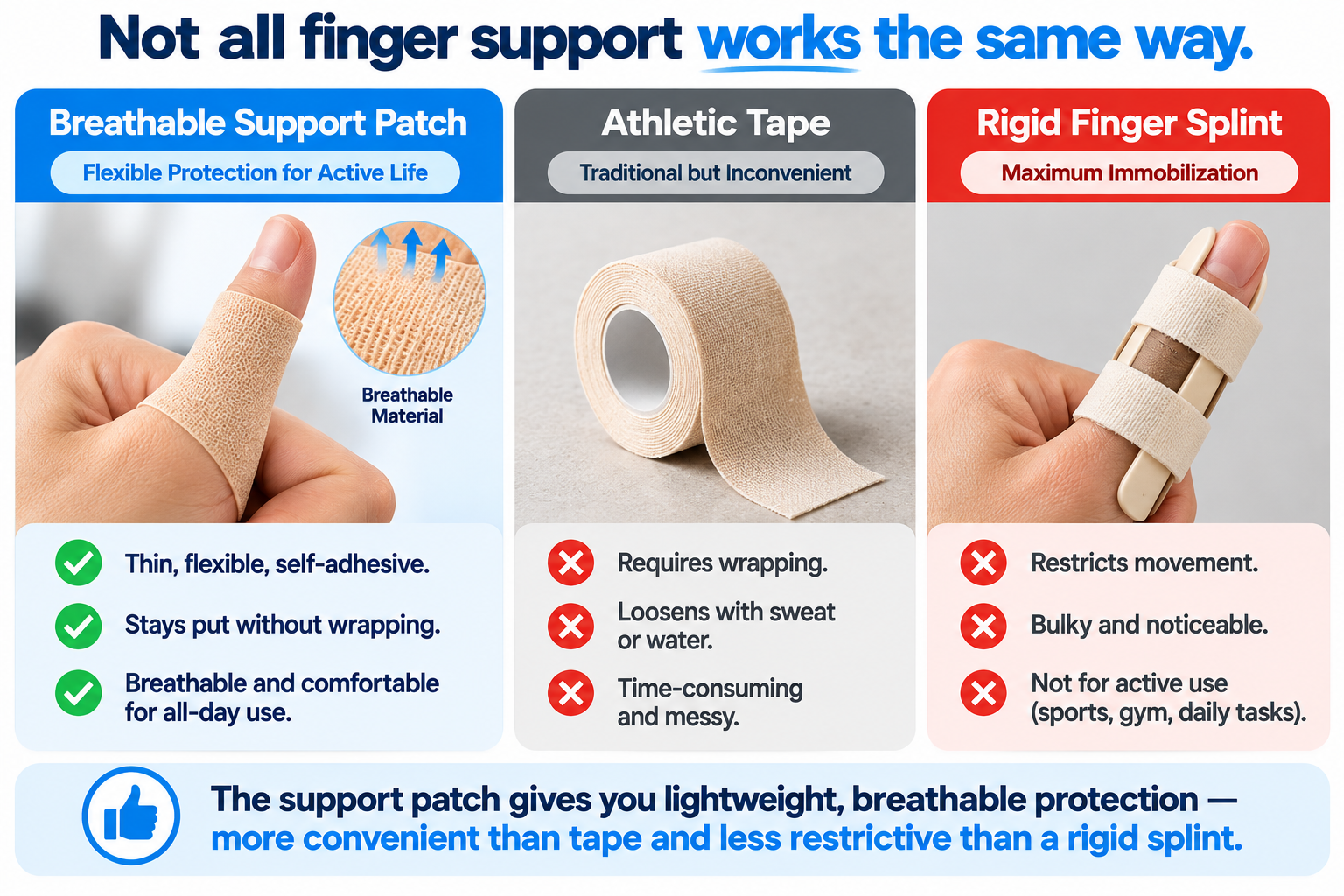
Self-adhesive and breathable thumb supports have a specific appeal. They are simple to apply, low-profile, less bulky in appearance, and potentially easier to integrate into daily routines. They can offer adjustable positioning depending on product design, direct contact with the thumb, and convenience for short-term or activity-based support.
But convenience does not automatically make one design medically appropriate for every thumb problem. A low-profile patch cannot replace a structured thumb-spica splint when that level of stabilization is required. The goal of this guide is to help you match the product to your situation, not to convince you that one design solves everything.
What This Guide Will Help You Decide
Support vs convenience
What makes a thumb splint suitable for daily use, and where does it fall short of structured alternatives?
What breathable actually means
Material, ventilation, moisture, and why breathability is only one factor in the decision.
How a self-adhesive support should fit
Application, positioning, pressure, and what to check after wear.
How much support to look for
Light, moderate, or structured, and why more rigid is not automatically better.
Mistakes to avoid
The ten purchasing and use errors that lead to frustration or skin problems.
When a simple support is not enough
Red flags that suggest professional assessment should come before product selection.
There is no universally best self-adhesive thumb splint. For everyday use, compare the support area, fit, breathability, fastening or adhesive security, comfort, mobility, and intended use. A suitable product should remain secure without creating excessive pressure, and should match the type of support your situation requires. Significant injuries, persistent symptoms, or major swelling warrant professional assessment before relying on an off-the-shelf product.
Self-Adhesive Thumb Splint vs Traditional Thumb Brace
Understanding the difference between these two categories helps you avoid buying the wrong type of support for your situation.
How a Self-Adhesive Thumb Support Works
A self-adhesive thumb support typically uses a support material that wraps around or contacts the thumb, with an adhesive or self-fastening mechanism to help maintain position. The design is often lower profile than some traditional braces. Material selection affects comfort and breathability, and correct application affects both effectiveness and comfort. It is important to understand what this type of support is designed to do: provide light to moderate positional support during daily activity, not diagnose or heal a condition.
Self-Adhesive vs Velcro Thumb Brace
| Feature | Self-Adhesive Thumb Splint | Traditional Velcro Brace |
|---|---|---|
| Application | Adhesive or self-fastening | Strap or Velcro |
| Profile | Often low-profile | Can be bulkier |
| Adjustability | Product-dependent | Usually strap-based |
| Breathability | Material-dependent | Material-dependent |
| Daily convenience | Potentially high | Depends on design |
| Repositioning | Product-dependent | Usually straightforward |
| Support level | Product-specific | Product-specific |
When a Traditional Thumb Spica May Be More Appropriate
Not every thumb problem should be managed with a low-profile adhesive support. A thumb-spica design extends over the wrist and thumb and provides substantially different stabilization. The Cleveland Clinic finger splint resource describes thumb-spica splints as extending from the forearm across the wrist and around the thumb, providing broader stabilization than a patch-style support.
For significant thumb injuries, post-surgical recovery, or conditions requiring more structured immobilization, a traditional thumb spica may be the better option. The self-adhesive patch is best understood as a daily-support option for lighter needs, not as a replacement for structured medical immobilization.
Why Breathability Matters in a Daily-Use Thumb Splint
Breathability is not a marketing buzzword. It directly affects how a splint feels during extended wear, especially if you work with your hands, live in a warm climate, or use the support during activity.
What Does “Breathable” Actually Mean?
A breathable material allows some airflow through the construction. This can reduce heat buildup, help manage moisture from sweat, and improve comfort during long wear. Key factors include the material itself, its thickness, whether the design includes ventilation openings, and the surface that contacts the skin.
However, breathable material does not automatically prevent irritation. Material and ventilation can influence comfort, but skin still needs to be monitored. If you notice redness, itching, numbness, tingling, or other changes in the skin or sensation, remove the support and seek appropriate advice.
Breathability vs Support
The most breathable product is not necessarily the product that provides the amount of support a particular problem requires. These two features can trade off against each other. A thinner, more ventilated patch may feel cooler but provide less structural support than a thicker, more substantial design.
Why Material Matters During Extended Daily Activities
Working at a computer
Long hours of typing and mouse use create heat and repetitive pressure. Breathable material keeps the thumb more comfortable.
Outdoor activity
Warm environments and sun exposure increase sweating. Moisture management becomes more important.
Gym use
Grip, resistance, and sweat stress both the material and the fit. Choose a design that stays in place without tightening.
Household work
Cooking, cleaning, and lifting all involve hand use. The support should stay comfortable through variable tasks.
Warm climates
Heat and humidity make ventilation a priority for any product worn for extended periods.
Long periods of hand use
Full workdays or long sessions stress the material and the skin. Breathability helps reduce cumulative discomfort.
8 Things to Look for Before Buying a Self-Adhesive Thumb Splint
This is the core buyer guide. Each factor is something you can physically verify or ask about before purchasing.
1. Correct Support Area
First ask what part of the thumb actually needs support. This is not a small detail. Thumb conditions can affect different structures. Thumb arthritis commonly affects the basal or CMC joint at the base of the thumb, while de Quervain’s involves tendons on the thumb side of the wrist, according to the Mayo Clinic thumb arthritis overview. Before buying, identify whether you need support at the thumb tip, IP joint, MCP joint, base of thumb, thumb-web area, or thumb-wrist area.
2. Secure Self-Adhesive Fit
The support should stay appropriately positioned during its intended use without requiring excessive tightening. Look for ease of application and removal, manufacturer instructions, and feedback about whether it slips excessively during normal activity. It should not create excessive pressure points, and it should not require constant readjustment.
3. Breathable Construction
Evaluate the material, its thickness, whether the design includes ventilation, how it handles sweat and moisture, and the surface that contacts the skin. A well-designed breathable support reduces heat buildup and moisture retention, making extended wear more tolerable.
4. Appropriate Support Level
Light
Minimal support with high mobility. Suitable for mild or intermittent discomfort and activity-based support.
Moderate
Balanced support and mobility. Often appropriate for daily use where some positional support is useful.
Structured
Greater restriction. May require professional guidance depending on the situation. Not always better.
More rigid does not automatically mean better. The appropriate level depends on why support is needed.
5. Thumb Mobility
Daily activities require thumb movement. Typing, phone use, writing, opening containers, light household tasks, and work activities all depend on thumb flexibility. A support designed to restrict movement may not be suitable when the reader needs substantial thumb mobility. If the product interferes with these tasks, it will not be worn consistently.
6. Skin Comfort
Look for smooth edges, a comfortable contact surface, appropriate tension, correct sizing, and no excessive pressure. Watch for warning signs: numbness, tingling, significant discoloration, or increasing pain. The Cleveland Clinic finger splint resource advises seeking medical attention when splint users develop severe pain, worsening swelling, discoloration, or changes in sensation.
7. Size and Fit
Follow the measure-compare-apply-recheck sequence. Measure according to the manufacturer’s instructions. Compare your measurement with the specific product’s size chart. Apply according to instructions. Recheck after wear. Be cautious about “one-size-fits-all” claims — evaluate them carefully against your actual measurements.
8. Intended Daily Activity
| Activity | What to Consider |
|---|---|
| Typing | Thumb mobility and low profile |
| Phone use | Flexibility and grip |
| Writing | Grip interference |
| Household tasks | Secure fit and comfort |
| Gym | Movement, sweat, and durability |
| Outdoor work | Durability and moisture handling |
| Rest | Comfort during extended wear |
Which Thumb Problems May Require Different Support?
Different thumb problems can require different support designs. This section is educational, not diagnostic.
Thumb Arthritis
Thumb arthritis commonly affects the joint at the base of the thumb and can cause pain with gripping or pinching. The Mayo Clinic thumb arthritis treatment guidance notes that splints can support the joint and limit excessive thumb and wrist movement, depending on the situation. Readers who need broader finger and thumb support options can explore the site’s medical finger splint supplier resources for a wider overview.
De Quervain’s-Type Symptoms
De Quervain’s affects tendons on the thumb side of the wrist and may be associated with repetitive gripping, lifting, or twisting. The Mayo Clinic de Quervain’s treatment guidance describes splinting as one part of conservative treatment in appropriate cases, often alongside activity modification. A self-adhesive thumb patch alone may not provide the coverage required for de Quervain’s-related symptoms, which typically involve the thumb-side wrist region.
Thumb Sprain or Recent Injury
A self-adhesive support should not automatically be treated as a substitute for assessment after significant trauma. The Cleveland Clinic sprained thumb resource notes that thumb sprain treatment varies with severity, and that more significant injuries may require a thumb-spica splint or other medical treatment.
3D Interactive Infographic — Anatomy and Product Design
Before you evaluate any product, it helps to know what you are looking at. The interactive 3D component explorer below breaks down the parts of a self-adhesive thumb support. Click each component to see what it does and why it matters.
Self-Adhesive Thumb Support Component Explorer
Click a component to learn what it does and why it matters when you are buying.
How to Apply a Self-Adhesive Thumb Splint Correctly
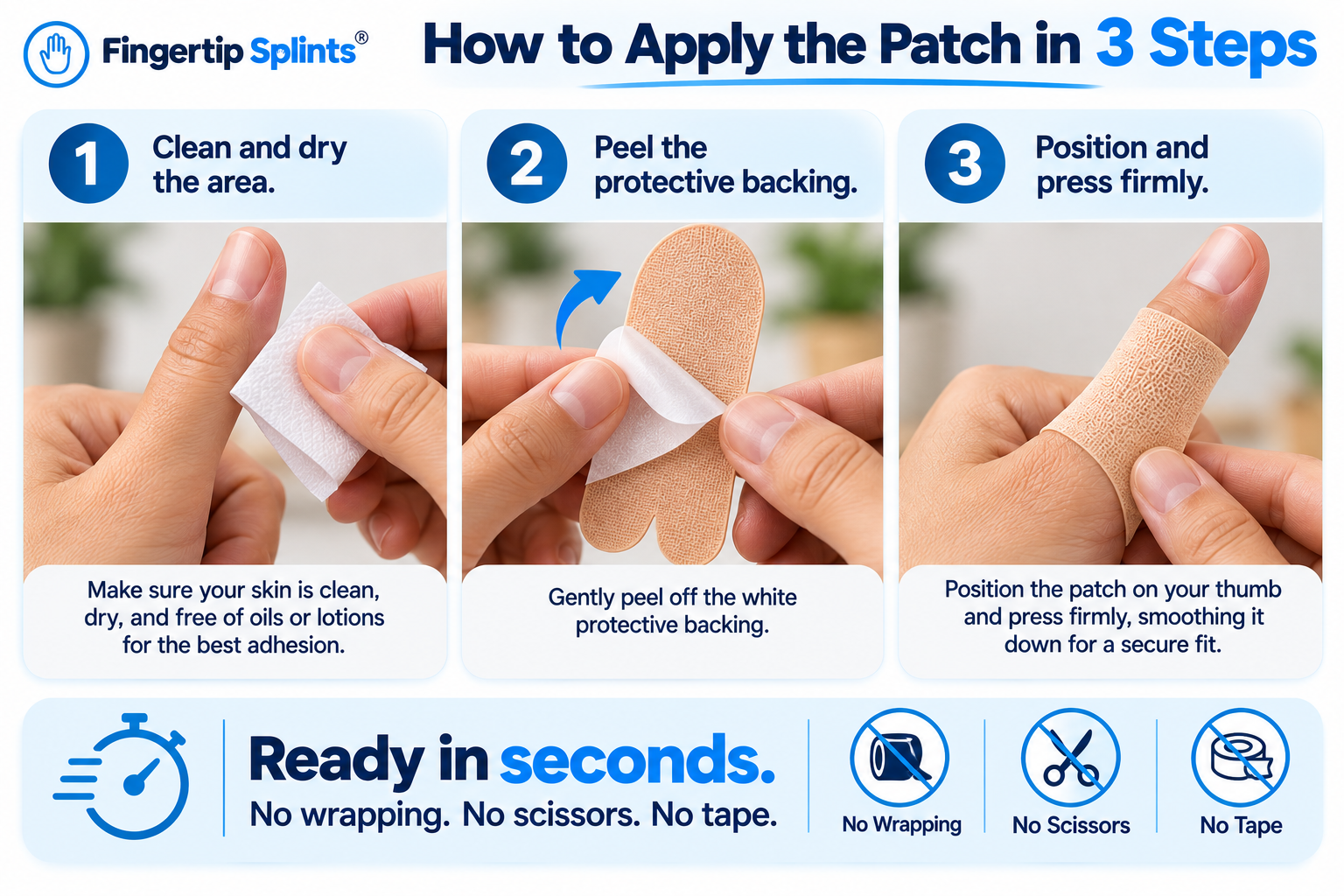
Correct application affects both comfort and function. Follow these seven steps and check the fit after use.
Too Tight, Too Loose, or Properly Fitted?
The fit of a thumb splint determines whether it helps or hurts. Use the three states below to evaluate any self-adhesive support.
Too Tight
- Numbness
- Tingling
- Excessive pressure
- Discoloration
- Increasing discomfort
Too Loose
- Movement of the support
- Slipping during use
- Poor positioning
- Inconsistent support
Appropriate Fit
- Secure
- Comfortable
- Intended position maintained
- No concerning pressure
- Normal sensation
Can You Wear a Self-Adhesive Thumb Splint During Daily Activities?
Daily-use suitability depends on the activity and the product. This section walks through common situations.
At Work
Computer use, manual tasks, and repetitive movements each place different demands on a thumb support. A low-profile design may work well for computer use but may not stay in place during heavier manual tasks. Match the design to your actual work routine.
While Typing
Support should not unnecessarily interfere with keyboard or mouse use. If the splint restricts thumb movement needed for typing, it will be removed during work sessions. Consider a low-profile design that preserves thumb mobility.
While Using a Phone
A low-profile design may be convenient, but movement requirements vary. If thumb scrolling, tapping, or swiping is restricted, the support may not be practical for phone use.
During Exercise
Separate light activities from activities involving heavy gripping. Light exercise may be compatible with a self-adhesive support. Heavy gripping may stress the adhesive or fastening system and require a different design.
During Household Tasks
Gripping, lifting, twisting, and moisture exposure all affect how the support performs. Choose a design that stays secure and handles moisture during household tasks.
While Driving
Any support that restricts hand function can affect control. Follow applicable safety and product guidance, and consider whether the support interferes with your grip on the wheel before driving.
Daily-Use Benefits of a Breathable Self-Adhesive Thumb Splint
These are design and use benefits, not medical claims.
Low-Profile Convenience
Some buyers prefer a less bulky support that fits under clothing and does not interfere with hand movement. A low-profile design can be easier to integrate into everyday routines.
Easy Application
Useful for people who dislike complicated straps. A self-adhesive design can be applied quickly and without the multi-step process of some traditional braces.
Potentially Better Integration With Routine
A simple design can be easier to incorporate into everyday tasks. The support becomes part of the daily flow rather than a separate, cumbersome object.
Breathable Comfort
Material-related comfort is a real benefit for extended wear. Breathability helps reduce heat buildup and moisture retention, which is important for all-day use.
Targeted Support
Focused support of the intended area without automatically immobilizing the whole hand. This preserves useful hand function while providing local support.
Everyday Portability
A compact support is easier to carry than a larger brace. This matters for people who need support at work, at home, and during travel.
Recovery Timeline — What Should You Expect?
This is a reassessment framework, not a promised week-by-week healing schedule. Duration of splint use depends on the underlying problem. The Mayo Clinic thumb arthritis treatment guidance notes that splint use can vary from nighttime use to daytime and nighttime use, depending on the situation, and de Quervain’s management also depends on the individual situation.
Stage 1 — Initial Fit
Check position, comfort, skin, and sensation. If the support feels too tight or causes numbness, reposition or remove it before extended wear.
Stage 2 — Early Daily Use
Monitor whether the support stays positioned, whether activities aggravate symptoms, and whether skin tolerates the material. Adjust the wearing schedule as needed.
Stage 3 — Reassessment
Ask whether symptoms are improving, whether function is changing, and whether the support is still appropriate. If symptoms worsen, seek professional assessment.
Stage 4 — Adjusting the Routine
Any reduction or change in splint use should depend on the underlying problem and professional or product guidance. Do not assume that comfort equals recovery.
10 Mistakes People Make When Buying a Self-Adhesive Thumb Splint
A sleek design does not guarantee appropriate support. Look at the structure and coverage.
Breathability is one factor, not the entire decision. Support and fit matter equally.
Tighter is not automatically more supportive or safer. Excessive pressure can cause new problems.
A thumb support that does not cover the intended area may not meet the user’s needs.
Daily activities often require thumb movement. A support that restricts too much will not be worn consistently.
Incorrect sizing can affect comfort and positioning. Follow the specific product’s guidance.
Different conditions can require different designs. A self-adhesive patch is not the right answer for every situation.
Do not continue ignoring numbness, tingling, discoloration, or significant irritation. Remove the support and reassess.
A significant injury may require a different type of immobilization or professional evaluation.
A splint can be part of management in some situations, but it is not a universal diagnosis or treatment.
Who Should Consider a Self-Adhesive Thumb Splint?
This section focuses on buyer profiles, not medical diagnoses.
The everyday worker
Needs low-profile support while working. Prioritizes convenience and comfort during extended wear.
The phone and computer user
Wants a support that does not unnecessarily interfere with thumb movement for typing, scrolling, and tapping.
The active buyer
Needs to consider sweat, movement, and grip during exercise or outdoor activity.
The general buyer
Has mild or intermittent concerns and wants to understand support options before committing to a product.
Who Should Pause Before Buying?
- Significant trauma
- Severe pain
- Major swelling
- Visible deformity
- Sudden loss of thumb function
- Persistent numbness
- Significant discoloration
- Symptoms that continue or worsen
Doctor Advice — How a Professional Would Think About Thumb Support
This section is written in the tone of a practical professional checklist. It is not a diagnosis and does not replace an in-person assessment.
First Question: Where Is the Problem?
Base of the thumb? Thumb joint? Thumb-side wrist? Fingertip? The location of the problem determines the appropriate support design. A self-adhesive patch designed for the thumb tip will not stabilize the base of the thumb, and vice versa.
Second Question: What Movement Causes Trouble?
Gripping? Pinching? Twisting? Lifting? Understanding which movements aggravate symptoms helps determine how much and what type of support is needed.
Third Question: How Much Movement Should Be Restricted?
Not every thumb problem needs complete immobilization. The Mayo Clinic thumb arthritis treatment guidance specifically notes that splints can support a thumb joint while limiting excessive movement, but the appropriate use depends on the situation.
Fourth Question: How Long Should Support Be Used?
There is no universal schedule. Duration depends on the underlying problem, the product instructions, and professional guidance. Additional trusted resources include the Cleveland Clinic de Quervain’s resource, the Cleveland Clinic thumb arthritis page, the WebMD splints overview, and the Healthline thumb braces for arthritis guide.
Fifth Question: Is There an Injury That Needs Assessment?
This is where professional evaluation becomes more important. Significant trauma, deformity, or functional loss should not be managed with a self-adhesive patch alone.
Product Guide — Evaluating the FingerTipSplint Self-Adhesive Thumb Support
Use this section as a worked example of how to evaluate a self-adhesive thumb support against the criteria in this guide. The product being evaluated is the Fingertip Splint Thumb Breathable Support Patch from FingerTipSplint.
Fingertip Splint Thumb Breathable Support Patch
- Self-adhesive format: Designed to stay positioned without traditional straps
- Breathable construction: Material intended for extended daily wear
- Coverage: Support intended for thumb and fingertip applications
- Fit: Check the product page for sizing and application guidance
- Mobility: Low-profile design intended to preserve useful movement
- Comfort: Skin-contact surface designed for daily use
- Daily use: Intended for everyday support and activity-based wear
- Care: Follow the manufacturer’s cleaning and replacement instructions
| Buying Factor | What to Check |
|---|---|
| Adhesive or self-fastening | How it stays positioned during use |
| Breathability | Material construction and ventilation |
| Coverage | Which part of thumb or hand it supports |
| Fit | Sizing and application instructions |
| Mobility | What movement remains available |
| Comfort | Skin-contact design and edges |
| Daily use | Whether it suits intended activities |
| Care | Cleaning and replacement instructions |
For buyers specifically looking for a breathable, self-adhesive format, this product is worth evaluating against the criteria above. For a deeper look at how breathability and fit interact with sports use, see our guide on breathable thumb support patch features and fit. If you are comparing thumb support with adhesive protection for individual fingers, our guide on how to choose a self-adhesive finger protector covers the selection process in more detail. For additional questions, visit the FingerTipSplint FAQ.
Buyer Decision Tool — Which Features Matter Most to You?
Select your priority and we will show you what to look for. This is a shopping decision tool, not a medical recommendation.
- Breathable material and ventilation
- Smooth edges without roughness
- Low-pressure fit
- Comfortable skin-contact surface
- Correct sizing to avoid pressure points
Bundle Strategy — Build a Practical Finger and Thumb Support Setup
Effective hand support is not about buying more products. It is about using the right combination of support, information, and guidance.
Daily thumb support
A self-adhesive, breathable thumb patch matched to your daily activities and support needs.
Finger support options
For users who also require finger protection or support. Readers comparing different finger-support options can explore the FingerTipSplint medical finger splint supplier page for a broader overview of available support solutions.
Product range
Browse the full FingerTipSplint shop for additional support options across fingers, thumbs, and wrists.
When a bundle makes sense
Buying multiple supports only makes sense when each serves a genuine need. Do not buy products you will not use.
7 Quick Tips Before You Buy
Frequently Asked Questions
A self-adhesive thumb splint is a support device that uses an adhesive or self-fastening mechanism to remain positioned on the thumb. It is typically lower profile than a traditional strap or Velcro brace and is designed to provide light to moderate positional support during daily activities. It does not diagnose a thumb condition and does not replace structured medical immobilization when that level of support is required.
Self-adhesive designs appeal to people who want simple application, a less bulky appearance, and easy integration into daily routines. They can be useful for mild or intermittent discomfort, activity-based support, or situations where a low-profile option is preferred. However, convenience does not make the design appropriate for every thumb problem, and significant injuries should be assessed professionally before relying on an off-the-shelf product.
It can be, depending on your activities and the product’s design. Daily-use suitability depends on comfort, fit, breathability, whether the support stays positioned during movement, and whether it preserves enough thumb mobility for the tasks you need to do. A low-profile self-adhesive support may work well for typing, phone use, and light household tasks, but may not stay in place during heavier gripping or lifting.
If the support interferes with tasks you need to perform, it will not be worn consistently. Choose a design that matches your actual daily routine, and monitor skin and sensation during use. If symptoms are persistent or worsen, seek professional assessment rather than relying on the support indefinitely.
Breathability comes from the material and construction of the splint. A breathable material allows some airflow through the product, which can reduce heat buildup and help manage moisture from sweat. Factors that affect breathability include the material itself, its thickness, whether the design includes ventilation openings, and the surface that contacts the skin.
However, breathable material does not automatically prevent skin irritation. Material and ventilation can influence comfort, but skin still needs to be monitored. If you notice redness, itching, numbness, tingling, or other changes, remove the support and seek appropriate advice.
It should be secure and comfortable, not excessively tight. You should be able to wear it for the intended period without numbness, tingling, significant discoloration, or increasing pain. A support that creates excessive pressure is not providing better support — it is creating new problems.
If concerning symptoms occur, remove the support and seek appropriate advice rather than simply tightening or continuing to wear it. The Cleveland Clinic finger splint resource advises seeking medical attention when splint users develop severe pain, worsening swelling, discoloration, or changes in sensation.
It depends on the mobility the product preserves and the design’s profile. A low-profile self-adhesive support may allow typing and phone use if it does not restrict thumb movement significantly. A more structured splint may limit the thumb mobility needed for these tasks.
Before relying on a splint during typing or phone use, test it during short sessions. If it interferes with keyboard use, scrolling, tapping, or swiping, it will likely be removed during work sessions. Choose a design that matches the demands of your daily tasks.
Start by identifying the area you want supported — thumb tip, IP joint, MCP joint, base of thumb, thumb-web area, or thumb-wrist area. Check the product’s sizing and application instructions. Look for breathable construction if you will use it regularly. Confirm that the design preserves the movement you need for daily tasks.
Do not assume tighter means better. Monitor skin and sensation during use. If symptoms persist, worsen, or involve significant injury, seek professional assessment before relying on the product. For buyers specifically looking for a breathable, self-adhesive format, evaluate the product against the criteria in this guide rather than choosing based on appearance or price alone.
Seek medical advice if you have significant trauma, severe pain, major swelling, visible deformity, sudden loss of thumb function, persistent numbness, significant discoloration, or symptoms that continue or worsen. These are red flags that should not be managed by buying a support product online.
The Cleveland Clinic sprained thumb resource notes that thumb sprain treatment varies with severity and that more significant injuries may require a thumb-spica splint or other medical treatment. The Mayo Clinic thumb arthritis and de Quervain’s treatment guidance also describe splinting as one part of a broader management approach, not as a stand-alone solution. Proper assessment matters for both treatment and return-to-activity decisions.
Stop Guessing, Start Comparing
Identify your need. Check the design. Review the fit. Compare support. Choose the appropriate product. Evaluate the Fingertip Splint Thumb Breathable Support Patch against the criteria in this guide before deciding.
Explore FingerTipSplint’s thumb and finger support range, browse the medical finger splint supplier resources, read the FingerTipSplint FAQ, or use the request-a-quote page for wholesale or business inquiries.
View the Product Explore Thumb SupportConclusion: Match the Support to Your Daily Life
The best self-adhesive thumb splint is the one that fits your thumb, supports the intended area, stays comfortable during your daily activities, and preserves the movement you need. A low-profile breathable design can be an excellent option for everyday support, provided you understand what it is designed to do and what it is not designed to replace. Before you buy, identify the area you want supported, check the sizing and application instructions, confirm breathability, and verify that the design matches your routine.
If symptoms persist, worsen, or involve significant trauma, deformity, severe pain, numbness, or loss of function, do not simply buy a stronger product. Seek appropriate medical evaluation. For medical finger splint supply and distribution, see the medical finger splint supplier page and the finger splint distributor page. For the full FingerTipSplint range, visit the FingerTipSplint homepage.