
Choosing a toe splint can be surprisingly difficult. Different products may look similar while offering very different levels of separation, support, adjustability, coverage, and mobility. The right choice depends less on finding the most rigid or heavily marketed option and more on matching the product’s design, fit, and intended use to your needs. Start with our finger, toe and support solutions to explore the full range.
Table of Contents
- What Is a Toe Splint?
- Types of Toe Splints
- Which Type Should You Consider?
- 12 Things to Look For
- Interactive Feature Scorer
- 3D Anatomy Explorer
- How Should a Toe Splint Fit?
- Interactive Fit Checker
- Flexible vs Structured
- Separator vs Splint
- Daytime vs Nighttime
- Does It Fit in Your Shoes?
- Featured Product
- Feature Priority Matrix
- 12 Buying Mistakes
- Product Listing Red Flags
- When to Seek Advice
- Questions to Ask
- How to Evaluate If It’s Helping
- Care & Maintenance
- Buying Checklist
- FAQ
- CTA
What Is a Toe Splint and What Does It Do?
When choosing a toe splint, compare its intended use, support level, toe coverage, adjustability, material, fit, comfort, mobility, fastening system, size options, and care requirements. The best choice is not necessarily the most rigid or tightest design; it should provide the intended support while remaining appropriately fitted and comfortable for the activity and wear period recommended by the manufacturer.
A toe splint is a support device designed to help position, separate, or support one or more toes. Different designs exist because different people have different needs. Some products focus primarily on creating space between adjacent toes. Others provide more structured positioning. Some are flexible and low-profile for everyday comfort, while others are more rigid for specific support requirements.
It is important to understand that a toe splint is not a guaranteed correction device. It can help hold a position or separate toes while it is worn, but permanent structural changes depend on the underlying condition, severity, duration of use, and individual factors. When reading product descriptions, look for language like “helps position,” “supports,” “separates,” or “holds” rather than claims of guaranteed correction.
Types of Toe Splints and Supports
Understanding the different types helps you narrow down your options before comparing specific products.
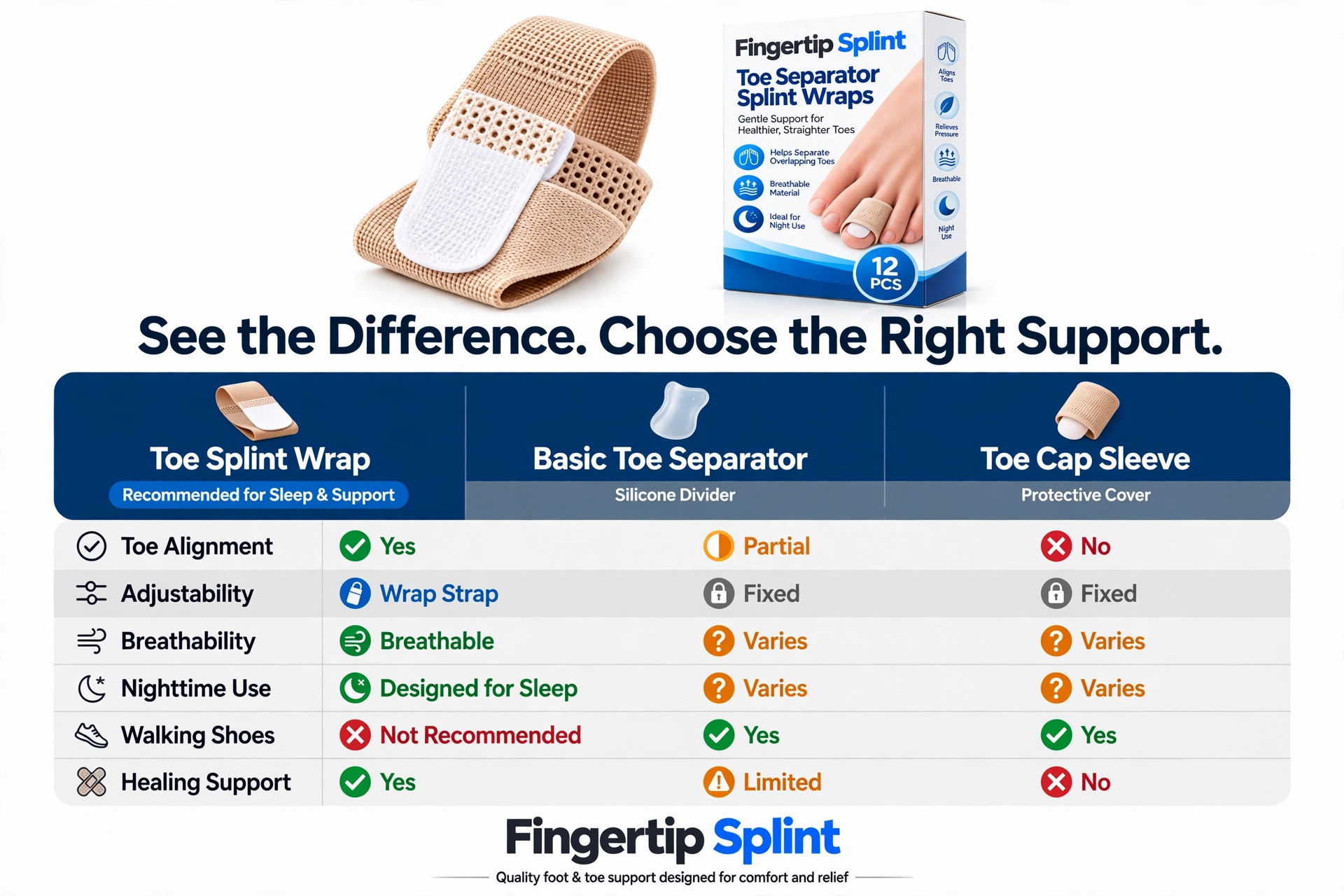
| Type | Main Characteristic | Adjustability | Mobility | Typical Buying Priority |
|---|---|---|---|---|
| Toe separator | Creates space between toes | Low–moderate | High | Comfort |
| Toe separator wrap | Adjustable wrap-based support | High | Moderate–high | Fit |
| Soft toe splint | Flexible support | Moderate | Moderate–high | Comfort/support |
| Structured toe splint | More defined positioning | Varies | Lower | Stability |
| Rigid support | Greater structure | Usually limited | Lower | Specific support needs |
Actual characteristics vary by product, so shoppers should evaluate the specific design rather than relying only on the product category name.
Which Type of Toe Splint Should You Consider?
Find Your Toe Splint Type
Answer a few questions to identify which type of product may best match your priorities.
What is your priority?
Select your priority above to see guidance.
12 Things to Look for When Buying a Toe Splint
These are the core factors that determine whether a toe splint will meet your needs. Evaluate each one before making a purchase decision.
1. Intended Use
The first question to ask is: what do you actually want the product to do? Are you looking for toe separation? Positioning support? Rest? Everyday use? Activity-related support? Nighttime use? Starting with your intended use prevents you from being swayed by features that do not matter for your situation.
2. Support Level
Support levels range from flexible to semi-structured to structured. More structure is not automatically better. A flexible design may be more comfortable for everyday wear, while a structured design may provide more positioning support for specific needs. Match the support level to your intended use.
3. Adjustability
Look for adjustable straps, wrap systems, multiple sizing options, or customizable positioning. Adjustability is useful when you want to fine-tune the fit or when your needs change over time. However, adjustable does not mean “tighten as much as possible.”
4. Fit and Sizing
Evaluate foot size, toe size, product dimensions, the size chart, and the adjustment range. Fit is the most important factor for comfort and effectiveness. For a detailed fit guide, see our toe separator wrap fit and comfort guide.
5. Comfort
Consider soft contact areas, edge design, pressure points, friction, breathability, and material feel. A product that feels fine for a few minutes may become uncomfortable after extended wear. Comfort should be a priority, not an afterthought.
6. Toe Coverage
Does the product cover one toe, two toes, multiple toes, or part of the forefoot? Coverage affects mobility and compatibility with footwear. A product that covers more area may provide more support but may also be more noticeable.
7. Mobility
Ask whether you can move your toes and foot as intended for your activity. A product designed for resting may differ from one intended for walking. If mobility is important, look for low-profile, flexible designs.
8. Material
Evaluate softness, flexibility, breathability, durability, skin contact, and cleaning requirements. Different materials suit different needs. If you have sensitive skin, pay extra attention to the materials that will contact your skin.
9. Fastening System
Compare slip-on, hook-and-loop, wrap, strap, and fixed separator designs. Consider ease of adjustment and stability. A secure fastening system keeps the product in position without requiring excessive tightening.
10. Profile and Bulk
Profile and bulk matter for shoes, socks, walking, and everyday use. A product that feels fine barefoot may be uncomfortable inside a narrow shoe. If you plan to wear the product with shoes, check the available space in the toe box.
11. Cleaning and Maintenance
Check washing instructions, drying requirements, material durability, and repeated-use suitability. A product that is difficult to clean may not be practical for regular use.
12. Intended Wear Time
Determine whether the product is designed for short periods, daytime, walking, rest, nighttime, or extended use. Following the manufacturer’s intended wear time helps ensure safe and appropriate use.
Score the Toe Splint You’re Considering
Interactive Feature Scorer
Rate each factor from 1 (poor) to 5 (excellent) to see how well a product matches your priorities.
Rate the factors above to calculate your overall product match.
Explore the Anatomy of a Toe Splint
Interactive 3D Anatomy View
Click each part to learn what it does and why it matters.
How Should a Toe Splint Fit?
The most important rule for toe splint fit is simple: secure does not mean tight. A well-fitting toe splint stays in position, distributes pressure evenly, and does not interfere with circulation or sensation.
Signs of a Good Fit
- Stable — stays in place when you move
- Comfortable — no significant pain or throbbing
- Correctly positioned — sits where intended
- Normal sensation — you can feel your toes
- No significant pressure — no deep marks or numbness
Signs of Poor Fit
- Sliding or shifting out of position
- Excessive pressure or deep marks
- Numbness or tingling
- Significant discoloration
- Increasing discomfort
- Skin rubbing or irritation
Is Your Toe Splint the Right Size?
Interactive Fit Checker
Answer these questions to assess your current fit.
1. Does it stay in place when you move?
2. Does it create excessive pressure?
3. Can you feel your toes normally?
4. Does it rub your skin?
5. Does it interfere with intended movement?
Answer all questions to see your result.
Flexible vs Structured Toe Splints: Which Should You Choose?
Flexible and structured designs serve different purposes. The right choice depends on your intended use, comfort preferences, and the level of support you need.
| Factor | Flexible | Structured |
|---|---|---|
| Comfort potential | Higher | Depends |
| Mobility | Usually greater | Usually lower |
| Position control | Moderate | Higher |
| Bulk | Often lower | Often higher |
| Everyday use | Often practical | Depends |
| Adjustment | Varies | Varies |
Choose based on intended use rather than assuming that greater rigidity means greater benefit.
Toe Separator vs Toe Splint: What’s the Difference?
These terms are often used interchangeably, but they describe different product categories.
Toe Separator
Primary concept: creates space between toes. Usually flexible and low-profile.
Toe Splint
Broader category: may provide separation, positioning, or support. Can be flexible or structured.
Toe Separator Wrap
Adds adjustability and wrap-based positioning. For a detailed guide, see our toe separator wrap fit and comfort guide.
Should You Buy a Toe Splint for Daytime or Nighttime Use?
Daytime and nighttime use have different requirements. Your choice should reflect when and how you plan to use the product.
| Consideration | Daytime | Nighttime |
|---|---|---|
| Mobility | High priority | Lower priority |
| Shoe compatibility | Important | Usually less important |
| Bulk | Important | Comfort still matters |
| Stability | Important | Important |
| Comfort | Essential | Essential |
| Intended wear | Activity-specific | Rest-specific |
For a detailed guide on nighttime use, see our best toe separator splint for nighttime use.
Does the Toe Splint Fit Inside Your Shoes?
Footwear compatibility is a critical factor that many buyers overlook. A product that feels comfortable barefoot may create pressure inside a shoe.
Wide Toe Box
More room for the product. Generally the most compatible option.
Standard Footwear
Check product bulk. Some designs work well; others may create pressure.
Narrow Footwear
Potential pressure problem. If the shoe is already tight, adding a product may make things worse.
Socks
Socks can change fit and friction. Some people find they help hold the product in place; others find they increase pressure.
Will This Fit in My Shoes?
Featured Product: Toe Separator Wraps 12PCS Adjustable Toe Alignment Support
Toe Separator Wraps 12PCS Adjustable Toe Alignment Support
This product is one option to evaluate if you are specifically looking for an adjustable, wrap-style toe support. Compare it against the criteria discussed throughout this guide.
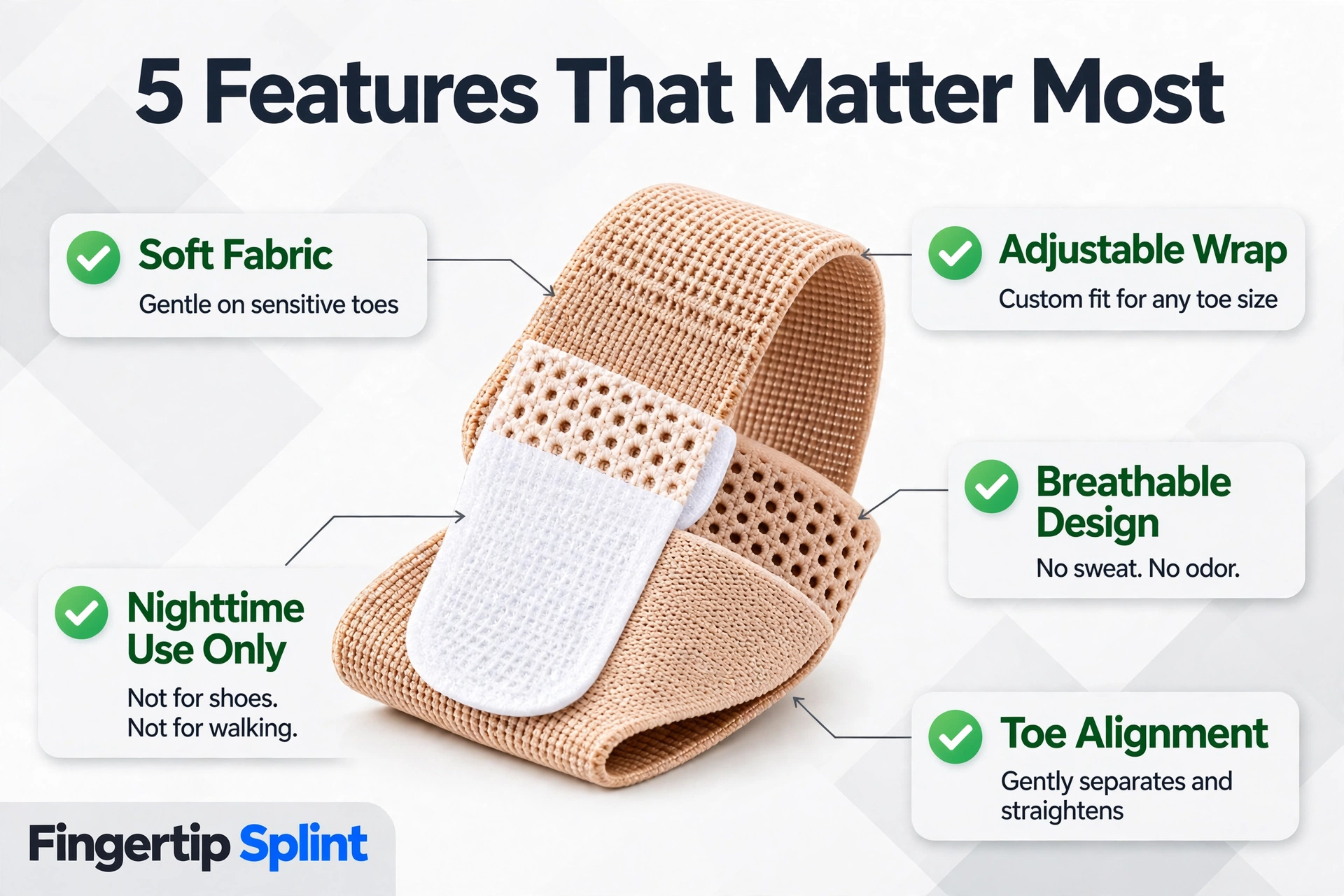
- Adjustable design for customized fit
- Toe separation support
- Wrap format for positioning control
- 12-piece set for multiple toes or backup use
- Low-profile design for everyday wear
- Suitable for repeated use with proper care
What Makes This Product Worth Comparing?
The adjustable design allows you to customize the fit, which is useful when you want to fine-tune tension or positioning. The wrap format provides a different fit experience than a fixed separator. The 12-piece set offers value for multiple toes or backup use.
Fit Considerations
Connect this product to the fit checklist earlier in this guide. Check the size, positioning, and tension before committing to longer wear.
Comfort Considerations
Consider the material, contact areas, and whether the design is appropriate for your intended use. If you have sensitive skin, pay extra attention to how the product feels.
Who Should Compare This Option?
Users specifically evaluating adjustable wrap-style designs. If adjustability is a priority for you, this product is worth comparing against other options using the 12 factors discussed above.
Which Toe Splint Features Matter Most for You?
Prioritize soft material, low bulk, and proper fit.
Prioritize wrap design, adjustable fastening, and size range.
Prioritize separator design, positioning, and stability.
Prioritize mobility, footwear compatibility, and secure fit.
Prioritize comfort, stability, low pressure, and intended overnight use. See our nighttime guide.
Prioritize washable materials and straightforward care instructions.
12 Common Toe Splint Buying Mistakes
Avoid these common errors when choosing a toe splint.
1. Choosing the Tightest Product
Tighter is not better. Excessive pressure can cause numbness, tingling, and skin damage.
2. Buying Without Checking the Size Chart
Size affects fit, stability, and comfort. Do not guess.
3. Assuming All Toe Splints Work the Same Way
Different designs serve different purposes. Match the product to your needs.
4. Ignoring Intended Use
A product designed for rest may not work for walking. Check the manufacturer’s intended use.
5. Choosing Based Only on Appearance
Looks do not determine function. Evaluate the features that matter.
6. Ignoring Shoe Compatibility
If the product does not fit in your shoes, it will not be practical for daytime use.
7. Assuming More Rigidity Is Better
Greater rigidity is not automatically greater benefit. Match the support level to your needs.
8. Ignoring Material and Skin Contact
Materials that contact your skin should be comfortable and appropriate for prolonged wear.
9. Buying Without Considering Adjustability
Adjustability can improve fit and comfort. Consider whether it matters for your situation.
10. Expecting Permanent Correction
A toe splint can hold a position while worn, but permanent structural correction cannot be promised.
11. Ignoring Product Care Instructions
Proper care helps maintain the product and protect your skin.
12. Continuing to Use a Product That Causes Significant Discomfort
Pain is a signal. Remove the product and reassess if it causes significant discomfort.
What to Question When Reading Toe Splint Product Listings
Be cautious with vague or exaggerated claims. These are red flags that suggest a product may not be marketed responsibly.
- “Guaranteed correction”
- “Permanent alignment”
- “Works for everyone”
- “Instant cure”
- “No need for professional advice”
Instead, look for clear sizing information, intended use, materials, instructions, adjustment mechanism, care instructions, and manufacturer information. A product that provides these details is more likely to be responsibly marketed and appropriate for comparison.
When Should You Seek Professional Advice Instead?
Some situations require professional evaluation rather than self-treatment with a support product. Seek assessment if you have significant pain, a recent injury, visible deformity, severe swelling, numbness, tingling, significant discoloration, open wounds, difficulty walking, or symptoms that persist or worsen.
The right support depends on the underlying issue. For authoritative background on bunions, see the Mayo Clinic’s bunion overview. For hammertoes, the Cleveland Clinic hammertoe page provides useful context. The AAOS bunion information and the NHS bunion guide are also reliable sources. For general foot pain information, see WebMD’s foot pain overview and Healthline’s bunion article. The American College of Foot and Ankle Surgeons provides professional-level information.
Questions to Ask a Healthcare Professional
Questions for Your Appointment
How to Evaluate Whether Your Toe Support Is Helping
Do not expect a fixed recovery timeline. Instead, evaluate your progress in stages.
Stage 1 — Initial Fit
Is the product comfortable? Does it stay in position? Can you feel your toes normally?
Stage 2 — Short-Term Use
Does it remain stable during your intended activity? Are there any pressure points or irritation?
Stage 3 — Routine Use
Are there any skin or comfort problems? Does the product continue to fit well?
Stage 4 — Reassessment
Are symptoms improving, unchanged, or worsening? If not improving, reassess your approach.
Stage 5 — Professional Review
If symptoms persist or worsen, seek appropriate evaluation. A support product is not a substitute for professional assessment.
How to Care for a Toe Splint
- Follow manufacturer instructions for cleaning and use.
- Clean as directed and dry completely before storage.
- Do not use damaged products.
- Inspect straps and fastening systems regularly.
- Check material condition for tears, rough edges, or deformation.
- Store appropriately to maintain shape and function.
Toe Splint Buying Checklist
Before You Buy
Frequently Asked Questions About Toe Splints
Compare intended use, support level, toe coverage, adjustability, material, fit, comfort, mobility, fastening system, size options, and care requirements. The best choice is the one that matches your needs without creating unnecessary pressure or discomfort.
Check the manufacturer’s size chart and measure your foot or toe as directed. If you are between sizes, consider whether the product allows adjustment. Fit is the most important factor for comfort and effectiveness.
Not necessarily. Adjustability can improve fit and comfort, but it depends on your needs. A fixed design may work well if it fits correctly. Adjustable designs are useful when you want to fine-tune tension or positioning.
It depends on your intended use. Flexible designs are often more comfortable for everyday wear and allow more mobility. Structured designs may provide more positioning support. Choose based on your needs, not on the assumption that greater rigidity is better.
A toe separator primarily creates space between toes. A toe splint is a broader category that may provide separation, positioning, or support. Some products combine both functions.
Yes, if there is enough space in the toe box. Wide-toe-box shoes and open-toe footwear are generally more compatible. Narrow shoes may increase pressure. Check the fit and comfort before relying on the combination for extended wear.
It depends on the product. Not every toe splint is designed for overnight use. Check the manufacturer’s instructions. For a detailed guide, see our best toe separator splint for nighttime use.
Secure but not excessively tight. You should be able to feel your toes normally without numbness or tingling. If the product leaves deep marks, causes pain, or restricts sensation, it is too tight.
No. A toe splint can hold or separate toes while worn, but permanent structural correction cannot be promised. Long-term changes depend on the underlying condition, severity, duration of use, and individual factors.
Stop using the product if you experience numbness, tingling, significant discoloration, increasing pain, skin damage, or persistent irritation. If problems continue, seek professional advice.
Ready to Choose the Right Toe Splint?
Start With Your Intended Use
Start with your intended use, then compare support, fit, adjustability, comfort, mobility, material, and wear requirements. The right product is the one that matches those needs without creating unnecessary pressure or discomfort.
The Toe Separator Wraps 12PCS Adjustable Toe Alignment Support is one option to evaluate if adjustable fit is a priority. Explore the full toe and foot support collection to compare options, or read our nighttime toe separator guide for overnight-specific guidance.
Explore Toe Support Products View Toe Separator WrapsChoose the Toe Splint That Matches Your Needs
Buying a toe splint is not about choosing the strongest-looking product. It is about choosing a design that matches your intended use, fits properly, provides the appropriate type of support, and remains practical for the way you plan to use it.
Purpose leads to type. Type leads to fit. Fit leads to comfort. Comfort leads to mobility. Mobility leads to safety. Follow this sequence, and you will be better equipped to choose a product that meets your needs.
For more detailed guidance, see our toe separator wrap fit and comfort guide and our nighttime toe separator guide. For professional purchasing information, visit the medical splint and support resources page, or request a product quote for bulk or clinical needs.