
If your fingers feel weaker than they used to, or if you have noticed that your hand tires more easily during everyday tasks, you may be wondering what kind of exercise could help. You might already have tried squeeze balls or hand grippers, but felt that they did not address every movement your hand needs. That is where finger extensor training comes in. A finger extensor exerciser is a resistance-based tool designed to work the muscles involved in opening or extending the fingers. This guide explains how it works, what the potential benefits are, how to use resistance safely, and what to check before buying. For a broader view of hand support and exercise options, explore the full FingerTipSplint range.
Table of Contents
- Why Finger Strength and Extension Matter
- What Is a Finger Extensor Exerciser?
- How a Finger Extensor Exerciser Works
- Finger Extensor Exerciser Benefits
- Finger Extensor Exerciser vs. Hand Gripper
- How to Choose a Finger Extensor Exerciser
- How to Use a Finger Extensor Exerciser Safely
- How Long Does It Take to Improve Finger Strength?
- Finger Extensor Exerciser Mistakes to Avoid
- Who Should Consider a Finger Extensor Exerciser?
- When to Seek Medical Advice
- Is the FingerTipsSplint Finger Extensor Exerciser Right for You?
- Frequently Asked Questions
A finger extensor exerciser is a resistance-based tool designed to work the muscles involved in opening or extending the fingers. Depending on its design, it may help users train finger extension and complement a broader hand-strengthening routine. The appropriate resistance, exercise technique, and frequency depend on the person’s goals, comfort, and any existing injury.
Why Finger Strength and Extension Matter in Everyday Life
Think about the last time you tried to spread your fingers wide, maintain control while holding a small object, or keep your hand comfortable during a long typing session. These movements rely on finger extension — the ability to open and straighten the fingers against resistance.
Grip strength and finger extension are different movements. Grip involves closing the hand around an object. Extension involves straightening or opening the fingers. Both matter for hand function, but they involve different movement patterns and should not be treated as interchangeable. According to Cambridge University Hospitals guidance on active finger exercises, hand exercises target specific joints and movements — so the exercise must match the goal.
Common Situations Where Extension Matters
- Struggling to spread the fingers — for example, when opening the hand fully.
- Difficulty maintaining control while handling small objects — this can be frustrating and affect daily tasks.
- Hand fatigue during computer work — prolonged typing can tire the hand, especially if strength is imbalanced.
- Feeling that squeezing exercises do not address every movement — grip training alone may not train extension.
If you are comparing equipment for finger-extension training, explore the FingerTipsSplint finger extensor exerciser and check its actual design, resistance mechanism, sizing, and instructions before deciding whether it matches your needs.
What Is a Finger Extensor Exerciser?
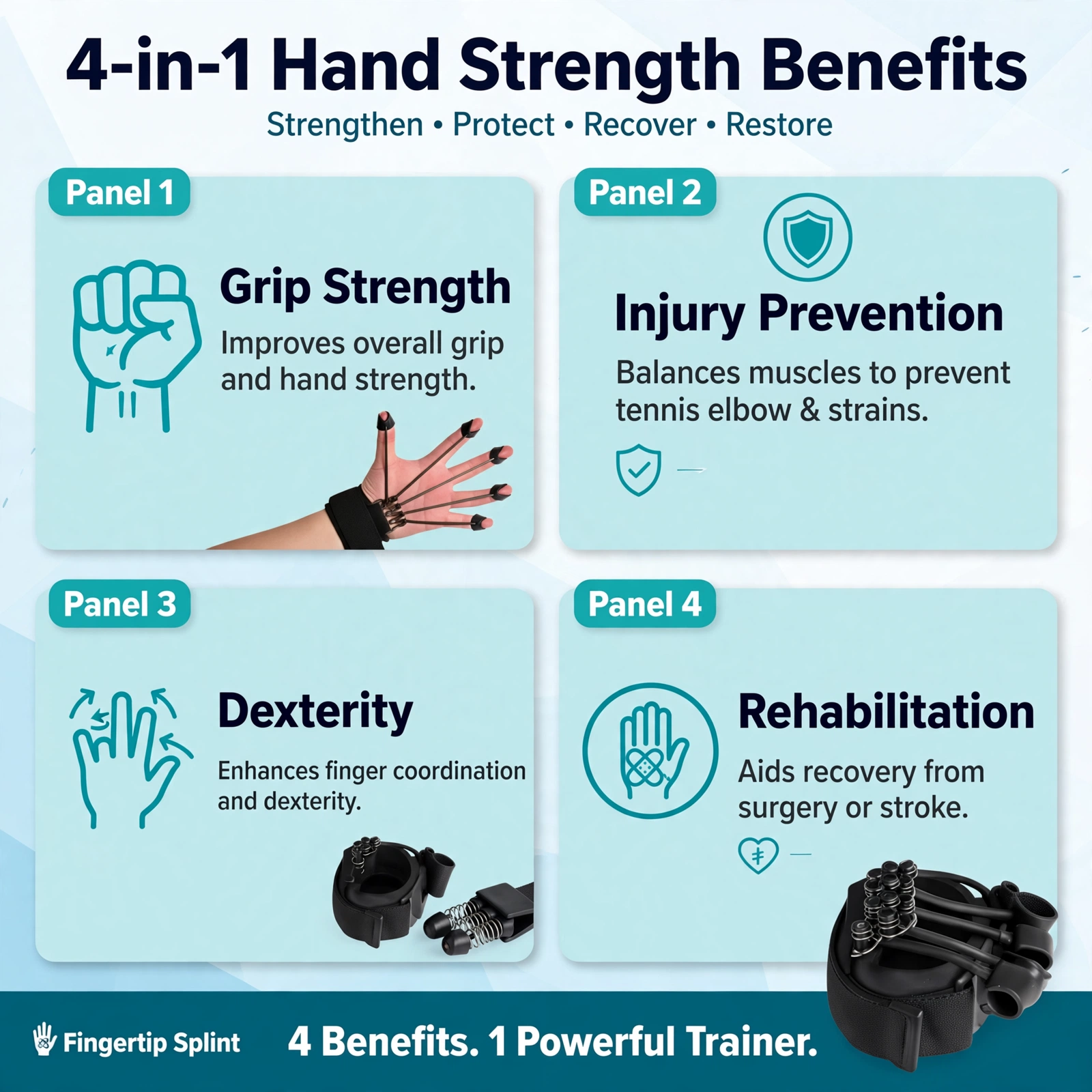
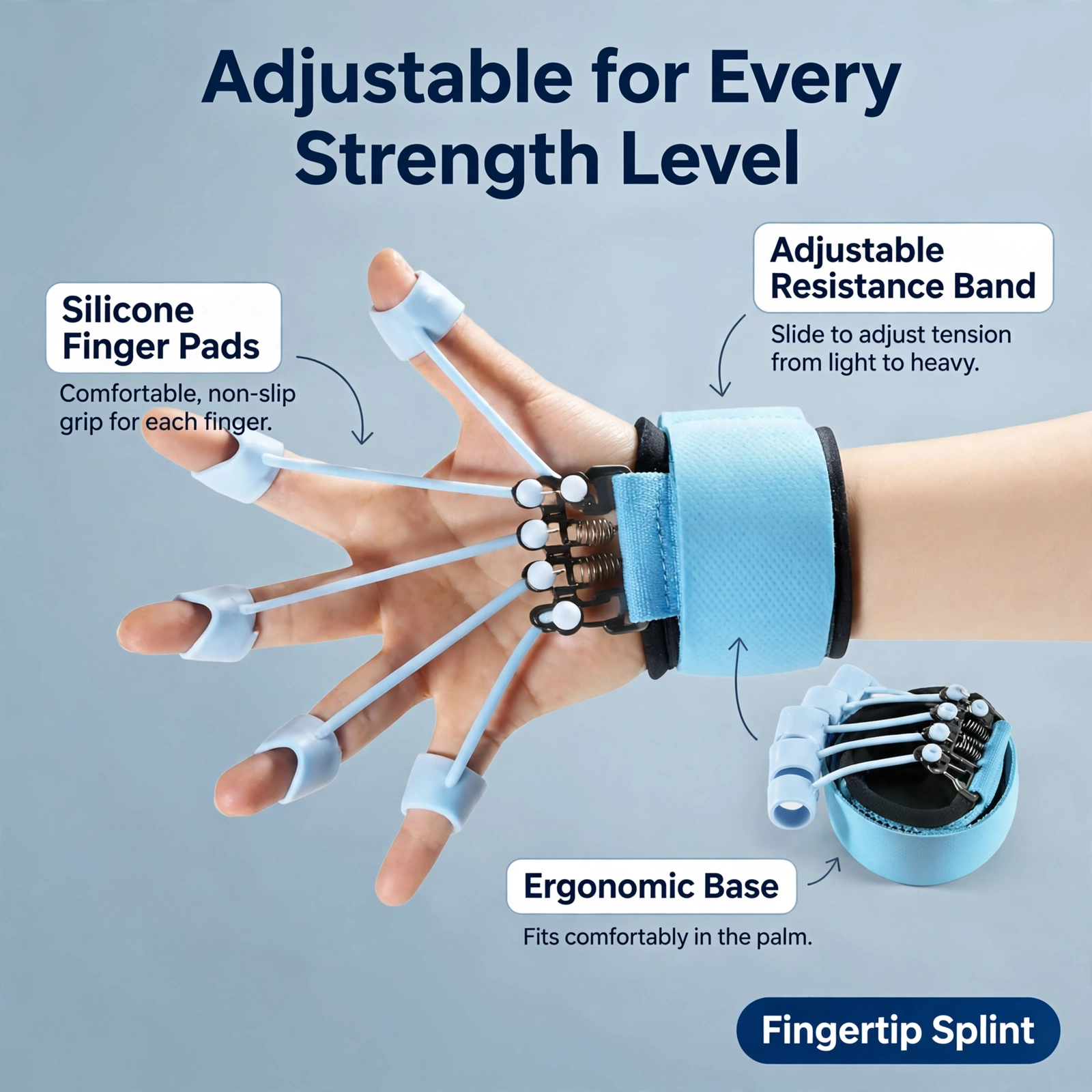
A finger extensor exerciser is exercise equipment that provides resistance when you open, spread, or extend the fingers, depending on the design. It is different from a squeeze ball or hand gripper, which focuses on closing the hand.
What Finger Extension Means
Finger extension is the movement of straightening or opening the fingers. It involves the extensor tendons, which run along the back of the hand and fingers, and the muscles in the forearm that contribute to the movement.
How Resistance Makes Exercise More Demanding
When you move your fingers without a device, the resistance is minimal. An exerciser adds resistance, which makes the muscles work harder. This is the principle behind progressive resistance training.
Different Designs, Different Movements
Not all extensor exercisers are the same. Some are designed to provide resistance when you open the fingers. Others may focus on spreading the fingers or a combination of movements. Check the product instructions to understand which movement the device is designed to train.
For a clinically grounded explanation, Cambridge University Hospitals’ guidance on extensor tendon repair explains that rehabilitation after tendon repair follows specific protocols and is different from routine strength training.
How a Finger Extensor Exerciser Works
The movement cycle of a finger extensor exerciser typically involves three stages. Understanding them helps you use the device correctly.
Starting Position
The fingers are positioned according to the device’s instructions, without forcing a painful joint. The starting position should feel comfortable.
Extension Against Resistance
The user opens or extends the fingers against the resistance provided by the tool. The movement should be controlled, not rushed.
Controlled Return
The fingers return to the starting position slowly, where the device allows this movement. This controlled return is part of the exercise.
Resistance and Technique
More resistance is not automatically better. Excessive resistance may encourage compensation, poor technique, or discomfort. Choose a resistance level that allows controlled movement.
| Training Goal | Movement Focus |
|---|---|
| Finger extension | Opening or straightening the fingers |
| Finger spreading | Moving the fingers apart |
| Grip strengthening | Closing the hand around an object |
| Finger mobility | Practising an appropriate range of movement |
For a closer look at how hand exercises target specific joints and movements, see Cambridge University Hospitals’ active finger exercise guide. Therapeutic exercises after injury should follow professional instructions.
Explore Finger Extension
Select an area below to learn about its role and safety considerations.
Finger Extensor Exerciser Benefits for Hand Strength
The potential benefits of finger extensor training depend on the device, the user’s goals, and consistent, appropriate training.
Practising Finger-Opening Strength
Progressive resistance may help train the movement involved in opening the hand. Results depend on consistent, appropriate training and the individual’s starting point.
Training a Movement That Grip Exercises May Not Emphasize
Squeezing a gripper trains grip. Extending the fingers trains a different movement. Both can be useful, but a grip device alone does not provide the same movement as a finger-extension tool.
Supporting a Broader Hand-Training Routine
Extension exercises may complement other suitable hand exercises when the user has no contraindication. A single tool does not train every muscle or prevent all hand problems.
Developing Movement Awareness and Control
Controlled movement, appropriate resistance, and avoiding unnecessary tension in the wrist or other fingers are part of good training technique.
Supporting Goal-Oriented Practice
A specific functional goal — such as improving performance during hobbies, work, or everyday tasks — is more useful than expecting an exerciser to improve every aspect of hand function.
For practical context, Guy’s and St Thomas’ NHS Foundation Trust’s therapeutic putty exercises show another form of hand-strengthening exercise. They are not interchangeable with an extensor exerciser, but they illustrate how different tools target different movements.
Finger Extensor Exerciser vs. Hand Gripper
Different devices serve different purposes. Here is how they compare.
| Device | Primary Movement or Function | What to Consider |
|---|---|---|
| Finger extensor exerciser | Finger opening or extension against resistance | Finger placement, resistance, comfort, and intended movement |
| Hand gripper | Closing the hand around a resistance handle | Grip-focused training and comfortable handle size |
| Silicone hand grip trainer | Squeezing or other hand exercises | Material, resistance, cleaning, and instructions |
| Adjustable finger resistance trainer | Resistance-based finger training | Adjustment range and correct use |
Compare the actual construction rather than relying on product names alone. Readers comparing progressive finger resistance can explore how an adjustable finger resistance trainer supports grip training. Readers considering another type of equipment can read about silicone hand grip trainers and their daily exercises.
How to Choose a Finger Extensor Exerciser
Choosing the right exerciser requires matching the device to your current ability and goals. Here is a practical buyer’s checklist.
- Resistance level: Is the resistance appropriate for the user’s current ability? Beginners may need a lower starting demand.
- Finger placement: Can the device be positioned correctly without awkward wrist or finger angles?
- Adjustability: If resistance is adjustable, are the settings clear and suitable for the intended user?
- Comfort: Are the contact points comfortable, without excessive pressure or rubbing?
- Ease of use: Can the user follow the instructions without forcing the device or using compensatory movements?
- Durability and care: Are cleaning instructions and product-care information available?
- Intended use: Is the device designed for general exercise, rehabilitation under supervision, or another purpose?
After identifying your intended movement and training goals, browse the FingerTipSplint shop to explore relevant products.
How to Use a Finger Extensor Exerciser Safely
Safe use is essential. Follow this general safety framework, adapted to your specific device and situation.
Step 1: Read the product instructions and confirm the intended movement.
Step 2: Start with a comfortable hand position and a resistance level that permits controlled movement.
Step 3: Keep the wrist relaxed and avoid using momentum to complete the movement.
Step 4: Move smoothly and avoid snapping the fingers back against resistance.
Step 5: Stop if sharp pain, increasing symptoms, numbness, or unusual tingling occurs.
Step 6: Allow recovery between sessions and increase difficulty only when the movement remains comfortable and controlled.
How Long Does It Take to Improve Finger Strength?
Progress depends on the person’s baseline strength, training consistency, resistance, technique, recovery, and whether a medical condition affects movement. There is no single timeline that applies to everyone.
Instead of promising week-by-week results, here is a framework for monitoring progress:
- Starting point: Record the movement or everyday task you want to improve.
- Early practice: Focus on learning the movement and using the device correctly.
- Consistent training: Track comfort, movement quality, and the ability to use appropriate resistance.
- Reassessment: If progress stalls or symptoms worsen, reconsider technique, resistance, and whether professional advice is needed.
Finger Extensor Exerciser Mistakes to Avoid
Some mistakes can limit results or cause discomfort. Here are the most common ones.
Excessive resistance can lead to poor technique and discomfort.
Solution: Start with a resistance that allows controlled movement.
Rushing repetitions reduces the effectiveness of the exercise.
Solution: Move smoothly and control both the extension and the return.
Compensating with other muscles makes the exercise less targeted.
Solution: Keep the wrist relaxed and focus on the finger movement.
They involve different movement patterns and require different exercises.
Solution: Choose exercises that match your specific goals.
Pain is a signal to stop and reassess.
Solution: Stop and seek advice if symptoms persist or worsen.
Different tools serve different purposes.
Solution: Use the right tool for the specific movement you want to train.
Who Should Consider a Finger Extensor Exerciser?
Different groups of people may find a finger extensor exerciser useful, depending on their goals and health.
General Fitness Users
People looking to add finger-extension movements to a broader hand-training routine.
People Who Already Train Grip
Users interested in practising a different movement from squeezing or gripping.
Musicians, Hobbyists, and Computer Users
People exploring hand exercises to complement their activities — though the device does not prevent repetitive-strain conditions.
People Returning to Exercise
Users who need an appropriate starting resistance and gradual progression.
People Recovering From an Injury
Only where the treating clinician confirms that resistance exercise is suitable. For tendon injuries, see North Tees and Hartlepool NHS Foundation Trust guidance on extensor tendon rehabilitation. A post-surgical exercise programme must be prescribed for the individual’s injury and stage of recovery.
When a Finger Extensor Exerciser Is Not the Right First Step
Resistance training is not an appropriate first response to every hand problem. Some symptoms require professional assessment.
Seek medical advice for:
- New weakness
- A sudden inability to straighten a finger
- Severe pain
- Visible deformity after an injury
- Altered sensation
The message should be reassuring but direct: first identify the problem, then choose the appropriate exercise or support device.
Is the FingerTipsSplint Finger Extensor Exerciser Right for You?
If you are exploring resistance-based finger-extension training, the FingerTipsSplint Finger Extensor Exerciser is one option to evaluate. This guide does not claim that it cures any condition or guarantees strength gains. What it offers is a design intended to provide resistance during finger extension.
Before purchasing, consider these questions:
- What movement is the device designed to train?
- How does the user position the fingers?
- What resistance or adjustment options are actually available?
- What instructions are provided for use and care?
- Is the design appropriate for the buyer’s intended purpose?
- When should the buyer consult a healthcare professional before using it?
Verify these details against the live product page. Do not assume resistance levels, materials, or certifications unless they are clearly stated. If your goal is to explore resistance-based finger-extension training, review the FingerTipsSplint finger extensor exerciser to check its intended use and product instructions before making a decision.
For broader brand context, visit the FingerTipsSplint homepage. For questions about ordering or product information, see the FingerTipsSplint FAQs.
Explore the Finger Extensor Exerciser
If your goal is to explore resistance-based finger-extension training, review the FingerTipsSplint Finger Extensor Exerciser, check its intended use and product instructions, and decide whether its design matches your needs.
View the Product Browse All ProductsFinger Extensor Exerciser FAQs
A finger extensor exerciser provides resistance when you open, spread, or extend the fingers, depending on the design. It is used to train the muscles involved in finger extension — a different movement from grip strengthening.
It may help train the muscles involved in finger extension when used consistently with appropriate resistance and technique. However, results depend on the individual’s starting point, consistency, and whether a medical condition affects movement.
A hand gripper trains closing the hand around a resistance handle. A finger extensor exerciser trains opening or extending the fingers. Both are useful, but they involve different movement patterns and should not be treated as interchangeable.
Daily use is not appropriate for everyone. The right frequency depends on your goals, the device, and your current ability. Allow recovery between sessions and increase difficulty gradually.
This depends on the injury and the stage of recovery. Recent injuries, tendon repairs, fractures, or surgery may require professional guidance before resistance exercise. Follow your clinician’s instructions rather than starting on your own.
A beginner should choose a resistance level that allows controlled movement. More resistance is not automatically better — excessive resistance may encourage poor technique or discomfort. Increase resistance only when the movement remains comfortable and controlled.
Stop using the exerciser if you experience sharp pain, increasing symptoms, numbness, unusual tingling, or changes in finger colour. Seek medical advice if symptoms persist or worsen.
Build a Smarter Finger-Strength Routine
Finger extension is a different movement from gripping. The right resistance tool depends on your goal, and safe technique matters more than simply choosing a stronger device.
Use this guide as a framework: understand the movement you want to train, review the product’s actual specifications, choose a resistance level that allows controlled movement, and follow safe-use principles. Stop using the exerciser if it causes pain or unusual symptoms, and seek professional advice if symptoms persist.
For readers who want to explore support products, the FingerTipSplint shop offers a selection. For more hand-care education, visit the FingerTipSplint blog. For personalized assistance, you can request a quote or review the frequently asked questions.
Your hands carry you through everything. Choosing the right exercise tool — and knowing when to seek professional advice — is part of caring for them well.