
You might train your hands regularly, but still struggle with sustained gripping, finger control, or repetitive hand tasks. It is a frustrating experience: you feel like you are putting in the effort, yet the improvement is not showing up in the activities you care about. One reason may be that grip training is not only about squeezing a hand gripper. Finger movement and the muscles controlling it also matter. An adjustable finger resistance trainer is a tool that allows you to add controlled, progressive resistance to finger-focused exercises. This guide explains what it does, how it differs from other hand-training equipment, how to use one safely, and what to check before buying. For a broader view of hand and finger support products, explore the full FingerTipSplint range.
Table of Contents
- What Is an Adjustable Finger Resistance Trainer?
- How It Improves Grip Training
- Potential Benefits
- Adjustable Trainer vs. Traditional Hand Gripper
- How to Use an Adjustable Finger Resistance Trainer
- How to Choose the Right Trainer
- Common Finger Training Mistakes to Avoid
- Who May Benefit — and Who Should Ask for Advice First?
- How to Track Your Grip-Training Progress
- Explore Finger Resistance Training Products
- Frequently Asked Questions
An adjustable finger resistance trainer can add controlled, adjustable resistance to finger-focused exercise. Depending on its design, it may complement grip training by helping users practise specific finger movements and progress gradually. Choosing the right resistance, maintaining proper technique, and following relevant safety guidance are important for a suitable training routine.
What Is an Adjustable Finger Resistance Trainer?
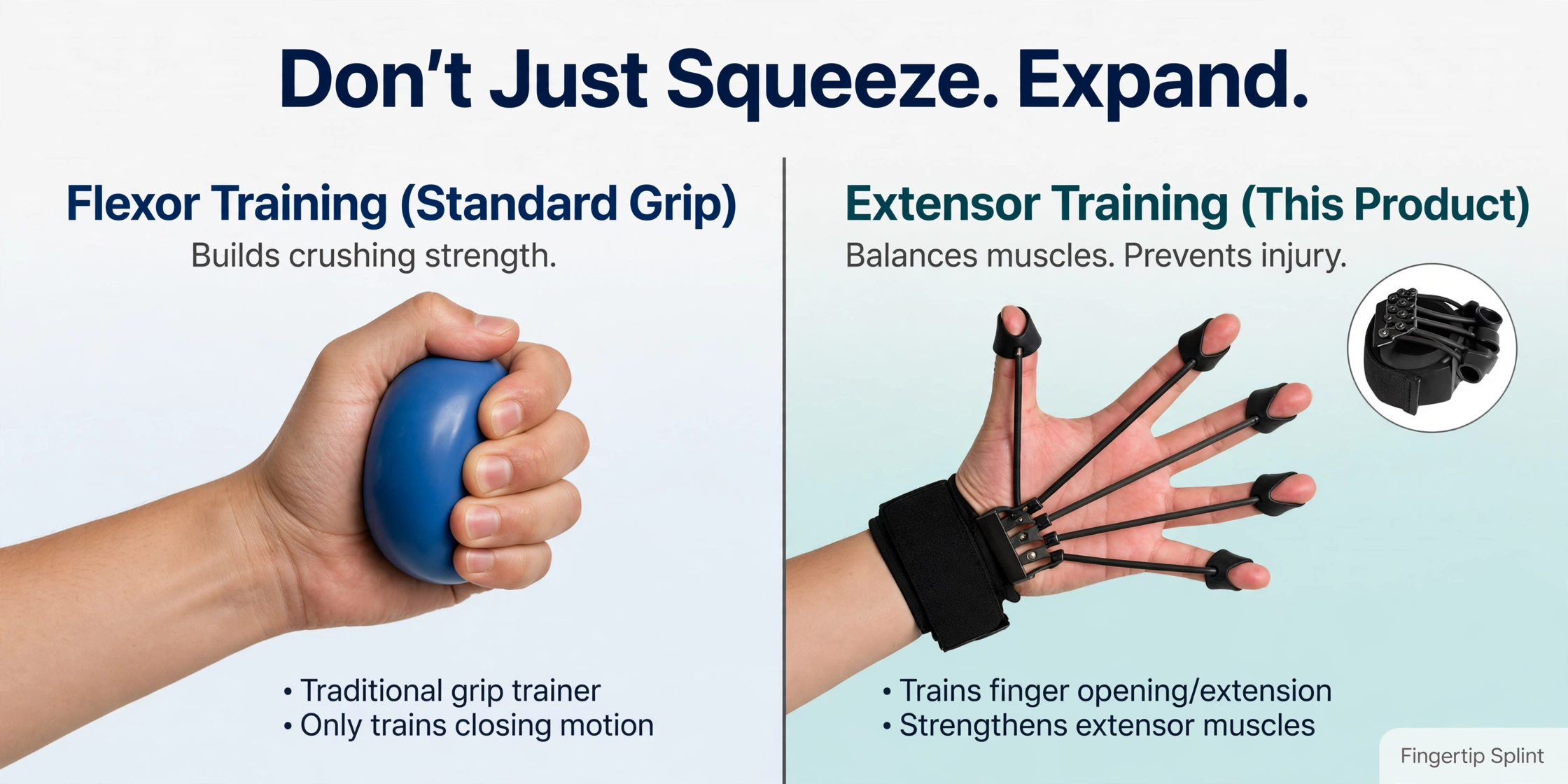
An adjustable finger resistance trainer is a device designed to provide resistance during finger exercises. Unlike a traditional hand gripper that focuses on closing the hand around a handle, a finger resistance trainer typically targets specific finger movements — opening, closing, or individual finger control — depending on the design.
What “Adjustable Resistance” Means
Adjustable resistance means the device allows you to change the level of difficulty. This can be useful for different training levels, from beginners to more experienced users. According to Cambridge University Hospitals guidance on active finger exercises, hand exercises should be tailored to the specific movement and joint involved.
How Finger Training Differs from Gripper Training
A hand gripper primarily trains grip strength — the ability to close the hand around an object. A finger resistance trainer can train different movements, such as finger extension, individual finger control, or finger flexion. The exact movement depends on the device’s design and instructions.
How an Adjustable Finger Resistance Trainer Improves Grip Training
An adjustable finger resistance trainer can complement a broader hand-training routine by adding controlled resistance to finger-focused movements. Here is how it may help.
Progressive Resistance
Adjustable resistance allows users to gradually increase the challenge as their ability and comfort develop. According to Guy’s and St Thomas’ NHS Foundation Trust’s therapeutic putty exercises, hand-strengthening exercises often involve progressive resistance.
Finger-by-Finger Control
Some designs allow users to focus on individual finger movements. This can help develop coordination and control, depending on the trainer’s design.
Training Consistency
A simple, repeatable routine can help users track their practice and maintain consistency. This is often more important than using the highest resistance available.
Balanced Hand Training
Grip involves different movements and muscle groups. A finger resistance trainer may help train movements that a hand gripper alone does not emphasize, but one device may not train every aspect of hand function.
Explore Finger Resistance Training
Select a factor below to see its role in grip training.
Potential Benefits of Adjustable Finger Resistance Training
The potential benefits of an adjustable finger resistance trainer are practical and specific. They depend on the device design, exercise technique, and consistency.
Adaptable Training
Resistance may be adjusted to match the user’s current ability, allowing gradual progression.
Controlled Practice
A suitable trainer can help users focus on deliberate finger movements rather than rushing through repetitions.
Training Progression
Users can record resistance settings and note how exercises feel over time, providing a way to track progress.
Convenience
A compact device may fit into a home or desk-based exercise routine, making it easier to train consistently.
Grip-Training Variety
Finger-focused resistance may complement other appropriate hand exercises, providing variety in a training routine.
For a related type of finger training, the article on finger extensor exerciser uses and benefits explains extension-focused equipment in more detail.
Adjustable Finger Resistance Trainer vs. Traditional Hand Gripper
Different devices serve different purposes. Here is how they compare.
| Feature | Finger Resistance Trainer | Traditional Hand Gripper |
|---|---|---|
| Main training emphasis | Depends on its finger-resistance mechanism | Repeated squeezing |
| Resistance adjustment | Available on adjustable models | Varies by model |
| Finger movement | Depends on device design | Typically involves closing the hand around handles |
| Progress tracking | Can record the setting, if adjustable | Can record resistance or repetitions, if known |
| Best choice | Depends on the intended exercise and fit | Depends on the user’s grip-training goals |
Neither device is universally superior. A trainer designed for finger extension, for example, should not be described as equivalent to one designed for finger flexion. For readers considering another type of equipment, the article on silicone hand grip trainers and daily exercises provides useful context.
How to Use an Adjustable Finger Resistance Trainer
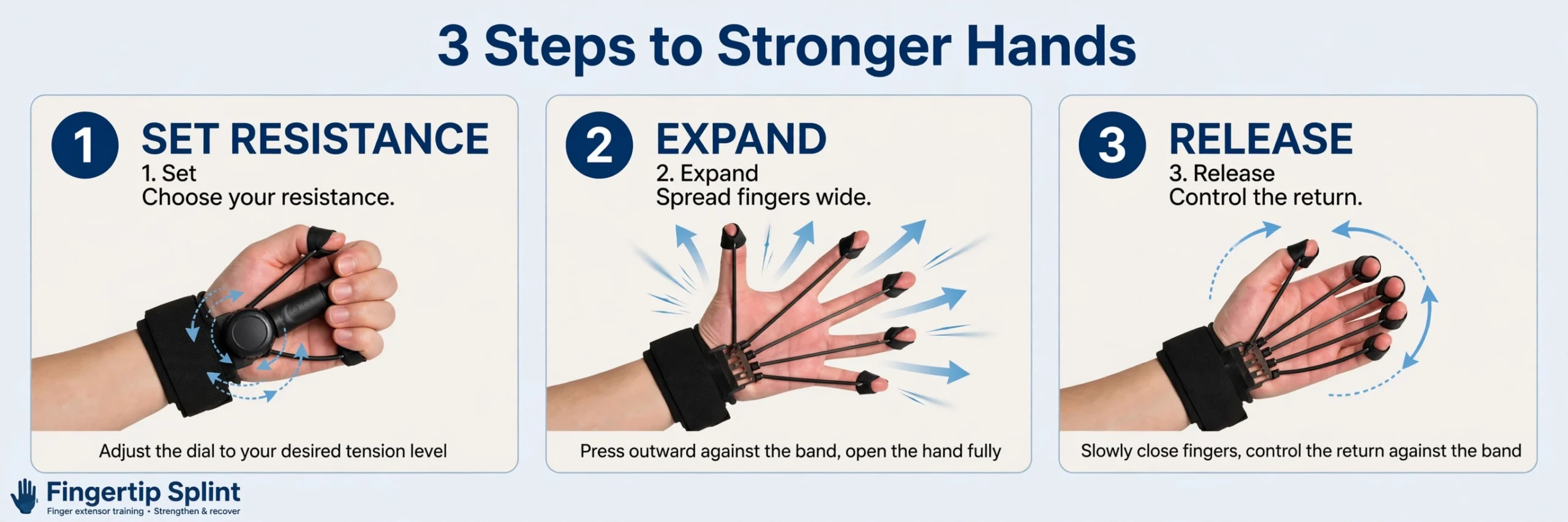
Safe use is essential for comfort and effectiveness. Follow this beginner-friendly guide, adapting it to the specific device instructions.
Step 1: Read the manufacturer’s instructions and inspect the trainer.
Step 2: Select a comfortable starting resistance.
Step 3: Position the fingers and hand as directed for that model.
Step 4: Move slowly and maintain control rather than forcing the movement.
Step 5: Stop if the exercise causes pain, unusual swelling, numbness, or worsening symptoms.
Step 6: Record the setting and how the exercise felt so progress can be reviewed.
How to Choose the Right Adjustable Finger Resistance Trainer
Choosing the right trainer requires matching the device to your goals and ability. Here is a practical checklist.
Resistance Range
Check whether the available levels suit the intended use. A beginner may need a lower starting range.
Adjustment Mechanism
Confirm that the resistance can be changed easily and securely.
Fit and Comfort
Consider hand size, finger placement, and pressure points. The device should feel comfortable during use.
Exercise Direction
Determine whether the model trains opening, closing, or another movement. Match the device to your intended exercise.
Build and Care
Review the verified material, cleaning instructions, and manufacturer guidance. Product transparency matters.
Product Transparency
Look for clear photos, dimensions, instructions, and return or support information.
Common Finger Training Mistakes to Avoid
Some mistakes can undermine training or make the device uncomfortable. Here are the most common ones.
Excessive resistance can lead to poor technique and discomfort.
Solution: Start with a resistance that allows controlled movement.
Rushing repetitions reduces the effectiveness of the exercise.
Solution: Move slowly and control both phases of the movement.
Pain is a signal to stop and reassess.
Solution: Stop and seek advice if symptoms persist or worsen.
Progressing too quickly can lead to poor technique or injury.
Solution: Increase resistance gradually, only when the current level feels comfortable.
Different devices train different movements.
Solution: Choose a device that matches your specific goal.
Rehabilitation after injury or surgery requires professional guidance.
Solution: Follow your clinician’s instructions.
Who May Benefit — and Who Should Ask for Advice First?
Healthy adults interested in hand exercise may consider a suitable trainer as part of general fitness. Suitability depends on the product’s intended purpose and the user’s needs.
Who May Benefit
- People looking to add finger-focused resistance to a hand-training routine
- People who want to practise individual finger movements
- People returning to exercise who need an appropriate starting resistance
- People interested in complementing other hand exercises
Who Should Seek Advice First
People with ongoing pain, swelling, reduced movement, numbness, or a recent injury should seek appropriate professional advice before beginning resistance exercises. This includes those recovering from a tendon injury, fracture, or surgery. According to NHS guidance on finger pain, these symptoms should be assessed by a healthcare professional.
How to Track Your Grip-Training Progress
Tracking your training helps you see whether you are making progress and whether the routine is working for you. A simple training log can record:
- Date and exercise performed
- Resistance setting (if the product has one)
- Repetitions or duration according to the device instructions
- Comfort and movement control
- Any unusual symptoms
Progress should be evaluated through consistency, comfort, and control — not simply by increasing resistance as quickly as possible. There is no guaranteed timeline for strength gains.
Explore Finger Resistance Training Products
If you are looking for an adjustable finger resistance trainer, browse the FingerTipSplint shop to compare available products. Before purchasing, check the product’s actual resistance range, adjustment mechanism, finger placement, and instructions.
Related products and guides may also help you understand the differences between finger training, finger support, and rehabilitation devices:
- Finger exerciser splint uses and benefits — for readers considering a supportive device rather than resistance training
- How a finger training brace supports finger movement — for readers who need movement support rather than active exercise
- Finger straightener orthosis features and daily use — for readers considering positioning products
For product or ordering questions, review the FingerTipSplint FAQs.
Explore Finger Resistance Training Products
If you are ready to add finger-focused resistance to your training routine, browse the FingerTipSplint shop, compare products, and confirm that the design and instructions match your intended use.
Browse the Shop Read the FAQsFrequently Asked Questions
An adjustable finger resistance trainer provides resistance during finger exercises. The adjustable setting allows users to change the level of difficulty. Depending on the design, it may train finger extension, individual finger control, or other movements. Always follow the manufacturer’s instructions.
It may help train specific finger movements that contribute to grip function, but it is not a guaranteed grip-strength solution. Grip involves different movements and muscle groups. A balanced routine may include multiple approaches. Results depend on consistent, appropriate training.
Neither device is universally better. A hand gripper focuses on closing the hand around a resistance handle, while a finger resistance trainer can target different finger movements. The right choice depends on your training goals and the exercise you want to practise.
Beginners should choose a resistance level that allows controlled movement. More resistance is not automatically better. Start with a comfortable setting and increase only when the current level feels manageable.
Daily use is not appropriate for everyone. The right frequency depends on your goals, the device, and your current ability. Allow recovery between sessions and follow the manufacturer’s instructions. If you experience pain or unusual symptoms, stop and seek advice.
It may help some people practise controlled finger movement, but stiffness has different causes. Some conditions benefit from gentle movement, while others require rest or immobilization. Professional assessment is recommended before using resistance exercise for stiffness.
Avoid resistance exercises if you have a recent injury, tendon repair, fracture, surgery, significant swelling, persistent pain, or new numbness. Seek professional advice before beginning resistance training in these situations.
Build a Smarter Finger-Training Routine
An adjustable finger resistance trainer can add flexibility to a finger-focused training routine by allowing controlled, progressive resistance. But it is not a guaranteed shortcut to stronger grip or a cure for any hand condition.
Use this guide as a framework: understand the movement you want to train, review the product’s actual specifications, choose a resistance level that allows controlled movement, and follow safe-use principles. Stop using the trainer if it causes pain or unusual symptoms, and seek professional advice if symptoms persist.
For readers who want to explore support products, the FingerTipSplint shop offers a selection. For more hand-care education, visit the FingerTipSplint blog. For personalized assistance, you can request a quote or review the frequently asked questions.
Your hands carry you through everything. Choosing the right training tool — and knowing when to seek professional advice — is part of caring for them well.