
If your toes overlap, rub against each other, or feel uncomfortable inside your shoes, choosing the right support can be confusing. Product descriptions often promise relief, but the real question is whether the device matches the actual source of your discomfort. An elastic forefoot pad may help cushion or separate the toes, depending on its design. But a comfortable fit matters more than forcing toes into a particular position. This guide explains what a forefoot pad does, how to check fit, common mistakes to avoid, and when a different product or professional assessment is the right next step. For a broader view of foot and hand support products, explore the full FingerTipSplint range.
Table of Contents
- Understanding Overlapping Toes and Forefoot Pressure
- What Is an Elastic Forefoot Pad?
- Potential Comfort Benefits
- Product Guide — Choosing the Right Support
- Forefoot Pad vs. Toe Separator vs. Bunion Pad
- How to Check Fit and Wear Comfortably
- What to Expect When Adjusting
- Common Fit and Comfort Mistakes
- Who May Be Suitable?
- Doctor Advice — When Foot Discomfort Needs More
- Buyer Checklist
- Combining Footwear Changes With the Right Support
- Frequently Asked Questions
An elastic forefoot pad is designed to provide cushioning or support around the front of the foot, depending on its design. For overlapping toes, the right product depends on where pressure occurs and whether the toes need cushioning or separation. A comfortable fit should not cause pain, numbness, skin irritation, or additional pressure.
Understanding Overlapping Toes and Forefoot Pressure
Overlapping toes occur when one toe sits partly above, below, or against another. This can cause rubbing, pressure, and difficulty finding shoes that fit comfortably.
Common Contributing Factors
- Foot structure: Some people are naturally more prone to toe crowding.
- Toe deformities: Conditions like bunions or hammer toes can change toe alignment.
- Footwear pressure: Narrow shoes can squeeze the toes together.
- Underlying conditions: Arthritis and other conditions may affect toe alignment.
According to the NHS bunion guidance, not every overlapping toe is caused by hallux valgus. The location of discomfort matters.
Why the Location of Discomfort Matters
- Pain between two toes: May involve friction or crowding.
- Pain beneath the ball of the foot: May have a different cause.
- A prominent joint near the big toe: May be associated with a bunion.
- Sudden pain, swelling, or new deformity: May need medical assessment.
What Is an Elastic Forefoot Pad, and How Does It Work?
An elastic forefoot pad is a supportive device designed to fit around the front of the foot. Its function depends on its design — some pads cushion the ball of the foot, others separate the toes, and some combine both functions.
Key Design Considerations
- Intended placement: Does the device sit around the forefoot, between the toes, or over a specific joint?
- Function: Does it cushion, separate, support, or combine functions?
- Elasticity: How does the material affect fit and pressure?
- Thickness: Thicker materials provide more cushioning but take up more room in the shoe.
- Instructions: The product-specific instructions determine how it should be worn.
Elastic Forefoot Pad for Overlapping Toes — Potential Comfort Benefits
The potential benefits of an elastic forefoot pad depend on the device’s design, the person’s foot condition, and how it is used.
Reducing Friction
Appropriate cushioning or separation may reduce contact between toes in certain situations. According to the Cleveland Clinic’s guide to toe separators and spacers, separation and cushioning are different functions.
Improving Footwear Comfort
Some users may find a correctly fitted product more comfortable when paired with shoes that leave adequate room for the toes. If the shoe is too tight, the device may add pressure instead of relieving it.
Supporting a Daily Routine
A product that is easy to position and maintain may fit into a daily foot-care routine, provided it is designed for the intended use.
Helping Users Explore Conservative Options
Pads, spacers, and appropriate footwear may form part of a broader comfort strategy. A pad that is too thick or tight can increase pressure, so benefits depend on the product design and the person’s foot condition.
Explore Forefoot Fit and Toe Support
Select an area below to learn more about it.
Product Guide — Choosing the Right Support for Your Feet
Choosing the right support requires matching the product to your actual problem. Here are the practical questions to answer.
- Where is the problem located? Is the discomfort between the toes, under the ball of the foot, or around a prominent joint?
- What does the product do? Does it cushion, separate, or support?
- Is the material suitable for skin contact? Check for softness and skin compatibility.
- Can the fit be adjusted? Some devices offer adjustable straps or multiple sizes.
- Will it fit inside your shoes? The device should not make the shoe tighter.
- Are cleaning and wear instructions available? Follow the manufacturer’s guidance.
If you are specifically looking for a toe separation option, the FingerTipsSplint Hallux Valgus Toe Separator is one product to evaluate. Check the live listing for its exact design and specifications before describing material, size, or use.
Forefoot Pad vs. Toe Separator vs. Bunion Pad
This is one of the most important comparisons for confused buyers. Different products serve different purposes.
| Product Type | Main Intended Function | What to Check |
|---|---|---|
| Elastic forefoot pad | Cushioning or support around the forefoot | Placement, thickness, and shoe fit |
| Toe separator | Creates space between selected toes | Correct toe placement and comfortable separation |
| Bunion pad or guard | Cushions the prominent area near the big-toe joint | Whether it adds pressure inside shoes |
| Toe splint | Supports or positions toes, depending on design | Fit, intended use, and mobility requirements |
| Shoe insert or orthotic | May change pressure distribution or support foot mechanics | Correct selection for the individual problem |
Someone with toe-to-toe rubbing may need a separator, while someone with pressure beneath the ball of the foot may need a different approach. According to the American Academy of Orthopaedic Surgeons’ guide to tight shoes and foot problems, roomy toe boxes and appropriate footwear are important considerations.
How to Check Fit and Wear a Forefoot Support Comfortably
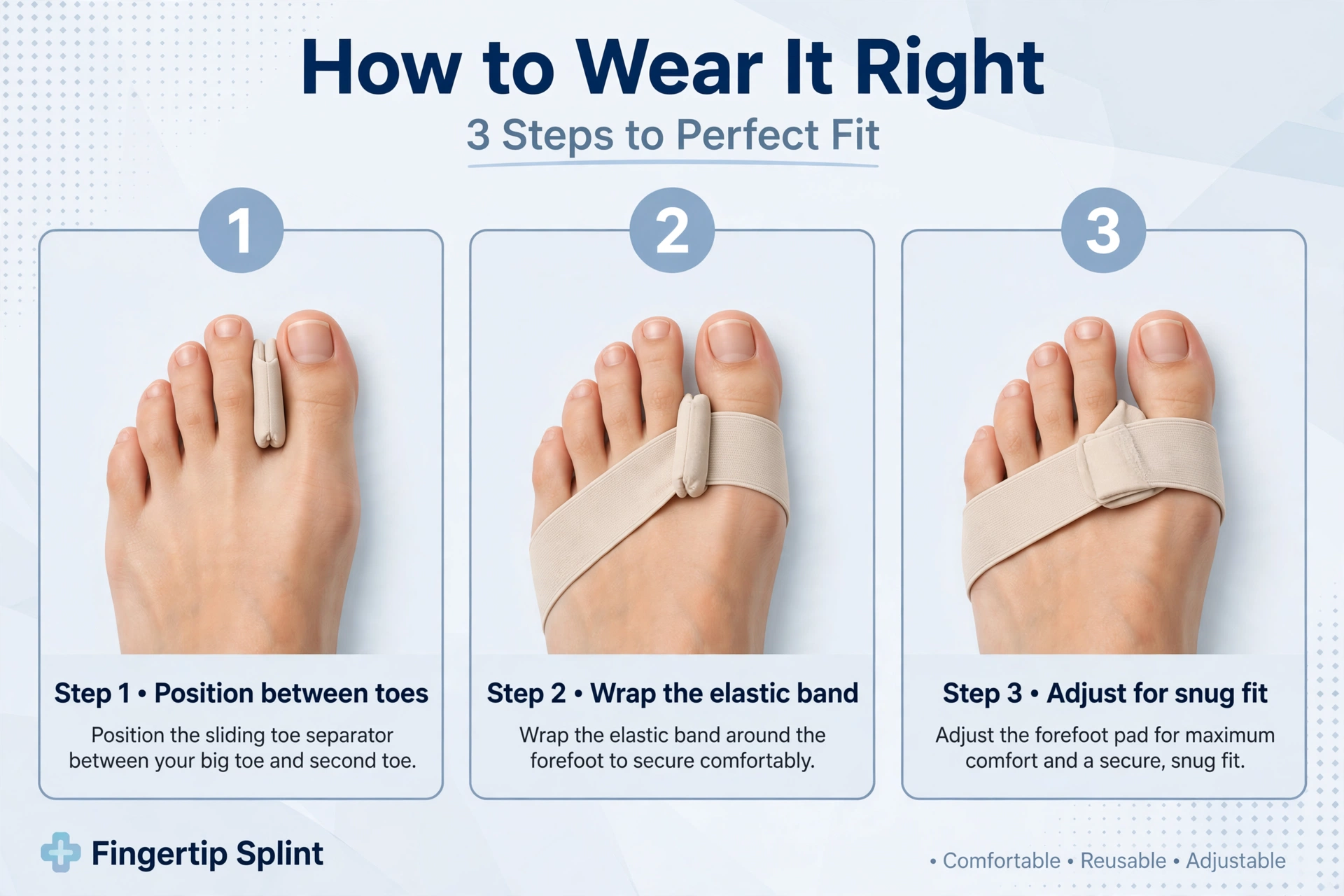
A practical fitting guide is essential. Follow this step-by-step process based on the product’s actual design.
Step 1: Read the manufacturer’s instructions and identify the correct placement.
Step 2: Inspect the skin for sores, blisters, redness, or irritation.
Step 3: Position the pad or separator without forcing the toes.
Step 4: Check for pressure points and confirm that it does not restrict comfortable movement.
Step 5: Try it with appropriate footwear only if the product is intended to be worn inside shoes.
Step 6: Remove it if pain, numbness, burning, or irritation develops. Clean and store it according to the product instructions.
What to Expect When Adjusting to a New Foot Support
Comfort may be noticeable during initial use, but it is not guaranteed. Results depend on the source of discomfort, product design, fit, and footwear.
Before First Use: Check Instructions and Skin
Review the instructions, confirm the intended placement, and check the skin for any problems.
During Initial Use: Evaluate Pressure and Fit
Assess whether the product feels comfortable and whether it creates any pressure points.
After Use: Inspect the Skin and Symptoms
Check for redness, blisters, or irritation. Consider whether symptoms improved or worsened.
Ongoing Use: Reassess Fit and Suitability
Do not increase tightness or wear time to force results. If symptoms persist, seek professional assessment rather than assuming the device needs more time.
According to the Mayo Clinic’s bunion treatment information, conservative approaches may include footwear changes, padding, and other measures. An elastic pad or separator should not be expected to permanently correct a structural toe deformity.
Common Fit and Comfort Mistakes
Some mistakes can make the device less safe or less comfortable. Here are the most common ones.
A device designed for a different problem may not help.
Solution: Identify where the discomfort occurs before selecting a product.
Excessive pressure or thickness can make the shoe tighter and increase discomfort.
Solution: Choose a fit that is comfortable without excessive pressure.
Forcing the toes can cause injury.
Solution: Stop if the position creates pain or resistance.
The shoe may compress the device against the toes.
Solution: Ensure the shoe has enough room for the device.
Redness, blisters, or numbness indicate a problem.
Solution: Stop using the device and inspect the skin.
Different products serve different purposes.
Solution: Match the product to the specific problem.
Continuing to use a product over a wound or damaged skin, or delaying medical assessment when symptoms become persistent or severe, is also unsafe. According to WebMD’s discussion of toe spacers, more separation is not always better.
Who May Be Suitable for a Forefoot Pad or Toe Separator?
Suitability depends on the type and location of discomfort, the product’s design, skin health, and footwear.
Who May Consider a Pad or Separator
- People looking for a non-invasive way to reduce rubbing or improve comfort
- People with mild toe crowding or forefoot pressure
- People who can use the device without harmful pressure
Who Should Seek Guidance First
People with diabetes, poor circulation, reduced sensation, foot wounds, recent surgery, significant swelling, or severe pain should seek professional advice before using a forefoot support device.
Doctor Advice — When Foot Discomfort Needs More Than a Pad
Some foot problems require professional assessment rather than continued experimentation with support products.
Seek professional assessment for:
- Persistent pain
- Worsening toe overlap
- Difficulty walking
- Repeated skin irritation
- Problems finding suitable shoes
Buyer Checklist — What to Look for Before Purchasing
Before purchasing a forefoot pad or toe separator, use this checklist to evaluate whether it matches your needs.
- Correct function: Is the product for cushioning, toe separation, or another purpose?
- Comfortable fit: Does the design suit the intended part of the foot?
- Material and construction: Are details and care instructions available?
- Footwear compatibility: Will the device fit without compressing the toes?
- Skin safety: Can you monitor pressure and irritation?
- Clear instructions: Does the seller explain correct placement and use?
- Support and returns: Are customer-service and return details clear?
Review the FingerTipsSplint product page only when considering the relevant toe-separation option. Avoid assuming it is an elastic forefoot pad unless the live listing confirms that product design.
Combining Footwear Changes With the Right Support
Footwear and product fit must work together. A support device takes up space inside a shoe, so narrow footwear may create extra compression rather than improve comfort.
What to Consider
- Roomy toe boxes: Shoes with adequate width and depth are essential.
- Avoiding shoes that squeeze the forefoot: Narrow shoes can defeat the purpose of the support.
- Checking for pressure after use: Inspect the foot for redness or irritation.
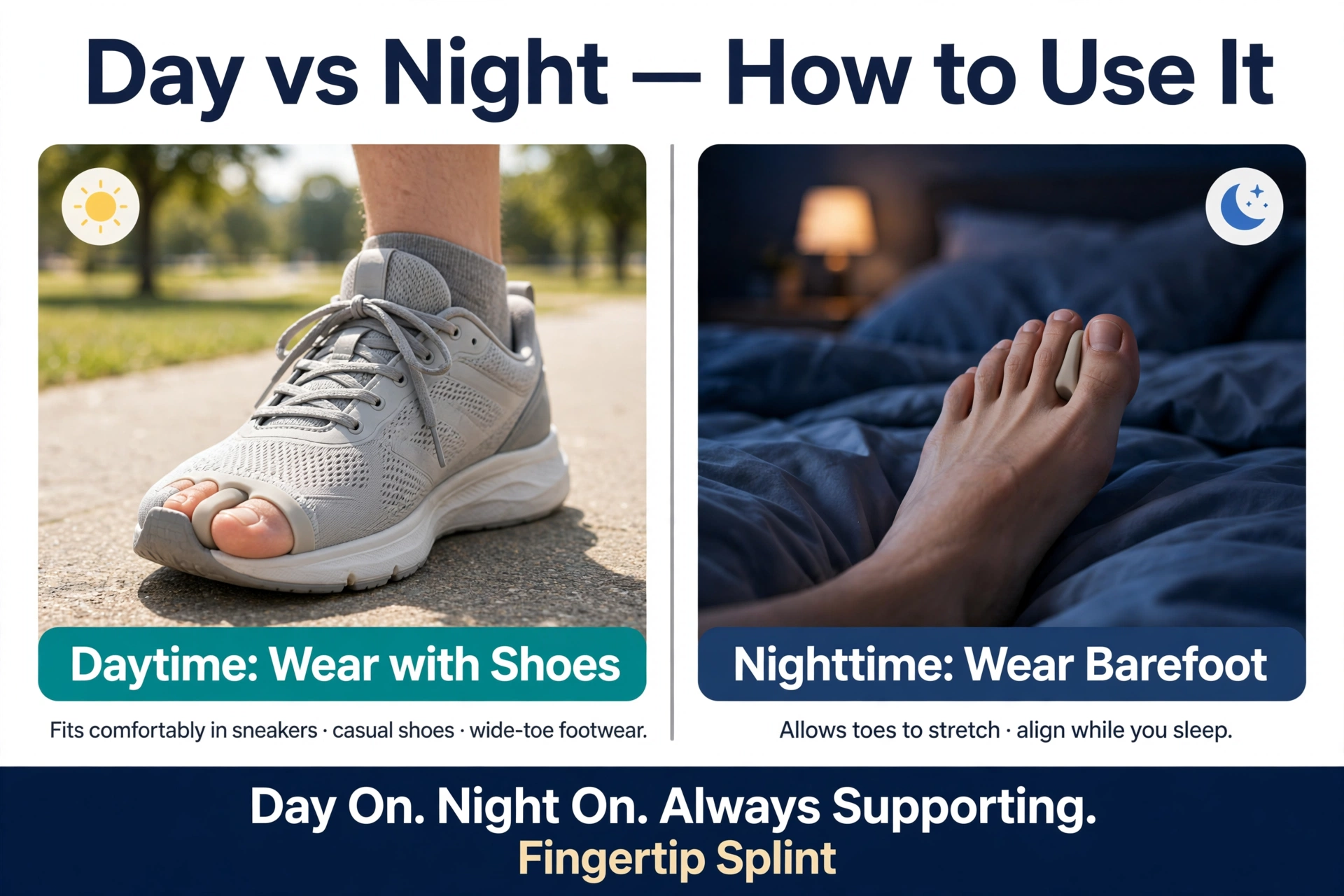
When discussing how intended wear conditions affect product choice, the article on bunion toe separator for day and night use provides useful context. For a broader explanation of toe separation, see hallux valgus toe separator: uses and benefits.
Find the Support That Matches Your Needs
Identify the problem, confirm the product’s intended function, and prioritize a comfortable fit. Review the FingerTipsSplint Hallux Valgus Toe Separator to see whether it addresses your concern, and check the specifications before purchasing.
View the Product Browse All ProductsFrequently Asked Questions
An elastic forefoot pad is used to cushion or support the front of the foot, depending on its design. For overlapping toes, the right product depends on where pressure occurs. A pad designed to cushion the ball of the foot is not automatically suitable for separating overlapping toes.
No. A forefoot pad typically cushions or supports the front of the foot, while a toe separator creates space between selected toes. They serve different purposes and are not interchangeable.
No. An elastic forefoot pad or toe separator may provide temporary comfort or spacing while worn, but it does not permanently correct the alignment of the toes. Structural correction requires professional assessment and, in some cases, surgery.
A correctly fitted product should feel comfortable without causing pain, numbness, or excessive pressure. Check the skin after use for redness, blisters, or irritation. If any of these occur, the fit is wrong.
This depends on the device design and whether your shoes have enough room. Never force a pad or separator into tight footwear. If your shoes cannot accommodate the device comfortably, consider footwear with a wider toe box.
Stop using the device immediately. Pain, numbness, or tingling may indicate that the device is too tight or incorrectly positioned. Inspect the skin and seek advice if symptoms persist.
Seek medical advice if you experience persistent or worsening pain, difficulty walking, repeated skin irritation, or increasing toe deformity. People with diabetes or reduced sensation should seek advice before using any pressure-producing device.
Comfort Starts With the Right Fit
Overlapping toes can have different causes, and the right support depends on the location of pressure, product design, footwear, and the person’s health needs.
A suitable pad or separator may help some users manage rubbing or discomfort, but a poor fit can create more problems. Persistent pain, skin injury, or difficulty walking deserves professional attention.
For readers who want to explore comfort products, the FingerTipSplint shop offers a selection. For more foot and hand care education, visit the FingerTipSplint blog. For personalized assistance, you can request a quote or review the frequently asked questions.
Your feet carry you through everything. Choosing the right support — and knowing when to seek professional advice — is part of caring for them well.