
If you have flat feet, you know how quickly everyday activities can become tiring. Standing for long periods, walking around town, or simply getting through a work shift can leave your feet feeling achy and worn out. You have probably seen advertisements for arch supports and wondered whether they could help — or whether they are just a marketing gimmick. This guide explains how flat feet arch supports work, what benefits you can realistically expect, and how to choose between gel arch support sleeves and orthotic insoles. For a broader view of foot and hand support products, explore the full FingerTipSplint range.
Table of Contents
- What Are Flat Feet Arch Supports?
- Common Problems That Lead to Arch Support Use
- Flat Feet Arch Supports: Uses and Benefits
- Gel Arch Support Sleeves vs. Orthotic Insoles
- How to Choose the Right Arch Support
- How to Use Arch Supports During Walking
- Adjustment, Expectations, and When to Reassess
- Mistakes to Avoid and When to Seek Medical Advice
- Explore Gel Arch Support Sleeves
- Frequently Asked Questions
Flat feet arch supports are devices designed to provide support or cushioning around the foot’s arch. Depending on the design and the person’s needs, they may improve comfort during walking or standing. They do not reliably cure flat feet, and persistent or worsening pain should be assessed by a healthcare professional.
What Are Flat Feet Arch Supports and How Do They Work?
Flat feet — also called pes planus — is a condition where the arch of the foot is lower than typical or disappears entirely when standing. Some people with flat feet experience no symptoms at all; others experience fatigue, discomfort, or pain.
According to the Mayo Clinic’s flat feet symptoms and causes guide, flat feet can be flexible (the arch reappears when not bearing weight) or rigid (the arch is always flat). The right approach depends on the type and the symptoms.
How Arch Supports Work
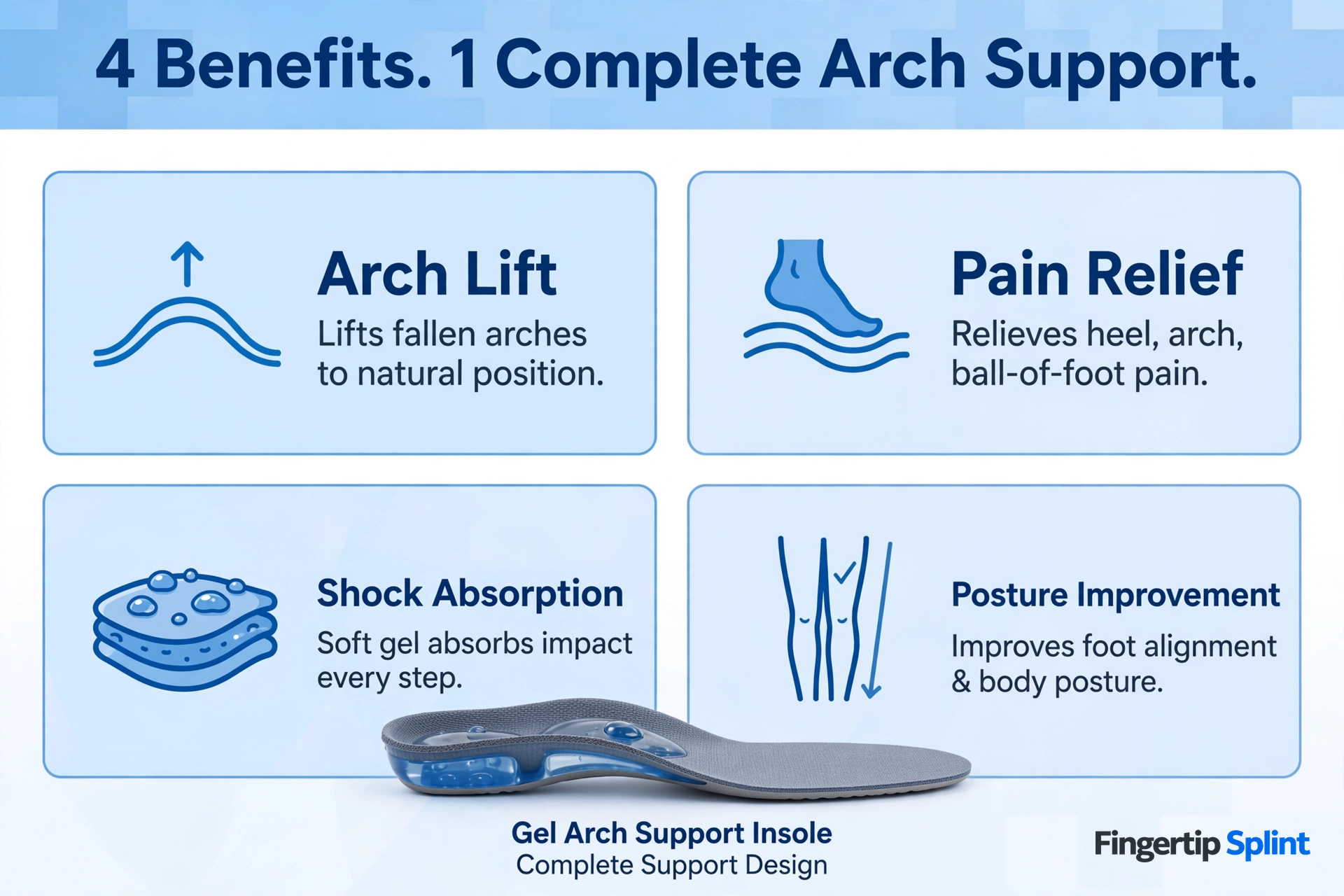
Arch supports are devices designed to provide support or cushioning around the arch. They do not rebuild a fallen arch or permanently change the structure of the foot. Instead, they may help distribute pressure more evenly, reduce strain on the arch, and improve comfort during selected activities.
What Arch Supports Cannot Do
- They do not cure flat feet.
- They do not permanently rebuild the arch.
- They do not guarantee pain relief for every user.
Common Problems That May Lead People to Try Arch Supports
People search for arch supports for a variety of reasons. Understanding the problem helps determine whether a support product is likely to help.
Common Complaints
- Arch fatigue: The arch feels tired or achy after prolonged standing or walking.
- Discomfort during walking: Walking becomes uncomfortable, especially on hard surfaces.
- Pressure from footwear: Shoes may press against the arch or fail to provide adequate support.
- Aching after long periods on feet: Work shifts or busy days leave the feet feeling worn out.
According to the Cleveland Clinic’s flat feet overview, these symptoms have multiple possible causes and should not automatically be attributed to flat feet. Footwear, activity level, and other conditions can all play a role.
Flat Feet Arch Supports: Uses and Potential Benefits
The potential benefits of arch supports depend on the design of the product and the individual’s foot condition.
Cushioning
Arch supports may provide cushioning under the arch, which can improve comfort during standing or walking.
Support During Standing
Some supports may help reduce strain on the arch by providing a more supportive surface under the foot.
Improved Comfort in Suitable Footwear
When paired with footwear that has adequate room and support, arch supports may help improve overall comfort.
Reduced Discomfort for Some Users
Some people may notice a reduction in arch fatigue or discomfort when using arch supports. According to the Cleveland Clinic’s guide to orthotics, different support products work in different ways, and results vary by person and device.
Explore Your Arch Support Options
Select an option below to learn more about it.
Gel Arch Support Sleeves vs. Orthotic Insoles
Gel arch support sleeves and orthotic insoles are different product formats. They are not interchangeable treatments.
| Feature | Gel Arch Support Sleeve | Orthotic Insole |
|---|---|---|
| Coverage | Usually focused around the arch area | Often supports a larger area of the foot |
| Main purpose | Local cushioning or support | Support, cushioning, or pressure redistribution |
| Placement | Worn around the foot | Placed inside compatible footwear |
| Shoe compatibility | Depends on thickness and shoe space | Depends on insole shape, shoe depth, and removable liners |
| Ease of switching | May be convenient between shoes | Usually needs to be moved between shoes |
| Best selection criterion | Comfortable positioning without excessive pressure | Appropriate support and fit for the shoe and activity |
| Important limitation | Does not necessarily provide the same coverage as an insole | Does not guarantee permanent arch correction or symptom relief |
The best choice depends on your symptoms and intended use. For a more detailed comparison of insole options, the article on gel arch support insoles for flat feet: fit and comfort provides useful context.
How to Choose the Right Arch Support for Flat Feet
Choosing the right arch support requires matching the product to your needs. Here are the factors to consider.
Comfort
The support should feel comfortable without causing pressure. The highest or firmest arch is not necessarily the best.
Correct Positioning
The support should sit correctly under the arch. If it shifts or creates pressure points, the fit is wrong.
Material
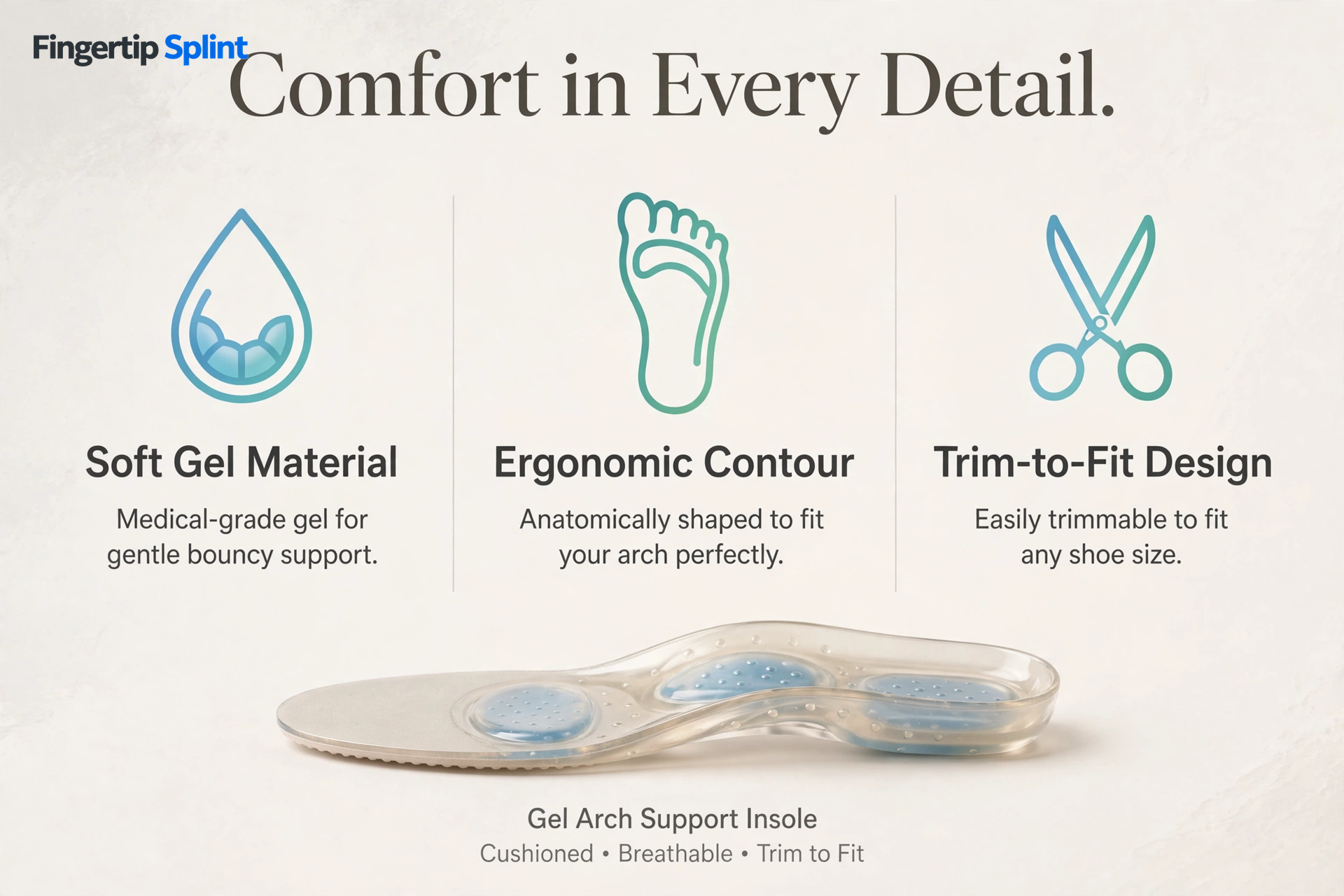
Gel materials are generally soft and conforming. Check that the material is skin-friendly and durable.
Shoe Fit
The support must fit inside your shoes without making them too tight. A tight shoe can defeat the purpose of the support.
Intended Activities
Consider what you will be doing while wearing the support. A support that works well for standing may not be suitable for running.
Ease of Cleaning
Can you follow the manufacturer’s cleaning instructions? Proper care affects hygiene and durability.
Product Instructions
Follow the manufacturer’s guidance for wear and care.
How to Use Arch Supports During Walking and Daily Activities
Using arch supports during walking and daily activities requires attention to fit and symptoms.
Check the Fit
Make sure the support sits correctly and does not create pressure points. It should feel comfortable without being too tight.
Follow Instructions
Follow the manufacturer’s instructions for placement and wear time.
Inspect the Skin
Check the skin after use for redness, irritation, or pressure marks.
Pay Attention to Symptoms
New support may feel different at first. However, significant or increasing pain is not something to push through. Stop using the support and seek advice if symptoms worsen.
For a closer look at how insoles support flat feet during walking, the article on how orthotic insoles support flat feet during walking provides useful context.
Adjustment, Expectations, and When to Reassess
There is no universal recovery timeline for flat feet. Some people are seeking comfort rather than recovering from an injury, and symptom response depends on the cause.
Some people may notice a difference in comfort within a short period of use. Others may need more time to adjust. If symptoms do not improve or worsen, reassess the fit and suitability of the support rather than assuming it needs more time.
Mistakes to Avoid and When to Seek Medical Advice
Some mistakes can make the support less effective or uncomfortable. Here are the most common ones.
A cheap product may not fit well or provide adequate support.
Solution: Evaluate fit, material, and intended use before price.
A higher arch is not automatically better and may cause pressure.
Solution: Choose a support that feels comfortable and supportive.
The support must fit inside the shoe without making it too tight.
Solution: Ensure the shoe has enough room.
Pain is a signal that the support is not suitable.
Solution: Stop using it and reassess the fit or product choice.
Arch supports do not cure flat feet.
Solution: Use the support for comfort with realistic expectations.
Explore Gel Arch Support Sleeves
If you are looking for support around your foot’s arch, the FingerTipSplint Gel Arch Support Sleeves are one option to evaluate. This guide does not claim that they cure flat feet or guarantee pain relief. What they offer is a design intended to provide cushioning and support around the arch.
Before purchasing, review the product listing for:
- Material and construction
- Sizing and fit guidance
- Intended placement
- Care and cleaning instructions
- Any stated limitations
Review the product details and fitting guidance, and decide whether this format suits your daily activities and footwear. For a broader range of foot support options, browse the FingerTipSplint shop.
Looking for Support Around Your Foot’s Arch?
Explore the FingerTipSplint Gel Arch Support Sleeves, review the product details and fitting guidance, and decide whether this format suits your daily activities and footwear.
View the Product Browse All ProductsFrequently Asked Questions
Arch supports may help improve comfort for some people with flat feet by providing cushioning and support around the arch. However, they do not cure flat feet or permanently change the structure of the foot. Results vary by person and product.
No. Gel arch support sleeves provide temporary cushioning and support while worn. They do not permanently correct the structure of the foot or rebuild the arch.
Neither is universally better. Gel sleeves offer focused support around the arch and may be convenient to switch between shoes. Orthotic insoles often provide broader support. The right choice depends on your symptoms and intended use.
Many people wear arch supports daily, but this depends on the product and your comfort. Follow the manufacturer’s instructions and monitor for any discomfort or skin irritation.
Some people notice a difference in comfort quickly, while others may need more time to adjust. If symptoms do not improve or worsen, reassess the fit and suitability of the support rather than assuming it needs more time.
This depends on the support product and your footwear. Some supports can be moved between shoes, while others are designed for specific footwear. Always check that the shoe has enough room for the support.
Seek medical advice for persistent or worsening pain, new swelling, weakness, difficulty walking, or sudden changes in arch shape. People with diabetes or reduced sensation should seek advice before using any foot support device.
Make an Informed Decision About Arch Support
Flat feet arch supports can provide cushioning and support around the arch, which may improve comfort for some people during walking or standing. But they do not cure flat feet, and they do not guarantee pain relief.
Use this guide as a framework: understand what arch supports can and cannot do, check the product specifications, follow safe-use instructions, and seek professional advice for persistent or worsening symptoms.
For readers who want to explore support products, the FingerTipSplint shop offers a selection. For more foot and hand care education, visit the FingerTipSplint blog. For personalized assistance, you can request a quote or review the frequently asked questions.
Your feet carry you through everything. Choosing the right support — and knowing when to seek professional advice — is part of caring for them well.