
Adjustable Thumb Splint vs Finger Support: What’s the Difference?
If both products are designed to support a digit, why can’t you simply use a finger support for your thumb? The answer lies in anatomy — the thumb has a different position, function, and relationship to the hand than the fingers do. This guide compares adjustable thumb splints and finger supports systematically by body area, coverage, construction, adjustability, fit, movement, and everyday use.
What This Guide Covers
- Quick Answer
- At-a-Glance Comparison
- What Is an Adjustable Thumb Splint?
- What Is a Finger Support?
- Why Thumb and Finger Designs Differ
- 3D Interactive: See the Difference
- Construction Comparison
- Adjustability — Why It Matters Differently
- Fit and Sizing Comparison
- Movement and Flexibility Comparison
- Activity-by-Activity Comparison
- Can a Finger Support Be Used on the Thumb?
- Comfort Comparison
- Common Selection Mistakes
- How to Decide Between Them
- Product Spotlight
- What a Healthcare Professional Would Consider
- Quick Tips
- FAQ
- Conclusion
Quick Answer: What Is the Difference Between an Adjustable Thumb Splint and a Finger Support?
An adjustable thumb splint is designed around the thumb’s unique position and movement, while finger supports are designed for individual fingers. Their differences can include coverage, construction, sizing, adjustment, positioning, and movement characteristics. The appropriate choice depends on the supported area, product design, and intended use.
For readers who need the foundational explanation of how an adjustable thumb support splint works, the reference Adjustable Thumb Support Splint: What Is It and How Does It Work? covers that ground. This article focuses specifically on the comparison between thumb-specific and finger-specific support designs.
Adjustable Thumb Splint vs Finger Support at a Glance
This table summarizes the key differences. Product designs vary, so this is a conceptual comparison rather than a universal classification.
| Consideration | Adjustable Thumb Splint | Finger Support |
|---|---|---|
| Main area | Thumb | Individual finger |
| Position | Around thumb/hand area depending on design | Around individual finger depending on design |
| Coverage | May include thumb base/palm | Usually centered around finger |
| Adjustment | Depends on product | Depends on product |
| Movement | Designed according to construction | Designed according to construction |
| Fit | Thumb/hand dimensions matter | Finger dimensions matter |
| Daily activities | Grip, phone, writing, etc. depending on design | Typing, writing, finger-specific tasks |
| Sizing | Thumb/hand-specific | Finger-specific |
Note: Product designs vary, so this is a conceptual comparison rather than a universal classification. Always check the manufacturer’s intended use and sizing information for the specific product.
What Is an Adjustable Thumb Splint?
An adjustable thumb splint is a wearable support device designed specifically around the thumb. It typically wraps around the thumb and may extend onto the lower palm for additional stability. The adjustable component allows the fit or positioning to be modified after application, within the product’s intended range.
Designed Around the Thumb
The splint is shaped to accommodate the thumb’s position and its relationship to the palm. This is different from a device designed around a straight finger.
Adjustable Fit
The adjustment mechanism allows the wearer to fine-tune fit and positioning within the product’s intended range.
Thumb-Specific Coverage
Coverage is designed for the thumb and may extend onto the palm. Coverage cannot be extended by adjustment.
If you want a deeper explanation of how the thumb splint mechanism works, the reference How an Adjustable Thumb Splint Provides Flexible Support covers the mechanism in detail.
What Is a Finger Support?
“Finger support” is a broad category rather than one single standardized product design. It can refer to different products that cover part of a finger, surround a joint, provide flexible support, use adjustable fastening, or provide more structured positioning.
Covers part of a finger
Surrounds a finger joint
Provides flexible support
Uses adjustable fastening
Provides structured positioning
Varies in coverage and movement
Important: “Finger support” is a broad category. Two products with the same label can have very different constructions, coverage areas, and movement characteristics. Always check the specific product details.
Why Thumb and Finger Support Designs Differ
The thumb is not simply another finger. It has a different position, different movement patterns, and a different relationship to the palm. These differences affect how support products are designed.
The Thumb
- Sits at a different angle from the fingers
- Interacts with the palm structurally
- Contributes strongly to grip and pinch
- Moves differently from the fingers
- Has a unique base/hand relationship
Individual Fingers
- Have different lengths and circumferences
- Move through different joint positions
- Work together during grip
- Often require finger-specific coverage
- Have a different relationship to the palm
Thumb Splint vs Finger Support: See the Difference — 3D Interactive
This interactive comparison highlights the key differences between thumb-specific and finger-specific support designs. Tap each hotspot to see what changes.
Interactive Comparison
Tap each hotspot to see how the two designs differ
ADJUSTABLE THUMB SPLINT
Designed around the thumb and its relationship to the palm
FINGER SUPPORT
Designed around an individual finger and its joints
Coverage
Thumb splint: Coverage is designed for the thumb and may extend onto the lower palm. The coverage area is shaped around the thumb’s position and its relationship to the hand.
Finger support: Coverage is usually centered around an individual finger. The shape and dimensions are designed for finger circumference and length.
Construction Comparison
Construction determines how each product provides support. The two categories differ in shape, coverage, and the relationship between the device and the supported body area.
Adjustable Thumb Splint Construction
- Thumb-oriented shape
- Palm relationship considered in design
- Adjustment mechanism designed for thumb positioning
- Coverage may extend toward the palm
- Support structure shaped around the thumb
Finger Support Construction
- Finger-oriented shape
- Circumference and length considered
- Joint coverage where applicable
- Movement considerations for finger tasks
- Support structure shaped around the finger
| Design Feature | Thumb Splint | Finger Support |
|---|---|---|
| Supported area | Thumb | Finger |
| Shape | Thumb/hand-oriented | Finger-oriented |
| Coverage | May extend toward palm | Usually finger-focused |
| Adjustment | Product dependent | Product dependent |
| Structure | Product dependent | Product dependent |
| Movement | Thumb-specific | Finger-specific |
Adjustability — Why It Matters Differently
Adjustability is a separate characteristic from body area. Both thumb splints and finger supports can be adjustable, but adjustability does not make them interchangeable.
Adjustable Thumb Splint
Adjustable around the thumb and its relationship to the hand. The adjustment mechanism modifies fit or positioning within the thumb splint’s intended range.
Adjustable Finger Support
Adjustable around an individual finger. The adjustment mechanism modifies fit or positioning within the finger support’s intended range.
This is why an adjustable finger support does not automatically work as a thumb support, even if both products are adjustable. The shape, coverage, and positioning are designed around different body areas.
Fit and Sizing Comparison
Fit and sizing differ between thumb splints and finger supports because the underlying anatomy differs. Trying to substitute one for the other simply because the size “looks close” can lead to poor positioning.
Thumb Splint Fit
- Thumb dimensions matter
- Hand/palm relationship considered
- Coverage determines which areas are supported
- Adjustment range affects fit flexibility
- Positioning along the thumb is important
Finger Support Fit
- Finger circumference matters
- Finger length matters
- Joint position affects coverage
- Adjustment range affects fit flexibility
- Positioning along the finger is important
Key insight: Thumb fit ≠ Finger fit. The sizing systems, coverage areas, and positioning requirements are designed around different body areas.
For a deeper look at thumb splint fit, the reference Thumb Splint Fit Guide: Understanding Adjustability and Comfort covers the topic in more detail.
Movement and Flexibility Comparison
Movement and flexibility differ between thumb splints and finger supports because the body areas have different movement patterns and functional roles.
Thumb Movement
- Grip and pinch
- Phone use
- Writing
- Object handling
- Opposition to fingers
Finger Movement
- Typing
- Writing
- Gripping
- Individual finger movement
- Fine motor tasks
Conceptual Spectrum: Movement vs Restriction
This is a conceptual spectrum only — actual movement characteristics depend on the specific product design
Activity-by-Activity Comparison
Different activities place different demands on the thumb and fingers. This table shows what to consider for each activity.
| Activity | Thumb Splint Considerations | Finger Support Considerations |
|---|---|---|
| Smartphone | Thumb movement and grip | Finger tapping and holding |
| Writing | Thumb positioning and grip | Finger grip and writing |
| Typing | Hand/thumb interaction | Individual finger movement |
| Studying | Writing and device use | Writing and page handling |
| Office work | Mouse, keyboard, and grip | Keyboard and finger movement |
| Light household tasks | Grip and thumb positioning | Finger dexterity |
Product-specific design matters more than the category name. A well-designed finger support may work better for a finger-related task than a poorly designed thumb splint, and vice versa. The key is matching the design to the body area and the activity.
For a deeper look at how adjustable thumb splints fit into daily routines, the reference Why Choose an Adjustable Thumb Support Splint for Daily Activities? covers the practical considerations.
Can a Finger Support Be Used on the Thumb?
This is one of the most common questions, and the answer requires nuance.
Do not assume interchangeability. A product designed for a finger may not provide the intended coverage or positioning around the thumb. Thumb geometry differs from finger geometry.
Reasons to Be Cautious
- Thumb geometry differs from finger geometry
- Coverage designed for a finger may not cover the thumb appropriately
- Positioning designed for a finger may not align with the thumb
- The thumb’s relationship to the palm is different
- Adjustment designed for a finger may not fit the thumb’s shape
What to Check
- The manufacturer’s intended body area
- Whether the product is described as thumb-specific or finger-specific
- Whether the sizing information matches thumb dimensions
- Whether the coverage area aligns with the intended purpose
- Whether the product instructions specify thumb use
If the question relates to an injury or medical condition, appropriate professional advice may be needed. A product guide cannot determine the appropriate device for a specific medical problem.
Comfort Comparison
Comfort is not determined by product category alone. Both thumb splints and finger supports can be comfortable or uncomfortable depending on how they fit and how they are constructed.
Correct size
Appropriate adjustment
Material
Seams and edges
Pressure distribution
Movement during use
Common Selection Mistakes
These mistakes come up repeatedly when people compare thumb splints and finger supports. Avoiding them improves the selection process.
Two products may look similar but be designed for different body areas.
Check: the manufacturer’s intended body area and coverage description.
Adjustment has limits. It does not change the fundamental anatomy a product is designed around.
Check: the intended body area and sizing information.
Construction and intended use matter more than price alone.
Check: the product’s design characteristics.
A support may cover a completely different area than expected.
Check: the coverage dimensions and area of the body supported.
Support requirements vary. More restriction is not automatically better support.
Check: whether the restriction level matches your needs.
Do not assume interchangeability. Thumb geometry differs from finger geometry.
Check: whether the product is intended for thumb use.
Persistent or worsening symptoms may require professional assessment.
Check: seek appropriate advice for significant or persistent symptoms.
Product designs differ in positioning, adjustment, and intended use.
Check: follow the manufacturer’s guidance for the specific product.
How to Decide Between Them
This framework helps you decide which characteristics to investigate based on your situation. It does not produce a medical recommendation.
Comparison Tool: Thumb Splint or Finger Support?
Answer four questions to see which product characteristics to investigate. This is educational guidance for product comparison, not a medical recommendation.
Answer all four questions to see which product characteristics to investigate.
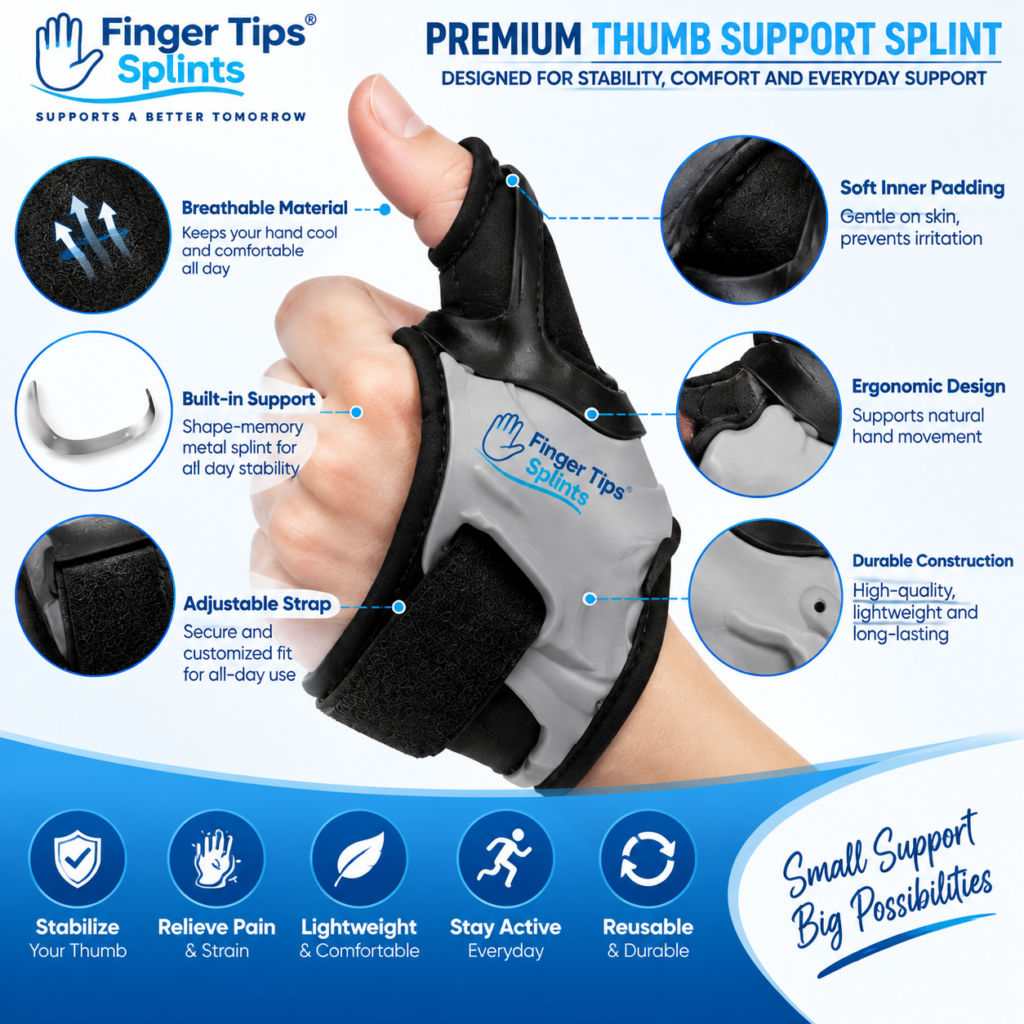
Product Spotlight: A Thumb-Specific Option to Examine
After understanding the differences between thumb splints and finger supports, here is a specific product to examine. The Adjustable Thumb Support Splint is one example of a thumb-oriented adjustable support design. For readers specifically researching adjustable thumb support, this product provides a relevant example.
Adjustable Thumb Support Splint
- Thumb-oriented adjustable design
- Designed for thumb coverage and positioning
- Adjustable fit within the product’s intended range
- Full product specifications available on the product page
Applying the Comparison Framework
Supported Body Area
The product is designed around the thumb. Confirm that the supported area matches your needs.
Construction and Coverage
Review the product page for details about construction and coverage. Check which thumb and hand areas are covered.
Adjustability and Fit
Review the adjustment mechanism and sizing information. Check how the adjustment works and whether it stays secure during movement.
Movement and Everyday Use
Consider how the splint’s movement characteristics match your activities. Review the care instructions.
For readers who want to understand buying considerations in more depth, the reference What to Look For When Buying an Adjustable Thumb Splint covers the buying process step by step.
What a Healthcare Professional Would Consider
This section presents evidence-based principles that apply to thumb and finger support products generally. It does not claim that a doctor has personally endorsed a specific product.
Body Area Matters
Thumb and finger anatomy are not identical. A support designed for one area may not function as intended for another.
Product Terminology Can Be Confusing
“Brace,” “splint,” and “support” may be used differently across products. Look at the construction and intended use.
Fit Matters
Incorrect fit can affect comfort and usability. A support should fit securely but not tightly.
Support Requirements Vary
A flexible support is not necessarily equivalent to a rigid immobilizing device. Different situations may require different approaches.
Persistent Symptoms Need Attention
Significant or worsening symptoms should not automatically be treated as a product-fit problem.
A Product Guide Cannot Diagnose
An online article cannot determine the cause of thumb or finger symptoms or the appropriate device for a specific medical problem.
Seek appropriate professional evaluation for: significant injury, visible deformity, severe or worsening pain, substantial swelling, major movement loss, persistent numbness or tingling, significant discoloration, or symptoms that do not improve.
For authoritative information about thumb, hand, and wrist conditions and treatments, the following resources provide evidence-based content:
- Mayo Clinic for condition overviews and patient education.
- WebMD for general thumb and hand concern overviews.
- Healthline for practical wellness information.
- AAOS OrthoInfo for orthopedic guidance from specialists.
- NHS guide on hand pain for UK-based clinical guidance.
- MedlinePlus hand injuries and disorders for a broad reference library.
- Cleveland Clinic for clear patient-oriented explanations.
- Johns Hopkins Medicine for clinical and research-based perspectives.
- FDA for regulatory context on medical devices.
- NIH for research-based health information.
These resources provide general information and do not replace individualized advice from a qualified healthcare professional.
Quick Tips
Frequently Asked Questions
An adjustable thumb splint is designed around the thumb’s unique position and movement, while finger supports are designed for individual fingers. Their differences can include coverage, construction, sizing, adjustment, positioning, and movement characteristics. The appropriate choice depends on the supported area, product design, and intended use. Neither category is universally better.
Do not assume interchangeability. A product designed for a finger may not provide the intended coverage or positioning around the thumb. Thumb geometry differs from finger geometry, and the relationship between the thumb and palm is different from the relationship between a finger and palm. Check the manufacturer’s intended body area and sizing information before using a product for a different body part than it was designed for.
The thumb sits at a different angle from the fingers, interacts with the palm structurally, contributes strongly to grip and pinch, and moves through a different range of motion. These differences affect how support products are designed. A splint designed for the thumb accommodates the thumb’s position, its relationship to the palm, and its movement patterns.
Not necessarily. Flexibility depends on the specific product’s material, construction, coverage, and intended design — not on the category name. An adjustable thumb splint can be flexible or structured. A finger support can be flexible or structured. The flexibility characteristics depend on the design, not on whether the product is a thumb splint or a finger support.
A correctly fitting support stays positioned during intended movement, covers the intended area, feels comfortable against the skin, and allows movement consistent with its design. It should not slide, bunch, or create numbness, tingling, or significant discoloration. For thumb supports, the fit should accommodate the thumb’s relationship to the palm. For finger supports, the fit should accommodate finger circumference and length. Always follow the manufacturer’s sizing and fitting instructions.
Suitability depends on the specific product’s characteristics and the activity. A support with appropriate coverage, comfortable material, secure fit, and enough movement for the activity is more likely to be suitable. The key is matching the product design to the body area and the activity you do most. Product-specific design matters more than the category name.
Seek professional advice if you have significant injury, visible deformity, severe or worsening pain, substantial swelling, major loss of movement, persistent numbness or tingling, significant discoloration, or symptoms that are not improving. Also seek advice if a specific type of support has been recommended. A consumer support product is not a substitute for professional medical assessment or prescribed medical support.
Match the Product to the Body Area
The primary difference between a thumb splint and a finger support isn’t the label — it’s how the device is designed around the anatomy, positioning, movement, and coverage requirements of the supported area. Understanding this difference helps you evaluate specific products with confidence. Body Area → Design → Coverage → Fit → Movement → Activity
The Bottom Line on Thumb Splint vs Finger Support
An adjustable thumb splint and a finger support are not interchangeable simply because both are support products. The primary difference is how each device is designed around the anatomy, positioning, movement, and coverage requirements of the supported area. The thumb has a different relationship to the palm, different movement patterns, and different functional roles than the fingers.
Neither category is universally better. The relevant question is whether the design matches the body area and intended purpose. A well-designed finger support may work perfectly for a finger-related task, just as a well-designed thumb splint may work perfectly for a thumb-related task. Matching the product to the body area is the foundation of a good selection.
If you want to continue exploring within this cluster, the foundational reference Adjustable Thumb Support Splint: What Is It and How Does It Work? covers the product definition, and the mechanism article How an Adjustable Thumb Splint Provides Flexible Support covers how flexible support works. For a wider reference, explore the full FingerTipSplint blog library.
This article is for general information only and is not a substitute for professional medical advice. Always consult a qualified healthcare provider for diagnosis and treatment of any medical condition.