
How to Choose an Adjustable Wrist Brace for Daily Support
You want wrist support, but you still need to type, use your phone, cook, study, drive, and carry light objects. The wrong brace gets in the way of all of it. The right adjustable brace gives you support without turning everyday tasks into a struggle.
This guide walks you through the measure → match → adjust → test → reassess framework. When you are ready to compare designs, browse our wrist support products in the shop and evaluate them against the criteria below.
Why Adjustability Matters More Than It First Appears
Wrist dimensions, daily activities, and comfort requirements differ from person to person. An adjustable brace allows you to modify the fit rather than relying on one fixed circumference. But here is the distinction most buyers miss: more adjustment does not automatically mean better support. A good adjustable design balances security, comfort, movement, and appropriate support.
Mayo Clinic notes that braces vary considerably in construction and should be matched to the activity and level of support required. The Mayo Clinic Q and A on bracing and the Mayo Clinic wrist pain overview both emphasize matching support to the situation rather than assuming that a brace is automatically helpful in every context.
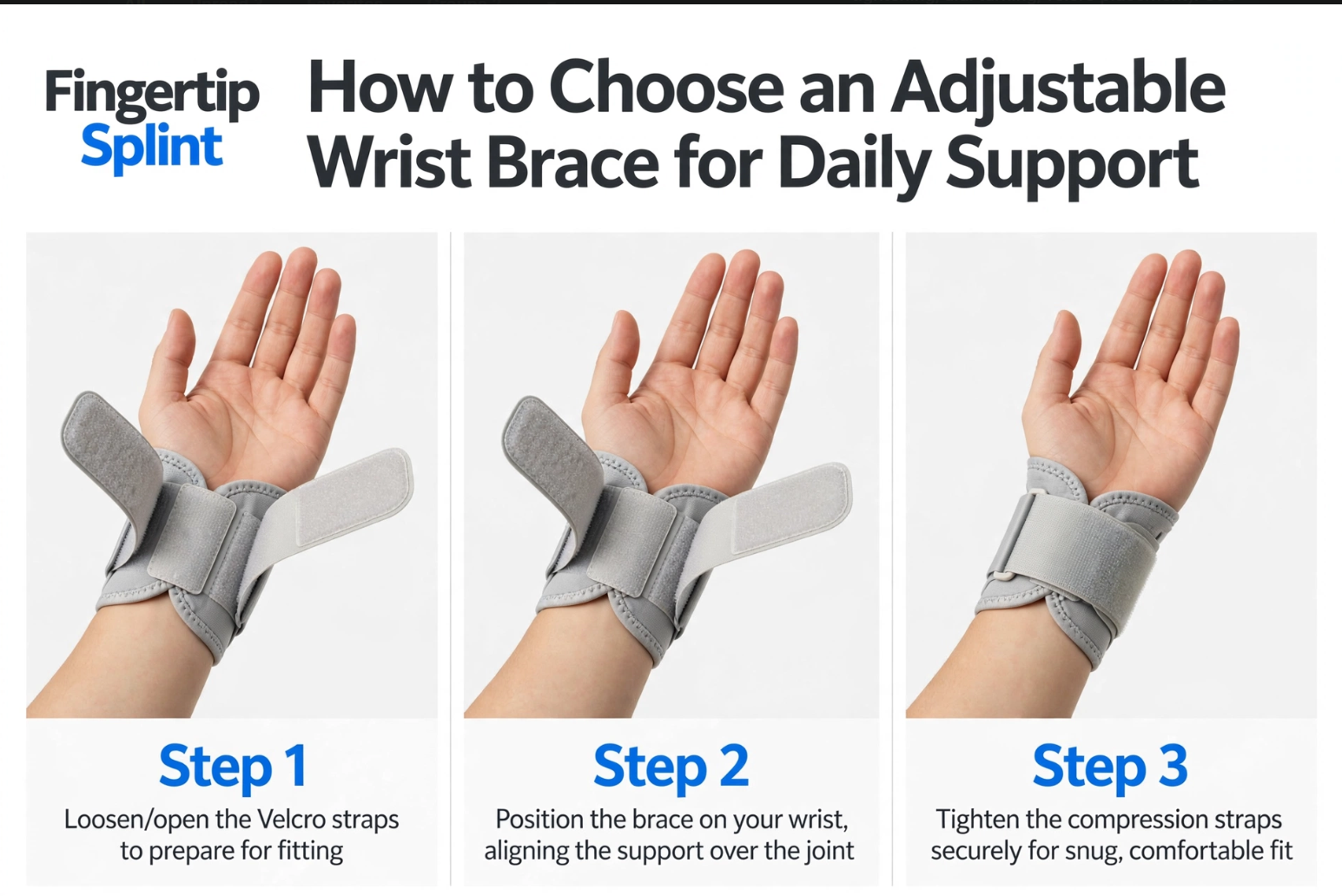
Choose an adjustable wrist brace by measuring your wrist circumference against the manufacturer’s specific size chart, checking that the straps allow secure but comfortable fastening, confirming that the support level matches your intended activity, and verifying that your fingers and thumb remain mobile enough for daily tasks. Secure, not tight. Appropriate, not excessive.
Table of Contents
- What Is an Adjustable Wrist Brace?
- Why Choose an Adjustable Design?
- Find Your Support Priority
- 8 Features Worth Checking
- 3D Anatomy of an Adjustable Brace
- How Much Support Do You Need?
- How to Measure Your Wrist
- How Tight Should It Be?
- Interactive Fit Checker
- Adjustable vs Fixed Wrist Brace
- Choosing for Real-Life Activities
- Adjustability vs Mobility
- Material and Comfort
- First 7 Days With Your Brace
- 10 Common Mistakes
- Who May Benefit
- When Professional Advice Matters
- Product Evaluation
- Buyer Decision Tree
- 7 Fast Tips
- FAQ
What Is an Adjustable Wrist Brace?
An adjustable wrist brace uses one or more fastening mechanisms that allow the wearer to modify how securely the brace sits around the wrist. Common adjustment systems include hook-and-loop straps, wraparound closures, multiple straps, buckle-style systems, and elastic adjustment. Not every product has all of these, and that is fine — the goal is to understand what each adjustment option actually does.
Adjustable wrist braces serve three basic functions. Position determines where the wrist is held. Pressure determines how firmly the brace contacts the wrist. Stability determines how much unwanted movement the construction is designed to limit. When you evaluate a brace, you are really evaluating how well it balances those three functions against the activity you intend to do while wearing it.
Why Choose an Adjustable Design?
There are five practical reasons an adjustable design often makes more sense than a fixed one for daily support.
1. Different wrist sizes
People do not have identical wrist dimensions. An adjustable brace accommodates a range of measurements that a single fixed size cannot.
2. Easier fit fine-tuning
A fixed brace has a predetermined fit. An adjustable brace can be modified as your wrist changes throughout the day or as your comfort needs change.
3. Different activities
The amount of support you want during typing, studying, household tasks, travel, or light activity may differ. Adjustability lets one brace serve multiple contexts.
4. Clothing and environment
Sleeve thickness and temperature can affect comfort. An adjustable strap lets you loosen slightly when conditions change without removing the brace.
5. Easy removal
An adjustable strap can make putting the brace on and taking it off simpler, which matters for people who need to remove it during the day.
For a deeper look at how adjustability affects everyday movement, see our companion guide on choosing an adjustable wrist brace for daily support, which expands on the practical fit and activity considerations discussed here.
Find Your Support Priority
What matters most to you? Select one priority and we will show you what to look for. This is a shopping decision tool, not a medical recommendation.
- Hook-and-loop closure with multiple fastening points
- Straps that are easy to secure and release
- A size range that accommodates your measurement
- Ability to loosen the brace without removing it
- Clear manufacturer sizing guidance
8 Features Worth Checking Before You Buy
Feature 1 — Adjustable Closure
Strap positioning matters. A good closure should allow secure fastening, controlled adjustment, and easy release. If the strap system requires excessive force to close or digs into your skin when tightened, the brace will not be worn consistently regardless of how supportive it looks.
Feature 2 — Multiple Adjustment Zones
If a product has multiple straps, different zones can affect different parts of the fit. But more straps does not automatically mean better support. Two well-placed straps may outperform five poorly designed ones. Look at where the straps sit relative to the wrist joint, not just how many there are.
Feature 3 — Wrist Positioning
Does the design allow the wrist to remain in a comfortable, appropriate position? For carpal-tunnel-related use, neutral positioning is particularly relevant. Both Mayo Clinic’s carpal tunnel overview and the AAOS carpal tunnel patient resource discuss wrist splinting that maintains a neutral wrist position. If carpal tunnel is your primary reason for considering wrist support, our carpal tunnel wrist brace buying guide explains fit, support, and sizing in greater detail.
Feature 4 — Support Insert
Inserts may be rigid, semi-rigid, or flexible. Focus on function, not material hype. A semi-rigid insert may be appropriate for daily support where some movement control is needed, while a fully rigid insert may be overkill for light activity. The right insert is the one that matches your intended use.
Feature 5 — Finger Freedom
Daily support becomes much less useful if the wearer cannot perform necessary hand movements. Consider typing, texting, writing, gripping, dressing, and light household tasks. A brace that immobilizes your fingers is usually not appropriate for daily wear unless it was specifically designed for that purpose.
Feature 6 — Thumb Design
Some braces allow full thumb movement; others incorporate thumb support. Check this before ordering. Thumb freedom affects whether you can use your phone, grip a pen, or handle everyday objects comfortably.
Feature 7 — Material
Cover breathability, softness, flexibility, moisture management, heat retention, and skin contact. The right material keeps you comfortable for your intended wearing period without causing skin irritation. Avoid assuming that one material is automatically medically superior.
Feature 8 — Ease of Adjustment
Ask yourself: can you actually adjust it comfortably when you are wearing it? This is particularly useful for people who may need to loosen or remove the brace during the day. A brace that is difficult to adjust will not be adjusted properly.
If you are comparing braces before making a purchase, see our guide on what to look for in a wrist brace for carpal tunnel support for a broader feature-by-feature framework.
3D Anatomy of an Adjustable Wrist Brace
Before you evaluate any product, it helps to know what you are looking at. The interactive 3D component explorer below breaks down the layers and features of a typical adjustable wrist brace. Click each component to see what it does and why it matters.
Adjustable Brace Component Explorer
Click a component to learn what it does and why it matters when you are buying.
How Much Support Do You Actually Need?
Support level should match the intended purpose, not just the severity of how your wrist feels on a given day. The three levels below help you frame the decision.
Level 1 — Light Support
For users prioritizing flexibility, comfort, and general support during everyday tasks. Usually lower profile and easier to wear for longer periods.
Level 2 — Moderate Support
For users who need more stability, stronger positional control, and reliable daily support during work or repetitive tasks.
Level 3 — More Structured Support
For situations where greater movement restriction may be appropriate. Usually bulkier and potentially more restrictive during daily activity.
How to Measure Your Wrist
Follow these four steps and compare your measurement against the specific product’s size chart. Sizing varies by manufacturer, so never assume that a small in one brand matches a small in another.
Step 1 — Get a flexible measuring tape
A cloth tape is ideal. If you only have a rigid tape, wrap a strip of paper around your wrist, mark it, and measure the paper with a ruler.
Step 2 — Measure according to the manufacturer’s instructions
Some ask for the wrist just below the palm; others ask for the palm itself. The measurement point matters.
Step 3 — Record the circumference
Write it down. Do not rely on memory, especially if you are comparing multiple products.
Step 4 — Compare with the specific size chart
Each brand’s chart is different. If you are between sizes, follow the manufacturer’s specific guidance.
How Tight Should an Adjustable Wrist Brace Be?
The answer is simple to state and surprisingly hard to judge: secure, comfortable, and stable. For carpal-tunnel splinting specifically, Mayo Clinic advises a snug rather than tight fit.
Too loose
- Slides during activity
- Loses positioning
- Requires repeated adjustment
- Feels unsupportive
Too tight
- Uncomfortable
- Creates pressure points
- May cause skin irritation
- May interfere with circulation or sensation
Is Your Wrist Brace Adjusted Correctly?
Click each item to confirm. If you cannot check most of these, the fit needs adjustment.
Adjustable vs Fixed Wrist Brace
Adjustable does not automatically mean superior. The comparison below shows where each design has advantages and where each has trade-offs.
| Feature | Adjustable Brace | Fixed Brace |
|---|---|---|
| Fit customization | Higher | Limited |
| Ease of fine-tuning | High | Low |
| Different wrist sizes | More adaptable | Product-dependent |
| Ease of removal | Usually easier | Depends |
| Complexity | Potentially higher | Usually simpler |
| Daily-use flexibility | Often useful | Depends on design |
| Potential downside | Too much adjustment | Less customization |
Choosing an Adjustable Wrist Brace for Real Life
This is where the decision becomes practical. Different activities have different requirements, and one brace may not be ideal for every context.
At a Desk
Keyboard height, mouse position, wrist neutrality, and breaks all matter. Mayo Clinic recommends keeping wrists in a relaxed, neutral position when typing and taking regular breaks during prolonged keyboard use. A low-bulk brace with finger freedom is usually more practical here than a bulky splint.
While Studying
Writing, laptop use, mouse use, and note-taking all require finger mobility. A brace that restricts your fingers will make studying harder, not easier. Prioritize finger freedom and low bulk.
Using a Phone
Thumb movement, grip, and brace bulk determine whether you can use your phone comfortably. If thumb freedom is compromised, the brace will likely be removed during phone use.
Household Tasks
A brace should not automatically be worn during every activity. Some tasks are safer without it, and some tasks require more mobility than the brace allows. Match the brace to the activity, not the other way around.
Travel
Portability, storage, adjustment, and ease of removal matter when you are away from home. A brace that is difficult to adjust in a car or on a plane will not be used consistently.
Light Recreation
Check whether the product is actually intended for the activity you have in mind. A wrist brace does not replace sport-specific protective equipment.

Adjustability vs Mobility: More Support Can Mean Less Freedom
There is an inherent trade-off in brace design. A brace designed to control movement may necessarily restrict some movement. The buyer’s objective is to find the appropriate balance for their situation.
A person typing all day may value support plus finger freedom plus low bulk. Someone needing stronger movement control may prioritize support plus secure positioning. Neither person necessarily needs the same brace, and that is the point.
Material and Comfort: What Should It Feel Like?
Breathability
Important for prolonged wear. A brace that traps heat will not be worn for long periods.
Soft inner surface
Can reduce rubbing and pressure points, especially along the edges.
Padding
May improve comfort around pressure points, particularly where the brace contacts bony areas.
Flexible edges
Can reduce irritation and prevent the brace from digging into the skin.
Moisture management
Relevant during longer use, especially in warm environments.
Bulk
A thick brace may interfere with sleeves, keyboard use, phone use, and gripping. Lower bulk is usually better for daily activities.
Your First 7 Days With an Adjustable Wrist Brace
This is a practical adjustment framework, not a medical recovery timeline. The purpose is to help you decide whether the brace is working for your daily activities.
Day 1 — Fit
Check sizing, strap position, pressure, and comfort. Make sure the brace stays in place and does not slide.
Days 2–3 — Activity
Test it during the intended low-risk activities. Ask: does it interfere with movement? Does it stay in place? Do the straps need repeated adjustment?
Days 4–5 — Comfort
Assess skin, heat, pressure points, and bulk. If you notice redness, itching, or discomfort, adjust the fit or reconsider the design.
Days 6–7 — Reassessment
Ask: is it helping the intended activity? Is it comfortable enough to continue? Is the support appropriate? Does it need adjustment?
10 Mistakes When Choosing an Adjustable Wrist Brace
Adjustment complexity is not the same as support quality. Two well-placed straps can outperform five poorly designed ones.
Never rely on generic size labels. Sizing varies by manufacturer.
Secure should not mean painful. Snug is the goal.
A brace suitable for resting may not be suitable for typing or physical activity.
Daily support often requires hand mobility. If your fingers cannot move, the brace will not be worn.
Construction matters too. A breathable fabric does not compensate for poor strap design.
A large brace can interfere with everyday tasks, sleeves, and equipment.
Straps can loosen during use. Recheck and readjust as needed.
Different activities have different requirements. One brace may not cover all contexts.
Persistent symptoms should not be managed indefinitely by buying progressively stronger support.
Who Should Consider an Adjustable Wrist Brace?
Potential buyers include people looking for general wrist support, adjustable positioning, support during selected daily activities, lightweight stabilization, a customizable fit, or occasional support. A brace may not be appropriate for every injury or medical condition, and it should not be used as a substitute for professional assessment when symptoms are persistent or worsening.
When Professional Advice Matters
- Persistent numbness
- Worsening weakness
- Significant loss of hand function
- Severe pain
- Major swelling
- Visible deformity
- Symptoms following significant trauma
- Persistent symptoms despite appropriate support
Mayo Clinic advises seeking professional care when wrist symptoms such as pain, numbness, or weakness persist, and notes that severe or worsening carpal-tunnel symptoms may require further treatment. Additional trusted resources include the NHS carpal tunnel syndrome page, the Cleveland Clinic carpal tunnel overview, Johns Hopkins Medicine, MedlinePlus, and the British Society for Surgery of the Hand.
What Would a Hand or Wrist Professional Want You to Check?
1. What activity are you supporting?
The brace should match the activity, not the other way around.
2. Mobility or movement control?
Decide which you need more of before choosing a design.
3. Is the brace correctly sized?
Fit is measurable. Check circumference and strap pressure.
4. Is the wrist positioned appropriately?
A brace that does not hold the wrist in a useful position is not doing its job.
5. Is the brace comfortable?
If you cannot tolerate it, you will not wear it consistently.
6. Are symptoms improving or worsening?
Track over weeks, not hours. Persistent or worsening symptoms deserve evaluation.
Product Evaluation: 1PCS Wrist Brace Carpal Tunnel Support
Use this section as a worked example of how to evaluate an adjustable brace against the criteria in this guide. The product being evaluated is the 1PCS adjustable wrist brace for carpal tunnel support from FingerTipSplint.
1PCS Wrist Brace Carpal Tunnel Support
- Adjustment system: Hook-and-loop fastening for adjustable fit
- Wrist coverage: Covers the wrist and lower palm area
- Support construction: Includes a support element intended to help maintain neutral wrist position
- Comfort: Breathable construction intended for extended wear
- Mobility: Finger and thumb openings for daily tasks
- Intended use: Nighttime neutral positioning and light daytime support
- Sizing: Check the product page for the specific size chart
- Care: Follow the manufacturer’s cleaning instructions
Rather than judging a wrist brace by appearance alone, compare its actual construction, adjustment system, fit, support, and intended use against the criteria in this guide. For medical finger splint supply, see the medical finger splint supplier page, and for wholesale inquiries, use the request-a-quote page.
Buyer Decision Tree: What Kind of Adjustable Wrist Support Do You Need?
Answer these five questions to narrow down what to look for.
7 Fast Adjustable-Wrist-Brace Tips
Frequently Asked Questions
An adjustable wrist brace is used for everyday support, positioning, and activity-specific use. It allows you to modify the fit rather than relying on a fixed circumference, which makes it useful for people who need support during typing, studying, household tasks, or light activity. It can also be used for nighttime positioning when appropriate, though the intended use varies by product.
Your brace should feel secure without creating excessive pressure. It should not slide excessively, but it also should not dig into your skin or cause numbness, tingling, or discoloration. Mayo Clinic advises a snug rather than tight fit for carpal-tunnel splinting. If the brace causes new symptoms, loosen it or reassess the design.
Adjustable does not automatically mean better. Adjustable braces offer more customization and are often easier to fine-tune, but fixed braces are simpler and may be appropriate for specific uses. The right choice depends on your wrist measurement, your activity, and whether you need to modify the fit during the day.
Yes, but the brace must allow finger mobility and should not be so bulky that it interferes with keyboard use. Mayo Clinic recommends keeping wrists in a relaxed, neutral position during keyboard use and taking regular breaks. A low-bulk brace with finger freedom is usually more practical for desk work than a rigid splint.
Nighttime use is common for some conditions, particularly carpal tunnel syndrome, where maintaining a neutral wrist position during sleep may help reduce nighttime symptoms. However, the intended use and fit matter. A brace that is uncomfortable overnight will not be worn consistently. Check the product’s intended use and follow the manufacturer’s guidance.
A correct fit is secure, comfortable, and allows appropriate movement without excessive pressure. The brace should stay in place without sliding repeatedly, you should be able to move your fingers comfortably, the straps should not dig into your skin, and you should be able to remove the brace without difficulty.
Seek professional advice if you experience persistent or worsening symptoms, increasing weakness, significant numbness, loss of hand function, severe pain, major swelling, visible deformity, or symptoms following significant trauma. Do not simply tighten the brace or buy a stronger one. Persistent symptoms deserve assessment rather than endless self-treatment.
Choose Adjustable Support With Confidence
Still unsure whether you are choosing the right size, support level, or strap system? Compare any brace against the practical criteria in this guide: fit, adjustability, comfort, mobility, and activity match.
Explore the 1PCS Wrist Brace Carpal Tunnel Support and evaluate it against the features above. For additional questions, visit the FingerTipSplint FAQ. For wholesale or business inquiries, use the request-a-quote page.
View the Product Browse All Wrist SupportConclusion: Match the Brace to Your Life, Not Just Your Wrist
The best adjustable wrist brace for daily support is the one that fits, supports appropriately, and can actually be worn during the activities you do. A premium product in the wrong size or with the wrong support level will underperform a simpler product that matches your needs. Before you buy, measure your wrist, check the manufacturer’s sizing chart, confirm the strap system and support construction, and verify that your fingers and thumb remain mobile enough for daily tasks.
If symptoms persist, worsen, or involve weakness, do not simply move to a stronger brace. Seek appropriate medical evaluation. For more buying guidance, explore the FingerTipSplint blog and the FingerTipSplint FAQ. For medical finger splint supply and distribution, see the medical finger splint supplier page and the finger splint distributor page.