
Adjustable Finger Splint for Sports: Features, Fit & Joint Support
You need finger support, but you do not want a bulky device that makes normal hand movement difficult. The challenge is not simply finding a finger splint. It is finding one that provides the intended support while fitting securely and allowing the movement your sport requires.
Three factors drive this decision: adjustability (can the fit be fine-tuned?), joint support (does the structure support the intended area?), and mobility (does the design allow appropriate movement?). Compare sports finger support solutions against these criteria before buying.
What an Adjustable Finger Splint Can—and Cannot—Do
Finger splints are used for different situations, and the appropriate design depends on the underlying problem. The American Society for Surgery of the Hand mallet finger resource notes that different finger conditions can require specific splinting approaches, and that treatment can depend on the particular injury. An adjustable sports splint is not a universal solution for every finger injury.
An adjustable splint can provide positioning support, joint stability within the design’s intended limits, and a layer of protection during approved activity. It cannot diagnose an injury, replace professional assessment, or guarantee that a finger is safe to use in competition. For medical finger splint supply information, see FingerTipSplint’s medical finger splint supplier page.
An adjustable finger splint for sports should provide a secure, comfortable fit while supporting the intended finger or joint without unnecessary restriction. Before buying, compare adjustability, sizing, joint coverage, material, comfort, mobility, and activity requirements. For significant injury, deformity, numbness, or major loss of movement, seek appropriate professional evaluation.
Table of Contents
- What a Splint Can and Cannot Do
- What Is an Adjustable Finger Splint?
- Why Adjustability Matters for Athletes
- 8 Key Features to Compare
- 3D Support Structure
- Interactive Feature Explorer
- Understanding Joint Support
- How to Choose the Right Fit
- Interactive Fit Checker
- Support vs Mobility
- Sports-Specific Considerations
- How to Put It On
- Reassessment Timeline
- 10 Common Mistakes
- Who Should Consider One
- Doctor Advice
- Product Evaluation
- Buyer Decision Tool
- 7 Quick Tips
- FAQ
What Is an Adjustable Finger Splint?
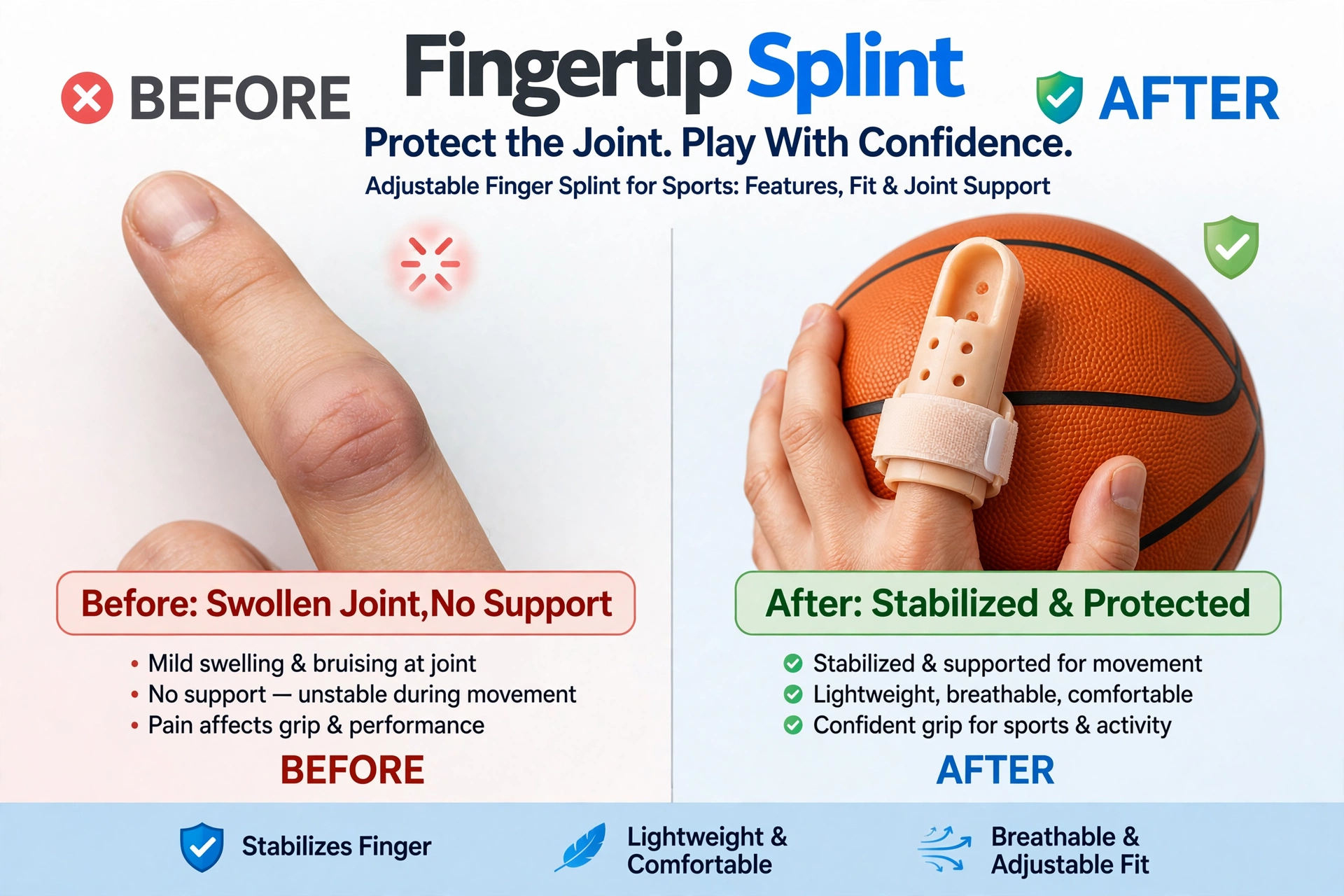
An adjustable finger splint is a support device that allows the wearer to modify the fit within the manufacturer’s intended range. Unlike a fixed design with a predetermined fit, an adjustable design lets you fine-tune the closure, the pressure, and — to a limited degree — the positioning.
Three concepts define how an adjustable splint works. Position determines how the product holds or supports the finger. Pressure determines how the closure or straps create a secure fit. Stability determines how the construction helps keep the support positioned during normal activity. When you evaluate a splint, you are really evaluating how well it balances those three functions against the activity you intend to do.
The key difference between fixed and adjustable support is simple. A fixed design has one fit. An adjustable design lets you modify the fit within a range. This is the first major reason the target reader might prefer an adjustable design. For a broader look at how adjustability fits into the overall sports-support decision, our broader basketball finger-splint buying guide covers the full product comparison.
Why Adjustability Matters for Athletes
Adjustability is not a marketing feature. It directly affects fit, comfort, and function during sports. Here is why it matters.
Different Finger Sizes
Two athletes can have completely different finger dimensions. A fixed-size splint may fit one player perfectly and slide off another. An adjustable closure accommodates a range of sizes within the manufacturer’s intended range.
Swelling Can Change Fit
After an injury, finger size may not feel identical from one day to another. Changes in finger size can affect how a product feels. An adjustable closure lets you modify the fit as conditions change, rather than forcing one fixed fit throughout the day.
Different Activities
The amount of movement required during basketball, volleyball, tennis, badminton, gym training, and recreational sports can differ. An adjustable splint lets you match support level to the activity rather than using the same fixed support in every context.
Easy Adjustment
An adjustable closure may be easier to fine-tune than a fixed design. This matters when you need to remove or refit the splint quickly during practice or competition.
Comfort
The user does not necessarily need maximum tightness. An adjustable closure lets you find the fit that is secure without being excessively tight. Remember: secure does not mean excessively tight.
8 Key Features to Compare Before Buying
Feature 1 — Adjustable Closure
The closure determines how the fit is modified. Hook-and-loop straps are common and allow fine-tuning within a range. A good closure should allow secure fastening, controlled adjustment, and easy release. Poor adjustment feels either too loose (slides) or too tight (pressure points).
Feature 2 — Joint Coverage
Ask which joint or part of the finger the product actually supports. Buyers should not assume that all finger splints support the same anatomical area. A splint designed for the middle joint will not stabilize the base joint, and vice versa.
Feature 3 — Finger Mobility
A sports player may need more movement than someone using a support for a completely different purpose. The tradeoff is direct: more restriction may mean less movement; more movement may mean less structural restriction. Neither is automatically better. Match the balance to your sport.
Feature 4 — Material
Consider flexibility, breathability, durability, skin-contact comfort, moisture, and cleaning requirements. The right material keeps you comfortable during play without causing irritation. Avoid assuming that one material is automatically medically superior.
Feature 5 — Low-Profile Construction
Excessive bulk may interfere with gripping, catching, passing, holding equipment, and everyday hand use. A splint that interferes with these actions will likely be removed during activity, defeating the purpose.
Feature 6 — Secure Positioning
The product should not simply slide around during ordinary movement. Correct sizing and adjustment work together to keep the support where it is intended. If it rotates or slides during catching or gripping, it is not providing consistent support.
Feature 7 — Ease of Adjustment
The user should be able to understand how the closure works without complicated instructions. If you cannot adjust the splint easily, you will not adjust it properly — and improper fit defeats the purpose.
Feature 8 — Manufacturer Sizing Guidance
Always prioritize the actual product’s sizing instructions rather than inventing a generic universal size chart. Sizing systems differ between brands, and between fingers. If you are comparing braces before making a purchase, see our guide on basketball finger support features to check before buying for a broader pre-purchase framework.
How an Adjustable Finger Splint Supports the Finger
Before you evaluate any product, it helps to know what you are looking at. The interactive 3D component explorer below breaks down how an adjustable splint supports the finger. Click each component to see what it does and why it matters.
Adjustable Support Structure Explorer
Click a component to learn what it does and why it matters when you are buying.
What Feature Matters Most to You?
Select one feature and we will show you what to look for. This is a shopping decision tool, not a medical recommendation.
- Correct size for the intended finger
- Manufacturer sizing guidance followed exactly
- Secure positioning that does not slide
- Comfortable contact without pressure points
- Ability to fine-tune the closure
Understanding Joint Support
Finger joints are involved in bending, straightening, gripping, catching, passing, and holding objects. Each joint has a different role, and the location of support matters.
A product designed around one area should not automatically be assumed to support another. A splint designed for the middle joint will not stabilize the base joint. A splint designed for the fingertip will not stabilize the middle joint. Before buying, confirm which joint the product is designed to support and whether that matches your situation.
Fingertip
The very end of the finger. Rarely the primary support area for sports splints unless the design specifically targets it.
DIP Joint
The joint closest to the fingertip. Specific injuries here may require specific splinting approaches rather than a generic sports brace.
Middle / PIP Joint
The middle joint of the finger. A common area for sports finger injuries and a common target for adjustable splints.
MCP / Base Region
Where the finger meets the hand. Support here affects grip and hand function differently than support at the middle joint.
How to Choose the Right Fit
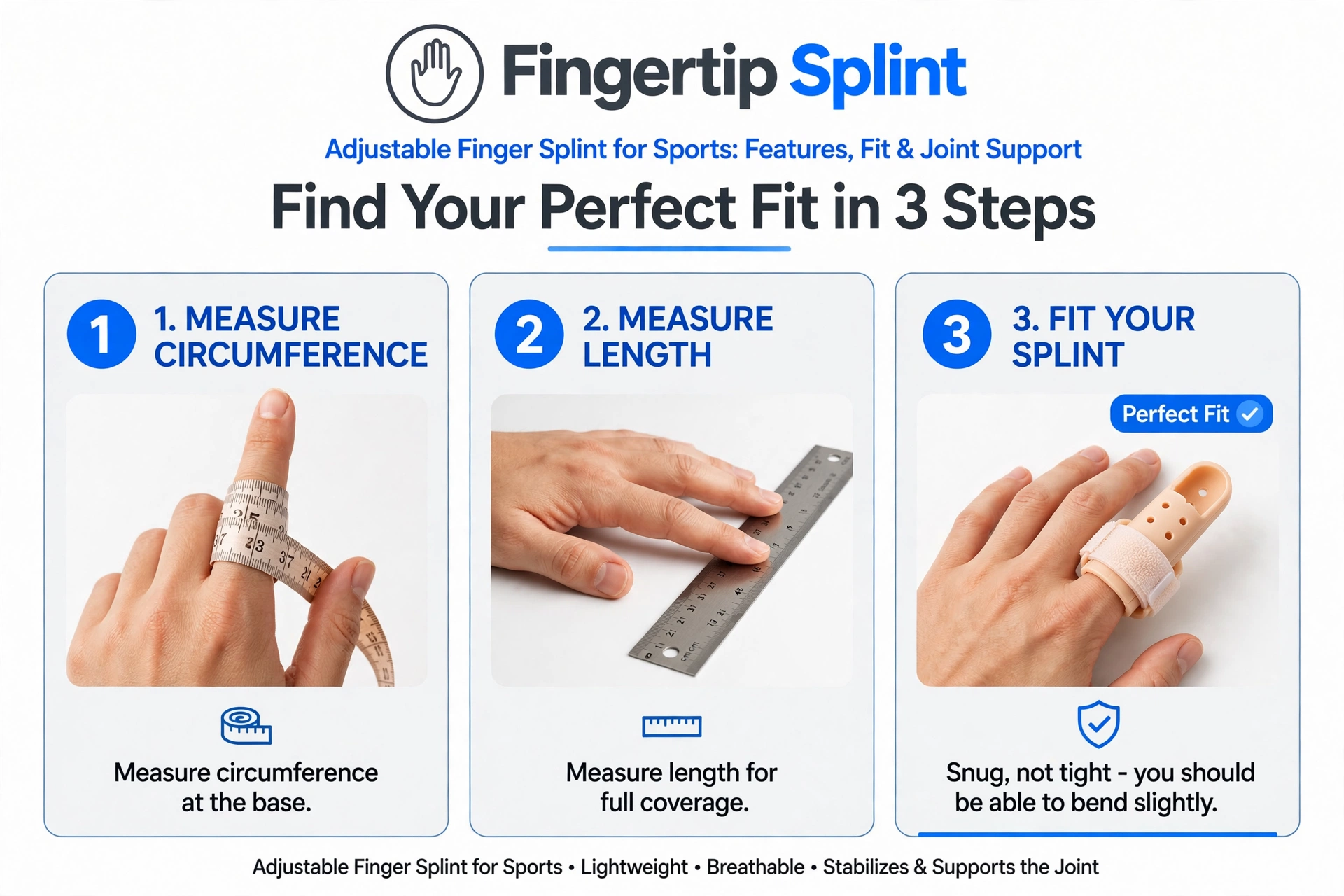
Fit is the single most common source of buyer frustration. Follow these seven steps and compare your measurement against the specific product’s size guidance.
Step 1 — Identify the intended finger
Index, middle, ring, or pinky. Do not guess based only on appearance.
Step 2 — Read the product sizing instructions
Manufacturer sizing should take priority over generic size charts.
Step 3 — Position the splint correctly
The intended support area should line up with the product’s design.
Step 4 — Adjust gradually
Do not immediately tighten the closure as much as possible.
Step 5 — Check stability
Does it stay in position during appropriate movement?
Step 6 — Check comfort
Look for uncomfortable pressure points, pinching, or edge irritation.
Step 7 — Recheck after movement
A product can feel fine when stationary but uncomfortable during activity.
Too Loose vs Too Tight vs Properly Fitted
Too loose
- Moves around
- Support does not stay positioned
- Feels unstable
Properly fitted
- Secure
- Comfortable
- Appropriately positioned
- Allows intended movement
Too tight
- Uncomfortable pressure
- Numbness or tingling
- Significant discoloration
- Increasing pain
Is Your Finger Splint Fitted Correctly?
Click each item to confirm. If you cannot check most of these, the fit needs adjustment.
Support vs Mobility: Finding the Right Balance
This is the central educational concept of this guide. A highly structured support may restrict more movement. A flexible design may preserve more movement. The correct balance depends on the product’s purpose, the activity, the finger involved, the underlying problem, and professional guidance where applicable.
Saying “maximum support is best” is not useful advice. For basketball, a player may need significant mobility for shooting and passing. For a resting situation, a more structured support may be more appropriate. The right balance is the one that matches your situation, not the one that provides the most restriction.
Sports-Specific Considerations
Basketball
Focus on catching, shooting, passing, dribbling, and ball contact. Finger mobility and secure positioning matter more here than maximum restriction. For a deeper look at the overall basketball decision, see our guide on how to choose the right basketball finger support.
Volleyball
Focus on finger contact, setting, blocking, and repeated ball impact. Comfort during repeated impact matters. A low-profile design that does not interfere with hand positioning is usually more practical than a bulky splint.
Tennis and Badminton
Focus on racket grip, finger positioning, and repeated hand movement. A splint that interferes with grip will likely be removed during play. Prioritize finger freedom and secure positioning.
Gym and Training
Focus on gripping, equipment handling, and resistance. A splint that cannot handle grip pressure or that interferes with equipment handling will not be worn consistently.
General Recreational Sports
Focus on comfort, movement, and secure fit. If the splint is comfortable and stays in place, it is more likely to be worn consistently.
Choose Your Activity
Select a sport and we will show you the main consideration. This is a shopping tool, not a medical recommendation.
- Grip and finger mobility for shooting and passing
- Secure positioning during catching and dribbling
- Low-profile design that does not interfere with ball release
- Comfort during repeated hand contact
How to Put On an Adjustable Finger Splint
Follow these nine steps for correct application, then recheck after several minutes of wear.
Adjustable Finger Splint Recovery & Reassessment Timeline
This is a reassessment framework, not a medical recovery timeline. Different finger injuries have very different recovery paths, so this section focuses on what to monitor rather than promising a healing schedule.
First 24–48 Hours
Focus on understanding the injury and following appropriate initial care. If you have significant pain, deformity, or loss of function, seek professional assessment rather than simply buying a splint.
Days 3–7
Monitor pain trend, swelling, movement, comfort, and function. Track patterns rather than single moments.
Week 2+
Assess whether symptoms are improving rather than assuming a fixed recovery schedule. Comfort does not equal recovery.
Return-to-Sport Consideration
Consider comfortable movement, functional ability, sport-specific tasks, and professional clearance when appropriate. Do not let a splint make the return-to-play decision for you.
For specific finger injuries, splinting can be highly specific. The American Society for Surgery of the Hand mallet finger resource describes mallet-finger treatment involving prolonged, specific splinting rather than a generic adjustable sports brace. That is a perfect example of why this article should not promise one universal recovery timeline.
10 Common Mistakes When Choosing an Adjustable Finger Splint
Comfort matters, but it is not the same as appropriate support. Check the structure and joint coverage too.
Check: does the design support the intended joint?
Sizing varies by brand and by finger. A generic size chart will not help.
Check: did you follow the specific product’s sizing method?
Excessive pressure can cause numbness, tingling, or discoloration. It does not improve support.
Check: can you wear it comfortably for the intended period?
Sports require grip, release, and hand movement. A splint that locks the finger may prevent the very movements you need.
Check: can you perform the movement your sport requires?
A splint designed for the middle joint will not stabilize the base joint, and vice versa.
Check: does the coverage match the joint you need to support?
Basketball, volleyball, and tennis place different demands on the finger.
Check: does the design suit your specific activity?
Straps can loosen during play. Recheck the fit periodically.
Check: does the splint stay in place after catching or gripping?
These are warning signs, not signs that the splint is working.
Check: is your finger normal in color and sensation?
Comfort does not equal recovery. Sport-specific function and professional clearance matter.
Check: has function returned, not just comfort?
A splint is a support tool. It does not diagnose or treat an injury.
Check: are you using it appropriately, or in place of assessment?
Who Should Consider an Adjustable Finger Splint?
Potential audiences include athletes comparing sports supports, basketball players, recreational athletes, people who value adjustable fitting, buyers replacing a fixed-size support, and people comparing mobility and support. A splint may not be appropriate for every injury or medical condition.
- Visible deformity
- Severe pain
- Major swelling
- Numbness or tingling
- Significant weakness
- Inability to move the finger normally
- Suspected fracture or dislocation
- Worsening symptoms
The American Society for Surgery of the Hand flexor tendon resource emphasizes that hand injuries can require accurate diagnosis and timely treatment, particularly where tendon, nerve, bone, or soft-tissue structures may be involved.
What a Hand Specialist Would Consider Before Using a Sports Finger Splint
This section is written in the tone of a practical professional checklist. It is not a diagnosis and does not replace an in-person assessment.
1. Which finger?
Different fingers have different sizing and different functional demands.
2. Which joint?
The splint must support the correct joint to be useful.
3. What happened?
A specific trauma event changes the evaluation compared to gradual discomfort.
4. Is there deformity?
A visibly deformed finger requires professional assessment, not a splint purchase.
5. Is movement possible?
Significant loss of movement is a red flag for further evaluation.
6. Is there numbness?
Numbness can indicate nerve involvement and should not be ignored.
7. Is swelling significant?
Significant swelling may indicate a more serious injury.
8. Is pain improving?
Worsening pain despite support suggests the situation needs reassessment.
9. Does the injury affect function?
Functional loss matters more than appearance for return-to-play decisions.
10. What sport does the person need to return to?
Different sports place different demands on the finger.
Product Evaluation: Basketball Finger Splint Adjustable Joint Support Brace
Use this section as a worked example of how to evaluate any adjustable sports finger splint against the criteria in this guide. The product being evaluated is the Basketball Finger Splint Adjustable Joint Support Brace from FingerTipSplint.
Basketball Finger Splint Adjustable Joint Support Brace
- Adjustability: Hook-and-loop fastening for fine fit adjustment
- Joint support: Support structure designed to help stabilize the intended finger joint
- Fit: Check the product page for the specific sizing guidance
- Mobility: Designed to preserve useful finger movement
- Comfort: Cushioned contact surface intended for extended wear
- Sports use: Adjustable support intended for basketball and similar activities
- Ease of use: Closure designed for straightforward application and adjustment
Rather than judging a finger splint by appearance alone, compare its actual construction, adjustment system, fit, support, and intended use against the criteria in this guide. For additional questions, visit the FingerTipSplint FAQ, and for wholesale inquiries, use the request-a-quote page.
| Feature | What the Buyer Should Evaluate |
|---|---|
| Adjustability | Can the fit be fine-tuned within a useful range? |
| Joint support | Which area does the design target? |
| Fit | Does the size correspond to the manufacturer’s guidance? |
| Mobility | How much movement remains? |
| Comfort | Does the contact area feel comfortable? |
| Sports use | Does its design suit the intended activity? |
| Ease of use | Can it be put on and adjusted easily? |
Buyer Decision Tool: What Kind of Adjustable Finger Support Do You Need?
Answer these questions to narrow down what to look for. This is a shopping tool, not a medical recommendation.
Quick Buyer Checklist
Before buying an adjustable sports finger splint, ask these questions. Click to confirm.
7 Quick Tips for Adjustable Sports Finger Splints
Frequently Asked Questions
An adjustable finger splint for sports is a support device that allows the wearer to modify the fit within the manufacturer’s intended range. It is designed to provide positioning support, joint stability within the design’s limits, and a layer of protection during approved activity. The adjustable closure is what makes fine-tuning possible.
An adjustable design lets you fine-tune the fit rather than relying on one fixed size. This matters because finger sizes differ, swelling can change fit, and different activities require different amounts of support. An adjustable closure may also be easier to remove and refit during activity.
It should be secure and comfortable, not excessively tight. You should be able to wear it for the intended period without numbness, tingling, significant discoloration, or increasing pain. If concerning symptoms occur, remove the device and seek appropriate advice rather than simply tightening or continuing to wear it.
Restriction varies by design. A more structured support may restrict more movement; a flexible design may preserve more. The correct balance depends on the product’s purpose, the activity, the finger involved, and the underlying problem. More restriction is not automatically better.
Suitability depends on the injury, the device design, and applicable basketball or league rules. Some splints are designed for sports use and preserve finger movement; others are intended for rest. Always check applicable league or facility rules and follow professional advice on return to play.
A correct fit is secure, comfortable, and allows appropriate movement without excessive pressure. The splint should stay in position without sliding repeatedly, you should be able to move the finger as intended by the design, and there should be no numbness, tingling, or significant discoloration.
Seek medical advice if you have obvious deformity, severe pain, major swelling, numbness, significant weakness, inability to move the finger normally, suspected fracture or dislocation, or worsening symptoms. These are red flags that should not be managed by buying a splint online. Proper assessment matters for both treatment and return-to-play decisions.
Ready to Compare an Adjustable Sports Finger Support?
You have now learned how to evaluate adjustability, joint coverage, fit, mobility, comfort, and sports requirements. Evaluate the Basketball Finger Splint Adjustable Joint Support Brace against those criteria before deciding.
For more buying guidance, explore the FingerTipSplint blog and the FingerTipSplint FAQ. For wholesale or business inquiries, use the request-a-quote page.
View Basketball Finger Splint Explore Finger Support ProductsConclusion: Match Adjustability to the Finger, the Joint, and the Sport
The right adjustable finger splint for sports is the one that fits, supports the intended joint, preserves the movement you need, and can actually be worn during the activities you do. A premium product in the wrong size or with the wrong support level will underperform a simpler product that matches your needs. Before you buy, measure the specific finger, check the manufacturer’s sizing guidance, confirm the support structure and joint coverage, and verify that your finger can still move enough for your sport.
If symptoms persist, worsen, or involve deformity, severe pain, numbness, or loss of function, do not simply buy a stronger splint. Seek appropriate medical evaluation. For medical finger splint supply and distribution, see the medical finger splint supplier page and the finger splint distributor page. For the full FingerTipSplint range, visit the FingerTipSplint homepage.