
Best Basketball Finger Splint: How to Choose the Right Finger Support
You jammed a finger. It is sore, swollen, or feels unstable. You search online and find dozens of finger supports that all look almost identical. The problem is that not every finger splint is designed for the same purpose, and picking the wrong one can leave you frustrated, uncomfortable, or still unable to play. This guide helps you compare the best basketball finger splint options by fit, support, adjustability, mobility, and comfort — so you can choose with confidence instead of guesswork.
You can browse basketball finger support products side by side while reading, or start with the featured answer below if you need a quick decision.
What a Basketball Finger Splint Can—and Cannot—Do
A finger splint can provide support or stabilization depending on its design. It does not automatically diagnose or treat an injury. Basketball finger injuries can range from minor irritation to injuries that require professional assessment. A visibly deformed finger, severe pain, major swelling, numbness, significant loss of movement, or persistent symptoms should not simply be managed by buying a brace online.
The Mayo Clinic finger injury overview and the AAOS hand and finger fracture resource both stress that proper assessment matters when symptoms are significant. Fit matters too, because excessive tightness can create discomfort or circulation and sensation problems. For a broader look at medical finger splint supply, see FingerTipSplint’s medical finger splint supplier page.
The best basketball finger splint depends on the finger involved, the support required, fit, adjustability, comfort, and how much movement you need during play. Look for a properly sized design that supports the intended joint without unnecessary restriction, and seek professional assessment when pain, deformity, swelling, or loss of function is significant.
Table of Contents
- What a Splint Can and Cannot Do
- Why Choosing Wrong Is Frustrating
- Types of Basketball Finger Support
- 3D Anatomy of a Finger Splint
- 10-Point Buyer Checklist
- Find Your Support Priority
- How Much Support Do You Need?
- Fit and Sizing Guide
- How to Put It On
- Basketball Activity Guide
- Reassessment Timeline
- 10 Common Buying Mistakes
- Who Should Consider One
- Doctor Advice
- Product Evaluation
- Buyer Decision Tree
- Fast Decision Section
- 7 Quick Tips
- FAQ
Why Choosing the Wrong Basketball Finger Splint Can Be Frustrating
Most basketball players do not start their search with a medical degree. They start with a sore finger, a missed practice, and a phone full of nearly identical-looking products. That is exactly why so many buyers end up with the wrong support — and why this section matters.
Problem 1: Everything Looks Similar
Many products online look almost identical. A thin sleeve, a wrapped splint, and a structured brace may all appear similar in thumbnail photos. But appearance alone is not enough to judge support, fit, or joint coverage. A product that looks supportive may not hold the finger in the intended position, and a product that looks minimal may be exactly right for your situation. You have to look at construction, not photography.
Problem 2: Too Much Support Is Not Automatically Better
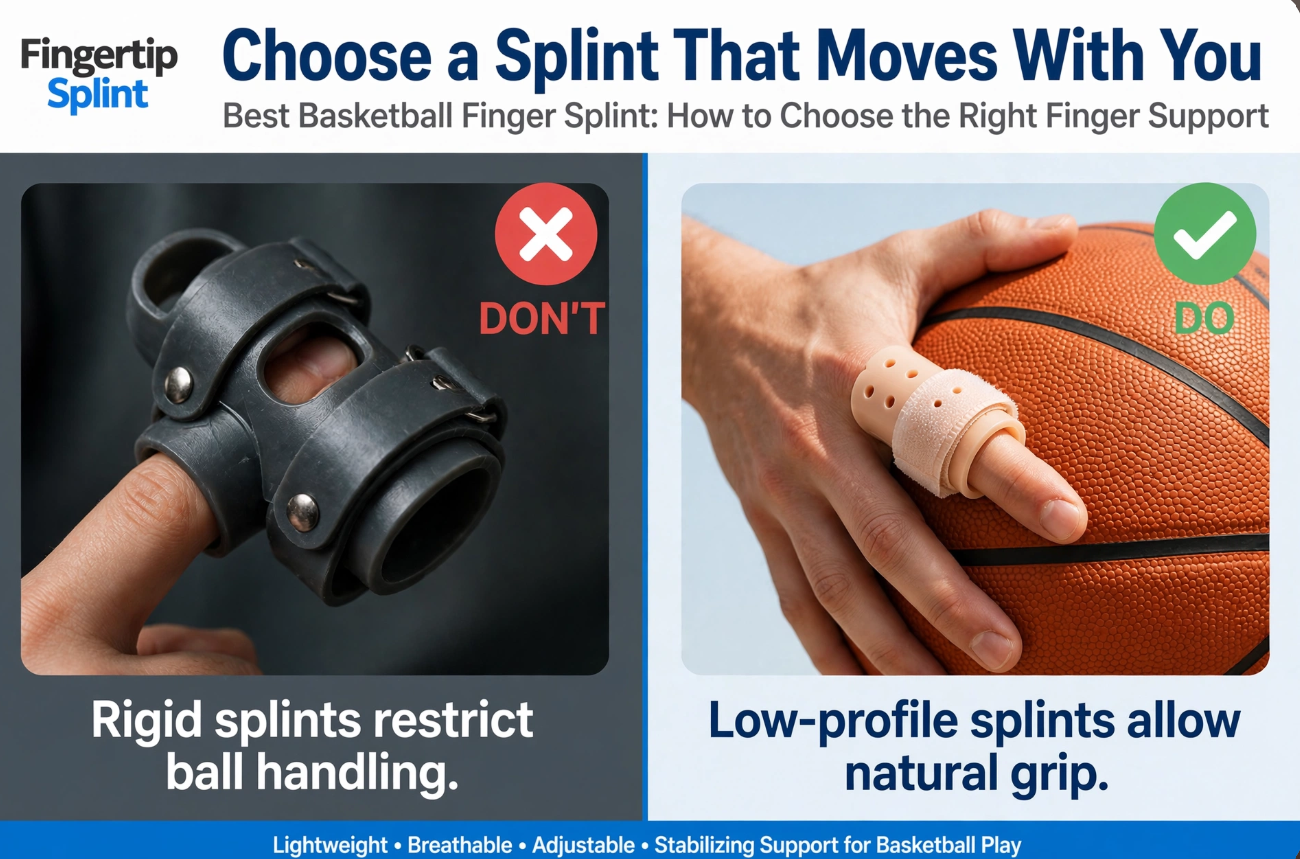
A highly restrictive brace is not automatically better. There is a real balance between support, mobility, and comfort. A brace that locks the finger completely may prevent the very hand movement you need for shooting, passing, and dribbling. The WebMD finger injuries overview and the Healthline finger injury resource both note that support needs depend on the specific injury, which is why a single “maximum support” product rarely suits everyone.
Problem 3: Wrong Size
A splint that moves around cannot provide the same stable fit as one appropriately sized for the intended finger. A brace that is slightly too large will slide, rotate, and lose positioning. A brace that is slightly too small will create pressure points and be intolerable during play. Sizing is not a minor detail.
Problem 4: Wrong Finger or Joint Coverage
Different designs may cover one joint, multiple joints, the finger shaft, the finger and thumb area, or neighboring fingers. Coverage should correspond to the intended support purpose. A brace that supports the wrong joint will not help regardless of how well it is made.
Problem 5: Basketball Requires Hand Function
Unlike a general immobilization situation, basketball involves gripping, passing, catching, shooting, dribbling, ball contact, and constant hand positioning. Mobility is not optional — it is part of the game. That is why choosing a splint for basketball requires a different evaluation than choosing one for rest or recovery. If you want a deeper look at how adjustability affects sports use, our guide on adjustable finger splint features and joint-support considerations is a useful companion read.
Types of Basketball Finger Support Compared
Not every finger support is designed for the same job. Use the comparison below to identify which category matches your situation — then evaluate specific products within that category.
| Support Type | Main Characteristic | Mobility | Best Comparison Question |
|---|---|---|---|
| Flexible finger sleeve | Lightweight coverage | High | Do I mainly want light support? |
| Adjustable finger splint | Customizable fit | Moderate to high depending on design | Do I need adjustable support? |
| More structured splint | Greater restriction | Lower | Do I need more stabilization? |
| Buddy-style support | Uses adjacent finger | Variable | Is this appropriate for my situation? |
| Protective sports support | Designed around activity | Variable | Does it suit basketball movement? |
No category is universally superior. The right category is the one that matches the finger, the joint, the type of support needed, and the amount of movement you require while playing.
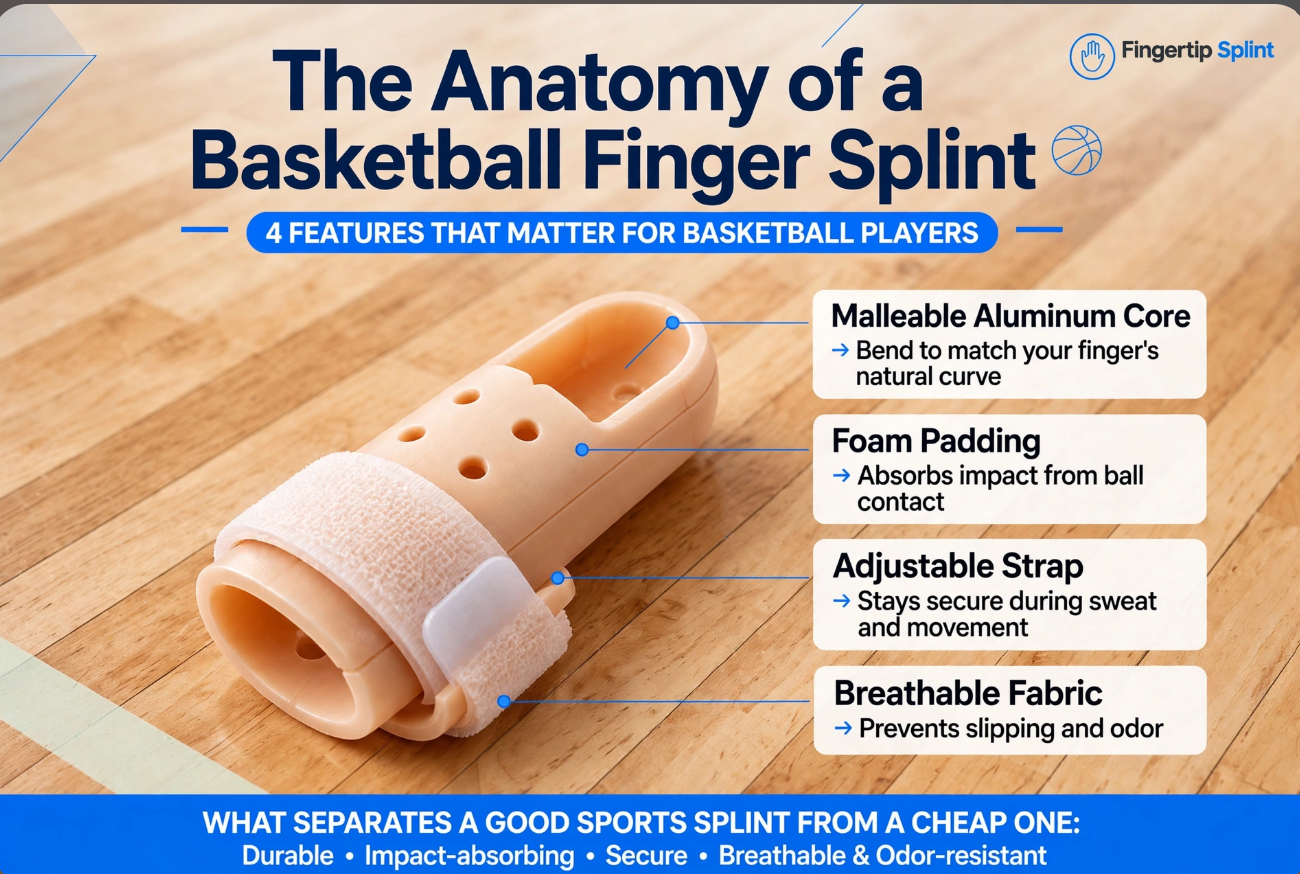
3D Anatomy of a Basketball Finger Splint
Before you evaluate any product, it helps to know what you are looking at. The interactive 3D component explorer below breaks down the layers and features of a typical adjustable finger splint. Click each component to see what it does and why it matters.
Finger Splint Component Explorer
Click a component to learn what it does and why it matters when you are buying.
10-Point Best Basketball Finger Splint Checklist
This is the core buyer section. Each point is something you can physically verify or ask about before you purchase.
1. Correct Finger Size
Sizing matters more than most buyers expect. A splint that is too loose slides and loses positioning; a splint that is too tight creates pressure points. Follow the manufacturer’s measurement method for the specific finger you are supporting.
2. Adjustable Closure
Useful when you need fine fit adjustment. Hook-and-loop closures let you modify the circumference rather than relying on one fixed size. This is especially important for basketball, where finger swelling can change during activity.
3. Appropriate Joint Coverage
The support area should match its intended purpose. A splint designed for the middle joint will not stabilize the base joint, and vice versa. Check which joint the product is designed to support before buying.
4. Mobility
Basketball players need to consider how much finger movement remains. A splint that locks the finger may prevent shooting, passing, or dribbling. If you want a broader comparison of support options before buying, our guide on what to look for before buying a basketball finger support brace covers additional pre-purchase checks.
5. Comfort
Pressure points, edges, and prolonged wear all matter. A splint that is uncomfortable after ten minutes will not be worn during practice or a game. Check the inner surface and edge finishing.
6. Material
Consider breathability, flexibility, durability, skin contact, and moisture management. The right material keeps you comfortable during play without causing skin irritation.
7. Secure Positioning
The support should stay where intended during ordinary movement. If it rotates or slides during dribbling or catching, it is not providing consistent support.
8. Easy Adjustment
Especially useful when you need to put it on or remove it quickly. If you cannot adjust the splint easily, you will not adjust it properly — and improper fit defeats the purpose.
9. Low-Profile Design
Excessive bulk can interfere with everyday hand use. A splint that interferes with gripping or catching will likely be removed during play, defeating the purpose entirely.
10. Clear Manufacturer Instructions
The buyer should understand sizing, use, cleaning, and limitations. If the product page does not tell you how to size it, how to wear it, and how to care for it, ask before buying.
Find Your Finger Support Priority
What matters most to you? Select one priority and we will show you what to look for. This is a shopping decision tool, not a medical recommendation.
- Soft inner contact surface
- Breathable, flexible material
- Low-pressure fastening
- Correct sizing for the intended finger
- Edge finishing that does not dig into skin
How Much Support Do You Actually Need?
Support should match the situation, not just the severity of how your finger feels on a given day. Use the three-level framework below to orient your decision.
Light Support
For situations where comfort and movement are the main priorities. Usually lower profile and easier to wear during activity. A flexible sleeve or light splint often fits this category.
Moderate Support
For users looking for a balance between support and movement. A semi-rigid splint with adjustable straps typically fits here — appropriate for controlled basketball activity when cleared by a professional.
Structured Support
For situations where greater restriction may be appropriate. Usually bulkier and more restrictive. The correct level depends on the underlying problem and professional guidance when needed.
Fit and Sizing Guide
Sizing is the single most common source of buyer frustration. Follow these six steps and compare your measurement against the specific product’s size guidance.
Step 1 — Identify the intended finger
Index, middle, ring, or pinky. Different fingers have different circumferences and different splint sizing.
Step 2 — Follow the manufacturer’s measurement method
Some ask for circumference at the base of the finger; others ask for the middle joint. The measurement point matters.
Step 3 — Compare with the manufacturer’s size guidance
Each brand’s chart is different. Never assume that a small in one brand matches a small in another.
Step 4 — Check finger positioning
The splint should align with the intended joint. If it sits too high or too low, it will not provide the support you need.
Step 5 — Test movement appropriate to the design
Open and close your hand, grip a ball lightly, and check that the splint stays in place during ordinary movement.
Step 6 — Check pressure and comfort
You should be able to wear the splint comfortably for the intended period without numbness, tingling, or discoloration.
How to Put On a Basketball Finger Splint
Follow these eight steps for correct application, then recheck after several minutes of wear.
Basketball Activity Guide: What to Consider
Different basketball activities place different demands on the fingers. Use the table below to think about which activities your splint needs to support.
| Activity | What to Consider |
|---|---|
| Shooting | Finger mobility and ball release. A splint that restricts the release point may affect your shot. |
| Dribbling | Grip and finger movement. The splint should not interfere with ball control. |
| Passing | Comfort and secure positioning. The splint should stay in place during rapid hand movement. |
| Rebounding | Hand contact and support. The splint should protect the finger without creating new pressure points on contact. |
| Practice | Duration and comfort. A splint that is comfortable for ten minutes may not be comfortable for two hours. |
| Competition | Fit, movement, and sport rules. Check applicable league or facility rules concerning braces, taping, or protective equipment. |
| Everyday Use | Adjustability and convenience. A splint that is easy to adjust and remove will be worn more consistently. |
Basketball Finger Support: A Reassessment Timeline
This is a reassessment framework, not a medical recovery timeline. Different finger injuries have very different recovery paths, so this section focuses on what to monitor rather than promising a healing schedule.
First 24–48 Hours
Focus on the injury situation, symptoms, and appropriate initial care according to professional advice. If you have significant pain, deformity, or loss of function, seek medical assessment rather than simply buying a splint.
Days 3–7
Assess pain trend, swelling trend, movement, comfort with support, and whether symptoms are improving. Track patterns rather than single moments.
Week 2+
Continue reassessment rather than assuming the finger is healed simply because the brace feels comfortable. Comfort does not equal recovery.
Before Returning to Normal Basketball Activity
Consider pain, movement, strength and function, ability to perform relevant basketball movements, and professional guidance when appropriate. Do not let a splint make the decision for you.
Additional trusted resources include the NHS finger injuries page, the Cleveland Clinic finger injury overview, and the MedlinePlus finger injuries resource.
10 Common Basketball Finger Splint Mistakes
Many finger splints look almost identical online. A product that looks supportive may not hold the finger in the intended position.
Check: does the construction match the support you need?
Excessive pressure can create discomfort, numbness, or circulation problems. Snug is not the same as tight.
Check: can you wear it comfortably for the intended period?
A splint that moves around cannot provide stable support. Sizing varies by manufacturer.
Check: did you measure the specific finger?
Basketball requires grip, release, and hand movement. A splint that locks the finger may prevent the very movements you need.
Check: can you grip and release a ball?
A splint appropriate for rest may not be appropriate for practice or competition.
Check: does the design match your intended activity?
Comfort does not equal recovery. Returning before the finger is ready can prolong the problem.
Check: has a professional cleared you to play?
Pain, swelling, numbness, or weakness that persists deserves assessment, not a stronger splint.
Check: are symptoms improving over time?
Straps can loosen during play. Recheck the fit periodically.
Check: does the splint stay in place after catching or dribbling?
Sizing, use, cleaning, and limitations matter. If the product page does not tell you, ask before buying.
Check: do you understand how to size and care for it?
A splint is a support tool. It does not diagnose or treat an injury.
Check: are you using it appropriately, or in place of assessment?
Who Should Consider a Basketball Finger Splint?
Potential buyers include basketball players comparing support options, players experiencing minor discomfort, players wanting adjustable support, players who need a product for practical everyday use, and buyers replacing an old finger support. A splint may not be appropriate for every injury or medical condition.
- Obvious deformity
- Severe pain
- Major swelling
- Numbness
- Significant weakness
- Substantial loss of movement
- Worsening symptoms
- Persistent symptoms
The Johns Hopkins Medicine finger injuries resource and the NIAMS sports injuries overview both emphasize the importance of proper assessment for significant hand and finger injuries.
What a Doctor Would Consider Before Choosing a Basketball Finger Splint
This section is written in the tone of a practical professional checklist. It is not a diagnosis and does not replace an in-person assessment.
1. Which finger is affected?
Different fingers have different sizing and different functional demands.
2. Which joint is involved?
The splint must support the correct joint to be useful.
3. Is there swelling?
Swelling can affect fit and may indicate a more significant injury.
4. Is there deformity?
A visibly deformed finger requires professional assessment, not a splint purchase.
5. Is movement significantly restricted?
Significant loss of movement is a red flag for further evaluation.
6. Is there numbness or tingling?
Numbness can indicate nerve involvement and should not be ignored.
7. Is pain getting better or worse?
Worsening pain despite support suggests the situation needs reassessment.
8. Was there a specific injury?
A specific trauma event changes the evaluation compared to gradual discomfort.
9. Can the person safely continue playing?
Return-to-play decisions should involve professional guidance, not just a splint purchase.
10. Does the injury require professional assessment?
If any of the red flags above apply, the answer is yes.
What a support product can potentially provide: positioning support, joint stability within the design’s intended limits, and a layer of protection during approved activity. What requires professional evaluation: diagnosis, treatment decisions, return-to-play clearance, and any injury with deformity, severe pain, major swelling, numbness, weakness, or significant loss of movement.
Product Evaluation: Basketball Finger Splint Adjustable Joint Support Brace
Use this section as a worked example of how to evaluate any basketball finger splint against the criteria in this guide. The product being evaluated is the Basketball Finger Splint Adjustable Joint Support Brace from FingerTipSplint.
Basketball Finger Splint Adjustable Joint Support Brace
- Adjustability: Hook-and-loop fastening for fine fit adjustment
- Support: Joint support structure designed to help stabilize the intended finger joint
- Intended finger use: Designed for finger joint support in sports and daily activity
- Fit: Check the product page for the specific sizing guidance
- Mobility: Designed to preserve useful finger movement
- Comfort: Cushioned contact surface intended for extended wear
- Everyday practicality: Low-profile design intended for daily use
- Sports use: Adjustable support intended for basketball and similar activities
Rather than judging a finger splint by appearance alone, compare its actual construction, adjustment system, fit, support, and intended use against the criteria in this guide. For general finger support education, see the FingerTipSplint FAQ, and for wholesale inquiries, use the request-a-quote page.
Buyer Decision Tree: What Kind of Finger Support Do You Need?
Answer these questions to narrow down what to look for. This is a shopping tool, not a medical recommendation.
Need a Basketball Finger Splint Quickly? Start Here
If you only have 60 seconds, check these 6 things
7 Quick Basketball Finger Splint Tips
Frequently Asked Questions
There is no universally best design. Selection depends on the finger involved, the joint that needs support, the level of stability required, fit, adjustability, comfort, and how much movement you need during play. Compare products against the 10-point checklist in this guide, and seek professional assessment if symptoms are significant.
Suitability depends on the injury, the device design, and applicable basketball or league rules. Some splints are designed for sports use and preserve finger movement; others are intended for rest. Always check applicable league or facility rules concerning braces, taping, or protective equipment, and follow professional advice on return to play.
It should be secure and comfortable, not excessively tight. You should be able to wear it for the intended period without numbness, tingling, significant discoloration, or increasing pain. If concerning symptoms occur, remove the device and seek appropriate medical advice rather than simply tightening or continuing to wear it.
Look for correct sizing for the intended finger, adjustable closure, appropriate joint coverage, preserved finger mobility, comfortable contact surfaces, breathable and durable material, secure positioning, easy adjustment, low-profile design, and clear manufacturer instructions for use and care.
Restriction varies by design. Some splints are designed to limit movement at a specific joint while preserving overall hand function; others are more restrictive. More restriction is not automatically better. For basketball, the right design supports the intended joint without unnecessarily limiting the finger movement you need.
There is no universal duration. Wear time depends on the underlying issue, the device instructions, and professional advice where necessary. Do not assume that comfort equals recovery. If symptoms persist, worsen, or involve weakness, numbness, or loss of function, seek professional assessment rather than continuing to wear the splint indefinitely.
Seek medical advice if you have obvious deformity, severe pain, major swelling, numbness, significant weakness, substantial loss of movement, worsening symptoms, or persistent symptoms. These are red flags that should not be managed by buying a splint online. Proper assessment matters for both treatment and return-to-play decisions.
Choose Basketball Finger Support With Confidence
You have now compared fit, support, adjustability, mobility, comfort, and basketball use. Evaluate the Basketball Finger Splint Adjustable Joint Support Brace against those criteria before deciding.
For more buying guidance, explore the FingerTipSplint blog and the FingerTipSplint FAQ. For wholesale or business inquiries, use the request-a-quote page.
View Basketball Finger Splint Explore Finger Support ProductsConclusion: Match the Splint to the Finger, the Joint, and the Game
The best basketball finger splint is the one that fits, supports the intended joint, preserves the movement you need, and can actually be worn during the activities you do. A premium product in the wrong size or with the wrong support level will underperform a simpler product that matches your needs. Before you buy, measure the specific finger, check the manufacturer’s sizing guidance, confirm the support structure and joint coverage, and verify that your finger can still move enough for shooting, passing, and dribbling.
If symptoms persist, worsen, or involve deformity, severe pain, numbness, or loss of function, do not simply buy a stronger splint. Seek appropriate medical evaluation. For medical finger splint supply and distribution, see the medical finger splint supplier page and the finger splint distributor page. For the full FingerTipSplint range, visit the FingerTipSplint homepage.