
Your finger is clicking, catching, stiff, or difficult to straighten. You want an adjustable trigger finger brace, but product pages leave you guessing. Will it fit? How tight should it be? Where should the support sit? Does the knob actually matter? This guide walks you through sizing, adjustment, support position, comfort, and how to know when the fit is right. For a broader look at the FingerTipSplint product ecosystem, start at the FingerTipSplint homepage.
Table of Contents
- Why Adjustable Fit Matters
- What Should a Brace Support?
- 8 Things to Check
- Fit Guide Step by Step
- Interactive Fit Checker
- 3D Brace Anatomy
- Adjustable vs Fixed Brace
- How Tight Should It Be?
- Recovery and Reassessment
- 10 Common Mistakes
- Who Should Consider One
- Product Evaluation
- Buyer Decision Tool
- Doctor Advice
- 7 Quick Tips
- FAQ
The best adjustable trigger finger brace should match the intended finger, provide the required support position, fit securely without excessive pressure, allow appropriate movement for its design, and remain comfortable during intended use. Follow the manufacturer's sizing and adjustment instructions rather than assuming tighter is better.
Why Adjustable Fit Matters More Than Simply Choosing the "Best" Brace
Most buyers search for the best adjustable trigger finger brace, expecting a single correct answer. The reality is that "best" depends on fit. A brace that fits one person's finger perfectly may be unwearable on another's. That is why adjustability, sizing, and support position matter more than any universal ranking.
One Finger Does Not Fit Every Brace
Finger circumference, finger length, joint location, hand size, finger shape, and the intended support position all differ from person to person. A brace sized for the index finger may not fit the pinky comfortably. A brace designed for the base of the finger may not support the middle joint. These are practical realities, not minor details.
Why an Adjustable Design Can Help With Fit
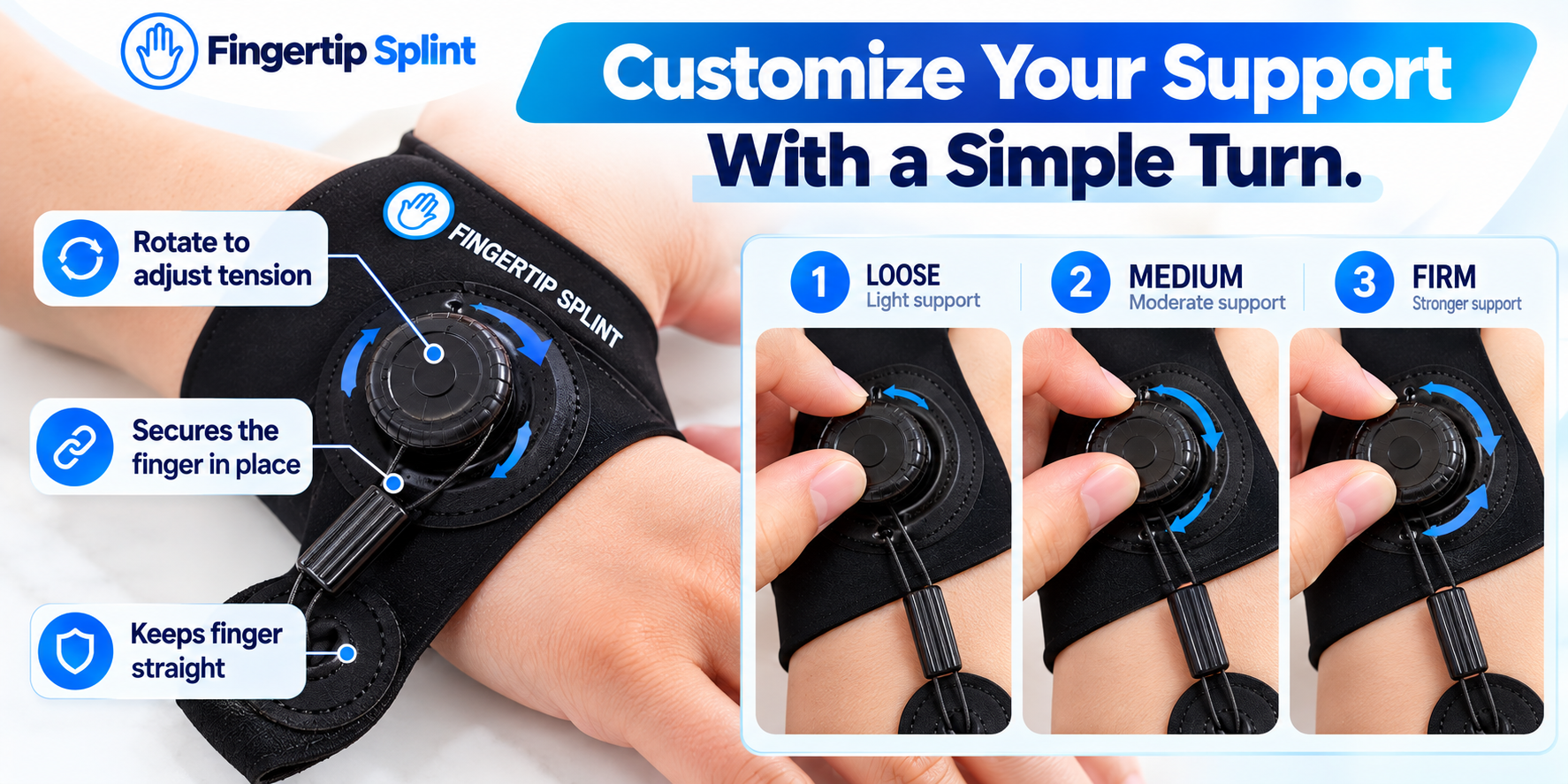
An adjustable design lets you modify position or tension within the manufacturer's intended range. This can be useful when your finger size changes slightly, when you need to fine-tune the support position, or when you want to adjust the pressure during wear. The practical advantage is control — you are not locked into one fixed fit.
Adjustable Does Not Mean Universal
An adjustable brace still has a design range, finger compatibility limits, support limitations, manufacturer sizing, and intended positioning. It is not a one-size-fits-all solution. Adjustability expands the range of fit, but it does not eliminate the need to check the product's sizing guidance and intended use.
What Should an Adjustable Trigger Finger Brace Actually Support?
Understanding the Finger's Movement
Finger joints work together to allow bending and straightening. The flexor tendon runs along the palm side of the finger and glides through a series of pulleys. When that gliding is restricted, catching or locking can occur. The Mayo Clinic trigger finger symptoms and causes page describes this mechanism clearly.
Support vs Immobilization
Supporting a finger and completely immobilizing a finger are not necessarily the same thing. A support brace is designed to help maintain an appropriate position or limit aggravating movement. An immobilization splint may restrict movement more substantially. These serve different purposes, and the right choice depends on your situation and professional guidance.
Why the Support Position Matters
A brace can feel tight but still be poorly positioned. If the support area does not align with the joint or region that needs support, the brace is not doing its job regardless of how secure it feels. This is why measuring, checking the product's support area, and confirming the intended positioning matter before buying.
8 Things to Check Before Buying an Adjustable Trigger Finger Brace
1. Correct Finger Compatibility
Check whether the product is designed for the index, middle, ring, or little finger. Do not assume one brace works equally well on every finger. Finger circumference and functional demand differ. Confirm the intended finger before comparing products.
2. Adjustability Range
Consider how much adjustment is available, whether the adjustment is continuous or fixed, whether the brace can accommodate your finger size, and whether adjustment affects support position. More adjustment is not automatically better — too much adjustment can make a product unnecessarily complicated. If you want a deeper look at how the adjustment mechanism affects fit and support, see our guide on trigger finger brace buying guide for knob design, fit, and support.
3. Support Position
Where is the brace designed to provide support? Check the joint position, the finger length, and the support contact area. A brace designed for one joint will not stabilize another, and a brace positioned incorrectly will not help regardless of how well it is made.
4. Knob or Adjustment Mechanism
Evaluate the adjustment mechanism for ease of adjustment, stability, precision, comfort, and ease of use. A knob can provide fine control, but it needs to hold its setting during wear. Do not simply assume that a knob design is automatically better. The important question is whether the mechanism matches your finger and your needs.
5. Size and Finger Circumference
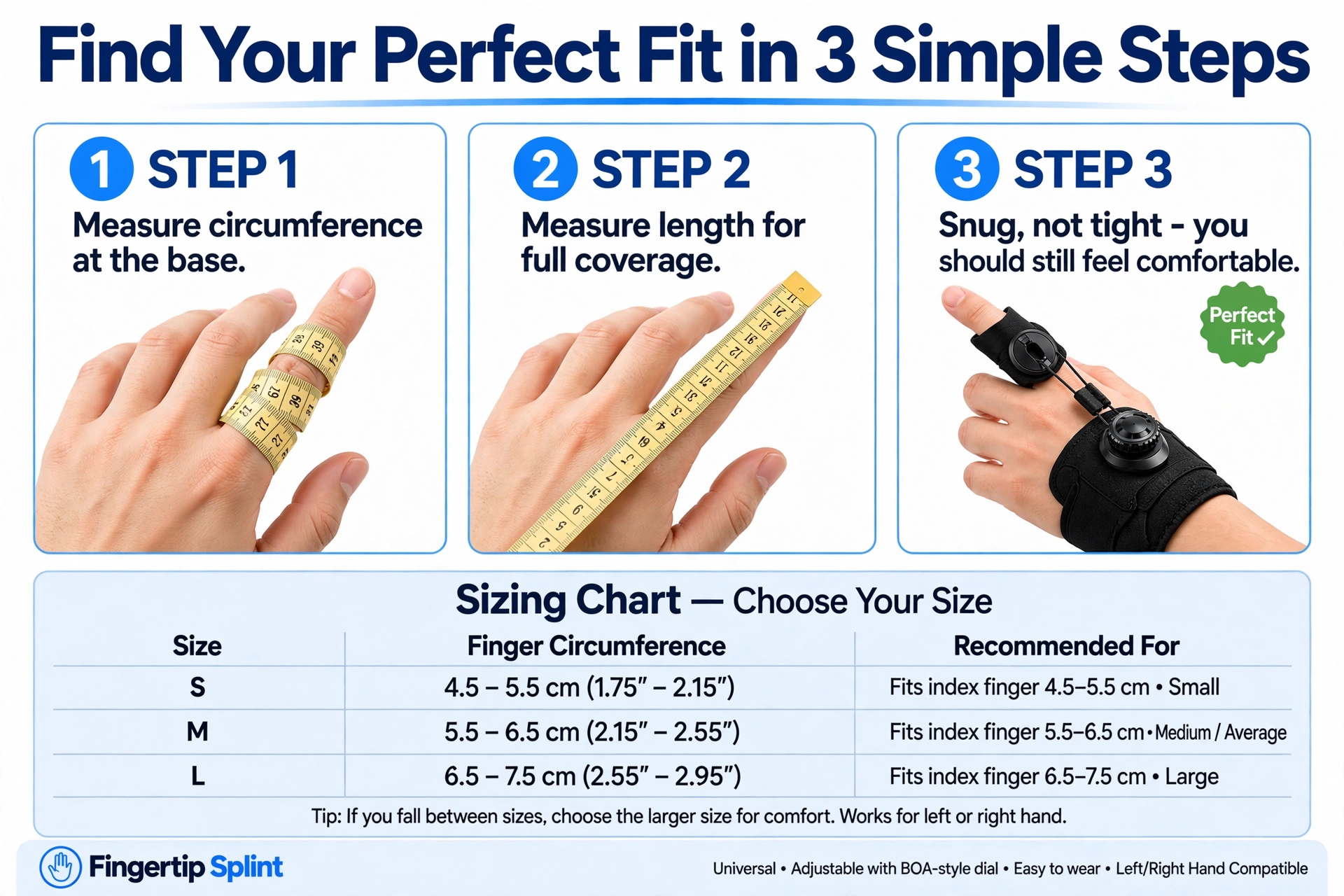
How to Measure
- Identify the finger.
- Follow the manufacturer's measurement point.
- Measure accurately with a flexible tape.
- Compare with the product size chart.
- Select the appropriate size range.
- Adjust gradually after application.
Why Guessing Your Size Can Backfire
A brace that is too loose slides and loses positioning. A brace that is too tight creates pressure points, numbness, or discoloration. Neither provides better support. Guessing your size is one of the most common mistakes buyers make.
6. Comfort and Material
Check the padding, skin-contact surfaces, breathability, flexibility, edges, and potential pressure points. Comfort does not mean no support. A comfortable brace still needs to remain appropriately positioned and provide the intended support level.
7. Mobility
Consider bending, straightening, grip, pinching, typing, and writing. The goal is not to promise unrestricted movement, but to help you understand the relationship between brace design and mobility. A brace that unnecessarily restricts the movement you need will not be worn consistently.
8. Intended Wearing Situation
Daytime
Movement and function often matter more. The brace should not interfere with typing, writing, or daily tasks.
Nighttime
Comfort and secure positioning over long hours matter more. The brace should stay in place without creating pressure points.
Short activity periods
Convenience and easy application may matter more. The brace should be simple to put on and take off.
Adjustable Trigger Finger Brace Fit Guide
This is the most important section for getting the fit right. Follow these eight steps and recheck after wear.
Interactive Adjustable Brace Fit Checker
Click each item to check your fit. If you cannot confirm most of these, the fit needs adjustment.
3D Interactive Infographic — Anatomy of an Adjustable Trigger Finger Brace
The interactive 3D component explorer below breaks down the parts of an adjustable trigger finger brace. Click each component to see what it does and why it matters.
Adjustable Brace Component Explorer
Click a component to learn what it does and why it matters when you are buying.
Adjustable vs Fixed Trigger Finger Brace
| Feature | Adjustable Brace | Fixed Brace |
|---|---|---|
| Fit customization | Usually higher | Usually limited |
| Size flexibility | Depends on design | Depends on product |
| Adjustment | Available | Limited or none |
| Ease of setup | May require learning | Often simpler |
| Support positioning | Product-dependent | Predefined |
| Daily convenience | Depends on design | Depends on design |
| User control | Higher | Lower |
When Adjustability Can Be Useful
If you need to fine-tune the fit, if your finger size changes, or if you want more control over the support level, an adjustable design can be beneficial. If you want a simpler setup, a fixed brace may be more appropriate.
When Simplicity May Matter More
A fixed brace has no adjustment learning curve and may be quicker to apply. It is not automatically inferior. The right choice depends on your situation.
Adjustable Brace vs Finger Sleeve
A brace provides structured support. A sleeve provides flexible coverage or compression depending on its design. Compare support, mobility, fit, coverage, adjustability, and intended use before choosing a category.
How Tight Should an Adjustable Trigger Finger Brace Be?
This is one of the most common buyer questions, and the answer matters for both comfort and function.
The "Tighter Is Better" Myth
Excessive pressure is not automatically better support. Tightening a brace until the finger cannot move does not make it more effective. It can cause numbness, tingling, discoloration, and increasing pain, none of which help the underlying problem.
What a Proper Fit Should Feel Like
Secure
Stays in place without sliding excessively during normal activity.
Stable
Provides consistent support without shifting or rotating.
Comfortable
Can be worn for the intended period without pressure points or irritation.
Appropriate support
Provides the intended support level without unnecessary restriction.
No concerning changes
No numbness, tingling, discoloration, or increasing pain during wear.
Allows necessary movement
Permits the movement you need for daily tasks and activities.
Warning Signs You Should Not Ignore
- Numbness
- Tingling
- Significant color change
- Increasing pain
- Excessive pressure
- Worsening symptoms
If any of these occur, remove the brace and reassess the fit. Do not simply tighten it further. If symptoms persist, seek appropriate medical advice.
Recovery Timeline and Reassessment
This is a reassessment framework, not a promised healing schedule. Trigger finger recovery varies considerably depending on the individual and the severity of the situation.
Stage 1 — Initial Fit and Protection
Focus on correct placement, comfort, skin response, and support position. If the brace does not fit or stay in place, address that before extended wear.
Stage 2 — Early Reassessment
Ask whether the brace is staying in place, whether it is comfortable, whether symptoms are improving or worsening, and whether movement is changing.
Stage 3 — Activity Reassessment
Consider whether normal activities are becoming easier or continuing to provoke symptoms. Adjust the wearing schedule as needed based on guidance.
Stage 4 — When Symptoms Persist
If symptoms persist, worsen, or interfere with function, seek professional evaluation rather than continuing to self-treat. The Mayo Clinic trigger finger diagnosis and treatment guidance notes that treatment depends on symptom severity and duration.
10 Adjustable Trigger Finger Brace Mistakes
Sizing varies by brand and finger. Use the specific product's chart.
Correction: measure first, compare second, buy third.
A brace can look supportive without matching your finger or joint.
Correction: look at the support area and adjustment range.
Adjustable expands the range but does not eliminate compatibility limits.
Correction: check finger compatibility and intended use.
Excessive pressure does not improve support and can create new symptoms.
Correction: secure, not tight. Adjust gradually.
A brace can cover the finger without supporting the right joint.
Correction: confirm the support area aligns with the intended joint.
A brace sized for one finger may not fit another comfortably.
Correction: confirm the intended finger before buying.
Pressure points, rough edges, and irritation matter for consistent wear.
Correction: check padding, edges, and material before extended use.
More restriction is not automatically more appropriate.
Correction: match the support level to your situation and guidance.
Symptoms that persist or worsen deserve professional assessment.
Correction: don't simply buy a stronger brace.
A brace is a support tool, not a diagnosis or cure.
Correction: read the product's intended use and instructions.
Who Should Consider an Adjustable Trigger Finger Brace?
Buyers looking for adjustable support
People who want to fine-tune the fit rather than accept a single fixed size.
People comparing different finger-brace designs
Buyers who want to understand how adjustable and fixed braces differ before choosing.
People who need a more customizable fit
Those whose finger size or support needs change during wear.
People looking for a low-profile support option
Buyers who want support without the bulk of a traditional splint.
When a Brace Should Not Be Your Only Next Step
- Severe pain
- Significant swelling
- Visible deformity
- Major movement loss
- Numbness or tingling
- Significant discoloration
- Suspected fracture or dislocation
- Symptoms that persist or worsen
The Cleveland Clinic trigger finger overview notes that providers commonly recommend nighttime splinting in trigger finger management, but the appropriate approach depends on the individual situation and should not replace professional assessment when symptoms are significant.
Product Guide — FingerTipSplint Adjustable Trigger Finger Brace with Knob
Use this section as a worked example of how to evaluate an adjustable trigger finger brace against the criteria in this guide. The product being evaluated is the FingerTipSplint Adjustable Trigger Finger Brace with Knob.
Fingertip Splint Adjustable Trigger Finger Brace with Knob
- Adjustable design: Knob-based adjustment for fine fit tuning
- Finger compatibility: Check the product page for specific finger compatibility
- Knob mechanism: Designed for controlled adjustment within the intended range
- Support structure: Intended to help maintain the intended finger position
- Fit: Check the product page for sizing and application guidance
- Application: Follow the manufacturer's instructions for correct placement
- Comfort: Cushioned contact surface intended for extended wear
- Intended use: Daily and nighttime support as recommended
What to Check Before Ordering
Verify size, finger compatibility, adjustment range, materials, instructions, and intended use. For buyers comparing different finger support options, explore the finger splint shop. For clinics, distributors, and healthcare supply purchasing, see the medical finger splint supplier page and the finger splint distributor page.
Buyer Decision Guide — Which Adjustable Brace Characteristics Matter Most?
Select your priority and we will show you what to look for. This is a shopping decision tool, not a medical recommendation.
- Correct size for the intended finger
- Adjustability within the manufacturer's intended range
- Support position that aligns with the intended joint
- Secure positioning that does not slide
- Manufacturer sizing guidance followed exactly
Doctor Advice: What Matters More Than the Word "Best"
This section is written in the tone of a practical professional checklist. It is not a diagnosis and does not replace an in-person assessment.
Correct support position
The brace must support the correct joint or region to be useful.
Appropriate fit
Secure, comfortable, and correctly positioned without excessive pressure.
Comfortable use
Can be worn for the intended period without irritation or pressure points.
Monitoring symptoms
Track whether symptoms are improving, stable, or worsening over time.
Knowing when to seek evaluation
Persistent or worsening symptoms deserve professional assessment.
Understanding that "best" is contextual
There is no universal best brace. The right brace depends on your finger, your situation, and your needs.
Additional trusted resources include the AAOS OrthoInfo trigger finger page, the ASSH trigger finger resource, the MedlinePlus trigger finger page, the NHS trigger finger page, the WebMD trigger finger overview, and the Healthline trigger finger resource.
7 Quick Tips Before You Order
Frequently Asked Questions
"Best" depends on finger compatibility, support position, adjustability, sizing, comfort, and intended use rather than one universal product. A brace that fits one person's finger perfectly may not fit another's. Focus on the criteria in this guide and match them to your situation rather than searching for a single best product.
For a broader look at selection, see our guide on how to choose the right fit for an adjustable trigger finger brace.
A correct fit is secure, comfortable, and positions the support area correctly. The brace should stay in place without sliding excessively, allow appropriate movement, and not create numbness, tingling, discoloration, or increasing pain. If you cannot confirm these, the fit needs adjustment.
Measure according to the manufacturer's instructions, compare with the size chart, position the brace correctly, adjust gradually, and recheck after wear.
It should be secure and comfortable, not excessively tight. You should be able to wear it for the intended period without numbness, tingling, significant discoloration, or increasing pain. Excessive tightness is not better support — it creates new problems.
If concerning symptoms occur, remove the brace and reassess the fit rather than tightening it further.
Suitability depends on the brace design and your individual circumstances. The Cleveland Clinic trigger finger overview notes that providers commonly recommend nighttime splinting in trigger finger management. Follow the product's instructions and your healthcare professional's guidance on wearing schedule.
A brace that is uncomfortable overnight will not be worn consistently. Check comfort and positioning before relying on it for nighttime use.
An adjustable brace allows the user to modify the fit within the manufacturer's intended range. A finger splint is typically designed for more structured positioning or stabilization, often to limit movement more substantially. Some splints are adjustable; some braces are not. The categories overlap.
The right choice depends on whether you need fine-tunable fit, structured positioning, or a combination of both.
Braces may be used as part of conservative management for some people. The Mayo Clinic trigger finger treatment guidance notes that splinting can help rest the tendon. However, persistent or significant symptoms require appropriate assessment rather than assuming the brace will resolve the underlying problem.
Do not rely on a brace indefinitely if symptoms persist, worsen, or involve locking that does not resolve.
There is no universal duration. Wear time depends on the underlying issue, product instructions, and professional advice. Reassess based on symptoms and function rather than assuming a fixed number of days or weeks.
If symptoms persist, worsen, or interfere with function, seek professional evaluation rather than continuing to self-treat. If you need a broader view, our guide on adjustable finger straighteners for bent fingers covers related selection factors.
Choose the Fit, Not Just the Product
Do not choose an adjustable trigger finger brace simply because it looks supportive. Choose one whose finger compatibility, adjustment range, support position, sizing, and comfort match what you actually need. Evaluate the FingerTipSplint Adjustable Trigger Finger Brace with Knob against the criteria in this guide before deciding.
Explore the finger splint shop, check the FingerTipSplint FAQ, or use the request-a-quote page for wholesale or business inquiries. For medical finger splint supply, see the medical finger splint supplier page.
View the Product Explore Finger SupportConclusion: A Better Fit Starts With Better Questions
The right adjustable trigger finger brace is the one that fits your finger, supports the intended area, adjusts within a useful range, and can actually be worn during the activities you do. Before you buy, measure the specific finger, check the manufacturer's sizing guidance, confirm the support position and adjustment range, and verify that the brace stays comfortable during the intended wearing period.
If symptoms persist, worsen, or involve locking that does not resolve, deformity, severe pain, numbness, or loss of function, do not simply buy a stronger brace. Seek appropriate medical evaluation. For medical finger splint supply and distribution, see the medical finger splint supplier page and the finger splint distributor page. For the full FingerTipSplint range, visit the FingerTipSplint homepage.