
Your finger is swollen, painful, difficult to move, and you are wondering whether a simple finger splint is enough. A sprain and a dislocation are not necessarily the same problem, and the right support depends on the injury. This guide explains the difference, what to check before buying a splint, and when professional assessment matters more than a product purchase. For a broader view of the FingerTipSplint range, start with the FingerTipSplint homepage.
Table of Contents
- Sprain vs Dislocation
- Why a Splint Is Used
- Types of Finger Splints
- Choosing a Splint After a Sprain
- Choosing a Splint After a Dislocation
- Do You Need a Doctor?
- 10 Features to Check
- How Tight Should It Be?
- 3D Injury & Splint Infographic
- Step-by-Step Buying Process
- 10 Common Mistakes
- Splint vs Guard vs Sleeve vs Tape
- Product Guide
- Recovery Timeline
- When to Stop Using a Splint
- When to Seek Professional Assessment
- Doctor Advice
- Interactive Support Selector
- Buyer Checklist
- FAQ
A finger splint may be used to support or limit movement after certain finger injuries, but the appropriate type and duration depend on the injury. A suspected dislocation, fracture, severe sprain, deformity, or significant loss of movement should be professionally assessed rather than treated by choosing a splint based only on appearance.
Sprain vs Dislocation — What’s the Difference?
Understanding the difference matters because the appropriate support and the urgency of professional assessment differ. This section is educational, not diagnostic.
What Is a Finger Sprain?
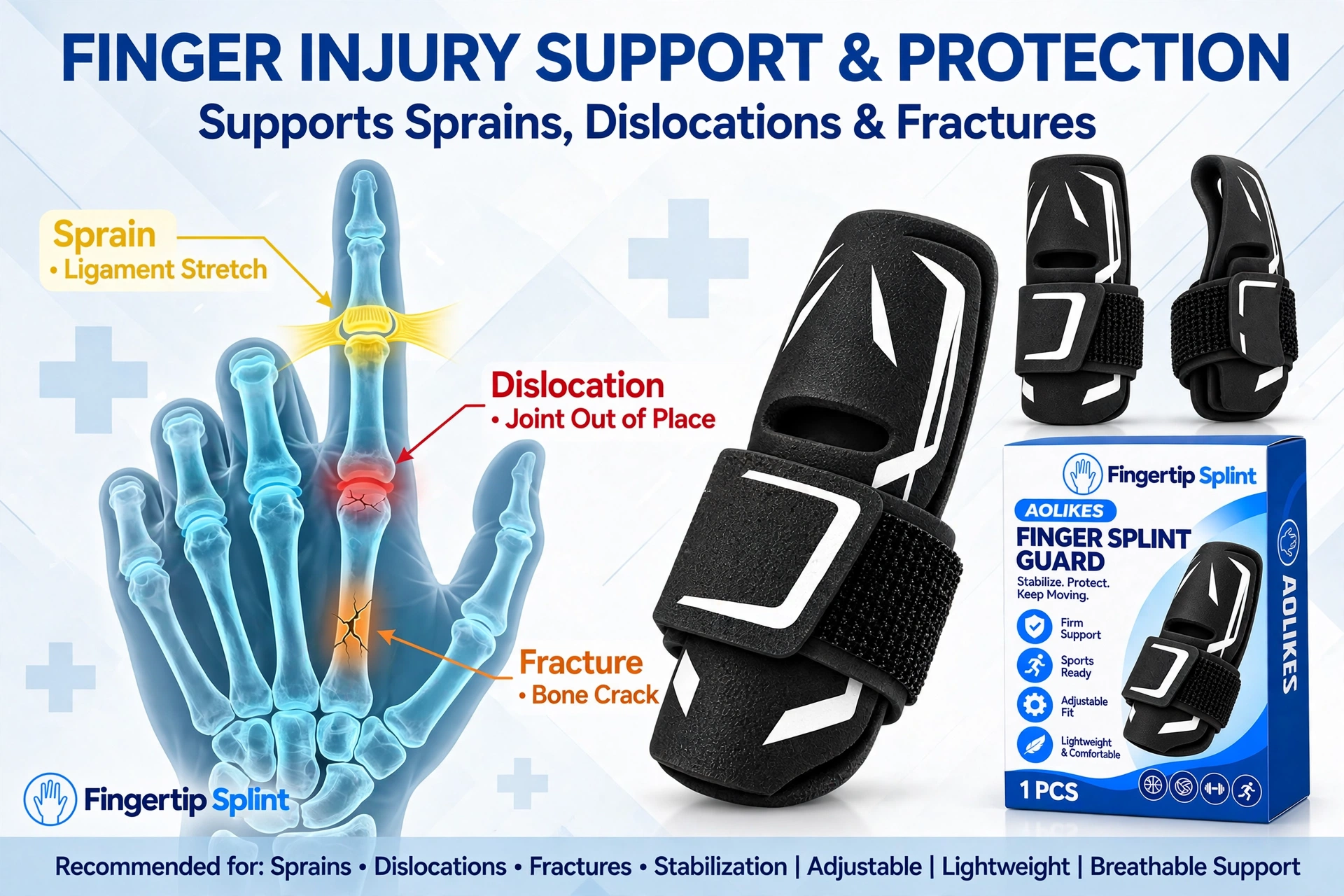
A finger sprain involves injury to the ligaments that support the finger joints. The ligament may be stretched or partially torn. Common causes include jamming the finger, awkward falls, and ball impact. Symptoms often include pain, swelling, and difficulty moving the finger normally. The Mayo Clinic sprains guidance describes sprains as injuries to ligaments that can range from mild to severe.
What Is a Finger Dislocation?
A finger dislocation occurs when the joint surfaces become displaced. The finger may appear abnormal or deformed, and movement can be significantly affected. A dislocation can involve ligament damage, associated fracture, or soft-tissue injury. The Mayo Clinic dislocation first aid guidance advises against forcing a dislocated finger back into position and recommends prompt medical attention.
Why They Can Be Confused
Symptoms can overlap with fractures, ligament injuries, tendon injuries, and other joint problems. Swelling and pain are common to many finger injuries. Do not determine the exact injury solely from an online article. If the injury is significant or you are unsure, professional assessment is the appropriate step.
Why Is a Finger Splint Used After an Injury?
Splints are used after certain finger injuries to support the injured area, limit unwanted movement, protect the finger during certain activities, and help maintain a position when clinically appropriate. The Cleveland Clinic finger splint resource explains that different splints serve different purposes and that a healthcare professional can determine the appropriate type.
Types of Finger Splints Buyers Should Know
| Splint Type | General Purpose | Movement | Typical Consideration |
|---|---|---|---|
| Finger guard | Protection and support | More movement | Activity protection |
| Finger splint | Stabilization | Reduced | Injury-specific |
| Aluminum/foam splint | Structured support | Limited | Greater protection |
| Stack-type splint | Finger positioning | Limited | Specific fingertip or DIP conditions |
| Buddy support | Uses adjacent finger | Some movement | Selected injuries |
| Adjustable splint | Customizable positioning | Varies | Fit flexibility |
Each type is appropriate for specific situations. Do not assume that one splint type is correct for every sprain or dislocation.
How to Choose a Finger Splint After a Sprain
1. Know What Area Is Injured
Consider the fingertip, DIP joint, middle or PIP joint, MCP joint, or the entire finger. The location of the injury determines which splint design is appropriate.
2. Consider the Required Level of Stability
Protection is not the same as maximum restriction. The appropriate level depends on the injury. A mild sprain may only require light support, while a more significant sprain may require greater stabilization based on professional guidance.
3. Check Finger Position
A splint designed for one finger position may not be appropriate for another injury. The position of the splint affects how the finger heals and how comfortable it feels.
4. Look at Adjustability
Adjustability can help with fit, but it does not make a device universally appropriate. An adjustable splint still has design limits and intended uses.
5. Check Material and Padding
Skin contact
The material should be comfortable against the skin for the intended wear period.
Pressure points
Padding reduces the chance of pressure points forming during wear.
Edges
Smooth edges prevent new pressure points from forming.
Moisture
Consider how the material handles moisture during extended wear.
How to Choose a Finger Splint After a Dislocation
A dislocation is a more significant injury than a sprain. It can involve joint displacement, ligament damage, associated fracture, or soft-tissue injury. The following principles apply.
Do Not Choose Based Only on Swelling
Swelling is a symptom, not a diagnosis. Choosing a splint based on swelling alone can lead to the wrong support for the actual injury.
Do Not Force the Finger Into Position
Never attempt to force a dislocated finger back into position. This can cause further damage. The Mayo Clinic dislocation guidance advises against this.
Do Not Assume Any Finger Guard Is Enough
A dislocation may require specific immobilization or professional treatment. A commercial finger guard is not designed to manage every dislocation.
Follow Professional Instructions When the Injury Has Been Assessed
If a clinician has assessed the injury and recommended a specific type of splint or positioning, follow those instructions rather than selecting a product independently.
Can You Buy a Finger Splint Without Seeing a Doctor?
This depends on the situation. The answer is not a simple yes or no.
Minor support needs
For mild discomfort or minor injuries, a splint may be part of self-care. Choose based on fit, coverage, and manufacturer guidance.
Suspected serious injury
A suspected dislocation or fracture deserves appropriate assessment. Do not rely on a splint purchase to manage a potentially significant injury.
Persistent or worsening symptoms
Do not simply manage these by repeatedly changing splints. Seek professional evaluation.
Delaying care
A commercial splint should not be used to delay needed care. If symptoms are significant, seek assessment.
10 Finger Splint Features to Check Before Buying
Fit
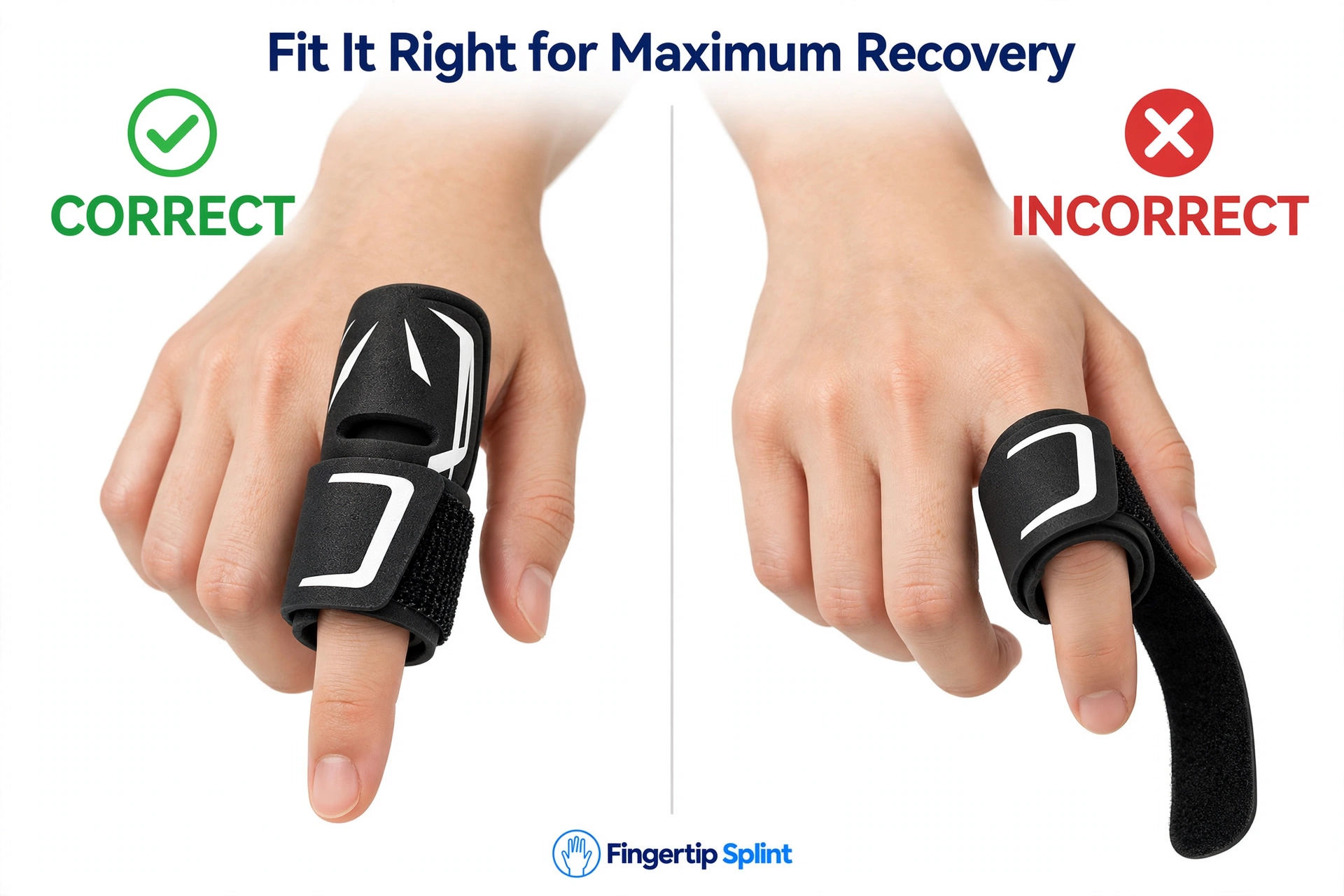
Fit determines where the splint sits and how well it supports the injured area. A splint that is too loose slides; one that is too tight creates pressure points.
Finger Coverage
Coverage should match the injured area. A splint designed for the fingertip will not stabilize the middle joint, and vice versa.
Support Level
Support level should match the injury. More rigid is not automatically better — it depends on the specific injury and professional guidance.
Adjustability
Adjustability can help with fit, especially when swelling changes the finger’s size. However, adjustability does not make a splint appropriate for every injury.
Padding
Padding reduces the chance of pressure points forming. Look for sufficient padding in the areas that contact the finger.
Material
The material should be comfortable against the skin for the intended wear period. Consider breathability, softness, and durability.
Edge Comfort
Smooth edges prevent new pressure points from forming. Rough edges can irritate the skin during extended wear.
Fastening
The fastening method determines how securely the splint stays in position. It should hold its setting during normal activity.
Ease of Cleaning
Follow the manufacturer’s cleaning instructions. A splint that cannot be maintained hygienically will not be used consistently.
Activity Compatibility
Consider what you will be doing while wearing the splint. A splint for rest has different requirements from one for activity.
Finger Splint Fit — How Tight Should It Be?
Fit is one of the most common sources of frustration. This section explains what to aim for.
Secure Does Not Mean Painfully Tight
A splint should feel secure without creating persistent pressure. If you feel a squeezing sensation, the splint is too tight.
Swelling Can Change Fit
Swelling can change the finger’s size. A splint that fits well in the morning may feel tight later in the day. Adjustability helps manage this.
Pressure Points Matter
Check for pressure points during wear. Redness, indentation, or discomfort indicate the splint needs adjustment.
Circulation and Sensation Matter
Numbness, tingling, or discoloration indicate the splint is interfering with circulation or nerve function. Remove it and reassess.
3D Interactive Finger Injury & Splint Infographic
The interactive 3D component explorer below shows where finger injuries can occur and how splints provide support. Click each component to see what it does and why it matters.
Finger Injury & Splint Explorer
Click a component to learn what it does and why it matters when you are choosing a splint.
Interactive “Which Finger Support Do I Need?” Selector
Answer the questions to see what to consider. This is not a diagnostic tool.
Answer the questions above to see what to consider. This tool does not diagnose your injury.
Step-by-Step Finger Splint Buying Process
Common Mistakes When Buying a Finger Splint
Convenience is not the same as appropriateness.
What to do instead: check fit, coverage, and support level.
A splint that is too loose or too tight will not provide consistent support.
What to do instead: measure and compare with the product’s chart.
Excessive pressure does not improve support and can cause new problems.
What to do instead: secure and comfortable, not tight.
Swelling changes fit. A splint that fits in the morning may not fit later.
What to do instead: monitor fit and adjust as needed.
More restriction is not always more appropriate.
What to do instead: match the support level to the injury.
A splint designed for one joint will not stabilize another.
What to do instead: confirm coverage matches the injured area.
Different splint types serve different purposes.
What to do instead: follow professional guidance for specific injuries.
These are warning signs, not signs that the splint is working.
What to do instead: remove the splint and seek advice if symptoms persist.
A worn or damaged splint may not provide the same support.
What to do instead: inspect before use and replace when needed.
Comfort does not equal correct treatment.
What to do instead: seek professional assessment for significant injuries.
Finger Splint vs Finger Guard vs Finger Sleeve vs Tape
| Product | Main Concept | Support | Protection | Mobility |
|---|---|---|---|---|
| Finger splint | Stabilization | Higher, varies | Varies | Reduced |
| Finger guard | Protection | Low to moderate, varies | Moderate | Usually higher |
| Finger sleeve | Coverage and cushioning | Low | Moderate | Higher |
| Finger tape | Securing and support | Varies | Limited | Varies |
| Buddy tape | Finger-to-finger support | Moderate | Moderate | Reduced |
The product category should follow the need, not the other way around. Choose the category that matches the injury and the required support level.
Product Guide — AOLIKES Sport Finger Splint Guard
Use this section as a worked example of how to evaluate a finger splint against the criteria in this guide. The product being evaluated is the AOLIKES Sport Finger Splint Guard from FingerTipSplint.
AOLIKES Sport Finger Splint Guard
- Designed for: Sport finger protection and support
- Protection: Guard structure intended to reduce impact on the finger
- Fit: Check the product page for specific sizing information
- Adjustability: Check the product page for adjustment details
- Coverage: Designed for finger joint or fingertip protection
- Low-profile construction: Intended to minimize interference with movement
- Intended use: Sports activities and light daily support
What This Product Is
The AOLIKES Sport Finger Splint Guard is a protective guard designed for sport finger protection and support. It is not a diagnostic device or a treatment for every sprain or dislocation.
Key Features to Examine
Check the coverage area, support structure, fastening method, materials, and intended use. For buyers comparing different finger protection options, explore the FingerTipSplint shop.
Who May Consider It
Sports participants
Those who want finger protection during activity.
Players returning from injury
Those cleared to return to activity and needing protection.
Buyers wanting low-profile protection
Those who prefer a guard that does not interfere with hand movement.
General finger protection users
Those who need light support for daily activities.
What It Should Not Be Used to Assume
This product is not appropriate for every sprain or dislocation. A suspected dislocation, fracture, or significant injury requires professional assessment. Do not use a commercial guard to delay needed care. For a broader buying guide on basketball-specific protection, see our article on the best finger splint guard for basketball.
Recovery Timeline — What Should You Expect?
This is a stage-based framework, not a promised week-by-week healing schedule. Duration depends on the specific injury and professional guidance.
Stage 1 — Initial Protection
Focus on protecting the injured area and obtaining appropriate assessment. If the injury is significant, seek professional evaluation before relying on a splint.
Stage 2 — Reassessment
Look at pain, swelling, movement, and function. If symptoms are not improving, reassess your approach and seek professional guidance.
Stage 3 — Gradual Return
Activity should progress according to the injury and professional guidance. Do not push through pain.
Stage 4 — Return to Normal Activity
Do not use a fixed “everyone heals in X weeks” claim. Recovery varies. Follow your clinician’s advice on return to activity.
When Should You Stop Using a Finger Splint?
- Increasing pain
- Numbness
- Tingling
- Significant color change
- Skin breakdown
- Worsening swelling
- Inability to use the finger normally
- Symptoms that are not improving
Wearing a splint longer is not automatically better. Follow professional guidance on the appropriate duration and reassess regularly.
When Should You Seek Professional Assessment?
- Visible deformity
- Suspected dislocation
- Suspected fracture
- Severe pain
- Major swelling
- Substantial loss of movement
- Numbness
- Persistent symptoms
- Worsening symptoms
The AAOS hand and finger fracture resource notes that significant finger injuries require proper assessment. Additional trusted resources include the NHS finger injuries guidance, the MedlinePlus finger injuries page, the ASSH flexor tendon injury resource, the WebMD finger injuries overview, and the Healthline finger injury resource.
Doctor Advice — What Matters When Choosing a Finger Splint?
This section is written in the tone of a practical professional checklist. It is not a diagnosis and does not replace an in-person assessment.
1. Correct diagnosis
A splint is only appropriate when the injury has been correctly identified.
2. Appropriate positioning
The splint should support the injured joint in the intended position.
3. Appropriate support
Support should match the injury, not be maximum by default.
4. Regular reassessment
Symptoms should be monitored, and the splint should be reassessed as healing progresses.
A splint that feels comfortable is not necessarily the correct splint for a particular injury. Follow professional guidance when the injury has been assessed.
Buyer Checklist
Click each item to confirm. Aim to check all 10 before buying.
Frequently Asked Questions
A finger splint may be used to support or limit movement after certain finger sprains. The appropriate type and duration depend on the specific injury. For mild sprains, light support may be appropriate. For more significant sprains, professional assessment is recommended.
Follow the manufacturer’s instructions for application and your clinician’s guidance on duration.
A dislocated finger should be assessed professionally before choosing a splint. The appropriate type depends on the specific injury, which may involve ligament damage, fracture, or soft-tissue injury. Do not attempt to force the finger back into position.
Follow your clinician’s recommendation on the appropriate device and positioning.
Wearing duration depends on the injury and professional guidance. Some injuries require continuous wear; others require wear only during certain activities. Follow your clinician’s recommendation rather than assuming a universal schedule.
Monitoring skin and sensation during wear is important. Remove the splint if you notice numbness, tingling, or discoloration.
It should be secure and comfortable, not excessively tight. You should be able to wear it without numbness, tingling, significant discoloration, or increasing pain. Excessive tightness does not improve support and can cause new problems.
If concerning symptoms occur, remove the splint and seek appropriate advice.
A splint can potentially make an injury worse if it is the wrong type, incorrectly fitted, or worn for too long. Excessive pressure can cause skin breakdown or circulation problems. Wrong positioning can interfere with healing.
Follow professional guidance on the appropriate splint, fit, and duration. If symptoms worsen, remove the splint and seek assessment.
Seek professional assessment if you have visible deformity, severe pain, major swelling, substantial loss of movement, numbness, or symptoms that are not improving. A suspected dislocation or fracture also requires professional evaluation.
Do not rely on a commercial splint to manage a potentially significant injury.
This depends on the injury, the splint design, and applicable league or facility rules. Some splints are designed for sports use; others are intended for rest. Check applicable rules and follow professional advice on return to play.
For sports-specific protection, see our article on the basketball finger guard buying guide for fit, protection, and support.
Choose the Right Support, Not Just Any Splint
A finger splint is a support device, not automatically a treatment for every finger injury. Evaluate the AOLIKES Sport Finger Splint Guard against the criteria in this guide before deciding. If the injury is significant or you are unsure, seek professional assessment first.
Explore the FingerTipSplint shop for other support options, check the FingerTipSplint FAQ, or use the request-a-quote page for bulk or business purchasing. For medical finger splint supply, see the medical finger splint supplier page.
View the Product Explore Finger SupportFinal Takeaway: Match the Splint to the Injury, Not the Symptom
Choosing a finger splint after a sprain or dislocation is not about finding the most protective product. It is about matching the support to the specific injury, the affected joint, and the required level of stabilization. A suspected dislocation, fracture, or significant injury requires professional assessment rather than a product purchase.
If symptoms persist, worsen, or involve visible deformity, severe pain, major swelling, numbness, or significant loss of movement, seek appropriate medical evaluation. For medical finger splint supply and distribution, see the medical finger splint supplier page and the finger splint distributor page. For the full FingerTipSplint range, visit the FingerTipSplint homepage.