
You reach for a jar and feel that familiar pain at the base of your thumb. Holding your phone for more than a minute becomes uncomfortable. Even turning a key or buttoning a shirt feels harder than it should. If you have thumb-base osteoarthritis, these small daily frustrations are more than just annoying — they can affect your independence, your mood, and your quality of life. A CMC thumb brace for osteoarthritis may help you manage these symptoms during everyday activities, but only if it is chosen, fitted, and used correctly. This guide explains how a CMC brace may help, which activities may become easier, and how to choose and use one safely. For a broader range of hand and thumb support products, explore the full FingerTipSplint range.
Table of Contents
- What Is CMC Joint Osteoarthritis?
- How a CMC Thumb Brace May Improve Comfort
- Everyday Activities: Where Support May Help
- CMC Brace vs. Other Thumb Support Options
- Choosing a CMC Thumb Brace for Daily Comfort
- How to Wear a Brace Safely During Everyday Tasks
- What to Expect When Starting to Use a Thumb Brace
- Common Mistakes and When to Seek Medical Advice
- Combining Joint Support With Other Practical Strategies
- Frequently Asked Questions
A CMC thumb brace may help people with thumb-base osteoarthritis manage discomfort during activities such as gripping, pinching, writing, and using household items. By supporting the carpometacarpal joint and limiting selected movements, a suitable brace may improve comfort for some users. Fit, design, activity demands, and individual symptoms all affect results.
What Is CMC Joint Osteoarthritis?
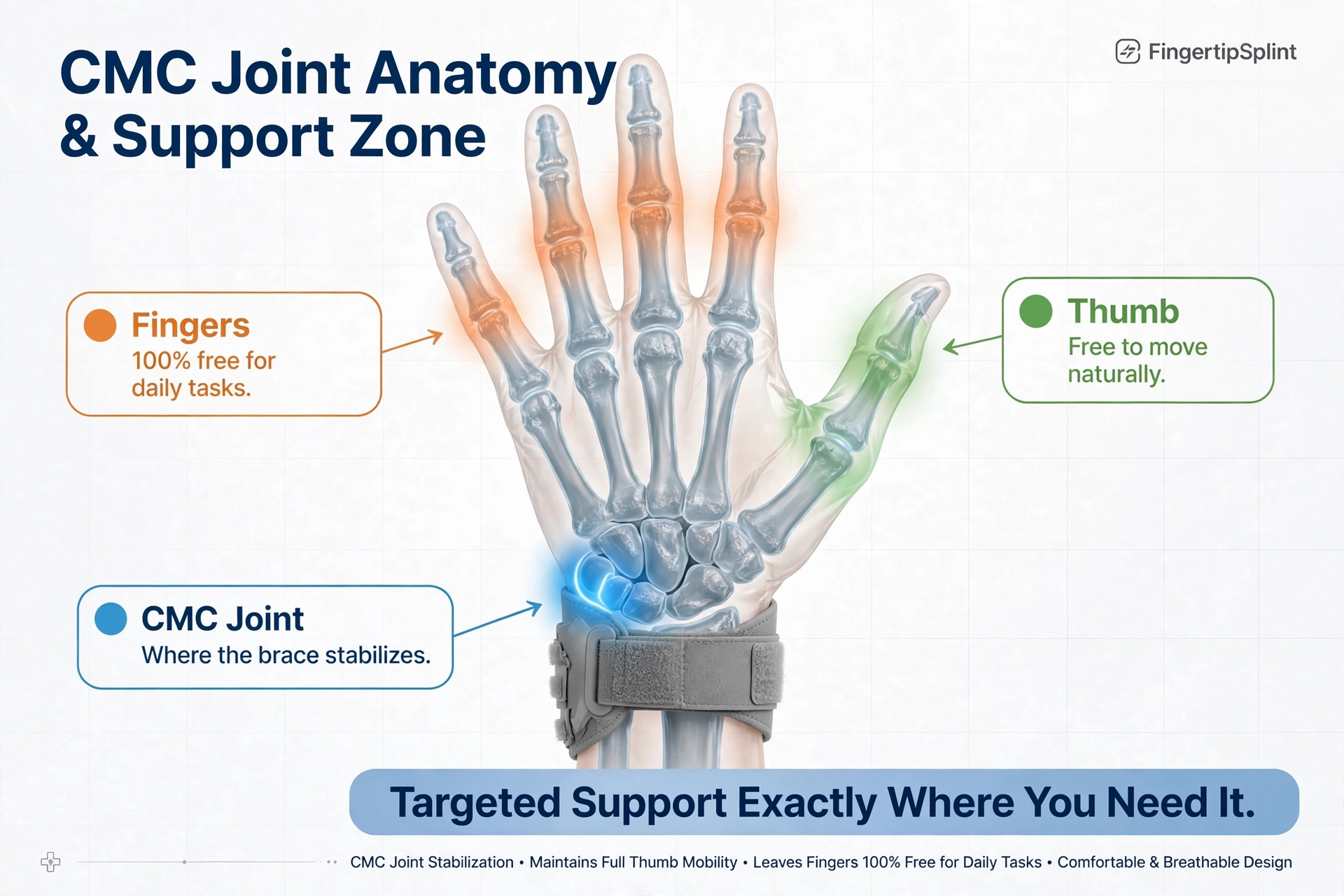
The carpometacarpal (CMC) joint sits at the base of the thumb, where the thumb’s metacarpal bone meets a small wrist bone called the trapezium. This joint is central to the thumb’s ability to pinch, grip, rotate, and oppose the other fingers.
According to the American Academy of Orthopaedic Surgeons, osteoarthritis of the thumb most commonly affects the CMC joint. The cartilage that cushions the joint gradually wears down, leading to pain, stiffness, and reduced grip strength.
Common Symptoms
People with CMC joint osteoarthritis often report:
- Pain at the base of the thumb, especially during pinching or gripping
- Stiffness after periods of inactivity
- Swelling or tenderness around the joint
- Weakness in the hand when gripping objects
- A grinding or clicking sensation during movement
For a broader look at CMC thumb brace uses and benefits, the article on CMC thumb brace uses, benefits, and joint support covers the topic in greater detail.
How a CMC Thumb Brace May Improve Comfort
A CMC thumb brace is designed to support the base of the thumb, limit selected movements that aggravate the joint, and provide compression and stability. The goal is not to immobilize the whole hand — it is to support the joint while preserving useful hand function.
Stabilizing the Joint
By wrapping around the base of the thumb, the brace provides support that may reduce the load on the CMC joint during movement. This can reduce pain that occurs during gripping and pinching.
Limiting Selected Movements
Depending on the design, the brace may limit movements that provoke pain, such as certain pinching or gripping motions. The amount of restriction depends on the brace’s construction and fit.
Balancing Stability and Function
The best braces provide stability without excessively restricting the hand. If a brace is too rigid or too tight, it may interfere with daily tasks and reduce the ability to perform them comfortably.
According to the American College of Rheumatology / Arthritis Foundation guideline, hand orthoses are one option in the management of first CMC osteoarthritis. The appropriate design and wearing schedule should be determined with professional guidance.
For a closer look at how a CMC brace supports the thumb without limiting hand function, the article on how a CMC thumb brace supports the thumb without limiting hand function covers the balance between stability and function in detail.
Explore Thumb Support in Daily Life
Select an activity below to see practical advice.
Everyday Activities: Where Support May Help
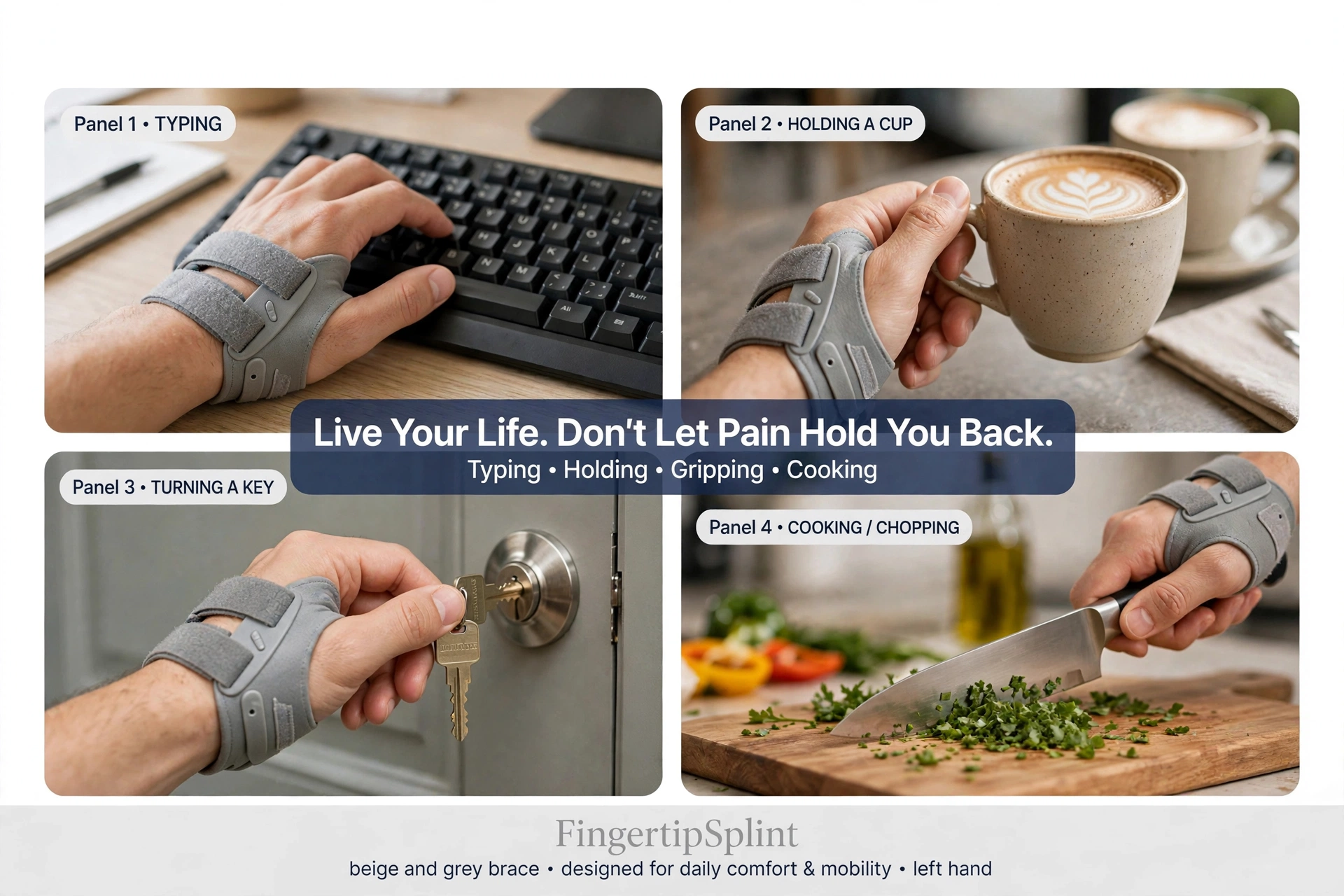
Thumb-base osteoarthritis affects many everyday activities. A CMC brace may provide support during some of these tasks, but results vary. Here is a practical look at common activities and how a brace may help — along with one modification to try.
Opening Containers
The movement involved: Gripping and twisting a lid places significant load on the CMC joint.
How a brace may help: The brace may reduce pain by supporting the joint during the gripping and twisting motion.
Practical modification: Use a jar-opening aid or ask someone to loosen the lid first.
Writing
The movement involved: Holding a pen requires sustained pinch and fine motor control.
How a brace may help: The brace may provide stability during writing, but it may also feel bulky. Test comfort and dexterity before relying on it for long writing sessions.
Practical modification: Use a pen with a wider grip or take frequent breaks.
Using a Phone
The movement involved: Holding a phone requires continuous grip and pinch.
How a brace may help: The brace may reduce discomfort during phone use, but it may also make holding the phone less comfortable.
Practical modification: Use a phone stand or switch hands frequently.
Dressing
The movement involved: Fastening buttons, zipping, and pulling clothing require fine motor control and pinch strength.
How a brace may help: The brace may provide support during these tasks, though the bulk of the brace may make fine motor tasks harder.
Practical modification: Choose clothing with larger buttons or elastic waistbands when possible.
Cooking
The movement involved: Chopping, stirring, lifting, and opening ingredients all involve the CMC joint.
How a brace may help: The brace may support the joint during light cooking tasks, but heavier tasks may remain uncomfortable.
Practical modification: Use lightweight utensils, sit when possible, and take breaks.
CMC Brace vs. Other Thumb Support Options
Not all thumb braces are the same. Here is how a CMC-focused brace compares to other common options.
| Support Type | Movement Allowed | Consider It When |
|---|---|---|
| CMC-focused brace | Fingers and wrist mostly free | Mild to moderate CMC pain; functional movement is important |
| Full thumb spica | Thumb and sometimes wrist restricted | More severe symptoms or post-injury recovery |
| Rigid splint | Significant restriction | Acute injury or conditions requiring immobilization |
| Activity modification | No device; changes how tasks are performed | Mild symptoms or as a complement to bracing |
No single brace design is best for every person or every stage of symptoms. According to a systematic review of thumb osteoarthritis orthoses, different brace designs can have different effects, and the choice should be guided by individual needs.
Choosing a CMC Thumb Brace for Daily Comfort
Choosing the right brace requires matching the design to your symptoms and daily activities. Here are the key factors.
Joint Coverage
Does the brace cover the CMC joint at the base of the thumb? Check the product description and images to confirm coverage.
Sizing and Hand Orientation
Choose a size that matches your hand measurements. Confirm whether the brace is designed for the left hand, right hand, or both.
Material and Closure
Check the material for comfort and skin compatibility. Look for an adjustable closure that allows you to customize the fit.
Intended Activities
Consider the activities you need to perform while wearing the brace. A brace that is comfortable for light tasks may be less suitable for heavier gripping.
Cleaning and Care
Can you follow the manufacturer’s cleaning instructions? This affects long-term hygiene and durability.
How to Wear a Brace Safely During Everyday Tasks
Proper fitting and safe use are essential for comfort and effectiveness. Follow this step-by-step process based on the product’s design and the manufacturer’s instructions.
Step 1: Confirm the correct hand and size. Verify that the brace is designed for your hand and that the size matches your measurements.
Step 2: Position the brace. Follow the manufacturer’s placement instructions. The brace should sit over the CMC joint at the base of the thumb.
Step 3: Fasten securely. The brace should feel secure but not tight. You should be able to move your fingers freely.
Step 4: Check for warning signs. Look for numbness, tingling, redness, or changes in finger colour or temperature. If any of these occur, loosen or remove the brace.
Step 5: Begin with low-risk activities. Test the brace during light tasks before relying on it for heavier or more demanding activities.
Wear schedules vary depending on the product, symptoms, and professional guidance. Follow your clinician’s or the manufacturer’s instructions rather than assuming all-day wear is appropriate.
What to Expect When Starting to Use a Thumb Brace
There is no fixed timeline for comfort improvement from a CMC thumb brace. Osteoarthritis is typically a chronic condition, and improvement in comfort does not mean the joint has healed. Here is a practical way to assess your experience.
Initial Fit: Check Comfort and Positioning
When you first wear the brace, check that it fits comfortably, sits over the CMC joint, and does not cause pressure points. If it feels too tight or too loose, adjust it or try a different size.
During Daily Tasks: Notice Whether the Brace Helps
Notice whether the brace helps during activities that usually provoke symptoms — such as gripping, pinching, or holding objects. If pain increases or new discomfort appears, the brace may not be suitable.
Follow-Up: Reassess After Several Days
After several days of use, review whether the brace is helping and whether any skin irritation or other issues have appeared. If symptoms persist or worsen, seek professional advice.
According to the NICE guidance on osteoarthritis, management should be individualized and may include a combination of approaches. A brace is one part of a broader plan, not a standalone treatment.
Common Mistakes and When to Seek Medical Advice
Some mistakes can turn a helpful brace into a source of additional discomfort. Here are the most common ones.
A brace that is too tight can compress nerves and blood vessels, causing numbness or tingling.
Solution: Adjust the fit so it feels secure but not tight.
If the brace does not sit over the CMC joint, it may not provide effective support.
Solution: Follow the manufacturer’s placement instructions.
A brace that is too small or too large will not fit correctly and may restrict movement unnecessarily.
Solution: Measure according to the manufacturer’s size guide.
A brace supports the joint but does not cure osteoarthritis or reverse joint damage.
Solution: Use the brace as part of a broader management plan.
If pain increases while wearing the brace, it may not be suitable for your condition.
Solution: Stop using it and seek professional advice.
Pain after an injury may require professional assessment before using a brace.
Solution: Seek medical advice for injuries or unexplained symptoms.
According to NHS guidance on arthritis, persistent joint symptoms should be assessed by a healthcare professional. Early diagnosis and appropriate management can make a significant difference.
Combining Joint Support With Other Practical Strategies
A brace is one part of symptom management — not a complete solution for everyone. Here are additional strategies that may help alongside brace use.
Task Modification
Changing how you perform tasks can reduce stress on the CMC joint. For example, using both hands to lift objects, sliding heavy items rather than lifting them, or using jar-opening aids.
Reducing Excessive Pinch Force
Many people grip objects more tightly than necessary. Learning to reduce grip force can reduce pain during daily tasks.
Helpful Household Tools
Adaptive tools — such as wider-handled utensils, electric can openers, and jar-opening aids — can reduce the load on the thumb joint.
Professional Guidance
A clinician or hand therapist can help you choose the right brace, fit it correctly, and develop a broader management plan that suits your needs. According to the National Institute of Arthritis and Musculoskeletal and Skin Diseases, early diagnosis and appropriate management can help reduce pain and maintain function.
Explore the 1PCS CMC Thumb Brace for Osteoarthritis
If thumb-base osteoarthritis is affecting your daily activities, review the 1PCS CMC Thumb Brace, check its coverage and fit details, and decide whether its design matches your support needs. For more options, browse our full hand and thumb support range.
View the Product Browse All ProductsFrequently Asked Questions
A CMC thumb brace may help reduce pain during gripping and pinching by supporting the joint and limiting certain aggravating movements. However, results vary, and a brace does not cure osteoarthritis. It is typically used as part of a broader management plan that may include activity modification and professional guidance.
Some people can perform these tasks while wearing a brace, but comfort and dexterity vary by brace design, fit, and individual needs. Test these activities carefully before relying on the brace for them. If the brace makes a task more difficult, adjust the fit or reassess whether the brace is suitable for that activity.
No. A CMC thumb brace may support symptom management, but it does not reverse the underlying joint changes or cure osteoarthritis. It is a support tool, not a treatment for the disease itself.
Wearing schedules depend on the specific brace, your symptoms, the manufacturer’s instructions, and professional advice. Some people wear a brace during activities that provoke symptoms, while others wear it more continuously. Follow your clinician’s guidance rather than assuming all-day wear is appropriate.
A properly fitted brace should sit over the CMC joint, feel secure but not tight, and allow you to move your fingers freely. Check for numbness, tingling, redness, or changes in finger colour or temperature. If any of these occur, adjust the fit or remove the brace.
A CMC-focused brace supports the thumb base while leaving more of the hand free. A full thumb spica splint restricts more movement and may be appropriate for more severe symptoms or post-injury recovery. The right choice depends on your symptoms, activities, and professional guidance.
Seek medical assessment if you have persistent or worsening pain, recent injury, deformity, significant swelling, reduced function, or concerning sensory or circulation changes. Early assessment can help identify the cause and guide appropriate treatment.
Conclusion: Support That Keeps You Doing What Matters
A CMC thumb brace for osteoarthritis can be a useful tool for managing thumb-base pain during daily activities. It supports the joint, limits certain aggravating movements, and may help reduce discomfort during gripping and pinching. But it is not a cure for osteoarthritis, and it does not replace professional assessment or task modification.
Use this guide as a framework: understand the joint, identify your symptoms, review the product’s actual specifications, choose a brace that fits your hand and your activities, and test it carefully during low-risk tasks. Stop using the brace if it causes pain or irritation, and seek professional advice if symptoms persist.
For readers who want to explore support products, the FingerTipSplint shop offers a selection. For more hand-care education, visit the FingerTipSplint blog. For personalized assistance, you can request a quote or review the frequently asked questions.
Your hands carry you through everything. Choosing the right support — and knowing when to seek professional advice — is part of caring for them well.