
Imagine coming home after a long day, sitting down, and putting on a warming knee massager without having to find a power outlet or manage a tangle of cords. A cordless knee massager with heat, vibration, and infrared is designed for exactly that kind of convenience. But before buying one, you need to understand what each function actually does, whether the device fits comfortably, and whether heat is appropriate for your symptoms. This guide explains the three functions separately, what buyers should verify, how to use the device safely, and when professional advice is the better next step. For a broader view of comfort and support products, explore the full FingerTipSplint range.
Table of Contents
- Why Do People Look for a Cordless Knee Massager?
- What Is a Cordless Knee Massager?
- How Heat, Vibration, and Infrared Differ
- Potential Benefits
- Who May Find This Device Suitable?
- Cordless Massager vs. Heating Pad vs. Ice Pack
- Featured Product Guide — What to Check
- How to Use a Cordless Knee Massager Safely
- What to Expect Over Time — Comfort vs. Recovery
- Common Mistakes When Using Heated Massage Devices
- Doctor Advice — When Not to Use a Knee Massager
- Combining With Other Knee-Comfort Strategies
- Frequently Asked Questions
A cordless knee massager with heat, vibration, and infrared combines several advertised features in one wearable device. Heat may provide temporary comfort for some types of stiffness, while vibration offers a massage sensation. The benefits of infrared depend on the device’s specifications and supporting evidence. Safe use depends on the user’s symptoms and health needs.
Why Do People Look for a Cordless Knee Massager?
People search for a cordless knee massager for practical, everyday reasons. Often, it is not about a medical condition — it is about wanting to feel more comfortable during ordinary activities.
Common Situations
- Stiffness after prolonged sitting: When you stand up after sitting for a while, the knee may feel tight or stiff.
- Discomfort after ordinary activity: A long walk, a day of shopping, or an afternoon of gardening can leave the knee feeling achy.
- Difficulty fitting a relaxation routine into a busy day: A cordless device can be used during a short break without being tied to a power outlet.
According to NHS guidance on knee pain, knee discomfort can have many causes, including osteoarthritis, tendon problems, injuries, and other conditions. A massager cannot identify which cause is responsible.
Temporary Comfort vs. Needing Treatment
Someone seeking warmth for occasional stiffness has a different need from someone whose knee became swollen after a fall. According to the Johns Hopkins Medicine osteoarthritis overview, symptoms and management vary depending on the condition.
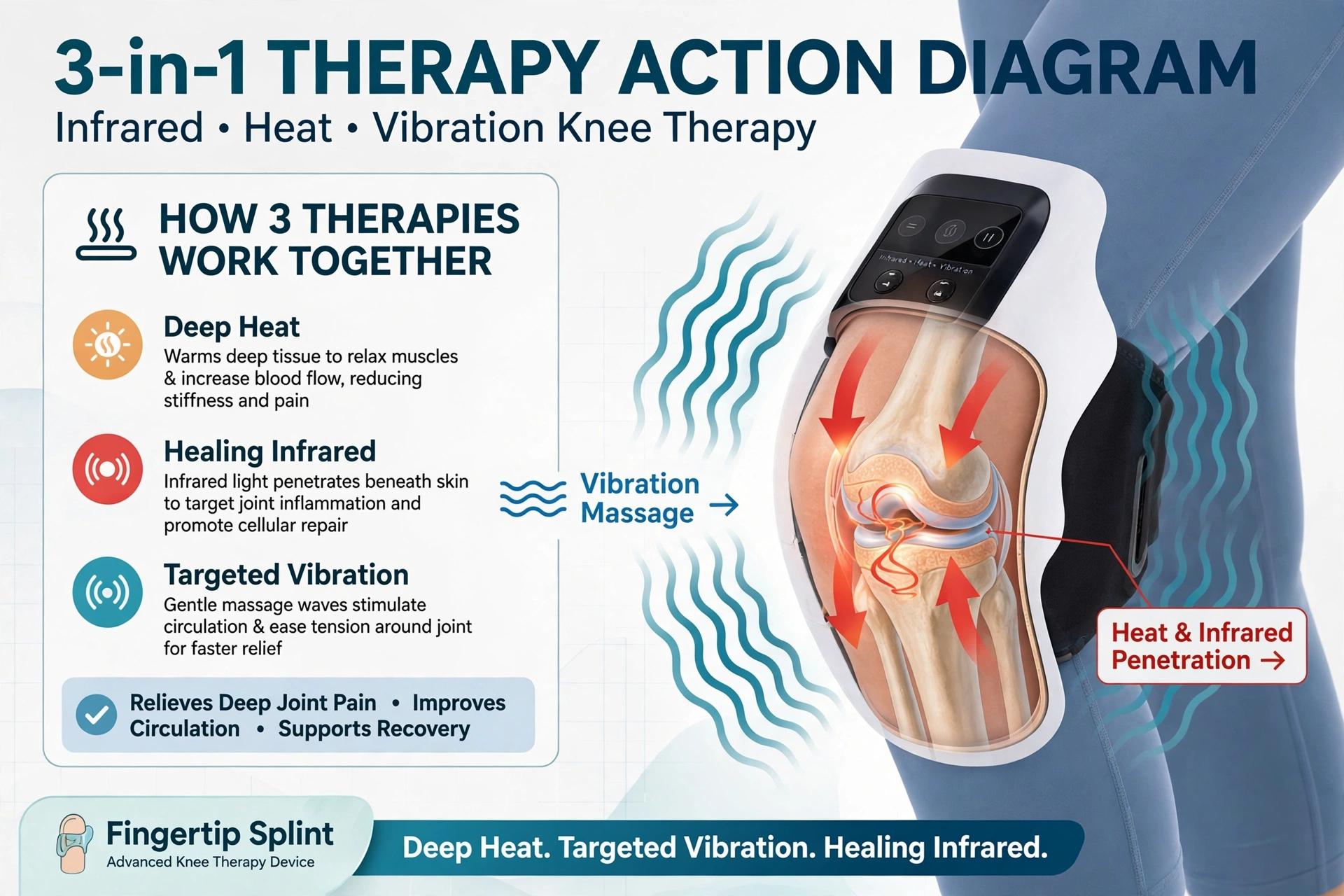
What Is a Cordless Knee Massager with Heat, Vibration & Infrared?
A cordless knee massager is a wearable device that wraps around the knee and provides several functions. It is designed to be used without a continuously attached power cable.
Physical Design Features
- Wearable, cordless format with adjustable wraparound straps.
- Digital LED display for controlling settings.
- Four advertised heat settings.
- Four advertised vibration intensity levels.
- Advertised infrared-light function.
The Meaning of “Cordless”
“Cordless” means you can use the device without a continuously attached power cable. It does not necessarily mean unlimited runtime or suitability for use while walking. Check the manufacturer’s charging and runtime details.
Explore the Cordless Knee Massager
Select a function below to learn more about it.
How Heat, Vibration, and Infrared Differ
The three advertised functions work in different ways. Understanding them separately is essential for evaluating the device.
Heat — Temporary Warmth and Comfort
Some people find warmth soothing when a knee feels stiff. Warmth may provide temporary comfort, but it is not automatically appropriate for every situation. According to the Cleveland Clinic’s guide to heat or ice for arthritis, warmth is often used for stiffness, while cold may be more suitable for certain painful or swollen situations.
Vibration — The Massage Sensation
Vibration is mechanical stimulation that may create a relaxing sensation. Its intensity, placement, and comfort vary by person. The device does not rebuild cartilage, repair ligaments, or guarantee better circulation.
Infrared — What the Feature Means
Infrared refers to a range of electromagnetic radiation. The potential effects of a device depend on its wavelength, output, and design. The product listing advertises an infrared-light function, but the technical details are not sufficiently verified to establish a specific therapeutic effect. Do not equate the advertised function with proven laser therapy.
Does Combining All Three Make It More Effective?
Several features may be convenient in one device, but more features do not automatically mean better outcomes. Convenience, comfort, and demonstrated clinical effectiveness are different concepts.
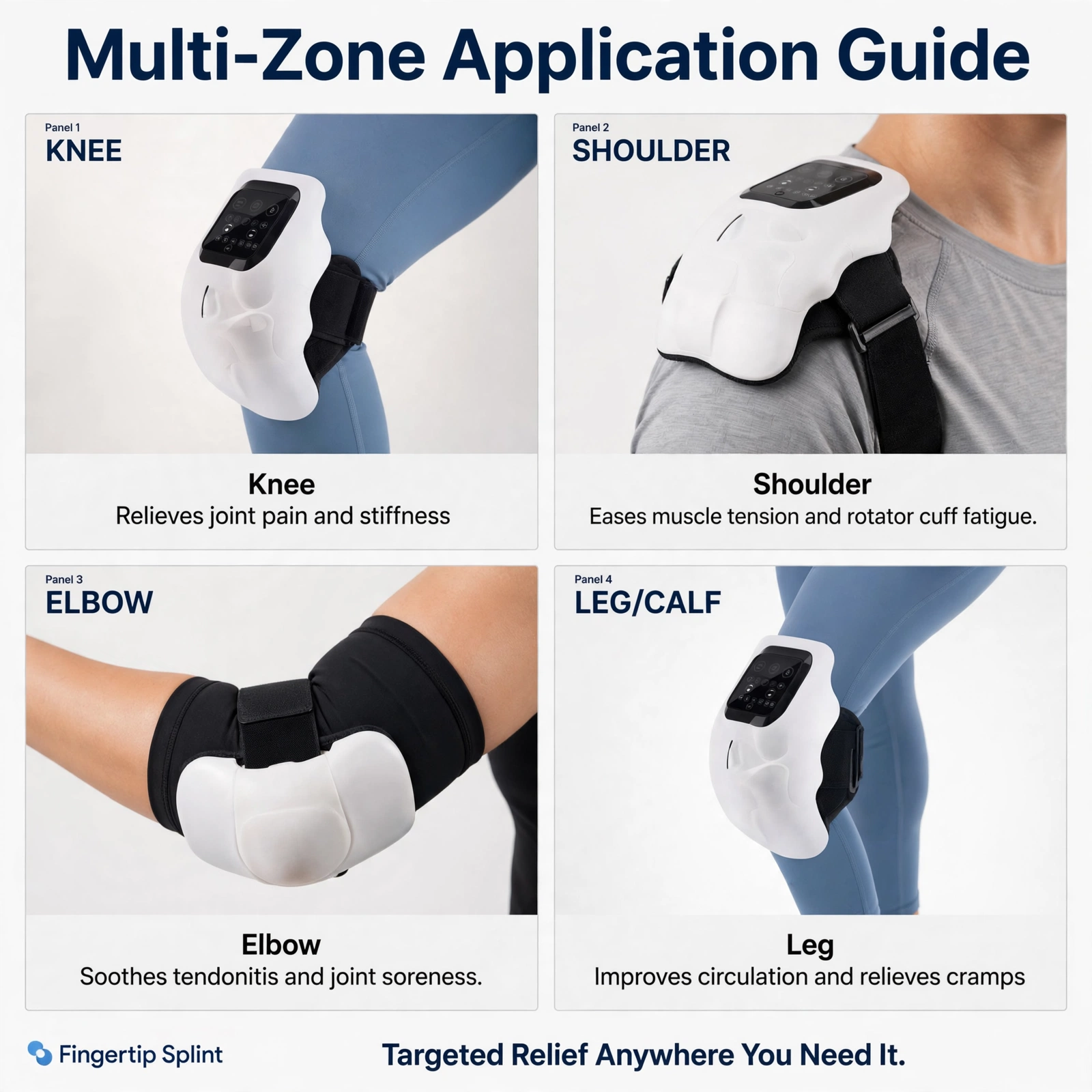
Potential Benefits of a Cordless Knee Massager
The potential benefits of a cordless knee massager are practical and conditional. They depend on the device, the user’s condition, and how the device is used.
Convenience
A cordless design may be easier to use in different suitable locations, without being tied to a power outlet.
Adjustable Comfort
Multiple settings may let users choose a preferred warmth and vibration level.
Temporary Soothing Warmth
Gentle heat may help some people feel more comfortable when experiencing certain types of stiffness. According to the Mayo Clinic’s osteoarthritis treatment guide, heat is one possible supportive measure.
Massage Experience
Vibration may provide a relaxing sensation around the knee.
Combined Functions
A single device may appeal to people who want more than a basic heating pad. However, convenience is not the same as medical effectiveness.
Who May Find This Device Suitable?
A cordless knee massager may be suitable for some adults, but not for everyone. Suitability depends on the cause of knee symptoms, device fit, skin sensitivity, and the manufacturer’s safety instructions.
Potentially Suitable Readers
- Adults looking for a wearable warmth and massage accessory
- People who value a cordless format
- Those who want adjustable settings for a relaxing routine
Who Should Seek Medical Advice First
People with impaired temperature sensation, certain circulation problems, damaged skin, or a hot and swollen knee should seek appropriate medical advice before using a heated device. Anyone recovering from surgery or a significant injury should follow their clinician’s guidance.
Cordless Knee Massager vs. Heating Pad vs. Ice Pack
Different options serve different purposes. Here is how they compare.
| Option | Main Purpose | What to Consider |
|---|---|---|
| Cordless knee massager | Wearable warmth, vibration, and advertised infrared function | Fit, controls, battery details, and safety |
| Heating pad | Local warmth | Temperature control, coverage, and safe-use instructions |
| Wrapped cold pack | Cooling for certain injuries or swelling | Safe application and avoiding direct skin contact |
| Knee brace | Support or movement restriction, depending on design | Whether the type suits the condition |
Heat and cold serve different purposes, and neither is universally appropriate. A new injury with significant swelling may require assessment rather than an immediate heated massage session. According to Johns Hopkins Medicine’s cold therapy guide, cold can be appropriate for some injuries involving pain and swelling.
Featured Product Guide — What to Check Before Buying
If you are considering a cordless knee massager, the FingerTipSplint 3-in-1 Cordless Heated Knee Massager is one option to evaluate. The device combines a cordless wearable design, heat, vibration, and an advertised infrared-light function.
Verified, Advertised Features
- Cordless wearable design
- Heating with four advertised settings
- Vibration with four advertised intensity levels
- Advertised infrared-light function
- LED display and adjustable straps
What to Assess Before Buying
- Fit: Does the device fit your knee comfortably?
- Controls: Are the settings easy to operate?
- Session limits: Does the manufacturer specify session durations and temperature settings?
- Charging and runtime: Are the details clearly stated?
- Infrared documentation: Is the light function adequately documented?
- Return policy: What does the return policy cover?
For a related view of the device’s functions, the article on 3-in-1 heated knee massager uses and benefits provides additional context. For daily comfort considerations, see smart heated knee massager for daily joint comfort.
Explore the Cordless Knee Massager
Review the FingerTipSplint 3-in-1 Cordless Heated Knee Massager, check its specifications, and decide whether its design matches your comfort needs.
View the Product Browse All ProductsHow to Use a Cordless Knee Massager Safely
Safe use is essential for comfort and to prevent skin problems. Follow this step-by-step guide based on the manufacturer’s instructions.
Step 1: Read the manufacturer’s instructions before first use.
Step 2: Inspect the housing, straps, and charging components.
Step 3: Make sure the skin is intact and dry.
Step 4: Position the device as directed and secure the straps without excessive pressure.
Step 5: Start at the lowest comfortable heat setting.
Step 6: Follow the manufacturer’s session limits. Stop if burning, irritation, excessive warmth, or worsening discomfort occurs. Turn the device off before removing or adjusting it.
What to Expect Over Time — Comfort vs. Recovery
Comfort during a session is different from recovering from a medical condition. Here is a realistic timeline for evaluating your experience.
First Session: Check Fit, Comfort, and Skin Response
Assess whether the device fits comfortably and whether the skin responds well. Do not judge medical effectiveness from one session.
First Few Uses: Observe Comfort and Symptom Stability
Note whether the experience feels comfortable and whether symptoms remain stable. Stop if symptoms worsen.
Following Days: Stop if Symptoms Worsen
Do not respond to worsening symptoms by automatically increasing heat or vibration.
Over Subsequent Weeks: Seek Assessment if Pain Persists
Persistent knee pain should prompt appropriate assessment rather than reliance on the device.
According to NHS guidance on knee pain, the timeline for recovering from knee pain depends on its cause, severity, and treatment. The massager does not establish a recovery schedule.
Common Mistakes When Using Heated Massage Devices
Some mistakes can make the device less safe or less comfortable. Here are the most common ones.
Starting too hot can cause discomfort or skin irritation.
Solution: Start with the lowest comfortable setting.
The feature name alone does not establish a therapeutic effect.
Solution: Treat infrared claims cautiously and check the specifications.
Heat may not be appropriate for a new injury with swelling.
Solution: Seek guidance before using heat on a new injury.
Excessive pressure can reduce circulation and cause discomfort.
Solution: Fasten the straps without excessive pressure.
Sleeping with the device on can lead to skin damage.
Solution: Never sleep with the heating function operating.
The device may not be designed for continuous use or movement.
Solution: Check the manufacturer’s intended use and instructions.
Using a massager instead of seeking care for severe or persistent symptoms is another common mistake. If symptoms are concerning, professional assessment is the priority.
Doctor Advice — When Not to Use a Knee Massager
A heated massager is not suitable for every knee problem. Heat may be inappropriate around a recent injury with swelling, a hot or red joint, damaged skin, or an area with reduced sensation.
Seek prompt medical assessment for:
- Inability to bear weight
- Major swelling or deformity after an injury
- A locked knee
- Severe pain
- A hot, red knee accompanied by fever or feeling unwell
Combining a Massager With Other Knee-Comfort Strategies
Appropriate knee management may include suitable physical activity, strengthening, activity adjustments, and professional advice, depending on the diagnosis.
According to the Mayo Clinic guide to exercise and arthritis, suitable physical activity can be an important part of joint management. A massager may be an optional comfort accessory, but it should not replace prescribed treatment.
Frequently Asked Questions
A cordless knee massager combines heat, vibration massage, and an advertised light function in a wearable device. Heat may provide temporary comfort for some types of stiffness, while vibration offers a massage sensation. The benefits of infrared depend on the device’s specifications and supporting evidence.
Gentle warmth may provide temporary comfort for some types of knee stiffness. However, stiffness has different causes, and the device does not address the underlying condition. If stiffness is persistent or worsening, seek medical advice.
Heat provides warmth that may ease the sensation of stiffness for some people. Vibration provides a mechanical massage sensation that varies with intensity and placement. They are different functions with different mechanisms.
The technical details of this product’s light function are not fully verified, so a specific therapeutic effect cannot be confirmed. Do not equate the advertised infrared function with proven laser therapy. Seek professional advice for arthritis management.
Follow the manufacturer’s session limits. Do not assume that longer sessions provide greater benefits. If you experience discomfort or skin irritation, stop using the device.
Daily use may be appropriate for some people, but it depends on the device, your skin sensitivity, and your symptoms. Follow the manufacturer’s instructions and check the skin regularly.
People with a recent injury with swelling, damaged skin, impaired sensation, circulation problems, or a condition affecting temperature awareness should seek professional advice before using a heated device.
Choose Based on Your Needs, Not Just the Features
A cordless knee massager with heat, vibration, and an advertised infrared function combines several features in one device. Its suitability depends on your symptoms, fit, safety considerations, and realistic expectations.
Use this guide as a framework: understand the three functions, check the specifications, follow safe-use instructions, and seek medical advice for persistent or concerning symptoms. The device may provide temporary comfort, but it is not a treatment for every cause of knee pain.
For readers who want to explore comfort products, the FingerTipSplint shop offers a selection. For more hand and joint care education, visit the FingerTipSplint blog. For personalized assistance, you can request a quote or review the frequently asked questions.
Your comfort matters. Choosing the right accessory — and knowing when to seek professional advice — is part of caring for your knees well.