
How Adjustable Finger Sleeves Create a More Flexible Fit
A better-fitting sleeve starts with flexibility. But “flexible fit” has two different meanings — and confusing them is why so many people end up with a sleeve that doesn’t work for them. This article explains the difference between material flexibility and fit flexibility, how adjustability actually creates adaptable fit, and what to check to know whether the fit is right for your finger and your activity.
What This Guide Covers
- Quick Answer
- What “Flexible Fit” Actually Means
- 3D Flexible-Fit Anatomy
- Adapting to Finger Shape
- Mechanics of Adjustable Fit
- Material Stretch vs Adjustable Mechanism
- Contact and Pressure
- Flexible Fit and Finger Movement
- Adjustable vs Fixed Fit
- Flexible Fit and Coverage
- Flexible Fit During Activities
- How to Test Fit Flexibility
- Common Flexible-Fit Problems
- How to Adjust the Sleeve
- Adjustable Doesn’t Mean One Size
- Who May Value an Adjustable Fit
- Product Spotlight
- Build Your Flexible Fit
- What to Know Before Using
- Quick Tips
- FAQ
Quick Answer: How Do Adjustable Finger Sleeves Create a Flexible Fit?
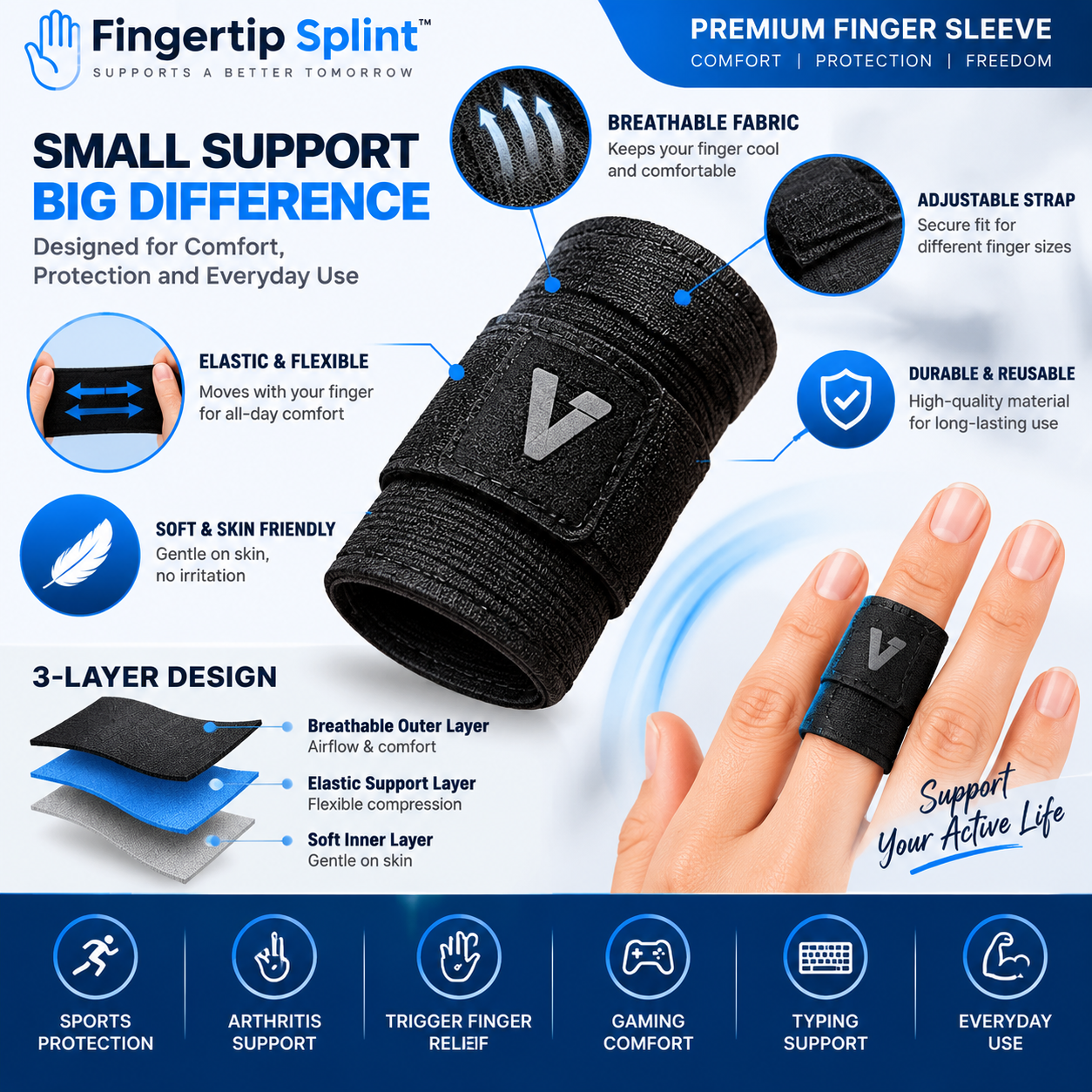
Adjustable sleeves can create a more flexible fit through a combination of stretchable materials, adjustable fastening, positioning, and coverage. These features can allow the sleeve to accommodate small differences in finger size and positioning, while the actual fit depends on the product’s construction and adjustment range.
If you want the basic explanation of what an adjustable sleeve is and how it works, see Adjustable Finger Support Sleeve: What Is It and How Does It Work? This guide focuses specifically on how adjustability creates adaptable fit.
What Does “Flexible Fit” Actually Mean?
This is the most important concept in this article. “Flexible fit” is used loosely in product marketing, but it actually refers to five different things — and understanding the difference helps you evaluate any sleeve.
1. Material Flexibility
Can the material stretch and move with the finger? This is about the physical properties of the fabric or construction. A stretchy material conforms more readily to finger shape.
2. Fit Flexibility
Can the wearer adjust the circumference or position? This is about the adjustment mechanism — the ability to modify fit after the sleeve is on the finger.
3. Movement Flexibility
Can the finger move within the limits of the design? This depends on material, thickness, coverage, and structure — not just on adjustability.
4. Coverage Flexibility
Can the sleeve be positioned around the intended area? Some designs allow repositioning; others have fixed coverage.
5. Comfort Flexibility
Can the fit be modified if it feels too loose or too tight? This is a practical outcome of having an adjustment mechanism — you can react to discomfort rather than being stuck with a fit that doesn’t work.
Interactive 3D: How an Adjustable Sleeve Creates a Flexible Fit
Tap each zone to understand what contributes to adaptable fit
🔄 Stretch Zone
Shows material flexibility. The stretch zone is where the sleeve’s material can conform to finger shape. Elastic materials may accommodate small variations in circumference. This is one part of the flexible-fit equation — but material stretch alone has limits.
A flexible fit comes from all these zones working together, not from any single feature.
How Adjustable Finger Sleeves Adapt to Finger Shape
Fingers aren’t identical. The differences matter when choosing a sleeve, because a fixed-size sleeve has to match your finger closely — while an adjustable sleeve has more room to accommodate variation.
📏 Finger circumference
📐 Finger length
🦴 Joint dimensions
👆 Finger shape (taper)
💧 Ordinary swelling through the day
🏃 Position during movement
Important: Adjustment may help accommodate ordinary differences within the product’s intended sizing range. It’s not a solution for significant swelling, injury-related changes, or finger dimensions outside the product’s adjustment range.
The Mechanics Behind an Adjustable Fit
Here’s how the adjustment process actually works, step by step. Understanding the sequence helps you evaluate whether a specific sleeve will create the flexible fit you need.
Each step contributes to the fit. If any step goes wrong, the sleeve may not feel right — even if it’s well-made. For a deeper look at the mechanism itself, see Adjustable Finger Support Sleeves: A Complete Guide for Buyers.
Material Stretch vs Adjustable Mechanism
This is one of the most important distinctions in the article. Many people assume a stretchy sleeve and an adjustable sleeve are the same thing. They’re not.
| Characteristic | Stretch Material | Adjustable Mechanism |
|---|---|---|
| Adapts through | Material elasticity | User-controlled adjustment |
| Main role | Flexibility | Fit customization |
| Changes fit? | To a limited extent | More directly |
| Movement | Depends on material | Depends on construction |
| Range | Material-dependent | Mechanism-dependent |
Both approaches can create a “flexible fit” — but they do it in different ways. Stretch material conforms automatically. An adjustment mechanism requires the wearer to modify the fit. Both are valid; they suit different preferences.
How Adjustment Changes Contact and Pressure
Here’s the relationship that determines how the sleeve feels during wear:
Interactive: Loose vs Secure vs Too Tight
Tap each position to see how adjustment affects fit and comfort
✅ Secure Fit
Stays positioned during movement. Feels comfortable — snug but not restrictive. Allows the intended movement for your activity. Maintains coverage where intended. This is the target: appropriate fit, not maximum tightness.
Important: The goal isn’t maximum tightness — it’s an appropriate, comfortable fit. Excessive tightness can cause discomfort, pressure marks, numbness, tingling, or discoloration. If any of these occur, loosen or remove the sleeve and seek appropriate advice if symptoms persist.
Flexible Fit and Finger Movement
A flexible fit should allow the finger to move naturally during activity. But movement is affected by several factors, not just adjustability.
Movement Depends On
- Material flexibility
- Thickness
- Coverage area
- Structure
- Position on the finger
- Adjustment level
Key Concept
Fit must remain secure without unnecessarily interfering with intended movement. A sleeve that stays positioned but restricts movement isn’t flexible. A sleeve that allows movement but slips isn’t secure.
The right balance depends on your activity. Typing needs flexibility with secure positioning. Writing needs grip compatibility. Phone use needs fingertip dexterity. Match the sleeve’s movement characteristics to your actual needs.
Adjustable Fit vs Fixed Fit
Here’s how the two approaches compare specifically in terms of fitting. For the full comparison, see Adjustable Finger Brace vs Fixed Support: What’s the Difference?
| Factor | Adjustable Fit | Fixed Fit |
|---|---|---|
| Customization | Higher | Limited |
| Positioning | More modifiable | Predetermined |
| Sizing tolerance | Depends on adjustment range | Depends heavily on size |
| Repositioning | Easier | Limited |
| Components | May be more complex | Often simpler |
| Fit control | User-modifiable | Predetermined |
Flexible Fit and Coverage
Adjustment can affect where the sleeve sits on the finger. This matters because coverage determines which area receives support or protection.
Coverage Options
- Fingertip coverage
- Middle-finger coverage
- Joint-area coverage
- Partial coverage
- Extended coverage
Important Limitation
Adjustment cannot extend beyond the physical dimensions of the product. A sleeve designed for fingertip coverage can’t magically extend to cover the entire finger — no matter how much it’s adjusted.
For a deeper look at coverage, see Finger Brace Fit Guide: Understanding Adjustability and Coverage.
Flexible Fit During Everyday Activities
Here’s how different activities test whether a fit is truly flexible. Tap each activity to see what to watch for.
Interactive: Fit Testing by Activity
Tap each activity to see how it challenges the fit
TYPING
Repeated movement
WRITING
Grip changes
SMARTPHONE
Repeated bending
STUDYING
Extended use
HOUSEHOLD
Object handling
TRAVEL
Varied conditions
Typing
Fit challenge: Repeated finger movement may reveal slipping or bunching.
What to check: Does the sleeve stay positioned through continuous typing? Does it interfere with key contact? Does the adjustment hold steady?
How to Test Whether the Fit Is Flexible Enough
Here’s a practical 5-point test you can run with any adjustable sleeve:
5-Point Flexible Fit Test
Tap each item as you check it.
Common Flexible-Fit Problems
These six problems are the most common when a sleeve’s fit isn’t working as intended. Each has a potential cause and a check to run.
Possible fit, size, or position issue.
Check: size, placement, and adjustment level.
Could be excess material or incorrect positioning.
Check: length, fit, and coverage alignment.
May need repositioning or loosening.
Check: adjustment level and pressure points.
Movement may be shifting the sleeve.
Check: adjustment security and coverage stability.
Recheck adjustment immediately.
Check: loosen the adjustment or remove the sleeve.
Adjustment has a practical range.
Check: whether the current setting matches your actual needs.
How to Adjust an Adjustable Finger Sleeve
Here’s the practical 8-step sequence for adjusting the sleeve correctly:
Important: Never deliberately tighten the product simply to create a stronger sensation of support. Tightness is not a measure of effectiveness. Adjust for comfort and secure positioning — not for maximum pressure.
Adjustable Fit Doesn’t Mean “One Size Fits Everyone”
This is a common misconception worth addressing directly. Adjustability sounds like it should solve sizing problems entirely — but it has limits.
What Adjustment Can Do
- Accommodate small differences in finger size
- Allow repositioning for different activities
- Provide fine-tuning for comfort
- Adjust to ordinary shape variations
What Adjustment Can’t Do
- Compensate for significantly wrong sizing
- Fit fingers outside the adjustment range
- Extend coverage beyond product dimensions
- Substitute for correct measurement and size selection
Practical advice: Choose the correct size before relying on adjustment. Adjustment extends the fit’s range — it doesn’t replace proper sizing. If the sleeve requires extreme adjustment to fit, you probably have the wrong size.
Who May Value an Adjustable Fit?
An adjustable design may appeal to someone who wants:
🎛️ More control over fit
📍 Flexible positioning
🔄 Easier readjustment
🎨 Customizable feel
📏 Accommodation of ordinary size differences
🏃 Positioning for different activities
This is a preference-based list, not a medical recommendation. An adjustable sleeve isn’t automatically appropriate for every situation — and it’s not a substitute for professional guidance when a specific type of support has been recommended.
Product Spotlight: Adjustable Finger Support Sleeve
After understanding how adjustability creates a flexible fit, here’s a specific product to examine. The Adjustable Finger Support Sleeve is one option if customizable fit and positioning flexibility are among your priorities.
Adjustable Finger Support Sleeve
- Adjustable design for customizable fit
- Flexible sleeve-style construction
- Product specifications available on the product page
- Designed for finger coverage and positioning
- Available to explore with current product details
Check the product page for: adjustment mechanism details, adjustment range (if specified), coverage, material, construction, fit information, and care instructions. For deeper buying guidance, see Choosing an Adjustable Finger Support: What Should You Consider?
Interactive: Build Your Flexible Fit
Answer four questions to see what to focus on when comparing adjustable sleeves. This is educational guidance, not a medical recommendation.
Answer all four questions to see your focus areas.
What Should You Know About Adjustable Finger Support?
Before using any finger support product, keep these considerations in mind:
Flexible Fit ≠ Medical Treatment
A flexible, adjustable fit is a comfort and usability feature. It doesn’t diagnose or treat a medical condition, and it doesn’t make a consumer sleeve a medical device.
Not Automatically a Splint
An adjustable sleeve isn’t automatically equivalent to a splint. If a splint has been prescribed, an adjustable sleeve is not a substitute.
Some Injuries Need Professional Guidance
Certain finger injuries require specific support strategies. Follow healthcare-provider instructions if the product is part of a treatment plan.
Don’t Create Excessive Pressure
Adjustment shouldn’t be used to deliberately create excessive pressure. Tightness is not a measure of support.
Persistent Symptoms Need Assessment
Persistent pain, significant swelling, deformity, numbness, tingling, concerning discoloration, or major movement loss should be evaluated appropriately.
Follow Product Instructions
Follow the manufacturer’s guidance for sizing, adjustment, care, and intended use of the specific product.
For trusted guidance, see the AAOS OrthoInfo hand and wrist conditions library, NHS guide on hand pain, and MedlinePlus hand injuries and disorders. Additional perspectives are available from Mayo Clinic, Cleveland Clinic, and Johns Hopkins Medicine. The NIH provides research-based information, and if a neurological component is involved, NINDS is the specialist resource. For regulatory context on medical devices, the FDA is authoritative, and for general public health information, the CDC is a trusted source.
Quick Tips for a Flexible Fit
These seven tips help you get the most from an adjustable sleeve:
Frequently Asked Questions
Adjustable finger sleeves create a flexible fit through a combination of stretchable materials and an adjustment mechanism that allows fit or positioning to be modified. The material provides baseline conformity to finger shape, while the adjustment mechanism allows the wearer to fine-tune tightness, reposition coverage, or adapt the fit to different activities. The actual flexibility depends on both the material’s stretch characteristics and the adjustment range of the specific product.
Material flexibility refers to how the sleeve’s material stretches and moves with the finger — this is a physical property of the fabric or construction. Adjustable fit refers to the wearer’s ability to modify the sleeve’s fit or positioning after it’s on the finger — this is a function of the adjustment mechanism. A sleeve can be stretchy without being adjustable, and it can be adjustable without being highly stretchy. Both contribute to a flexible fit, but in different ways.
Adjustable sleeves can accommodate small differences in finger size within their adjustment range. This is useful for fingers that fall between standard sizes, fingers with unusual shapes, or situations where the finger’s circumference changes slightly during the day. However, adjustment has limits. A sleeve that’s significantly too small or too large for your finger won’t be fixed by adjustment alone. Always choose the correct size first, then use adjustment to fine-tune the fit.
Not automatically. Movement depends on material, thickness, coverage, structure, and position — not simply on whether the sleeve is adjustable. A flexible, thin, low-coverage adjustable sleeve may allow significant movement. A thick, structured adjustable sleeve may restrict movement more. The adjustment mechanism itself is about fit and positioning; movement characteristics depend on the overall construction.
It should feel snug — secure enough to stay positioned without slipping or bunching — but not tight. You shouldn’t feel excessive pressure, numbness, tingling, or see deep marks after removal. Tightness doesn’t equal better support. Start with a comfortable adjustment and only modify if the sleeve shifts or doesn’t provide the intended positioning. If concerning symptoms occur, loosen or remove the sleeve and seek appropriate advice if symptoms persist.
Slipping can have several causes: the size may be incorrect, the position may not be right, the material may not grip well for your activity, the finger shape may not match the design, or the adjustment may not be sufficient for the movement level. Before assuming the size is wrong, check the adjustment level, verify the position, and consider whether the product’s design matches your activity. Don’t just tighten as a default — that may create pressure problems.
No. Adjustment ranges are limited. While adjustable designs are more forgiving of finger shape variation, they still have a specific range. A product that’s too small or too large for your finger won’t be fixed by adjustment alone. Sizing still matters — and shape and coverage requirements are additional considerations. Choose the correct size first, and use adjustment to fine-tune the fit within the product’s intended range.
Seek professional advice if you have a significant injury, visible deformity, severe or worsening pain, major swelling, persistent numbness or tingling, substantial loss of movement, or symptoms that aren’t improving. Also seek advice if a specific type of support has been recommended. An adjustable sleeve is a consumer support product — it can’t diagnose or treat a medical condition. Trusted resources include AAOS OrthoInfo, NHS, MedlinePlus, Mayo Clinic, and Cleveland Clinic.
Flexible Fit Isn’t Just Stretchy Material.
It comes from the interaction between material flexibility, adjustment range, positioning, coverage, and finger movement. Understanding how these work together helps you evaluate any adjustable sleeve with confidence. Adjustability → Adaptation → Contact → Positioning → Movement → Comfort
The Bottom Line on Flexible Fit
A flexible fit isn’t just about stretchy material. It comes from the interaction between material flexibility, adjustment range, positioning, coverage, and finger movement. Adjustable finger sleeves create a more adaptable fit by allowing fit and positioning to be modified after application — but the actual flexibility depends on the product’s specific construction and adjustment range.
Understanding the difference between material flexibility (the material stretches) and fit flexibility (the wearer adjusts the fit) helps you evaluate any sleeve more accurately. Both matter. Both contribute to how the sleeve performs. But they aren’t the same thing.
For readers ready to explore a specific product, the Adjustable Finger Support Sleeve product page is a natural next step. For deeper comparison, see Adjustable Finger Brace vs Fixed Support: What’s the Difference? For the wider fit framework, see Finger Brace Fit Guide: Understanding Adjustability and Coverage. And for everyday-use context, see Finger Protector Sleeves for Everyday Activities: What to Know. Explore the full FingertipSplint blog library for more guides.
This article is for general information only and is not a substitute for professional medical advice. Always consult a qualified healthcare provider for diagnosis and treatment of any medical condition.