
Adjustable Finger Brace vs Fixed Support: What’s the Difference?
A finger support can be designed around a relatively fixed fit, or it can include an adjustment mechanism that allows the user to modify positioning or fit. This sounds like a small detail, but it changes sizing flexibility, positioning, convenience, movement, coverage, and comfort. This guide compares adjustable and fixed designs directly — without declaring one universally better — so you can match the design to your own priorities.
What This Guide Covers
- Quick Answer
- What Adjustable Means
- What Fixed Means
- Main Comparison Table
- 3D Split-Screen Comparison
- Fit Comparison
- Positioning Comparison
- Movement Comparison
- Coverage Comparison
- Comfort Comparison
- Everyday Usability
- Ease of Application
- Durability & Maintenance
- Bulk & Profile
- Which Design Matters Most?
- Common Misconceptions
- Who Might Prefer Each Design?
- Product Spotlight
- When to Look Beyond
- Quick Decision Checklist
- FAQ
Quick Answer: What’s the Difference?
An adjustable finger brace allows some modification of fit or positioning, while a fixed support has a predetermined fit or configuration. This difference can affect sizing flexibility, positioning, convenience, movement, coverage, and comfort — depending on the construction. The right choice depends on your priorities, not on which design is universally better.
If you want a deeper explanation of how the adjustment mechanism works in a specific product, see Adjustable Finger Support Sleeve: What Is It and How Does It Work? This article focuses specifically on the adjustable vs fixed comparison.
Adjustable Finger Brace: What Does It Mean?
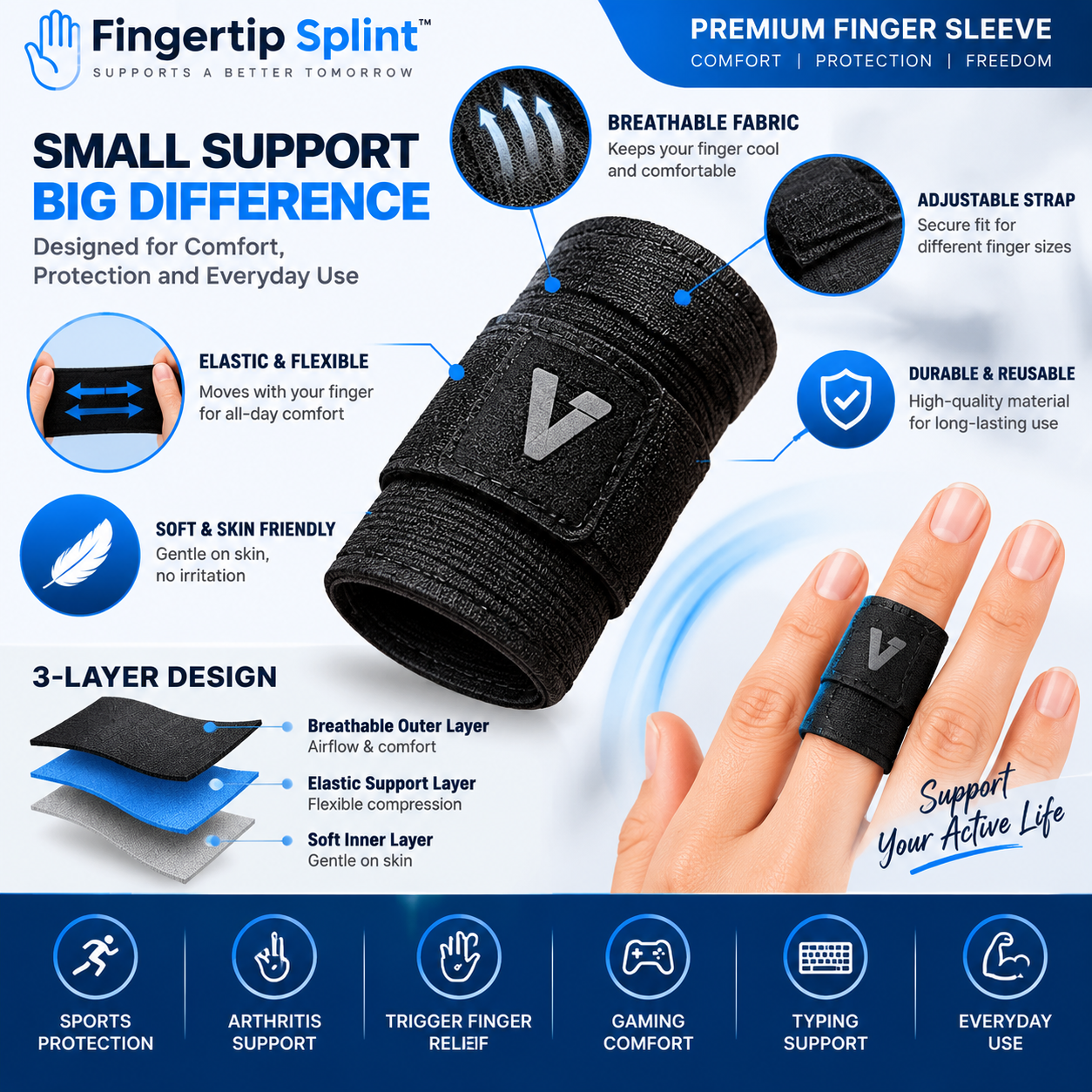
An adjustable finger brace is designed around a mechanism that allows the wearer to modify fit or positioning after the brace is on the finger. The adjustment may involve a strap, hook-and-loop closure, elastic element, overlapping material, or another design feature.
What Adjustability Allows
- Modifying fit after application
- Repositioning coverage as needed
- Fine-tuning tightness within the design’s range
- Adapting to different finger shapes
- Re-tuning after activity changes
What Adjustability Does NOT Automatically Mean
- More support than a fixed design
- Better protection
- Medical-grade stabilization
- Better comfort in every situation
- Greater effectiveness
Important: Adjustment is a design feature, not a quality guarantee. An adjustable brace that’s poorly sized or made from unsuitable materials won’t perform better than a well-designed fixed support.
Fixed Finger Support: What Does It Mean?
A fixed finger support has a predetermined fit, shape, or positioning. The design doesn’t include an adjustment mechanism — the fit is determined by size selection and material properties.
What Fixed Design Offers
- Simple construction
- Straightforward application
- Predetermined fit
- Fewer adjustment components
- Simple daily handling
Important Distinction
“Fixed” doesn’t necessarily mean rigid. A fixed support can still be flexible. The word refers to the fit being predetermined — not to the material being stiff. A stretch-based sleeve is “fixed” in the sense that it doesn’t have an adjustment mechanism, but it can still be quite flexible.
The Main Comparison Table
Here’s the direct comparison. These are general design tendencies, not universal rules — individual products vary.
| Characteristic | Adjustable Finger Brace | Fixed Finger Support |
|---|---|---|
| Fit | Modifiable | Predetermined |
| Positioning | Can often be adjusted | Generally fixed |
| Sizing flexibility | Potentially broader | More size-dependent |
| Adjustment | Available | Limited or none |
| Construction | Usually more components | Often simpler |
| Movement | Depends on design | Depends on design |
| Coverage | Can sometimes be repositioned | Predetermined |
| Bulk | May have additional fastening components | May have simpler profile |
| Convenience | More customization | Simpler setup |
| Maintenance | May require checking fasteners | Often simpler |
Interactive 3D: Adjustable vs Fixed Side-by-Side
Tap each hotspot to see what makes each design different
Adjustable Brace
A flexible design with an adjustment mechanism.
Fixed Support
A design with a predetermined fit and configuration.
⚙️ Adjustment Mechanism
The feature that allows fit or positioning to be modified. This may use hook-and-loop closure, straps, elastic elements, or other design approaches. The presence of an adjustment mechanism is what distinguishes an adjustable brace from a fixed support.
This illustration is conceptual. Actual construction varies by product. Always check the manufacturer’s specifications.
Adjustable vs Fixed: Fit
Fit is the most fundamental difference. Here’s how each design approach affects the fitting process.
Adjustable Fit
- Can accommodate small differences in finger size
- Allows repositioning as needed
- May help achieve a more secure fit
- Can be loosened or readjusted during wear
- More forgiving of finger shape variation
Fixed Fit
- Simpler sizing process
- Fewer components to manage
- Straightforward application
- Fit determined at purchase
- If the predetermined fit doesn’t suit, less opportunity to modify
For a deeper look at fit, see Finger Brace Fit Guide: Understanding Adjustability and Coverage.
Adjustable vs Fixed: Positioning
Positioning is where the difference between adjustable and fixed designs becomes most visible. Here’s how it works.
Interactive: Positioning Spectrum
Tap each position to see what it means
🔒 Fixed Position
The support’s position is determined by size selection and application. Once it’s on, the position doesn’t change unless you remove and reapply it. This is simple and predictable, but offers less flexibility if the initial position doesn’t feel ideal.
Adjustable vs Fixed: Movement
This is where a common misconception appears. Many people assume adjustable braces always allow more movement, or that fixed supports always allow less. Neither is accurate.
Here’s the practical picture of how each design affects different movements:
| Movement | Adjustable Design | Fixed Design |
|---|---|---|
| Finger flexion | Depends on construction and adjustment | Depends on material and coverage |
| Finger extension | Depends on construction | Depends on construction |
| Grip | Adjustment may help positioning | Depends on fit and design |
| Typing | May be easier to fine-tune for keyboard use | Depends on thickness and fit |
| Writing | Adjustability may help preserve pen grip | Depends on material flexibility |
| Smartphone interaction | Adjustment may help position for touchscreen use | Depends on fingertip coverage |
The key takeaway: adjustability doesn’t determine movement — construction does. Both adjustable and fixed designs can be flexible or structured depending on how they’re built.
Adjustable vs Fixed: Coverage
Coverage determines which portion of the finger receives support or protection. Here’s how adjustability affects coverage.
Adjustable Coverage
- May help position coverage more precisely
- Can sometimes be shifted between areas
- Fine-tuning possible during wear
- But physical dimensions still determine actual coverage range
Fixed Coverage
- Coverage determined by design
- Predictable coverage area
- No repositioning possible without removal
- Coverage range is exactly what the design specifies
Coverage options range from targeted areas to extended coverage. To understand how coverage area relates to movement, see Finger Protector Sleeves for Everyday Activities: What to Know.
Adjustable vs Fixed: Comfort
Here’s an important point that’s often misunderstood: customizable doesn’t automatically mean more comfortable.
Comfort depends on several factors working together, not just adjustability:
📏 Correct sizing
🧵 Material
⚖️ Pressure
🧶 Seam placement
✂️ Edges
📦 Thickness
💧 Moisture
🔄 Finger movement
⏳ Duration of use
For a comfort-focused guide, see How to Choose a Comfortable Finger Sleeve for Support.
Adjustable vs Fixed: Everyday Usability
How each design performs during daily activities depends on your priorities. Tap each activity to see the practical comparison.
Interactive: Everyday Usability Comparison
Tap each activity to see how each design compares
TYPING
Keyboard movement
WRITING
Grip & control
SMARTPHONE
Touchscreen use
STUDYING
Extended use
HOUSEHOLD
Object handling
TRAVEL
Portability
Typing
Adjustable: May allow fine-tuning for keyboard use.
Fixed: Depends on thickness and fit. A thin, well-sized fixed sleeve may perform very well here.
Which Design Is Easier to Put On?
The application process differs between the two approaches. Here’s the comparison:
Adjustable Brace Application
- Open the adjustment mechanism
- Position the brace
- Secure the adjustment
- Modify fit as needed
- Recheck movement and comfort
More steps, but more customization.
Fixed Support Application
- Select the correct size
- Position the support
- Secure it (if applicable)
- Check fit
Simpler steps, but less ability to modify.
Neither is universally easier. A fixed support may be quicker to apply. An adjustable brace may take longer but gives you more control over fit. Choose based on what matters to you.
Adjustable vs Fixed: Durability and Maintenance
Durability is an often-overlooked factor when comparing these designs. Here’s what to consider.
Adjustable — Maintenance Considerations
- Fasteners may wear over time
- Straps may lose elasticity
- Hook-and-loop components lose grip
- Repeated adjustment can stress components
Fixed — Maintenance Considerations
- Fewer moving or fastening components
- Simpler construction
- Less to check and maintain
- But material quality still matters
Durability ultimately depends on the actual material and manufacturing quality — not just on whether the design is adjustable or fixed.
Adjustable vs Fixed: Bulk and Profile
Bulk affects how the support interacts with everyday objects — keyboards, pens, phones, and more.
Adjustable Designs May Have
- Straps or fasteners
- Overlapping sections
- Additional components for adjustment
Fixed Designs May Have
- Simpler construction
- Fewer external components
- But not automatically thinner
Don’t assume fixed equals thinner. Material thickness and coverage remain important regardless of adjustability. Compare the actual product dimensions.
Interactive: Which Design Characteristics Matter Most?
Select your priority to see which design to compare. This is educational guidance, not a medical recommendation.
Select a priority above to see guidance.
Common Misconceptions
These six misconceptions cause confusion when comparing adjustable and fixed designs. Tap each card to reveal the reality.
“Adjustable always means better.”
“Fixed means rigid.”
“Tighter adjustment means more support.”
“Adjustable means one size fits everyone.”
“All adjustable braces provide the same movement.”
“A finger brace can replace any prescribed splint.”
Who Might Prefer Each Design?
This is a preference comparison, not a medical recommendation. Different people have different priorities.
An Adjustable Design May Appeal If You Prioritize:
- Customizable fit
- Positioning flexibility
- Repositioning during wear
- Accommodating different finger sizes
- Fine-tuning fit over time
A Fixed Design May Appeal If You Prioritize:
- Simple construction
- Straightforward application
- Predetermined fit
- Fewer adjustment components
- Simple daily handling
Product Spotlight: Why the Adjustable Design Is Worth Comparing
After understanding the differences between adjustable and fixed designs, here’s a specific product to examine. The Adjustable Finger Support Sleeve is one option if adjustable fit and positioning flexibility are among your priorities.
Adjustable Finger Support Sleeve
- Adjustable design for customizable fit
- Flexible sleeve-style construction
- Product specifications available on the product page
- Designed for finger coverage and positioning
- Available to explore with current product details
Check the product page for: adjustment mechanism details, fit information, coverage, materials, and everyday usability. For deeper buyer guidance, see Choosing an Adjustable Finger Support: What Should You Consider? and How Adjustable Finger Sleeves Create a More Flexible Fit. For the wider category, see Sleeve or Brace: Exploring Different Types of Finger Support.
When Should You Look Beyond an Adjustable or Fixed Finger Support?
Product choice shouldn’t substitute for professional assessment. Here’s when to seek appropriate guidance:
🩹 Significant injury
🦴 Visible deformity
💧 Major swelling
📈 Persistent or worsening pain
⚡ Numbness or tingling
🚫 Significant movement loss
🎨 Concerning discoloration
Also remember: if you’ve already been instructed to use a specific splint or immobilization method, follow that professional guidance. Different support products have different purposes. For trusted guidance, see the AAOS OrthoInfo hand and wrist conditions library, NHS guide on hand pain, and MedlinePlus hand injuries and disorders. Additional perspectives are available from Mayo Clinic, Cleveland Clinic, and Johns Hopkins Medicine. The NIH provides research-based information, and if a neurological component is involved, NINDS is the specialist resource. For regulatory context on medical devices, the FDA is authoritative, and for general public health information, the CDC is a trusted source.
Quick Decision Checklist
Before choosing adjustable or fixed support, walk through each item. Tap to mark complete.
Frequently Asked Questions
An adjustable finger brace allows some modification of fit or positioning after the brace is on the finger. A fixed support has a predetermined fit or configuration that doesn’t include an adjustment mechanism. This difference affects sizing flexibility, positioning, convenience, movement, coverage, and comfort — depending on the specific construction. Neither design is universally better; the right choice depends on your priorities and requirements.
Neither is universally better — they’re different design approaches with different trade-offs. An adjustable brace offers more customization and positioning flexibility, but usually has more components to manage. A fixed support offers simpler construction and application, but less ability to modify the fit after purchase. The right choice depends on whether you prioritize customization or simplicity, and on your specific requirements. Both designs can be well-made or poorly made.
No, not automatically. Adjustability is a fit and positioning feature, not a support-level guarantee. The level of support depends on the material, thickness, construction, and coverage — not on whether the product has an adjustment mechanism. A well-designed fixed support may provide more support than a poorly-designed adjustable brace, and vice versa. Check the actual product specifications rather than assuming based on the label.
No. “Fixed” refers to the fit being predetermined — not to the material being rigid. A fixed support can still be flexible. Many finger sleeves are “fixed” in the sense that they don’t have an adjustment mechanism, but they’re made from flexible, stretch-based materials that conform to the finger and preserve natural movement. The word “fixed” describes the fitting approach, not the material stiffness.
It depends on your perspective. A fixed support may be simpler to apply because it has fewer components and steps. An adjustable brace may take longer to apply because it involves opening, positioning, securing, and modifying the fit — but it offers more control over the final fit. Neither is universally easier. If you value speed and simplicity, a fixed design may suit you. If you value customization, an adjustable design may be worth the extra steps.
Yes, many people use adjustable braces during everyday activities like typing, writing, smartphone use, office work, studying, and travel. Their flexibility and customizable fit make them practical for daily wear. The adjustment feature is particularly useful when activities vary, since you can re-tune the fit between tasks. However, comfort during rest may differ from comfort during activity, so it’s worth evaluating the brace during the specific activities you do most.
No, not generally. An adjustable brace and a splint serve different purposes. An adjustable brace is designed for flexible support, coverage, and comfort with preserved movement. A splint is typically designed to stabilize, position, or restrict movement. If a medical professional has recommended a splint for immobilization, protection, or stabilization, an adjustable brace is not a substitute. Always follow professional advice if you have a diagnosed condition or injury.
Seek professional advice if you have a significant injury, visible deformity, severe or worsening pain, major swelling, persistent numbness or tingling, substantial loss of movement, or symptoms that aren’t improving. Also seek advice if a specific type of support has been prescribed. A comparison article can help you understand product differences, but it can’t diagnose what’s causing your symptoms. Trusted resources include AAOS OrthoInfo, NHS, MedlinePlus, Mayo Clinic, and Cleveland Clinic.
Now You Understand Both Designs. Compare With Confidence.
Adjustable gives you more control over fit and positioning. Fixed gives you a predetermined configuration. The right comparison depends on fit, movement, coverage, comfort, simplicity, and intended use. Fit → Adjustment → Positioning → Movement → Coverage → Usability
The Bottom Line on Adjustable vs Fixed Finger Support
Adjustable and fixed finger supports are built around different design priorities. An adjustable brace allows you to modify fit and positioning after application — providing more customization and flexibility. A fixed support has a predetermined fit and configuration — offering simpler construction and application. Neither design is universally better; the right choice depends on what you actually need.
When comparing options, think about your priorities: Do you want customizable fit? Is simple application more important? How much movement do you need? What area needs coverage? What does the manufacturer specify about sizing and intended use? Answering these questions will point you toward the design that matches your situation.
For readers ready to explore a specific product, the Adjustable Finger Support Sleeve product page is a natural next step. For deeper comparison, see Finger Protector Brace Explained: Features, Fit and Everyday Uses and Finger Support Sleeve vs Finger Splint: What’s the Difference? Explore the full FingertipSplint blog library for more guides.
This article is for general information only and is not a substitute for professional medical advice. Always consult a qualified healthcare provider for diagnosis and treatment of any medical condition.