
Why Choose an Adjustable Finger Support Sleeve?
Fixed supports are limited by their size. Fingers vary in circumference, length, and shape. Different activities require different levels of flexibility. A support that fits poorly can become uncomfortable or interfere with normal movement. This guide explains why an adjustable finger support sleeve may be useful, what adjustability actually offers for fit, positioning, comfort, and everyday use — and when a fixed design may be sufficient.
What This Guide Covers
- Quick Answer
- What Makes Adjustable Different?
- Reason 1 — More Flexible Fit
- Reason 2 — Easier Positioning
- Reason 3 — Adaptability to Finger Sizes
- Reason 4 — Support and Movement Balance
- Reason 5 — Different Everyday Activities
- Reason 6 — Fine-Tuning Comfort
- Reason 7 — Practical for Everyday Wear
- Reason 8 — Accommodating Small Fit Changes
- Adjustable vs Fixed Comparison
- Adjustable Does Not Mean Better for Everyone
- How to Decide If Adjustability Matters
- Fit: The Most Important Part
- Adjustability and Everyday Movement
- Product Features to Look For
- 3D Interactive: Why Adjustable Can Be Useful
- A Day With Adjustable Support
- Common Mistakes
- Product Spotlight
- Doctor Advice
- Quick Tips
- FAQ
- Conclusion
Quick Answer: Why Choose an Adjustable Finger Support Sleeve?
An adjustable finger support sleeve may be useful when you want more control over fit and positioning than a fixed design provides. Its adjustment feature can help accommodate normal differences in finger size, coverage preferences, and everyday activities while allowing the wearer to check comfort and movement within the product’s intended range.
If you are still at the stage of understanding the basic product, the foundational reference Adjustable Finger Support Sleeve: What Is It and How Does It Work? explains the product category and mechanism in detail. This article assumes you already understand the basics and now want to know why someone might prefer an adjustable design over a fixed one.
The short answer is not that adjustable is always better. It is that adjustability offers a specific kind of flexibility that some users value and others do not need. The purpose of this guide is to help you decide which group you are in — and what to look for if adjustability matters for your situation.
What Makes an Adjustable Finger Support Different?
An adjustable finger support sleeve allows the wearer to modify positioning or fit within the design’s intended adjustment range. That is the core difference. A fixed support is set at its size when it is made. An adjustable support can be changed after it is on the finger, within limits set by the design.
The adjustment itself can take several forms: adjusting the circumference around the finger, repositioning the coverage along the finger, or modifying the tension of the sleeve against the skin. Different designs offer different combinations of these. The common thread is that the wearer has some control over the fit after application — not just before.
What Adjustability Can Include
- Adjustable positioning along the finger
- Adjustable fit around the circumference
- Different adjustment ranges by design
- Repositioning after the sleeve is on
- Adaptability to individual finger dimensions
What Adjustability Does Not Mean
- One size fits every finger
- Unlimited modification of fit
- Automatic comfort regardless of size
- Replacement for correct sizing
- The same as a stretchy material
Important distinction: Stretch is not the same as adjustability. A material can stretch to conform to the finger without giving the wearer any control over the fit. Adjustability requires a mechanism the wearer can deliberately change.
This distinction matters because many products are described as “flexible” when they simply use an elastic material. Flexibility from stretch and flexibility from adjustment are different things. The guide How Adjustable Finger Sleeves Create a More Flexible Fit explains the difference in more depth, and understanding it makes the rest of this article easier to apply.
Reason 1 — More Flexible Fit Within the Product’s Intended Range
The most obvious reason to choose an adjustable finger support sleeve is fit flexibility. Fingers are not uniform. Two people with the same nominal finger size can still have different circumferences at the same point, different tapering along the length of the finger, and different joint dimensions. A fixed support has to match these dimensions precisely to work well. An adjustable support has more room to accommodate natural variation.
The flexibility is not unlimited. Every adjustable product has an intended range. Within that range, the wearer can fine-tune the fit for comfort and secure positioning. Outside that range, the product is simply the wrong size — and adjustment will not fix that.
Loose fit can be tightened
Secure fit can be confirmed
Adjustment range defines limits
Finger shape variations accommodated
Positioning adjusted for coverage
Comfort fine-tuned after application
Realistic expectation: Adjustment helps when your finger dimensions fall within the product’s range. It does not guarantee a perfect fit, and it does not replace correct sizing. If a product requires the extreme end of its adjustment range to fit, you are likely one size off.
For someone whose finger measurement falls between standard sizes, or whose finger shape differs slightly from the average the product was designed around, adjustability can make the difference between a support that works and one that does not. For someone whose finger matches a standard size closely, adjustability may offer less practical benefit.
Reason 2 — Easier Positioning and Repositioning
Fit is not just about circumference. It is also about where the support sits on the finger. An adjustable design usually allows more deliberate positioning than a fixed design, because the wearer can adjust how the product is oriented and where it sits along the length of the finger.
This matters for several reasons. Coverage area depends on position. Alignment of the support relative to the finger’s natural curves affects comfort. And if the support shifts during an activity, an adjustable design can be repositioned without removing it entirely.
Fixed supports can also be positioned, but the range of adjustment is usually narrower. If the product does not fit well in one position, it may not fit well in any position. An adjustable support gives the wearer more chances to find a position that works.
Positioning also interacts with coverage. If the support covers the fingertip and the wearer wants more of the middle finger covered, repositioning may shift the coverage. If the wearer wants coverage to stay in a specific spot, an adjustable design may make that easier. The guide Finger Brace Fit Guide: Understanding Adjustability and Coverage explores this relationship in more depth.
Reason 3 — Adaptability to Different Finger Sizes
Finger dimensions vary widely between people. Circumference, length, joint location, and overall shape all differ. Even between fingers on the same hand, the dimensions can vary significantly. An adjustable design can accommodate some of this variation within its intended range.
Dimensions That Vary
- Finger circumference at the base
- Circumference at the middle
- Circumference near the tip
- Overall finger length
- Joint location and size
- Natural tapering along the finger
What Adjustability Helps With
- Fingers that fall between standard sizes
- Fingers with unusual shape or taper
- Fingers that differ slightly from the average
- Users who want a more personalized fit
- Situations where exact sizing is uncertain
However, adjustability is not universal sizing. A product designed for a small finger will not fit a large finger just because it is adjustable. The adjustment range defines the product’s compatibility, and fingers outside that range will not fit properly regardless of adjustment.
Important: Do not interpret adjustability as a substitute for correct size selection. Always measure your finger and compare it to the product’s sizing chart and adjustment range before relying on adjustment to make the product fit.
Reason 4 — Balance Between Support and Movement
One of the most important reasons to consider an adjustable design is the balance between support and movement. Users often want both: enough support to feel secure, and enough movement to continue normal activities. A fixed support may not offer much flexibility in how these two are balanced. An adjustable support can often be tuned to a setting that balances them differently.
The common mistake is to assume that more support means tightening the support. That is not how it works. Support is a function of the design, the construction, and the fit — not of pressure. Tightening an adjustable support does not necessarily increase support; it may simply increase discomfort.
For users who want to keep using their fingers normally, the movement side of the balance matters more. For users who want a more stable fit, the support side matters more. An adjustable design lets the wearer explore where the balance feels right for them — within the limits of the product’s design.
This is also why movement depends on more than just adjustability. Material, thickness, coverage, structure, and positioning all contribute. Adjustment is one factor among several. The comparison article Adjustable Finger Brace vs Fixed Support: What’s the Difference? covers this interaction in more detail.
Reason 5 — Useful for Different Everyday Activities
A related benefit is that adjustability makes a single product more useful across a range of activities. The ideal fit may change depending on what the wearer is doing. Typing favors a low-profile, flexible fit. Writing favors grip compatibility. Smartphone use favors fingertip coverage. Household tasks favor stable positioning. An adjustable design can accommodate small differences between these contexts without requiring a different product for each.
Typing — movement and low profile
Writing — grip and comfort
Studying — mixed activity comfort
Smartphone — fingertip coverage
Office work — secure positioning
Travel — practical handling
The practical reference Finger Protector Sleeves for Everyday Activities: What to Know covers activity-specific considerations in detail. For this article, the key point is that adjustability extends the product’s usability across activities where a fixed support might be less flexible.
It is worth noting, however, that adjustability does not make a product universal. A sleeve designed for fingertip coverage still cannot cover the base of the finger. A sleeve with a low profile for typing still has a low profile during household tasks. Adjustability expands the fit and positioning range — not the product’s fundamental design characteristics.
Reason 6 — Easier to Fine-Tune Comfort
Comfort is not a fixed property. It depends on how the product feels against the skin, how it distributes pressure, how it behaves during movement, and how it holds up over time. An adjustable design gives the wearer a way to react to discomfort without replacing the product.
If the sleeve feels slightly loose after an hour, the wearer can tighten it slightly. If it begins to create pressure at one point, the wearer can loosen or reposition it. This kind of small adjustment is useful during long wear and during activities that change the way the finger is used.
Comfort Factors to Assess
- Pressure at the sleeve’s contact points
- Contact with the skin over time
- Slipping during activity
- Bunching as the finger moves
- Edge discomfort from seams or fasteners
- Movement restrictions that feel uncomfortable
What Adjustability Offers
- Fine-tuning of pressure
- Reduction of slipping if the fit was loose
- Repositioning to reduce edge discomfort
- Adjustment for different activity durations
- Practical response to changing comfort needs
Important safety point: Tighter does not automatically mean better. If a support causes numbness, tingling, significant discoloration, or persistent discomfort, it should not simply be tightened further. Loosen or remove the sleeve and seek appropriate advice if symptoms persist.
The article Choosing an Adjustable Finger Support: What Should You Consider? provides a broader framework for matching a product to your comfort and activity needs. It is useful context for this section.
Reason 7 — More Practical for Everyday Wear
Practicality matters in everyday wear. A support that is easy to put on, adjust, remove, clean, and store is more useful than one that requires special handling. Adjustable designs often score well on practicality because they can be repositioned and re-tuned without removing the product entirely.
Easy positioning
Adjustability during wear
Portability
Low profile (design dependent)
Easy repositioning
Storage and care
Not every adjustable sleeve has all these characteristics. Some are easier to adjust than others. Some have more complex fastening systems. Some require more care. The general benefit of adjustability is that it offers more practical flexibility — but the specific practical characteristics depend on the product.
When evaluating a specific product, check how the adjustment mechanism works, how easy it is to use repeatedly, and whether the care instructions are practical for your routine. These details matter more over time than the presence of an adjustment feature alone.
Reason 8 — Can Accommodate Small Fit Changes
An adjustable design allows minor fit changes without immediately replacing the product. This can include repositioning during the day, adapting to slight differences in how the finger is positioned, and adjusting to different activities. It also means that if the fit becomes slightly looser over time — as some materials relax with wear — the wearer can compensate.
The changes an adjustable product can accommodate are usually small. It cannot adapt to major changes in finger size, and it cannot compensate for a fundamentally wrong size. Claims about accommodating swelling or injury-related changes should not be taken at face value unless the product specifically states this capability and the situation has been medically assessed.
Realistic scope: Think of adjustability as covering small fit variations — not as a solution for significant changes in finger dimensions. If your finger dimensions are changing significantly, that is a reason to seek appropriate assessment rather than to rely on a consumer product.
Adjustable vs Fixed Finger Support
This comparison shows how adjustable and fixed supports differ across the characteristics that matter most for everyday use. The purpose is not to declare a winner, but to help you decide which category fits your needs.
| Feature | Adjustable Support | Fixed Support |
|---|---|---|
| Fit | Can be modified within its range | Predetermined by design and size |
| Positioning | Can allow repositioning | Usually less customizable |
| Adjustment | User-controlled | Limited or unavailable |
| Sizing flexibility | Potentially greater | Depends on available sizes |
| Everyday usability | Depends on design | Depends on design |
| Movement | Depends on construction | Depends on construction |
| Comfort | Depends on correct fit | Depends on correct fit |
| Maintenance | Depends on fastening and material | Depends on construction |
Important conclusion: Neither category is universally superior. Choose based on how much fit customization, positioning, and adjustability you actually need. If your finger measurement matches a standard size well and you do not need repositioning, a fixed design may serve you perfectly. If you value flexibility and adjustability, an adjustable design may serve you better.
Adjustable Does Not Mean “Better for Everyone”
Several misconceptions about adjustable finger supports come up repeatedly. Addressing them directly makes it easier to choose well.
“More adjustment always means better support.”
Adjustment is useful only within the product’s intended range. Beyond that, it cannot improve fit or support.
“Adjustable means one size fits everyone.”
Products still have sizing and design limitations. Adjustment works within a range — it does not eliminate sizing.
“Tighter means more effective.”
Excessive tightness can reduce comfort and may cause concerning symptoms. Tightness is not a measure of support.
“Adjustable supports can replace every type of finger support.”
Different support designs serve different purposes. An adjustable sleeve is one category, not a universal solution.
These myths matter because they lead to specific buying mistakes. A buyer who believes Myth 1 may over-adjust a product that is fundamentally the wrong size. A buyer who believes Myth 2 may skip the sizing chart entirely. A buyer who believes Myth 3 may tighten until the product is uncomfortable. A buyer who believes Myth 4 may use a sleeve in situations where a different support category is appropriate.
How to Decide If Adjustability Is Important for You
Adjustability is not equally important for everyone. This short decision framework can help you assess how much it matters in your situation.
Decision Questions
Answer these questions to see which support category is more likely to suit you.
Answer the questions to see your result.
The output of this decision framework is not a medical recommendation. It is a practical assessment of whether adjustability is likely to be more useful than a fixed design in your specific case.
Fit: The Most Important Part of Adjustability
Adjustability matters most when it produces a good fit. If the fit is wrong — too loose or too tight — the fact that the product is adjustable does not help. This section covers the three basic fit states and what each one looks and feels like.
Interactive 3D: Three Fit States
Select a fit state to see what to watch for
Appropriate Fit
Secure positioning during intended movement. Comfortable contact with the skin. Intended coverage maintained. Normal movement not unnecessarily restricted. This is the target: not the tightest fit, but the fit that works.
Too Loose
- Slides during movement
- Shifts position
- Coverage becomes inconsistent
- Requires frequent readjustment
Appropriate Fit
- Secure positioning
- Comfortable contact
- Coverage maintained
- Movement not unnecessarily restricted
Too Tight
- Pressure feels excessive
- Movement becomes uncomfortable
- Numbness or tingling may occur
- Significant discoloration is a warning sign
The appropriate fit is the one that stays in place, feels comfortable, maintains coverage, and allows the movement you need. It is not the tightest setting the product can reach. In practice, this means adjusting for comfort and secure positioning, then checking the fit through gentle movement before committing to an activity.
Adjustability and Everyday Movement
Movement is one of the reasons people consider adjustable designs. But movement is not created by adjustability — it comes from the product’s material, thickness, coverage, and structure. Adjustability affects movement indirectly by letting the wearer position and tension the product in a way that works with the movement they need.
An adjustable support should be evaluated according to how it behaves during the user’s intended activities. Typing, writing, phone use, studying, and office work all involve different movement patterns, and the ideal fit may change slightly from one to another. Adjustability provides a way to tune the product without replacing it.
Product Features to Look For
If you decide that adjustability matters for your situation, the next step is to know which product features to examine. The following checklist covers the most important characteristics.
Adjustable Finger Support Checklist
Tap each item as you check it for the product you are considering.
Not every product will provide all this information. A listing that provides most of it is easier to evaluate than one that provides none. If the adjustment mechanism, adjustment range, and sizing information are missing, the product is harder to compare meaningfully — treat that as a limitation of the listing, not a neutral absence.
Why Adjustable Finger Support Can Be Useful: 3D Interactive
The interactive below shows five reasons an adjustable design may be useful. Tap each hotspot to see what it addresses.
Interactive 3D: Five Reasons
Tap each reason to see what adjustability offers
① Adjustable Fit
Adjustability allows the wearer to modify the fit within the product’s intended range. This can help accommodate normal differences in finger size and shape. It does not guarantee a perfect fit and does not replace correct sizing.
These reasons work together. Adjustability is most useful when it supports a good fit, appropriate positioning, and comfortable movement.
Adjustment Range
This simplified visual shows the relationship between adjustment range and fit outcome.
A Day With Adjustable Support
The real-world value of adjustability becomes clearer when you look at how a single day might involve different fit needs. Tap each point in the day to see how the user might reassess position, fit, movement, and comfort.
Interactive: A Day With Adjustable Support
Tap each point in the day to see what the wearer might check
MORNING
Apply and check
WORK
Repetitive tasks
PHONE
Fingertip use
DESK
Long sessions
TRAVEL
Portability
EVENING
Remove and check
Morning
Position: Apply the sleeve and check that it sits where intended.
Fit: Confirm it feels snug but not tight.
Movement: Move the finger gently through its normal range.
Comfort: Check for any pressure points before starting the day.
Common Mistakes to Avoid
These mistakes come up repeatedly when people choose and use adjustable finger support sleeves. Avoiding them makes the experience better.
Adjustability is not automatically the right feature for every situation.
Check: whether you actually need adjustable positioning or fit.
Adjustment works within a range and does not replace correct size.
Check: measure your finger and compare it to the sizing chart first.
Products still have sizing limits and design constraints.
Check: the adjustment range and the base size the product is built around.
Tighter does not mean more supportive. It can reduce comfort and cause concerning symptoms.
Check: adjust for comfort and secure positioning, not maximum pressure.
Both are signs that the fit or positioning needs attention.
Check: re-adjust, reposition, or reconsider the size.
A general sleeve is not protective equipment against sharp objects, heat, or chemicals.
Check: the manufacturer’s stated intended use for the product.
Different situations may call for different support categories.
Check: whether the product’s purpose matches your situation.
Some symptoms require professional assessment, not a consumer product.
Check: seek appropriate advice if symptoms are significant or worsening.
Product Spotlight: A Product to Consider When Adjustable Fit Is a Priority
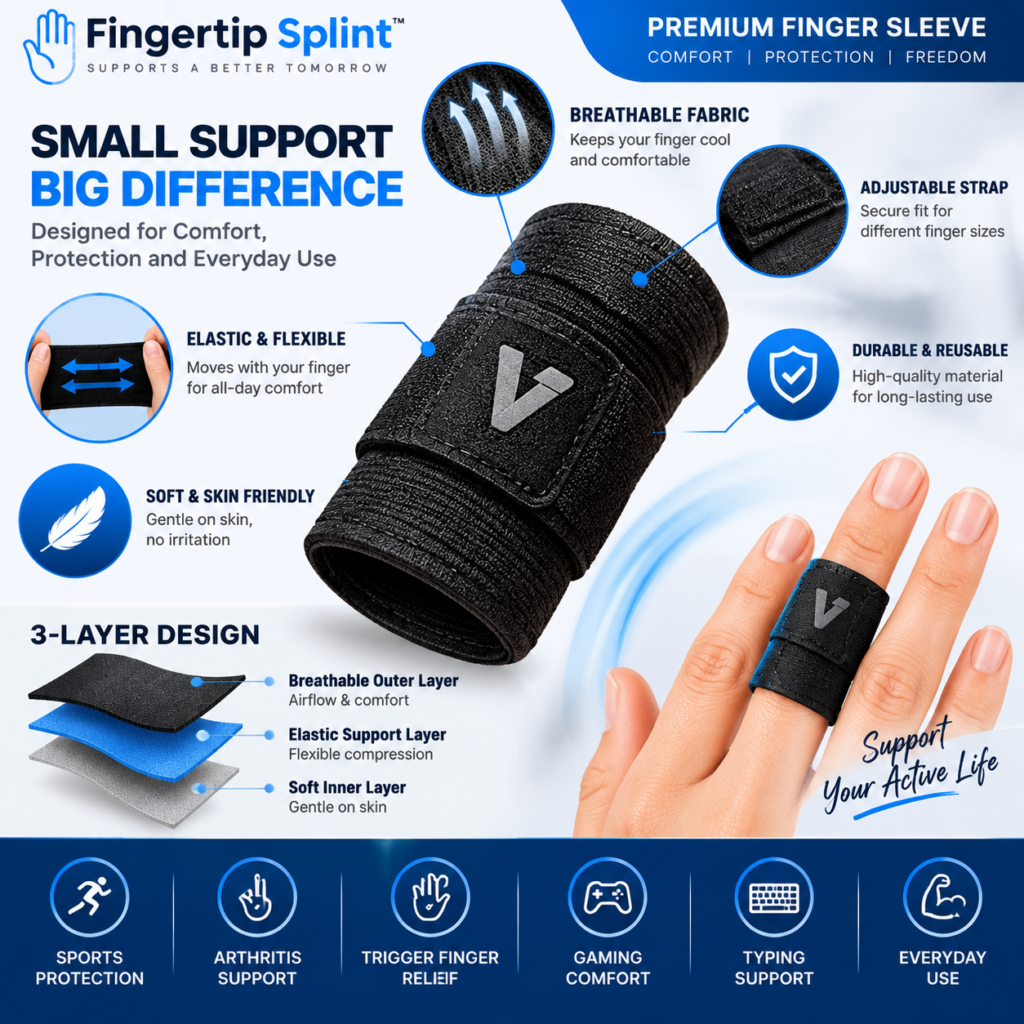
For readers who have decided that adjustable fit matters for their situation, here is a specific product to examine. The Adjustable Finger Support Sleeve is one option to consider if customizable fit and positioning are among your priorities. This section describes it in the same terms the article has used throughout.
Adjustable Finger Support Sleeve
- Adjustable design for customizable fit
- Flexible sleeve-style construction
- Designed for finger coverage and positioning
- Full product specifications available on the product page
What to Examine on the Product Page
Adjustable Design
Check how the adjustment works, what changes when it is adjusted, and whether the adjustment stays secure through movement.
Intended Coverage
Review the coverage area. Confirm the product covers the specific finger area you need, and compare its dimensions against your requirements.
Fit Considerations
Review the sizing information. Compare your measured finger circumference against the stated range before relying on adjustment.
Construction
Review the listed materials, thickness, and inner surface description. Confirm the construction suits your comfort and activity needs.
Everyday Usability
Consider how the sleeve’s characteristics match the activities you do most. Review the care instructions and confirm the intended use aligns with your situation.
Doctor Advice: When to Seek Professional Guidance
An adjustable finger support sleeve is a consumer product. It is designed for fit, positioning, and everyday comfort. It is not a substitute for professional assessment or for a prescribed medical support.
Seek professional guidance rather than relying on a finger sleeve if you have: significant pain, visible deformity, substantial loss of movement, persistent numbness or tingling, major swelling, concerning discoloration, or symptoms that are worsening or not improving.
Questions About the Area
- What area needs support or coverage?
- Is movement supposed to be restricted?
- Is flexible support appropriate for this use?
Questions About the Product
- Does the product match any recommended design?
- Is the fit comfortable and secure?
- Are there symptoms that need professional assessment?
For general information about hand and finger conditions, the following authoritative resources are useful and reliable:
- Mayo Clinic for condition overviews and patient education.
- AAOS OrthoInfo for musculoskeletal guidance from orthopedic specialists.
- MedlinePlus hand injuries and disorders for a broad reference library.
- NHS guide on hand pain for UK-based clinical guidance.
- Cleveland Clinic for clear patient-oriented explanations.
- Johns Hopkins Medicine for clinical and research-based perspectives.
- FDA for regulatory context on medical devices.
- NIH for research-based health information.
- WebMD for general overviews.
- Healthline for practical wellness information.
These resources provide general information and do not replace individualized advice from a qualified healthcare professional.
Quick Tips
These seven tips help you get the most from an adjustable finger support sleeve if you decide it is the right choice for you.
Frequently Asked Questions
An adjustable finger support sleeve may be useful when you want more control over fit and positioning than a fixed design provides. Its adjustment feature can help accommodate normal differences in finger size, coverage preferences, and everyday activities while allowing the wearer to check comfort and movement within the product’s intended range. Adjustability is most valuable for people whose finger dimensions fall between standard sizes, whose needs change across activities, or who want to fine-tune positioning and comfort over time.
Not automatically. Adjustable and fixed supports are different categories with different trade-offs. Adjustable supports offer more fit flexibility and repositioning, while fixed supports are often simpler and may suit users whose finger measurement matches a standard size well. The right choice depends on how much fit customization and positioning flexibility you actually need. Neither category is universally better.
No. Adjustable products work within a specific adjustment range built around a base size. While adjustable designs accommodate small variations in finger size more flexibly than fixed-size products, they still have limits. A finger significantly outside the product’s size and adjustment range will not fit properly, regardless of how the product is adjusted. Always choose the correct size first, and use adjustment to fine-tune within the product’s intended range.
It should feel snug and secure but not tight. The sleeve should stay positioned during intended movement, allow the intended movement, and remain comfortable through wear. It should not create unnecessary pressure, numbness, tingling, or concerning discoloration. Tightness is not a measure of support. If you notice concerning symptoms, loosen or remove the sleeve and seek appropriate advice if symptoms persist.
Movement depends on the product’s material, thickness, coverage, structure, and positioning, not simply on whether it is adjustable. A thin, low-coverage adjustable sleeve in a flexible material may allow significant movement. A thicker, more structured design may restrict movement more. Adjustability itself affects fit and positioning; movement characteristics depend on the overall construction. Match movement to your activity rather than to a marketing claim.
Consider the adjustment mechanism, adjustment range, available sizes, coverage, material, flexibility, edge construction, thickness, ease of positioning, care instructions, and manufacturer information. Compare the product’s specifications against your finger measurements and activity needs. Prioritize listings that provide specific measurements and construction details over listings that rely on general marketing language.
Seek professional advice if you have significant pain, visible deformity, substantial loss of movement, persistent numbness or tingling, major swelling, concerning discoloration, or symptoms that are worsening or not improving. Also seek advice if a specific type of support has been recommended. An adjustable finger sleeve is a consumer product and cannot diagnose or treat a medical condition.
Adjustable Means More Control — Not Automatically Better
Adjustability offers fit flexibility, easier positioning, adaptability to normal finger variation, and practical fine-tuning for everyday activities. Whether that control is useful depends on your finger, your activity, and your preference. Understand what adjustability offers. Then decide if it is right for you.
The Bottom Line on Choosing Adjustable Finger Support
An adjustable finger support sleeve is worth considering when fit flexibility, positioning control, and adaptability across everyday activities matter to you. Its adjustability allows the wearer to modify fit and positioning within the product’s intended range — a practical advantage for fingers that fall between standard sizes, for activities that require different fits, and for users who want to fine-tune comfort over time.
Adjustability is not automatically better. It is a design feature that offers specific benefits and comes with specific limits. It does not replace correct sizing, it does not eliminate the need to check the fit, and it does not make a product universally suitable. What it does offer is more control over how the product fits and sits — and for many users, that control is the reason they choose adjustable over fixed.
If you want to continue exploring within this cluster, the comparison article Adjustable Finger Brace vs Fixed Support: What’s the Difference? covers the trade-offs in more depth, and the broader buying guide Finger Support Sleeve Buying Guide: Fit, Design, and Comfort covers selection considerations in detail. For a wider reference, explore the full FingertipSplint blog library.
This article is for general information only and is not a substitute for professional medical advice. Always consult a qualified healthcare provider for diagnosis and treatment of any medical condition.