
Basketball Finger Support Brace: What to Look for Before Buying
You jammed a finger during a rebound, pass, or steal. Now you are searching for a basketball finger support brace, and dozens of products look almost identical. A brace can look protective without being appropriate for your needs. This guide gives you a practical pre-purchase checklist so you know exactly what to inspect before clicking Buy.
If you want the broader product-comparison view first, start with our basketball finger splint selection guide. This article focuses purely on what to check before spending money.
What a Brace Can and Cannot Do
A basketball finger support brace may provide support or protection, but choosing a product online does not determine what type of injury a person has. The Mayo Clinic Q and A on bracing notes that braces should match the activity and required level of support, and that a suspected serious injury may need professional assessment rather than simply choosing a brace online.
The Mayo Clinic dislocation first aid guidance specifically notes that finger dislocations can cause deformity, severe pain, and swelling, and should receive prompt medical attention rather than being forced back into place. A brace is a support tool, not a diagnostic device. For medical finger splint supply information, see FingerTipSplint’s medical finger splint supplier page.
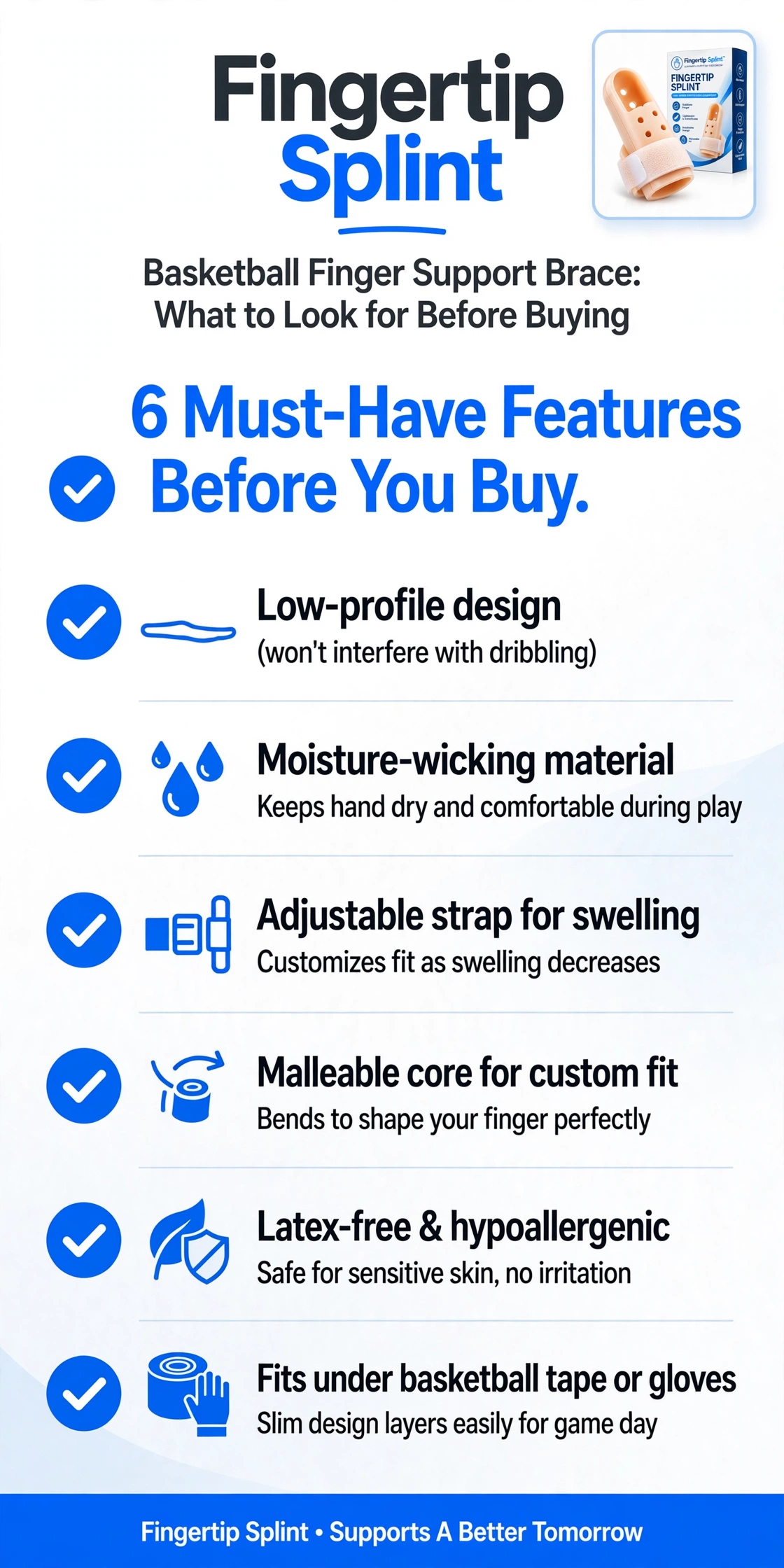
When buying a basketball finger support brace, check the fit, finger and joint coverage, support level, adjustability, material, closure, mobility, comfort, and sizing instructions. The right brace should provide appropriate support without being excessively tight or unnecessarily restricting movement. For significant injury symptoms, seek professional assessment before relying on an off-the-shelf brace.
Table of Contents
- What a Brace Can and Cannot Do
- What Is a Basketball Finger Support Brace?
- 10 Things to Check Before Buying
- Find Your Fit Checker
- How Much Support Do You Need?
- Basketball-Specific Design Features
- Mobility vs Support
- Material and Comfort Checklist
- Closure and Security
- Low-Profile Design for Basketball
- 3D Brace Anatomy
- 10 Questions to Ask Before Buying
- Common Buying Mistakes
- Compare Two Basketball Braces
- Product Spotlight
- When Should You NOT Just Buy a Brace?
- Doctor Advice
- 60-Second Buying Decision Tool
- Quick Buyer Checklist
- FAQ
What Is a Basketball Finger Support Brace?
Finger support is a broad category, not one specific type of device. Products marketed as finger support may include finger sleeves, finger support braces, adjustable finger splints, structured finger splints, and buddy-style supports. Each category serves a different purpose and provides a different level of support.
The buying question is not which category sounds best. The buying question is which category actually matches your finger, your joint, your activity, and the support level you need. For a deeper look at how adjustability works in sports products, see our guide on adjustable finger splint features and fit.
10 Things to Check Before Buying
1. Check the Finger It Is Designed For
Does the brace accommodate the index finger, middle finger, ring finger, little finger, or thumb? Finger position and joint coverage differ. A brace designed for the index finger may not fit the pinky comfortably, and vice versa. Confirm the intended finger before buying.
2. Check Which Joint It Supports
The DIP joint is closest to the fingertip. The PIP joint is the middle joint. The MCP joint is where the finger meets the hand. The buying question is simple: does the brace actually cover the area you need supported? A brace designed for the PIP joint will not stabilize the DIP joint, and vice versa.
3. Check the Support Level
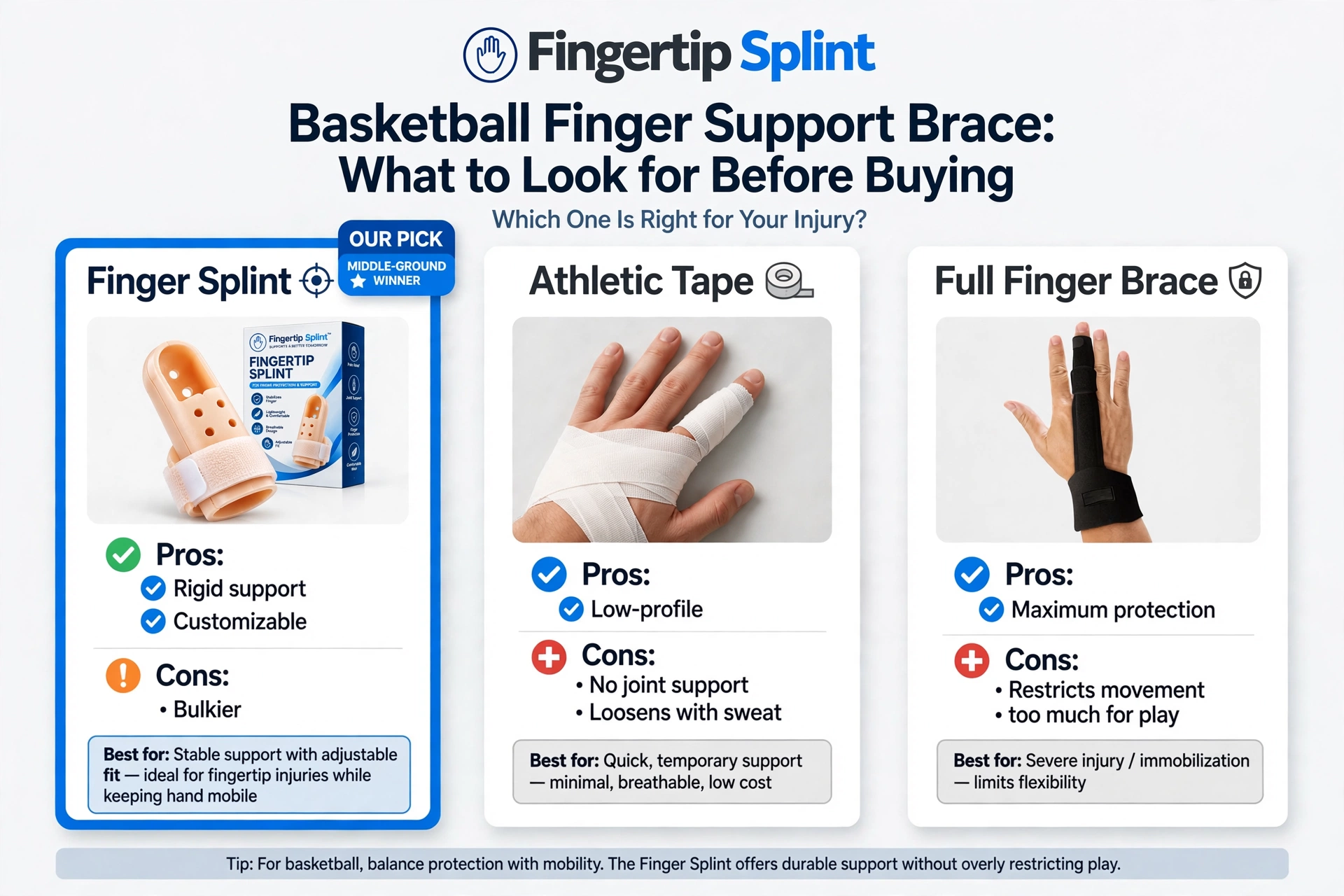
Support ranges from flexible to moderate to structured. More rigid or restrictive does not automatically mean better. The support should match the intended use and professional guidance when treating an actual injury. For basketball, a balance between support and movement is usually more practical than maximum restriction.
4. Check Adjustability
Adjustable straps, hook-and-loop closures, multiple adjustment points, and the ability to achieve a secure fit all matter. But adjustable does not automatically mean better. The adjustment system still needs to provide a stable and comfortable fit. If the closure cannot hold the fit during movement, adjustability is not helping.
5. Check Sizing Carefully
Identify the correct finger, read the manufacturer’s sizing instructions, measure according to the supplied method, compare measurements with the size chart, and do not choose based only on hand size or age. Sizing systems vary by brand and by finger. A size that works for one product may not work for another.
6. Check Basketball-Specific Design
The brace should be compatible with the movements required during basketball. Shooting, dribbling, passing, rebounding, defense, practice, and competition all place different demands on the finger. A brace that interferes with ball handling will likely be removed during play, defeating its purpose.
7. Check Material and Comfort
Consider whether the material is comfortable against the skin, whether it has padding or contact areas, whether seams could rub during movement, whether it is appropriate for repeated use, whether it can be cleaned according to manufacturer instructions, whether it becomes excessively hot or sweaty, and whether it stays positioned during activity.
8. Check the Closure and Security
Hook-and-loop closures are easy to adjust. Elastic provides a flexible feel but may be less adjustable. Multi-strap designs offer more adjustment points. Fixed or structured designs may be more stable but less flexible. No single closure type is universally superior — it depends on your needs.
9. Check the Profile
Bulk matters in basketball. Consider interference with neighboring fingers, grip, ball handling, shooting, passing, glove compatibility if applicable, and the ability to fit comfortably under other equipment. The central question: can you comfortably perform the movements you need while wearing it?
10. Check the Manufacturer Instructions
The product should clearly explain sizing, use, care, and limitations. If the product page does not tell you how to size it, how to wear it, and how to care for it, ask before buying. Clear instructions are a sign of a well-developed product.
Find Your Fit Checker
Click each item to check your fit. If you cannot confirm most of these, the brace may not be right for you.
How Much Support Do You Need?
Support should match the situation, not just the severity of how your finger feels on a given day. Use the three-level framework below to orient your decision.
Flexible
For situations where comfort and movement are the main priorities. Usually lower profile and easier to wear during activity. A finger sleeve or light support often fits this category.
Moderate
For users looking for a balance between support and movement. An adjustable support with secure closure typically fits here — appropriate for controlled basketball activity when cleared by a professional.
Structured
For situations where greater restriction may be appropriate. Usually bulkier and more restrictive. The correct level depends on the underlying problem and professional guidance when needed.
Basketball-Specific Design Features
Different basketball activities place different demands on the fingers. Use the table below to think about which activities your brace needs to support.
| Basketball Activity | What to Consider |
|---|---|
| Shooting | Finger mobility and ball feel. A brace that restricts the release point may affect your shot. |
| Dribbling | Secure positioning. The brace should not interfere with ball control. |
| Passing | Mobility and comfort. The brace should stay in place during rapid hand movement. |
| Rebounding | Protection and support needs. The brace should protect the finger without creating new pressure points on contact. |
| Defense | Stability during contact. The brace should stay secure during hand checks and body contact. |
| Practice | Comfort over longer sessions. A brace that is comfortable for ten minutes may not be comfortable for two hours. |
| Competition | Low-profile design and secure fit. Check applicable league or facility rules concerning braces, taping, or protective equipment. |
Mobility vs Support
This is a central trade-off in brace design. Flexible designs generally allow more movement. Structured designs may limit movement more. The appropriate balance depends on the purpose of the brace and the activity you need to perform.
Mayo Clinic’s general brace guidance emphasizes matching the brace to the activity rather than treating every brace as interchangeable. A player who needs to shoot and pass may prioritize mobility. A player recovering from a specific injury may need more restriction, based on professional guidance.
Material and Comfort Checklist
Instead of simply saying “choose breathable material,” here are the actual questions you should ask before buying.
Is the material comfortable against the skin?
Consider texture, softness, and whether it may cause irritation during prolonged wear.
Does it have padding or contact areas?
Padding can reduce pressure points, especially where the brace contacts bony areas.
Could seams rub during movement?
Seams that sit against the skin may cause irritation during gripping or ball contact.
Is the material appropriate for repeated use?
Consider durability, washing, and whether the material holds up over time.
Does the brace become excessively hot or sweaty?
Breathability matters for longer sessions and warmer environments.
Does it stay positioned during activity?
A brace that slides will lose both comfort and support during movement.
Closure and Security
The fastening mechanism determines how the brace secures and how easy it is to adjust. Compare the main closure types before buying.
Hook-and-Loop
Easy adjustment and release. Allows fine-tuning within a range. Common in adjustable sports braces.
Elastic
Flexible feel with some stretch. May be less adjustable than hook-and-loop, but can conform to finger shape.
Multi-Strap
More adjustment points for a more precise fit. May be more complex to apply during activity.
Fixed / Structured
Potentially more stable but potentially less flexible. Usually sized to a specific measurement.
No single closure type is universally superior. The right closure is the one that provides a secure, comfortable fit for your finger and your activity.
Low-Profile Design for Basketball
Bulk matters more in basketball than in many other activities. A bulky brace can interfere with ball handling, shooting, passing, and grip. When evaluating a brace, consider whether it interferes with neighboring fingers, whether it affects grip, whether it interferes with ball handling, and whether it stays comfortable during shooting and passing.
3D Anatomy of a Basketball Finger Support Brace
Before you evaluate any product, it helps to know what you are looking at. The interactive 3D component explorer below breaks down the parts of a typical basketball finger support brace. Click each component to see what it does and why it matters.
Brace Component Explorer
Click a component to learn what it does and why it matters when you are buying.
10 Questions to Ask Before Buying
Click each question to confirm you have checked it. If you cannot confirm most of these, the brace may not be right for you.
Common Buying Mistakes to Avoid
A brace looking strong does not tell you whether it fits your needs. Look at the structure, not the marketing photo.
Loose means poor positioning. Too tight means unnecessary pressure. Sizing varies by brand.
Support should match the intended purpose, not the maximum level available.
A brace can cover the finger without adequately supporting the specific area you expect.
A brace that severely interferes with ball handling may not suit the intended activity.
A generic size label will not help. Use the specific product’s chart.
The closure determines how easy the brace is to put on, adjust, and keep secure during play.
Excessive pressure can cause numbness, tingling, or discoloration. It does not improve support.
A brace is a support tool. It does not tell you what type of injury you have.
Significant injuries require professional evaluation, not just a product purchase.
Compare Two Basketball Braces
Select the criteria that matter most to you and we will show you what to compare. This is a decision tool, not a winner-picking tool.
Select two priorities above and click Compare. The result will help you decide which brace to evaluate first, but it will not declare a universal winner.
Product Spotlight: Basketball Finger Splint Adjustable Joint Support Brace
Use this section as a worked example of how to evaluate a basketball finger support brace against the criteria in this guide. The product being evaluated is the Basketball Finger Splint Adjustable Joint Support Brace from FingerTipSplint.
Basketball Finger Splint Adjustable Joint Support Brace
- Adjustability: Hook-and-loop fastening for fine fit adjustment
- Joint support: Support structure designed to help stabilize the intended finger joint
- Fit: Check the product page for the specific sizing guidance
- Closure: Adjustable closure designed for secure positioning
- Mobility: Designed to preserve useful finger movement
- Comfort: Cushioned contact surface intended for extended wear
- Basketball use: Low-profile design intended for basketball and similar activities
| Buying Factor | What to Examine |
|---|---|
| Adjustability | How the brace can be adjusted |
| Joint Support | Which areas the design covers |
| Fit | Available sizing and instructions |
| Closure | How it secures |
| Mobility | How the design interacts with finger movement |
| Comfort | Contact, padding, and material construction |
| Basketball Use | Whether its design fits the intended activity |
For additional questions, visit the FingerTipSplint FAQ. For wholesale or distribution inquiries, see the finger splint distributor page or use the request-a-quote page.
When Should You NOT Just Buy a Brace?
A brace is not a substitute for assessment when there are signs of a significant injury. The Mayo Clinic Q and A on broken finger symptoms notes that even finger fractures can sometimes present with relatively subtle symptoms, while deformity, inability to move, swelling, bruising, or numbness can be warning signs.
- Visible deformity
- Suspected dislocation
- Suspected fracture
- Inability to straighten or move the finger
- Severe swelling
- Persistent or worsening pain
- Numbness
- Unusual color change
- Significant loss of function
What a Hand Specialist Would Consider Before Choosing Support
This section is written in the tone of a practical professional checklist. It is not a diagnosis and does not replace an in-person assessment.
Location of the problem
Which finger, which side, and which joint are involved.
Affected joint
The brace must support the correct joint to be useful.
Movement
Is movement limited? Can the finger straighten normally?
Swelling
Significant swelling may indicate a more serious injury.
Deformity
A visibly deformed finger requires professional assessment.
Mechanism of injury
How the injury happened changes the evaluation.
Stability
Is the joint stable under gentle stress?
Sport and activity
Different sports place different demands on the finger.
Previous injury
A history of injury may change the support recommendation.
Required immobilization
Some injuries require specific splinting, not a generic brace.
Additional trusted resources include the NHS finger injuries page, the Cleveland Clinic finger injury overview, and the MedlinePlus finger injuries resource. The American Society for Surgery of the Hand flexor tendon resource also emphasizes that sports-related hand injuries can require different approaches depending on the athlete and injury.
60-Second Buying Decision Tool
Answer these five quick questions to narrow down whether a brace is right for you, or whether you should seek professional assessment first.
Answer the five questions above. The result will help you decide whether to continue shopping or seek professional assessment.
Quick Buyer Checklist
Before you buy, confirm these items. Click each to check it off.
7 Quick Tips Before You Buy
Frequently Asked Questions
Check the fit, finger and joint coverage, support level, adjustability, material, closure, mobility, comfort, profile, and sizing instructions. The right brace should provide appropriate support without being excessively tight or unnecessarily restricting movement. For significant injury symptoms, seek professional assessment before relying on an off-the-shelf brace.
It should be secure and comfortable, not excessively tight. You should be able to wear it for the intended period without numbness, tingling, significant discoloration, or increasing pain. Mayo Clinic advises that compression should not be excessively tight and that numbness, increasing pain, or swelling are reasons to loosen the wrap.
Suitability depends on the injury, the device design, and applicable basketball or league rules. Some braces are designed for sports use and preserve finger movement; others are intended for rest. Always check applicable league or facility rules and follow professional advice on return to play.
Restriction varies by design. A more structured brace may restrict more movement; a flexible design may preserve more. The correct balance depends on the purpose of the brace and the activity you need to perform. More restriction is not automatically better.
Identify the correct finger, read the manufacturer’s sizing instructions, measure according to the supplied method, compare measurements with the size chart, and do not choose based only on hand size or age. Sizing systems vary by brand and by finger.
Adjustable does not automatically mean better. Adjustable braces offer more customization and can be easier to fine-tune, but the adjustment system still needs to provide a stable and comfortable fit. The right choice depends on your finger, your activity, and your support needs.
Seek medical advice if you have obvious deformity, severe pain, major swelling, numbness, significant weakness, inability to move or straighten the finger normally, suspected fracture or dislocation, unusual color change, or worsening symptoms. These are red flags that should not be managed by buying a brace online.
Ready to Compare Your Options?
You have now learned what to check before buying: fit, joint coverage, support level, adjustability, mobility, material, closure, profile, and sizing instructions. Evaluate the Basketball Finger Splint Adjustable Joint Support Brace against those criteria before deciding.
For more buying guidance, explore the FingerTipSplint blog and the FingerTipSplint FAQ. For wholesale or business inquiries, use the request-a-quote page.
View Basketball Finger Splint Explore Finger Support ProductsConclusion: Check Before You Buy, Not After
The right basketball finger support brace is the one that fits, covers the intended joint, provides appropriate support, and can actually be worn during the activities you do. A premium product in the wrong size or with the wrong support level will underperform a simpler product that matches your needs. Before you buy, measure the specific finger, check the manufacturer’s sizing guidance, confirm the support structure and joint coverage, and verify that your finger can still move enough for shooting, passing, and dribbling.
If symptoms persist, worsen, or involve deformity, severe pain, numbness, or loss of function, do not simply buy a stronger brace. Seek appropriate medical evaluation. For medical finger splint supply and distribution, see the medical finger splint supplier page and the finger splint distributor page. For the full FingerTipSplint range, visit the FingerTipSplint homepage.