
If you have ever felt a sharp pain at the base of your thumb while opening a jar, holding your phone, turning a key, or gripping a pan, you know how quickly that discomfort can disrupt your day. The carpometacarpal (CMC) joint is one of the hardest-working joints in your hand, and when it is irritated or arthritic, even simple tasks become frustrating. A CMC thumb brace may help support the joint — but only when it is chosen, fitted, and used correctly. This guide explains what a CMC thumb brace does, when it may be useful, how it supports the thumb joint, and how to choose one safely. For a broader range of hand and thumb support products, explore the full FingerTipSplint range.
Table of Contents
- Understanding the CMC Thumb Joint
- How a CMC Thumb Brace Supports the Joint
- Potential Benefits in Everyday Life
- Comparing Thumb Braces and Other Support Options
- Product Guide: Choosing a CMC Thumb Brace
- Step-by-Step Fitting and Safe Use
- What to Expect: A Realistic Adjustment Timeline
- Common Mistakes and When to Seek Medical Advice
- Doctor Advice and a Broader Management Plan
- Frequently Asked Questions
A CMC thumb brace supports the carpometacarpal joint at the base of the thumb. It may help reduce discomfort during gripping and pinching by limiting certain thumb movements and improving stability. The right brace depends on the source of pain, hand function, fit, and professional advice when symptoms persist or worsen.
Understanding the CMC Thumb Joint
The carpometacarpal (CMC) joint sits at the base of the thumb, where the metacarpal bone of the thumb meets a small wrist bone called the trapezium. This joint is responsible for the wide range of motion that allows your thumb to pinch, grip, rotate, and oppose the other fingers.
According to the American Academy of Orthopaedic Surgeons, arthritis of the thumb most commonly affects the CMC joint. The cartilage that cushions the joint gradually wears down, leading to pain, stiffness, and reduced grip strength.
Why the CMC Joint Is Vulnerable
The CMC joint is subjected to high forces during pinching and gripping. Every time you open a jar, turn a key, hold a pan, or use your phone, the joint experiences significant load. Over time, this can lead to wear-and-tear changes, especially in people who perform repetitive hand tasks.
Common Symptoms
People with CMC joint problems often report:
- Pain at the base of the thumb, especially during pinching or gripping
- Stiffness after periods of inactivity
- Swelling or tenderness around the joint
- Weakness in the hand when gripping objects
- A grinding or clicking sensation during movement
For a broader look at CMC thumb brace uses and benefits, the article on CMC thumb brace uses and benefits covers the topic in greater detail.
How a CMC Thumb Brace Supports the Joint
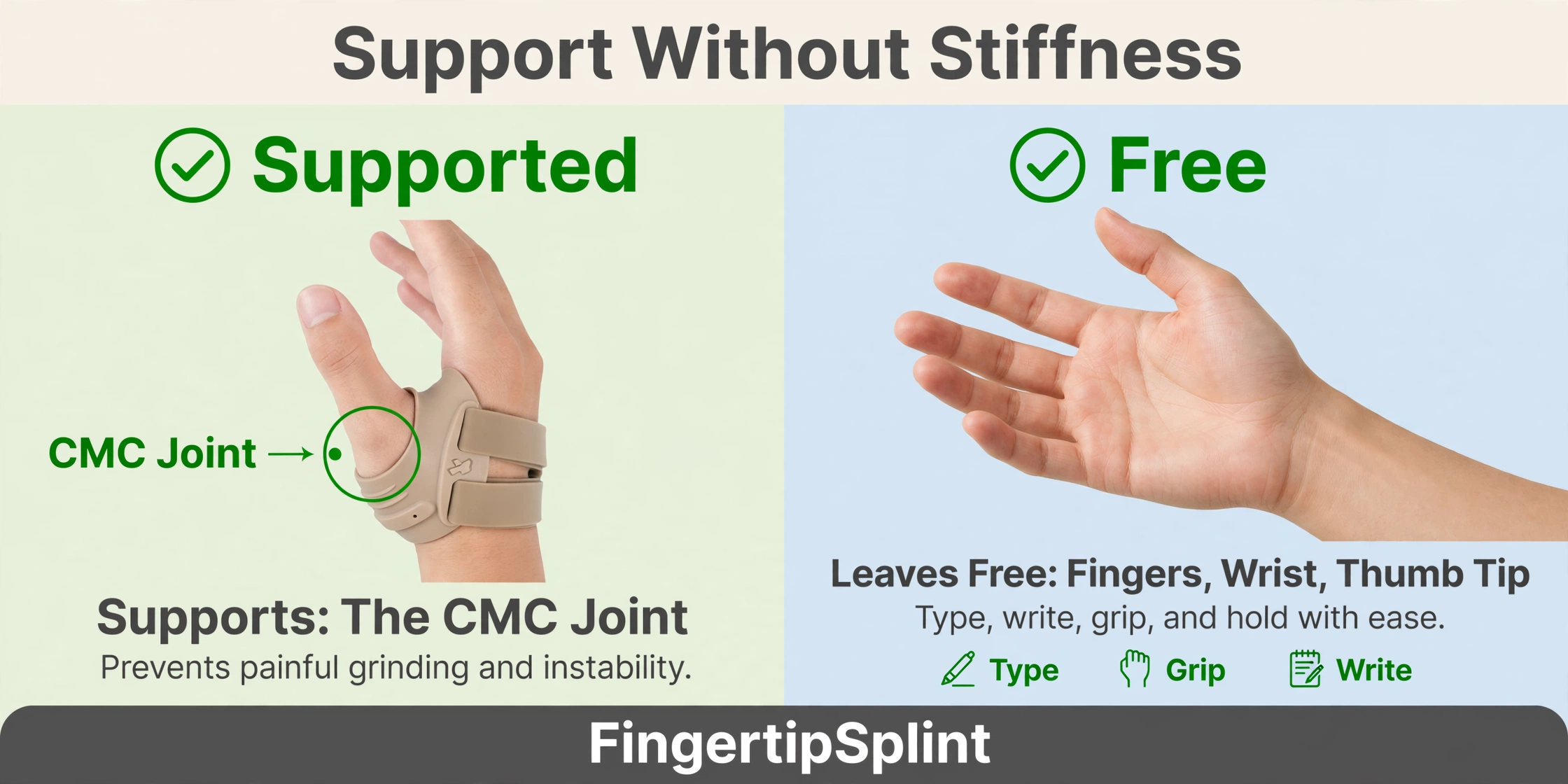
A CMC thumb brace is designed to support the base of the thumb, limit certain movements that aggravate the joint, and provide compression and stability. The goal is not to immobilize the thumb completely — it is to support the joint while preserving useful hand function.
Limiting Selected Movements
An appropriately fitted brace can limit movements that place stress on the CMC joint, such as certain pinching and gripping motions. This may help reduce pain during activities that would otherwise provoke symptoms.
Supporting the Thumb Base
The brace wraps around the base of the thumb and applies gentle compression. This can improve stability and reduce the load on the joint during hand use.
Balancing Stability and Movement
The best CMC braces provide stability without excessively restricting the hand. If a brace is too rigid or too tight, it may interfere with normal hand function and reduce the ability to perform daily tasks.
According to the American College of Rheumatology / Arthritis Foundation guideline, hand orthoses are one option in the management of first CMC osteoarthritis, but individual results vary. The right brace and wearing schedule should be determined with professional guidance.
For a closer look at how a CMC brace supports the thumb without limiting hand function, the article on how a CMC thumb brace supports the thumb without limiting hand function covers the balance between stability and function in detail.
Potential Benefits in Everyday Life
The practical benefits of a CMC thumb brace show up in everyday activities that involve gripping, pinching, and holding. Here is how a brace may help — and what it cannot guarantee.
Gripping and Pinching
Opening jars, turning keys, holding a pan, or using tools all place stress on the CMC joint. A brace may reduce the pain that occurs during these movements by supporting the joint and limiting certain aggravating motions.
Writing and Typing
Holding a pen or typing for long periods can aggravate thumb-base pain. A brace may help by supporting the thumb in a more neutral position. However, if the brace interferes with fine motor control, it may not be suitable for these tasks.
Cooking and Meal Preparation
Chopping, stirring, lifting, and opening containers all involve the CMC joint. A brace may provide additional support during these activities, but it should not make the hand feel more awkward or less controlled.
Dressing and Grooming
Fastening buttons, holding a hairbrush, or using scissors can be painful when the CMC joint is irritated. A brace may help reduce discomfort, but the wearer should test these activities carefully before relying on the brace for support.
Phone Use
Holding a phone for extended periods can stress the CMC joint. A brace may provide some support, though it may also make holding the phone less comfortable if the design is bulky.
Explore the CMC Thumb Joint
Select an area below to learn about its role and support considerations.
Comparing Thumb Braces and Other Support Options
There are several different types of thumb support available. The right choice depends on the severity of symptoms, the activities you need to perform, and professional guidance.
| Support Type | Main Purpose | Consider It When |
|---|---|---|
| Short CMC brace | Supports the thumb base while allowing most hand movement | Mild to moderate CMC joint pain during daily activities |
| Long thumb-and-wrist splint | Provides more extensive support and restricts movement | More severe symptoms or post-injury recovery |
| Rigid support | Restricts movement to protect the joint | Acute injury or conditions requiring significant restriction |
| Flexible support | Provides compression and light support | Mild symptoms or when movement is important |
| Activity modification | Reduces stress on the joint without a device | As a complementary approach or when symptoms are mild |
No single brace design has been shown to be best for every person with CMC joint pain. According to a systematic review of thumb osteoarthritis orthoses, different brace designs can have different effects, and the choice should be guided by individual needs and professional advice.
For a broader look at how CMC thumb braces support daily activities, the article on CMC thumb brace for osteoarthritis and daily activities covers practical use in more detail.

Product Guide: Choosing a CMC Thumb Brace
If you are looking for a CMC thumb brace to evaluate, the 1PCS CMC Thumb Brace for Osteoarthritis from FingerTipSplint is one option to consider. This guide does not claim that it cures osteoarthritis, reverses joint damage, or guarantees pain relief. What it offers is a design intended to support the CMC joint during daily activities.
Before purchasing, verify the following details on the product listing:
- Coverage: Does the brace cover the thumb base (CMC joint) or extend further up the thumb or wrist?
- Hand orientation: Is the brace designed for the left hand, right hand, or both?
- Sizing: Does the product provide sizing guidance or a size chart?
- Material and adjustability: Is the brace adjustable? What materials is it made of?
- Closure: How does the brace fasten, and is it easy to adjust?
- Cleaning and care: Can you follow the manufacturer’s cleaning instructions?
- Intended use: What activities or conditions is the brace designed for?
Evaluate the brace around four key questions:
- Will it support the right area? Support around the thumb base matters, and brace positioning is important.
- Can I still use my hand? The trade-off between limiting aggravating movement and retaining useful motion matters.
- Will it fit comfortably? Verify sizing, hand orientation, closure, material, and fitting guidance.
- Is it suitable for my symptoms? Persistent pain, significant swelling, recent injury, or unexplained symptoms may require assessment before choosing a brace.
For additional options, browse the FingerTipSplint shop or review the frequently asked questions for more information.
Step-by-Step Fitting and Safe Use
Proper fitting and safe use are essential for comfort and effectiveness. Follow this step-by-step process based on the product’s design and the manufacturer’s instructions.
Step 1: Check the correct hand and size. Confirm that the brace is designed for your hand and that the size matches your measurements.
Step 2: Position the brace over the intended joint. The brace should sit over the CMC joint at the base of the thumb, not higher or lower.
Step 3: Secure without excessive pressure. Fasten the brace so it feels secure but not tight. You should be able to move your fingers freely.
Step 4: Check skin and sensation. Look for redness, indentations, or irritation. If you feel numbness, tingling, or changes in hand colour or temperature, loosen or remove the brace.
Step 5: Follow the manufacturer’s instructions. Use the brace as directed, and check the product’s care and cleaning guidance.
If you are unsure how to fit the brace or whether it is suitable for your symptoms, a clinician or hand therapist can provide guidance.
What to Expect: A Realistic Adjustment Timeline
There is no universal timeline for comfort improvement from a CMC thumb brace. Osteoarthritis is typically a chronic condition, and improvement in comfort does not mean the joint has healed. Here is a practical way to assess your experience — not a week-by-week recovery promise.
Initial Wear: Check Fit and Comfort
When you first wear the brace, check that it fits comfortably, sits over the CMC joint, and does not cause pressure points. If it feels too tight or too loose, adjust it or try a different size.
During Daily Activities: Monitor Symptoms
Notice whether the brace helps during activities that usually provoke symptoms — such as gripping, pinching, or holding objects. If pain increases or new discomfort appears, the brace may not be suitable.
Follow-Up: Reassess After Several Days
After several days of use, review whether the brace is helping and whether any skin irritation or other issues have appeared. If symptoms persist or worsen, seek professional advice.
According to the NICE guidance on osteoarthritis, management should be individualized and may include a combination of approaches. A brace is one part of a broader plan, not a standalone treatment.
Common Mistakes and When to Seek Medical Advice
Some mistakes can turn a helpful brace into a source of additional discomfort. Here are the most common ones.
A brace that is too tight can compress nerves and blood vessels, causing numbness or tingling.
Solution: Adjust the fit so it feels secure but not tight.
If the brace does not sit over the CMC joint, it may not provide effective support.
Solution: Follow the manufacturer’s placement instructions.
If pain increases while wearing the brace, it may not be suitable for your condition.
Solution: Stop using it and seek professional advice.
A brace supports the joint but does not cure osteoarthritis or reverse joint damage.
Solution: Use the brace as part of a broader management plan.
Redness, tenderness, or blistering may indicate that the brace is too tight or incompatible with your skin.
Solution: Adjust the fit or discontinue use if irritation persists.
Pain after an injury may require professional assessment before using a brace.
Solution: Seek medical advice for injuries or unexplained symptoms.
According to NHS guidance on arthritis, persistent joint symptoms should be assessed by a healthcare professional. Early diagnosis and appropriate management can make a significant difference.
Doctor Advice and a Broader Management Plan
A CMC thumb brace is one possible part of care — not a complete treatment plan for every cause of thumb pain. A clinician may assess your symptoms, examine the thumb joint, and consider imaging when indicated.
What a Clinician May Do
- Take a history of your symptoms and activities
- Examine the thumb joint for tenderness, swelling, or instability
- Order imaging (such as X-rays) if needed
- Recommend a combination of approaches, such as activity modification, hand therapy, or bracing
When Self-Selecting a Brace Is Not Enough
If you have persistent or worsening pain, significant swelling, recent injury, deformity, or unexplained symptoms, professional assessment is the right next step. A brace may help support the joint, but it does not identify the cause of your symptoms.
For more information on arthritis and joint care, MedlinePlus provides reliable patient education resources.
Explore the CMC Thumb Brace for Osteoarthritis
If thumb-base pain is affecting your daily activities, review the 1PCS CMC Thumb Brace for Osteoarthritis, check the fit and care information, and decide whether its design matches your support needs. For more options, browse our full hand and thumb support range.
View the Product Browse All ProductsFrequently Asked Questions
A CMC thumb brace supports the joint at the base of the thumb (the carpometacarpal joint). It may help reduce discomfort during gripping and pinching by limiting certain thumb movements and providing stability. It is commonly used by people with thumb-base osteoarthritis or other causes of CMC joint pain.
Hand orthoses are one option in the management of first CMC osteoarthritis, according to clinical guidelines. However, individual results vary, and a brace does not cure or reverse joint damage. It is typically used as part of a broader management plan that may include activity modification, hand therapy, and other approaches.
Wearing schedules depend on the brace, your symptoms, the manufacturer’s instructions, and professional guidance. Some people wear a brace during activities that provoke symptoms, while others wear it more continuously. Follow your clinician’s or the product’s guidance rather than assuming all-day wear is appropriate.
The goal of a CMC thumb brace is to support the joint and limit certain aggravating movements without excessively restricting useful hand function. A brace that is too rigid may interfere with daily tasks, while one that provides too little support may not help. The right balance depends on your symptoms and needs.
Look for a brace that covers the CMC joint, fits your hand properly, and allows the movement you need. Check the sizing, hand orientation, material, and closure. A clinician or hand therapist can help you choose the right brace and fit it correctly.
There is no universal timeline. Some people notice improvement within a few days, while others take longer. Osteoarthritis is typically a chronic condition, and comfort may improve without the joint healing. If symptoms do not improve or worsen, seek professional advice.
Seek medical assessment if you have recent injury, severe or persistent pain, significant swelling, deformity, loss of function, or concerning sensory or circulation changes (such as numbness, tingling, or changes in hand colour or temperature). Early assessment can help identify the cause and guide appropriate treatment.
Conclusion: Support That Makes Daily Life Easier
A CMC thumb brace can be a useful tool for managing thumb-base pain during daily activities. It supports the joint, limits certain aggravating movements, and may help reduce discomfort during gripping and pinching. But it is not a cure for osteoarthritis, and it does not replace professional assessment when symptoms are persistent or worsening.
Use this guide as a framework: understand the joint, identify your symptoms, review the product’s actual specifications, choose a brace that fits your hand and your needs, and follow the manufacturer’s instructions for use and care. Stop using the brace if it causes pain or irritation, and seek professional advice if symptoms persist.
For readers who want to explore support products, the FingerTipSplint shop offers a selection. For healthcare providers and distributors, the medical finger splint supplier page provides additional information. For more hand-care education, visit the FingerTipSplint blog.
Your hands carry you through everything. Choosing the right support — and knowing when to seek professional advice — is part of caring for them well.