
What Makes an Adjustable Finger Protector Useful for Daily Wear?
A finger protector may look useful in a product listing, but daily usability depends on much more than its basic purpose. A practical everyday design needs to work with finger movement, normal activities, comfortable fit, appropriate coverage, adjustability, stability, and material contact. The most practical finger protector is not necessarily the most structured one — it is the design whose fit, coverage, movement, and construction suit the everyday activity.
What This Guide Covers
- Quick Answer
- What “Useful for Daily Wear” Means
- 1. Secure but Comfortable Fit
- 2. Useful Adjustability
- 3. Appropriate Coverage
- 4. Freedom of Intended Movement
- 5. Low-Profile Construction
- 6. Comfortable Material and Edges
- 7. Stable Positioning
- 8. Easy Care and Maintenance
- Activity-by-Activity Daily Wear Test
- The Daily Wear Scorecard
- Adjustable vs Fixed for Daily Use
- Adjustability and Daily Comfort
- What “Protection” Should and Shouldn’t Mean
- Daily-Wear Fit Guide
- What Makes a Protector Easy to Live With
- 3D Interactive: Everyday Anatomy
- A Day With an Adjustable Protector
- Common Daily-Wear Problems
- Who May Value an Adjustable Design?
- Product Spotlight
- Doctor Advice
- Quick Tips
- FAQ
- Conclusion
Quick Answer: What Makes an Adjustable Finger Protector Useful for Daily Wear?
An adjustable finger protector can be practical for daily wear when its fit, coverage, flexibility, and adjustment range work together without unnecessary bulk or discomfort. Useful everyday characteristics may include secure positioning, appropriate coverage, easy adjustment, comfortable materials, and enough movement for the intended activity. Product sizing and manufacturer instructions should always guide use.
If you are still at the stage of understanding whether adjustability matters for you at all, the reference Why Choose an Adjustable Finger Support Sleeve? explains the benefits of adjustable designs. This article assumes you have already decided an adjustable design is worth considering and now want to know what specific characteristics make one practical for daily wear.
The practical reality is that a finger protector can be well-made and still be frustrating to wear every day. A product that feels fine for five minutes may become noticeable after an hour. A product that works during desk work may shift during household tasks. Daily usability depends on how several design characteristics work together — not on any single feature.
What Does “Useful for Daily Wear” Actually Mean?
Daily usability is not a single property. It is the sum of several practical characteristics that determine how easy the protector is to live with. Understanding these characteristics makes it much easier to evaluate a specific product before and after purchase.
Easy to Put On
The user should not need an unnecessarily complicated process. Application should be straightforward and repeatable.
Easy to Adjust
The adjustment mechanism should be understandable and usable during the day without removing the product.
Secure
It should not constantly slide or rotate during normal activity. Stable positioning is a core daily-wear requirement.
Comfortable
Material and edges should not create obvious pressure points. Comfort over time matters more than comfort at first touch.
Practical
It should work reasonably with the user’s intended activities. Practicality is activity-dependent, not universal.
Easy to Maintain
Cleaning, drying, and storage should be manageable according to the manufacturer’s instructions.
These characteristics form the framework for the rest of this guide. Each of the following eight sections explores one design characteristic in detail, explaining why it matters for daily wear and what to check.
1. A Secure but Comfortable Fit
Fit is the foundation of daily usability. A protector that doesn’t fit well will not be comfortable, will not stay in position, and will not be practical to wear for extended periods. But fit is not simply tightness — it is a balance between stability and comfort.
What Fit Involves
- Appropriate sizing for your finger dimensions
- Positioning that places the protector on the intended area
- Adjustment that holds without excessive pressure
- Stability during normal movement
- Comfort over extended wear
What to Watch For
- Slipping during activity
- Bunching as the finger moves
- Pressure points from edges or fasteners
- Numbness, tingling, or discoloration
- Discomfort that develops over time
Size comes first. Adjustment fine-tunes. If you are using the extreme end of the adjustment range to make the protector fit, you probably need a different size. Correct sizing is the starting point for daily comfort.
The fit reference Finger Brace Fit Guide: Understanding Adjustability and Coverage covers fit in depth. For daily wear specifically, the important point is that the fit should remain comfortable and stable over the course of a day, not just at the moment of application.
2. Useful Adjustability
Adjustability is what distinguishes an adjustable protector from a fixed design. It allows the wearer to modify fit or positioning after the product is on the finger. For daily wear, this flexibility can be useful — but only if the adjustment is actually usable in practice.
Fine-tuning the fit
Positioning coverage
Fit customization
Repositioning during the day
Different preferences within range
Adjustment for different activities
Important limits: Adjustability is not unlimited adjustment. It is not one-size-fits-all. And it does not create stronger protection simply because it can be tightened. Adjustment works within the product’s range and does not replace correct sizing.
For daily wear, the useful question is whether the adjustment mechanism is easy to use repeatedly. A mechanism that is difficult to operate after the product is on the finger is less practical than one that can be adjusted quickly and safely. If adjustment requires removing the product each time, the convenience benefit is reduced.
The reference How Adjustable Finger Sleeves Create a More Flexible Fit explains the difference between adjustment and stretch, which is relevant here because stretchy material is not the same as an adjustable mechanism.
3. Appropriate Coverage
Coverage determines which part of the finger the protector covers. For daily wear, coverage has to match the intended purpose. Too little coverage may not serve the purpose. Too much coverage may interfere with movement, dexterity, grip, smartphone use, writing, and typing.
Coverage to Check
- Does it cover the intended finger area?
- Is the covered area the one you actually need?
- Does coverage stay in place during movement?
- Does coverage interfere with your activity?
Coverage-Movement Balance
More coverage generally means more material and potentially less movement. Less coverage generally means more freedom but less protection in the covered area. The right balance depends on what you need the protector to do.
Coverage is a physical property of the product and cannot be extended by adjustment. If the protector covers the fingertip but you need coverage lower on the finger, adjustment will not change that. Match coverage to purpose before considering other features.
4. Freedom of Intended Movement
Movement is one of the most important daily-wear considerations. A protector that restricts movement you need will be frustrating to wear. A protector that allows movement you don’t need may offer less stability than necessary. The appropriate amount of movement depends on the product’s intended design and your activity.
Bending
Straightening
Typing
Writing
Phone interaction
Light gripping
Movement depends on material, thickness, coverage, structure, and positioning — not just on whether the product is adjustable. A thin, low-coverage design in a flexible material may allow significant movement even if it is not adjustable at all. A thick, structured design may restrict movement more even when fully adjustable.
Practical check: Before relying on the protector for an activity, test the movement the activity actually requires. If typing feels more difficult or writing changes your grip, the protector may not allow the movement you need for that activity.
5. Low-Profile Construction
Profile refers to how bulky the protector is. A lower-profile design can be easier to integrate into everyday tasks, depending on construction. Excessive bulk can affect keyboard use, writing, phone handling, clothing, small objects, and desk work.
Keyboard use
Writing
Phone handling
Clothing interaction
Small objects
Desk work
Not every adjustable protector is low-profile. Profile depends on the specific construction. When evaluating a product, look for information about thickness and how the protector sits against the finger. Product photos that show the protector in place can be more informative than photos of the product alone.
6. Comfortable Material and Edges
Material and construction determine how the protector feels against the skin over time. A material can be flexible while the overall design still feels uncomfortable if edges, seams, or adjustment points are poorly positioned.
Material feel against skin
Seam placement
Edge construction
Pressure points
Moisture behavior
Bunching tendency
Daily wear tests material and construction in a way that short-term wear does not. A protector that feels soft at first touch may become noticeable after an hour if it retains moisture or creates pressure at a single point. If you plan to wear the protector for extended periods, prioritize how the material behaves over time, not just how it feels initially.
7. Stable Positioning
Stability means the protector stays in position during normal activity. Daily activities can cause movement for several reasons: repeated finger movement, grip, typing, sweating or moisture, incorrect sizing, or poor adjustment. Understanding why a protector shifts helps identify what to check.
Why Protectors Shift
- Repeated finger movement
- Grip changes during tasks
- Typing and tapping
- Sweating or moisture
- Incorrect sizing
- Poor adjustment
30-Second Stability Check
- Move — bend and straighten the finger gently
- Grip — close the finger against the thumb
- Release — open the hand normally
- Recheck — verify the protector is still where it should be
If the protector shifts during this brief check, it will likely shift during actual activity. Check the size, positioning, and adjustment level. Do not simply tighten as a default — that may create pressure problems.
8. Easy Care and Maintenance
Daily wear means daily care considerations. A protector that is difficult to clean, dry, or store becomes less practical over time. Following the manufacturer’s instructions is essential, but knowing what to check makes the process easier.
Cleaning per instructions
Drying
Storage
Inspecting material
Checking fasteners
Replacing damaged products
Do not invent washing instructions. Follow the manufacturer’s care guidance for the specific product. If care instructions are unclear or missing, that is a limitation of the listing worth noting before purchase. A protector that cannot be cleaned practically is harder to live with day after day.
Practical tip: Inspect the protector periodically for signs of wear — loosened fasteners, thinning material, or frayed edges. A damaged protector may no longer provide the same fit, and replacing it may be more practical than trying to compensate through adjustment.
Activity-by-Activity Daily Wear Test
Daily usability is activity-dependent. A protector that works well for one activity may be less suitable for another. This table shows what to evaluate for each common activity.
| Activity | What to Evaluate |
|---|---|
| Typing | Movement, profile, and stability through repeated keystrokes |
| Writing | Grip compatibility and finger positioning |
| Smartphone use | Dexterity and fingertip movement during tapping and swiping |
| Studying | Comfort during repeated desk tasks over longer periods |
| Office work | Movement and positioning through a full workday |
| Travel | Portability and ease of adjustment |
| Light household tasks | Stability and intended coverage during handling |
| Light gripping | Secure positioning and movement through grip changes |
The activity-focused article Finger Protector Sleeves for Everyday Activities: What to Know covers each activity in more depth. This section’s purpose is to reinforce that daily usability is not a single universal quality — it is evaluated against what you actually do.
The Daily Wear Scorecard
This scorecard helps you evaluate whether a specific protector is likely to work well for daily wear. Score each characteristic based on how the product behaves in practice. This is a product evaluation tool, not a medical recommendation.
Score a Protector for Daily Wear
For each characteristic, select whether the protector performs weakly, adequately, or strongly for your daily needs.
Score each characteristic to see a summary of how the protector performs for daily wear.
Adjustable vs Fixed for Daily Use
Both adjustable and fixed protectors can work for daily wear. The right choice depends on how much fit flexibility you want and how consistent your needs are.
| Daily-Wear Factor | Adjustable | Fixed |
|---|---|---|
| Fit customization | Potentially greater | More predetermined |
| Repositioning | Usually easier if designed for it | More limited |
| Fit consistency | Depends on adjustment | Depends on sizing |
| Convenience | Depends on mechanism | Depends on construction |
| Comfort | Depends on correct adjustment | Depends on correct fit |
| Everyday movement | Depends on design | Depends on design |
For a detailed comparison, see Adjustable Finger Brace vs Fixed Support: What’s the Difference?. The key point for daily wear is that adjustability offers flexibility, but only if the adjustment mechanism is practical to use on an ongoing basis.
Adjustability and Daily Comfort
Adjustability and comfort are connected through a practical sequence. Adjusting the protector changes its position, which affects how it sits against the finger, which affects comfort during movement. Understanding this sequence makes it easier to diagnose comfort issues when they arise.
A user may need to evaluate the support after starting an activity rather than judging the fit while completely still. Comfort that seems fine at rest may change during movement. This is why checking the fit during the actual activity matters more than checking it before the activity begins.
Comfortable
- Secure positioning
- No excessive pressure
- Appropriate coverage
- Expected movement allowed
Reassess
- Sliding during activity
- Bunching material
- Pressure points
- Unexpected movement restriction
Stop and Seek Advice
- Persistent numbness
- Tingling
- Significant discoloration
- Significant or worsening discomfort
What “Protection” Should and Shouldn’t Mean
The word “protector” needs careful handling. A general finger protector is designed for everyday coverage and contact reduction, not for hazard protection. These are two different categories.
Everyday Protective Coverage
A product may cover a portion of the finger and reduce ordinary contact or friction depending on its construction. This is the everyday use case for a general protector.
Certified Hazard Protection
This is a different category requiring specific design and rating. A general finger protector should not be assumed to provide this level of protection.
Do not assume a general finger protector protects against: heat, flames, chemicals, needles, sharp tools, heavy impact, or industrial machinery — unless the manufacturer specifically states and rates it for those hazards.
If you need protection from a specific hazard, choose a product designed and rated for that purpose. The word “protector” in product naming does not imply hazard protection. This distinction is important for safety and for matching products to intended use.
Daily-Wear Fit Guide
This section summarizes the three fit states for daily wear. Understanding what each looks and feels like makes it easier to identify when the fit needs attention.
Interactive: Daily-Wear Fit States
Tap each state to see what to watch for
TOO LOOSE
Slipping and rotating
APPROPRIATE
Stable and comfortable
TOO TIGHT
Excessive pressure
Appropriate Fit
Stable positioning during daily activity. Comfortable contact with the skin. Intended coverage maintained. Movement consistent with the product’s design. This is the target — not the tightest fit, but the fit that works for daily wear.
Important: Do not solve a fit problem simply by tightening the product further. If the protector is uncomfortable, check the size, position, and adjustment. Excessive tightness can cause discomfort and may create concerning symptoms.
What Makes an Adjustable Protector Easy to Live With?
This checklist compresses the daily-wear framework into a practical evaluation routine. Work through it before buying and again after receiving the product.
Before Buying
Tap each item as you confirm it for the product you are considering.
After Receiving
Tap each item as you confirm it for the product you received.
Everyday Finger Protector Anatomy: 3D Interactive
This interactive shows the six anatomical zones of an adjustable finger protector. Tap each zone to see its role in everyday usability.
Interactive 3D: Anatomy of an Everyday Protector
Tap each zone to see what it contributes to daily wear
Adjustment Area
Where the fit can be modified. For daily wear, the adjustment mechanism should be usable after the protector is on the finger. Check whether adjustment works smoothly and stays secure during normal activity.
All zones work together. Daily usability comes from the interaction between them, not from any single zone.
A Day With an Adjustable Protector
Daily wear is easier to understand when you see how a single day might involve different checks. Tap each point in the day to see what the wearer might assess.
Interactive: A Day With an Adjustable Protector
Tap each point in the day to see what to check
MORNING
Apply and check
STUDY
Repeated tasks
PHONE
Fingertip use
OFFICE
Long sessions
TRAVEL
Portability
EVENING
Remove and check
Morning
Fit: Apply the protector and confirm it feels snug but not tight.
Movement: Move the finger gently through its normal range.
Comfort: Check for any pressure points before starting the day.
Stability: Verify the protector stays in position during light movement.
Common Daily-Wear Problems
These problems come up most often when people wear adjustable finger protectors during daily activities. Each has a specific cause and a practical check.
The protector moves from its position during activity.
Possible factors: sizing, position, adjustment, activity type.
Material folds or gathers as the finger moves.
Check: placement, material, coverage, and size.
Tapping and swiping feel less responsive.
Check: profile, coverage, and fingertip movement.
The protector changes grip or creates pressure at the contact point.
Check: grip compatibility, thickness, and position.
Excessive pressure or discomfort develops.
Do not tighten further. Reassess fit according to manufacturer instructions.
The protector feels fine at first but becomes noticeable after an hour.
Check: pressure points, moisture behavior, and material contact.
Who May Value an Adjustable Design?
An adjustable design may appeal to people who prioritize certain practical characteristics. This is a preference-based list, not a medical recommendation.
Fine-tunable fit
Repositioning during the day
Flexible everyday use
Different activities
Customizable positioning
Easy adjustment
This list describes preferences, not medical appropriateness. An adjustable design is one option among several. The category reference Sleeve or Brace? Exploring Different Types of Finger Support explains how adjustable designs fit within the wider finger-support landscape.
Product Spotlight: An Option to Consider for Adjustable Everyday Finger Support
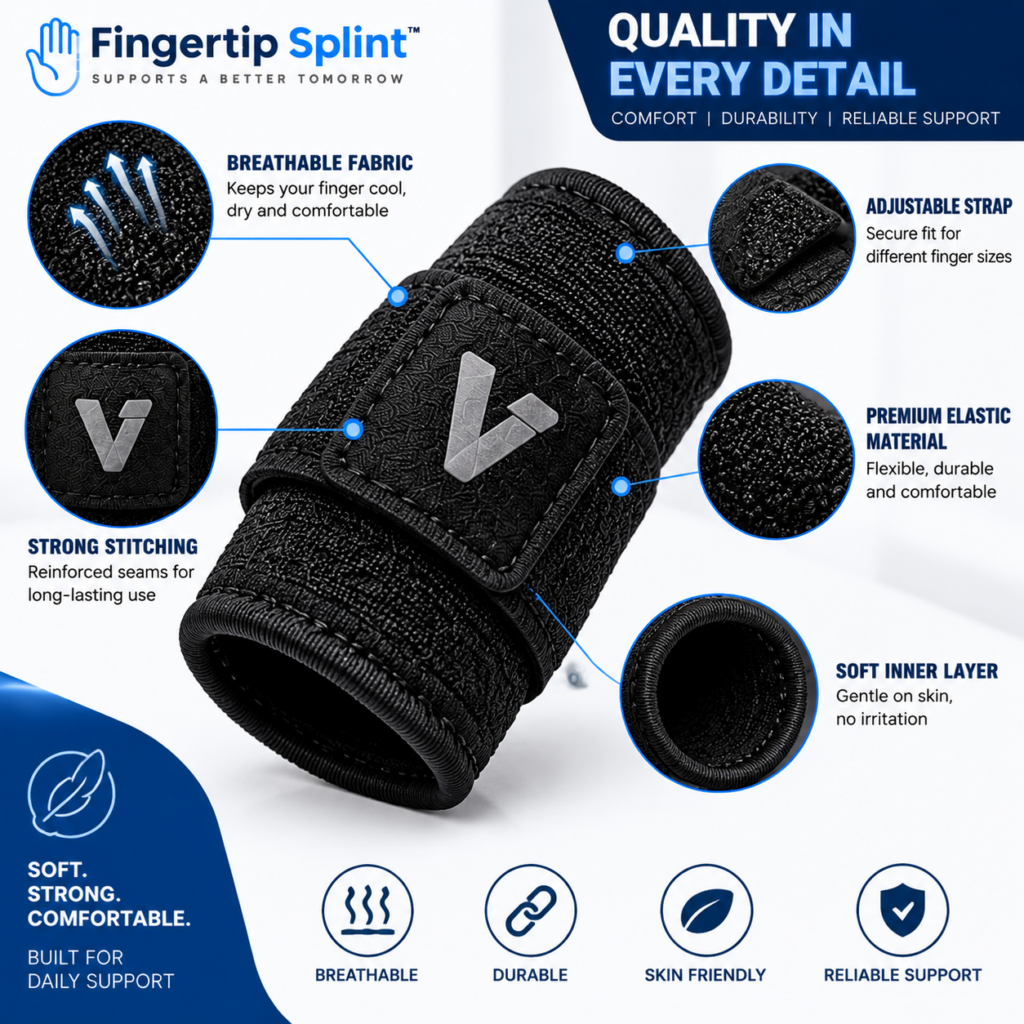
For readers whose priorities align with adjustable daily-wear characteristics, here is a specific product to examine. The Adjustable Finger Support Sleeve is one option to consider for adjustable everyday finger support.
Adjustable Finger Support Sleeve
- Adjustable design for customizable fit
- Flexible sleeve-style construction
- Designed for finger coverage and positioning
- Full product specifications available on the product page
What to Examine on the Product Page
Adjustment
Check how the adjustment works, whether it is easy to use repeatedly, and whether it stays secure during daily activity.
Coverage
Review the coverage area. Confirm the protector covers the specific finger area you need for daily activities.
Construction
Review the listed materials, thickness, and inner surface description. Confirm the construction matches your comfort and activity needs.
Fit and Sizing
Review the sizing information. Compare your measured finger circumference against the stated range before relying on adjustment.
Everyday Usability
Consider how the protector’s characteristics match the activities you do most. Review the care instructions and confirm the intended use aligns with your situation.
Doctor Advice: When Daily-Wear Guidance Isn’t Enough
This guide discusses product design and everyday usability. It does not diagnose finger conditions or determine which support is appropriate for a specific situation. General guidance has limits.
Seek appropriate professional assessment rather than relying on a consumer product if you have: significant or worsening pain, visible deformity, major swelling, significant loss of movement, persistent numbness or tingling, significant discoloration, or symptoms that do not improve.
If a healthcare professional has advised you to use a particular support, follow that guidance. A consumer finger protector is not a substitute for prescribed medical support.
For general information about hand and finger conditions, the following authoritative resources are useful:
- Mayo Clinic for condition overviews and patient education.
- AAOS OrthoInfo for musculoskeletal guidance from orthopedic specialists.
- MedlinePlus hand injuries and disorders for a broad reference library.
- NHS guide on hand pain for UK-based clinical guidance.
- Cleveland Clinic for clear patient-oriented explanations.
- Johns Hopkins Medicine for clinical and research-based perspectives.
- FDA for regulatory context on medical devices.
- NIH for research-based health information.
- WebMD for general overviews.
- Healthline for practical wellness information.
These resources provide general information and do not replace individualized advice from a qualified healthcare professional.
Quick Tips for Daily-Wear Practicality
These seven tips help you get the most from an adjustable finger protector if you decide it is the right choice for your daily routines.
Frequently Asked Questions
An adjustable finger protector is useful for daily wear when its fit, coverage, flexibility, and adjustment range work together without unnecessary bulk or discomfort. Useful characteristics include secure positioning, appropriate coverage, easy adjustment, comfortable materials, stable placement during movement, and enough movement for the intended activity. Product sizing and manufacturer instructions should always guide use.
Comfort depends on the specific product and your activity. A protector with a secure but not tight fit, comfortable materials, appropriate coverage, and enough movement for your task is more likely to be comfortable for everyday activities. Comfort that holds up during activity is a better signal than comfort at first touch. If the protector creates pressure points, numbness, tingling, or significant discoloration, adjust or remove it and seek appropriate advice if symptoms persist.
It should feel snug and secure but not tight. The protector should stay positioned during intended movement, allow the intended movement, and remain comfortable through wear. It should not create unnecessary pressure, numbness, tingling, or concerning discoloration. Tightness is not a measure of protection or support. Adjust for comfort and secure positioning, not for maximum pressure.
Many people can use an adjustable finger protector while typing or writing, provided the protector has a low enough profile, stays positioned during repeated movement, and does not interfere with fingertip contact or grip. Typing and writing place high demands on finger movement, so thin, flexible designs tend to work better than thicker ones for these activities. Test the protector during the specific activity before relying on it.
No. Adjustable protectors work within a specific adjustment range built around a base size. While adjustable designs accommodate small variations in finger size more flexibly than fixed-size products, they still have limits. A finger significantly outside the product’s size and adjustment range will not fit properly. Always choose the correct size first, and use adjustment to fine-tune within the product’s intended range.
Check the fit (secure but not tight), coverage (the intended area is covered), movement (the protector allows the movement your activity requires), stability (the protector stays in position during gentle movement), and comfort (no pressure points, numbness, or tingling). If any of these are off, adjust the position or fit before starting the activity. Do not simply tighten the protector as a default response to a fit problem.
No, not automatically. A general-purpose finger protector should not be assumed to protect against heat, flames, chemicals, needles, sharp tools, heavy impact, or industrial machinery unless the manufacturer specifically states and rates it for those hazards. The word “protector” in product naming does not imply hazard protection. If you need protection from a specific hazard, choose a product designed and rated for that purpose.
A Practical Daily-Wear Protector Balances Many Characteristics
Fit, comfort, coverage, movement, stability, adjustability, and ease of use all contribute to daily practicality. The right protector is the design whose characteristics work together for the activities you actually perform. Fit + Comfort + Coverage + Movement + Stability + Adjustability + Ease of Use
The Bottom Line on Adjustable Finger Protectors for Daily Wear
Daily wear is not about any single feature. It is about how several design characteristics work together: fit, comfort, coverage, movement, stability, adjustability, profile, ease of use, and maintenance. A protector that performs well on most of these characteristics may still be frustrating to wear if one is off. A protector that balances them well is easier to live with day after day.
The central question is practical: will this design work comfortably and practically during the activities I actually perform? Adjustability is useful when it supports that question — when it allows fine-tuning of fit and positioning within the product’s intended range. Adjustability is less useful when it complicates the daily routine without improving fit.
If you want to continue exploring within this cluster, the buying framework Choosing an Adjustable Finger Support: What Should You Consider? covers the selection process systematically, and the broader buying guide Finger Support Sleeve Buying Guide: Fit, Design, and Comfort covers additional considerations. Explore the full FingertipSplint blog library for more guides.
This article is for general information only and is not a substitute for professional medical advice. Always consult a qualified healthcare provider for diagnosis and treatment of any medical condition.