
Sleeve or Brace? Exploring Different Types of Finger Support
Sleeve, brace, splint, wrap, protector — these terms are used loosely and often overlap. Two products with different names can be constructed very similarly, while two products with the same name can behave completely differently. This guide explains the whole finger-support landscape, where sleeves and braces fit within it, and how to compare designs by their actual characteristics rather than by their labels.
What This Guide Covers
- Quick Answer
- What Counts as Finger Support?
- Finger Sleeve
- Finger Brace
- Finger Splint
- Finger Wraps and Soft Supports
- Finger Guards and Protectors
- Adjustable vs Fixed Support
- Finger Support Comparison Table
- Compare by 8 Key Factors
- 3D Finger Support Spectrum
- Sleeve vs Brace: Direct Comparison
- Which Type Suits Your Priorities?
- Fit Matters More Than the Product Name
- Adjustability Matrix
- Everyday Activity Comparison
- Common Terminology Mistakes
- How to Choose Between Support Types
- Product Spotlight
- Common Mistakes
- When General Guidance Isn’t Enough
- Quick Tips
- FAQ
- Conclusion
Quick Answer: What Are the Different Types of Finger Support?
Finger support products vary from flexible sleeves and wraps to more structured braces and splints. A sleeve generally emphasizes flexible coverage and everyday usability, while braces or splints may provide more structured positioning or movement control depending on their construction. The appropriate choice depends on fit, coverage, movement requirements, and the product’s intended purpose.
If you are still at the stage of understanding one specific product category in depth, the reference Adjustable Finger Support Sleeve: What Is It and How Does It Work? explains the sleeve category in detail. This article takes a wider view — the whole landscape of finger-support designs, including the ones you might not have considered yet.
The confusion is real. A search for “finger support” returns products called sleeves, braces, splints, wraps, protectors, guards, and soft supports — and the names do not always match the construction. Some “braces” are soft and flexible. Some “sleeves” have structured inserts. Some “splints” are rigid, while others are semi-rigid. The only way to compare them meaningfully is to look at what each product is actually made of and designed to do.
What Counts as Finger Support?
“Finger support” is an umbrella term. It covers products designed around several different goals, and the same product may serve more than one of them. Understanding these goals makes it easier to see where each product type fits.
Coverage
Products that cover a specific finger area. Coverage can range from a small portion of the fingertip to a larger section of the finger.
Positioning
Products that keep a finger in a specific position. Positioning can be gentle (a sleeve that keeps material in place) or more structured (a splint that holds a specific configuration).
Stability
Products that reduce unwanted movement. Stability can come from material, structure, or fit — not from tightness alone.
Protection
Products designed for coverage against ordinary contact. Not all products marketed as “protectors” are rated for hazards like sharp objects, heat, or chemicals.
Comfort
Products designed to make everyday finger use more comfortable. Comfort can come from cushioning, material softness, or simply keeping the finger covered.
Movement Control
Products that limit or guide finger movement. The degree of movement control varies widely and depends on construction.
The Support Spectrum
Rather than treating sleeve, brace, and splint as separate boxes, it helps to think of them as points on a spectrum from flexible to structured. This is a conceptual framework, not a medical classification.
Products can sit anywhere on this spectrum. A flexible brace might be closer to the sleeve end. A soft splint might be closer to the brace end. The label does not determine the position — the construction does.
Finger Sleeve — What Is It?
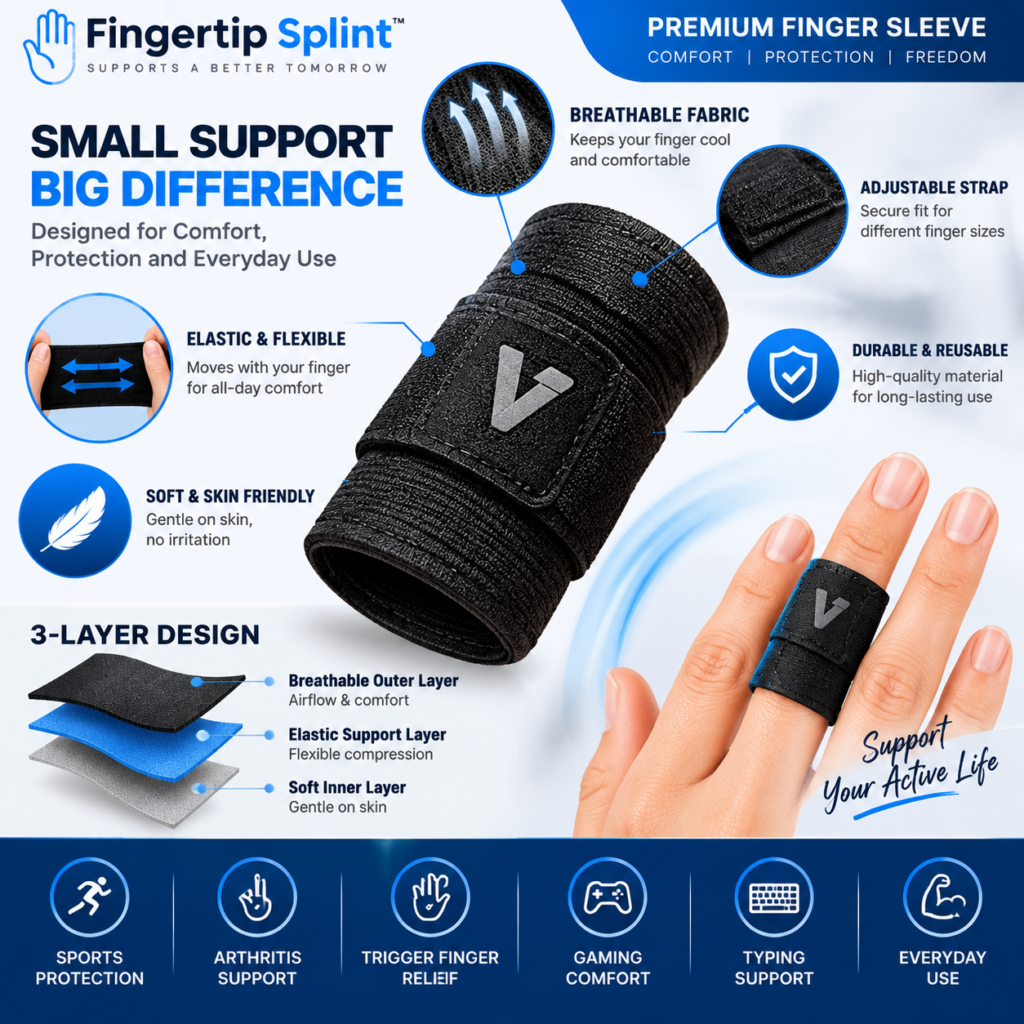
A finger sleeve is generally a flexible, sleeve-style product that fits over a finger or part of a finger. It is usually made from a stretchable material or fabric that conforms to the finger’s shape, and it may be designed primarily for coverage, positioning, comfort, or everyday use.
Typical Sleeve Characteristics
- Flexible construction
- Stretch or fabric material
- Low-profile possibilities
- Finger coverage
- Simple positioning
- Movement-friendly in most cases
- Adjustability where applicable
Who May Value a Sleeve
- Users prioritizing flexibility
- Users wanting simple positioning
- Users who prefer low bulk
- Users needing everyday usability
- Users wanting finger coverage
- Users who value easy repositioning
Not every sleeve has all these characteristics. Some sleeves are thicker than others. Some cover more of the finger. Some are adjustable, while others are fixed in size. The sleeve category is broad, and the specific product characteristics depend on design.
If you want a deeper look at the sleeve category and how adjustable sleeves fit within it, the reference What Makes an Adjustable Finger Protector Useful for Daily Wear explores how sleeve-style products perform in everyday contexts.
Finger Brace — What Is It?
“Brace” is a broader category than “sleeve.” A finger brace can be soft or structured, flexible or rigid, adjustable or fixed. The term “brace” describes a product that is designed around support, but it does not describe how that support is constructed.
Possible Brace Characteristics
- More structured support
- Adjustable positioning
- Targeted coverage
- Greater stability during movement
- Different levels of movement restriction
What “Brace” Does Not Mean
- Does not automatically mean rigid
- Does not automatically mean stronger
- Does not automatically mean more restrictive
- Does not automatically mean better support
Brace Constructions Can Include
- Soft fabric with adjustable closure
- Semi-structured with inserts
- Structured with rigid elements
- Joint-focused designs
- Coverage-focused designs
Because brace is such a broad term, the useful question is not “is this a brace?” but “what construction does this product use, and does that construction match what I need?” A soft, flexible brace may behave very similarly to a sleeve. A structured brace may behave very differently. The name alone does not tell you which.
Finger Splint — What Is It?
A finger splint is generally a product designed to position a finger, limit specific movements, or provide more structured support to an area. Splints tend to be more structured than sleeves, though some splints can be semi-rigid rather than fully rigid.
Splints May Be Designed To
- Position a finger in a specific configuration
- Limit specific movements
- Provide more structured support
- Stabilize an area
- Maintain a particular finger posture
What Splints Are Not
- Not all splints are rigid
- Not all splints are medical devices
- Not automatically better than a sleeve
- Not automatically more supportive
- Not appropriate for every finger situation
Splints can feel substantially different from flexible sleeves because they are often designed to reduce or guide movement rather than simply cover the finger. This difference in purpose is what makes the splint category distinct.
For a detailed comparison of the sleeve and splint categories specifically, the reference Sleeve or Brace: Exploring Different Types of Finger Support covers the trade-offs in more depth. If a medical professional has prescribed a splint for a specific situation, follow that guidance rather than substituting a different product based on an online guide.
Important: This article explains general product categories. It does not provide medical treatment guidance. If a healthcare professional has recommended a specific type of support for your situation, follow their guidance. Consumer products are not a substitute for prescribed medical support.
Finger Wraps and Soft Supports
Finger wraps and soft supports are a category of products that use wrapping or layered material to provide coverage and positioning. They are usually flexible and often adjustable through tension or overlap.
Wrapping material
Adjustable tension
Variable coverage
Flexibility
Repositioning
Bulk and ease of application
Wrap-style supports can vary significantly depending on the design. Some are thin and flexible, almost like a sleeve. Others are thicker and provide more coverage. Some use self-adhesive materials, while others use straps or bands. The common characteristic is that they wrap around the finger rather than sliding over it.
Wrap-style supports are often useful for situations where coverage and positioning matter, but where a rigid structure is not appropriate. They tend to be flexible and repositionable, which is useful for users whose needs change through the day.
Finger Guards and Protector Designs
Finger guards and protector designs are products built primarily around coverage or contact protection. They are often marketed for activities where the finger is at risk of minor bumps, friction, or contact — not for hazards like sharp objects, high heat, or chemicals.
Important distinction: A normal finger protector or sleeve should not automatically be assumed to protect against sharp objects, heat, chemicals, heavy impact, or industrial hazards — unless the product is specifically designed and rated for those hazards.
What Protectors May Be Designed For
- Everyday contact protection
- Coverage during light tasks
- Friction reduction
- Comfort during repeated contact
- Light bump protection
What Protectors Are Not Automatically Rated For
- Sharp objects or cutting tools
- Heat or flames
- Chemicals
- Heavy impact
- Industrial hazards
If you need protection from a specific hazard, choose a product designed and rated for that purpose. The word “protector” in product naming does not imply hazard protection. This distinction is important for safety and for matching products to intended use.
The activity-focused reference Finger Protector Sleeves for Everyday Activities: What to Know covers how protector-style products fit into daily routines.
Adjustable vs Fixed Support
Adjustability is a separate dimension from the category name. A sleeve can be adjustable or fixed. A brace can be adjustable or fixed. The two dimensions — support type and adjustability — combine to define a specific product.
Adjustable Support
- May allow the user to modify fit
- May allow the user to modify position
- May allow the user to modify coverage
- May allow the user to modify stability
- Works within the product’s adjustment range
Fixed Support
- Has a more predetermined configuration
- Fit is set by size and design
- Less repositioning flexibility
- Often simpler construction
- Fit depends heavily on correct sizing
For a deeper comparison of adjustable and fixed designs, the reference Adjustable Finger Brace vs Fixed Support: What’s the Difference? explores the trade-offs in detail.
The Finger Support Comparison Table
This table summarizes the general design characteristics of each finger-support category. These are general characteristics, not universal rules for every product sold under these names.
| Support Type | Typical Construction | Flexibility | Adjustability | Coverage | Movement Consideration | Common Design Focus |
|---|---|---|---|---|---|---|
| Finger Sleeve | Soft / flexible | Higher | Sometimes | Finger area | Generally allows movement depending on design | Coverage & everyday usability |
| Soft Wrap | Fabric / wrap | Flexible | Often | Variable | Usually flexible | Fit & positioning |
| Finger Brace | Soft to structured | Variable | Often available | Targeted / variable | Depends on construction | Support & positioning |
| Finger Splint | Structured / semi-structured | Lower in supported area | Sometimes | Targeted | May limit specific movement | Stabilization / positioning |
| Finger Protector | Soft to structured | Variable | Depends on design | Protective area | Depends on construction | Coverage / protection |
Note: These are general design characteristics, not universal rules for every product sold under these names. Two products in the same category can behave very differently depending on their specific construction.
Compare Them by 8 Key Factors
Instead of choosing by category name alone, compare products by the characteristics that actually affect how they behave. These eight factors cover the practical differences between finger-support designs.
1. Flexibility
How easily does the finger move while wearing it? Higher flexibility is useful for activities requiring finger motion. Lower flexibility may be appropriate for activities requiring more stability.
2. Structure
Is the support soft, semi-structured, or rigid? Structure affects how the support behaves during movement and how it feels against the finger.
3. Coverage
How much of the finger does it cover? Coverage is a physical property and cannot be extended by adjustment.
4. Adjustability
Can fit or positioning be modified? Adjustment works within the product’s range and does not replace sizing.
5. Movement
Does the design allow normal movement, or intentionally limit certain movement? Movement depends on construction, not just on category.
6. Profile
How bulky or low-profile is it? Profile affects how the support feels during fine-motor activities.
7. Comfort
How does the material and construction interact with the finger? Comfort depends on fit, edges, seams, and material.
8. Activity
Will it work with the intended everyday tasks? Activity determines which characteristics matter most.
3D Finger Support Spectrum
This interactive shows the conceptual spectrum from flexible to structured support. Tap each category to see what characterizes it.
Interactive: Support Spectrum
Tap each category to explore its characteristics
Sleeve
Usually flexible construction with stretch or fabric material. Typically designed for coverage and everyday usability. Movement is generally allowed. Adjustability depends on the specific design.
This is a conceptual design spectrum, not a medical classification. Products can sit anywhere on this spectrum depending on their construction.
Sleeve vs Brace: The Direct Comparison
This is the comparison most readers are looking for. It answers the direct question: how do sleeves and braces differ? Keep in mind that the comparison describes typical characteristics, not universal rules.
| Feature | Sleeve | Brace |
|---|---|---|
| Construction | Usually flexible | Flexible to structured |
| Profile | Often lower-profile | Variable |
| Adjustability | Depends on design | Often available |
| Coverage | Usually broader / flexible | Often targeted / variable |
| Movement | Generally more flexible | Depends on design |
| Positioning | Depends on construction | Often more configurable |
| Everyday use | Often convenient | Depends on design |
| Structure | Usually softer | Can be more structured |
Which Type Might Suit Different Priorities?
Instead of ranking product categories, this selector matches priorities to characteristics. Tap the priority that matters most to you.
Interactive: Choose by Priority
Tap a priority to see which category characteristics to investigate
FLEXIBILITY
Movement priority
COVERAGE
Area priority
ADJUSTABILITY
Fit priority
STRUCTURE
Support priority
EVERYDAY USE
Practical priority
Flexibility Priority
Explore sleeve-style designs and soft wraps. These typically prioritize movement and low profile. Check the material, thickness, and how the product behaves during the specific activity you need it for.
Fit Matters More Than the Product Name
Whatever the product is called, fit determines whether it works. A product called a “brace” may fit poorly, while a sleeve may fit appropriately — or vice versa. The label does not guarantee the fit.
Size and measurements
Position on the finger
Coverage of the intended area
Pressure and comfort
Slipping and bunching
Movement and activity fit
The detailed reference Finger Brace Fit Guide: Understanding Adjustability and Coverage covers fit in depth. For the purposes of this article, the key point is that fit is determined by the specific product’s sizing, positioning, and adjustment — not by the category name.
How Adjustability Changes the Comparison
Adjustability is a separate design feature from the category name. The four combinations below all exist, and each serves different needs.
Adjustable Sleeve
Flexible coverage with fit customization. Suited to users who want everyday usability plus fit flexibility.
Adjustable Brace
More structured support with fit customization. Suited to users who want positioning control and structure.
Fixed Sleeve
Flexible coverage without adjustment. Suited to users whose sizing closely matches a standard size.
Fixed Brace
Structured support without adjustment. Suited to users whose needs are consistent and whose sizing matches the product.
Everyday Activity Comparison
Different activities place different demands on finger support. This table shows the main consideration for each activity.
| Activity | Main Consideration |
|---|---|
| Typing | Finger movement and low profile |
| Writing | Grip and positioning |
| Smartphone use | Dexterity and coverage |
| Studying | Comfort and repeated movement |
| Office work | Movement and stability |
| Travel | Portability and fit |
| Light household tasks | Secure positioning and intended coverage |
The activity-specific reference Finger Protector Sleeves for Everyday Activities: What to Know covers each activity in more detail. Use it alongside this article when matching a support category to your routine.
Common Terminology Mistakes
These misconceptions come up repeatedly and can lead to choosing the wrong product.
Not necessarily. Braces can be soft, flexible, adjustable, or semi-structured.
Not necessarily. Some sleeves provide coverage, positioning, and stability.
Not always. The terms overlap, but construction and purpose can differ.
Not automatically. A general protector is not rated for sharp objects, heat, or chemicals.
False. Adjustment works within a range built around a base size.
Not necessarily. More structure can restrict movement that you need.
How to Choose Between Support Types
This six-question framework helps narrow the field before you start comparing specific products. Answer each question honestly about your situation.
Six-Question Decision Framework
Answer each question to see what to focus on when choosing a support type. This is educational guidance, not a medical recommendation.
Answer all six questions to see your focus areas.
Product Spotlight: An Adjustable Sleeve Option to Explore
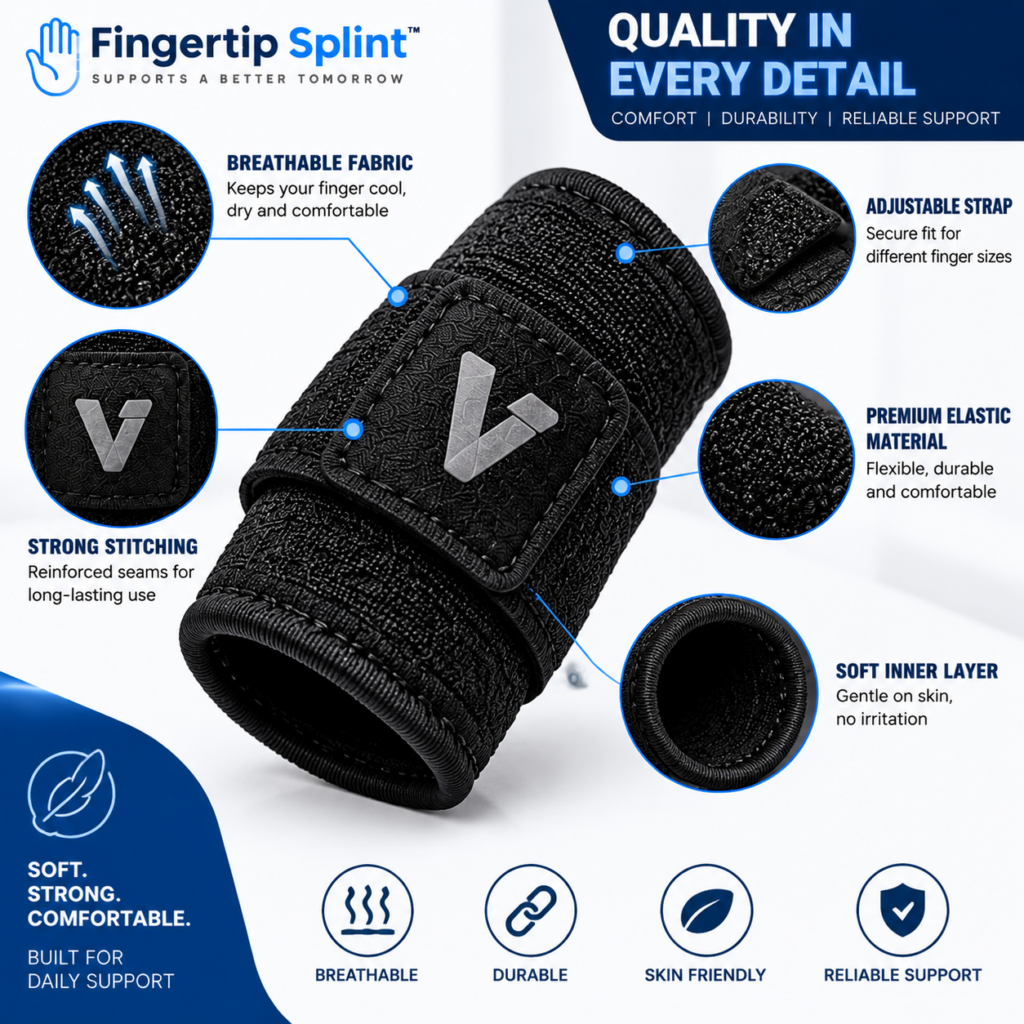
For readers whose priorities lean toward flexible coverage and adjustable positioning, here is a specific product that sits on the flexible side of the spectrum. The Adjustable Finger Support Sleeve is one option to examine if your priorities align with a sleeve-style design that offers adjustable fit.
Adjustable Finger Support Sleeve
- Adjustable design for customizable fit
- Flexible sleeve-style construction
- Designed for finger coverage and positioning
- Full product specifications available on the product page
What to Examine on the Product Page
Design and Adjustment
Check how the adjustment works, what changes when it is adjusted, and whether the adjustment stays secure during movement.
Coverage and Material
Review the coverage area and material composition. Confirm the sleeve covers the specific finger area you need and that the material matches your comfort and activity needs.
Fit and Sizing
Review the sizing information. Compare your measured finger circumference against the stated range before relying on adjustment.
Everyday Usability
Consider how the sleeve’s characteristics match your activities. Review the care instructions and confirm the intended use aligns with your situation.
Common Mistakes When Choosing Finger Support
These mistakes come up repeatedly. Avoiding them makes the selection process more effective.
Labels like “sleeve,” “brace,” and “splint” do not guarantee construction.
Check: the actual specifications and construction details.
Many braces are soft and flexible.
Check: the material and structure descriptions.
Some sleeves provide useful coverage and positioning.
Check: whether the sleeve’s characteristics match your needs.
Coverage determines which part of the finger is covered.
Check: coverage dimensions against your intended area.
Movement affects how well the support works during your activity.
Check: how the product behaves during the movement you need.
Correct sizing is essential regardless of product category.
Check: measure your finger and compare to the sizing chart.
More structure may restrict movement you need.
Check: whether the structure suits the activity.
Adjustment works within a range built around a base size.
Check: the adjustment range and base size.
General sleeves and protectors are not rated for sharp objects, heat, or chemicals.
Check: the manufacturer’s stated intended use.
Some symptoms require professional assessment, not a consumer product.
Check: seek appropriate advice if symptoms are significant or worsening.
When General Product Guidance Isn’t Enough
This article explains general product categories and their characteristics. It does not determine what specific situation you have or which support is appropriate for it. General product guidance has limits.
Seek appropriate professional assessment rather than relying on a consumer product if you have: significant or worsening pain, visible deformity, major swelling, significant loss of movement, persistent numbness or tingling, significant discoloration, or symptoms that do not improve.
If a healthcare professional has prescribed a specific type of support, follow that guidance. Consumer finger supports are not a substitute for prescribed medical support.
For general information about hand and finger conditions, the following authoritative resources are useful:
- AAOS OrthoInfo for musculoskeletal guidance from orthopedic specialists.
- MedlinePlus hand injuries and disorders for a broad reference library.
- NHS guide on hand pain for UK-based clinical guidance.
- Mayo Clinic for condition overviews and patient education.
- Cleveland Clinic for clear patient-oriented explanations.
- Johns Hopkins Medicine for clinical and research-based perspectives.
- FDA for regulatory context on medical devices.
- NIH for research-based health information.
- WebMD for general overviews.
- Healthline for practical wellness information.
These resources provide general information and do not replace individualized advice from a qualified healthcare professional.
Quick Tips
These seven tips help you navigate the finger-support category landscape more effectively.
Frequently Asked Questions
A finger sleeve is generally a flexible, sleeve-style product that fits over a finger, usually made from stretchable material or fabric. A finger brace is a broader category that can be soft or structured, flexible or rigid. The main difference is that “sleeve” describes a specific style of construction (soft, flexible, sleeve-like), while “brace” describes a broader category focused on support. A brace can be soft or structured; a sleeve is usually flexible. However, terminology is not standardized, and the actual construction matters more than the name.
No. A sleeve is generally flexible and designed for coverage or everyday use, while a splint is generally more structured and designed to position a finger, limit specific movements, or provide more structured support. Some overlap exists — a sleeve with a stiff insert could function similarly to a soft splint — but the categories serve different primary purposes. If a specific type of support has been recommended for your situation, follow that guidance.
The main categories include finger sleeves (flexible coverage), soft wraps (flexible positioning), finger braces (soft to structured support), finger splints (structured positioning or movement control), and finger protectors or guards (coverage-focused designs). These categories overlap, and terminology is not standardized. Products can sit anywhere on a spectrum from flexible to structured. The appropriate choice depends on fit, coverage, movement requirements, and intended purpose.
No. “Brace” does not automatically mean rigid. Many braces are soft, flexible, or adjustable. Some braces include semi-structured elements. Some are almost indistinguishable from sleeves in construction. The term “brace” describes a product designed around support, but it does not describe how that support is constructed. Always check the specific product’s material, structure, and construction rather than assuming a brace will be rigid.
Start by identifying the area that needs coverage, how much movement needs to remain available, whether you need adjustable positioning, how much structure is appropriate for your intended use, and what activity you will perform while wearing the support. Then compare the actual construction details of specific products against those requirements. Fit matters more than the product name. If a specific type of support has been prescribed, follow that guidance.
Not automatically. Adjustable supports offer more fit flexibility within their adjustment range, which can be useful for users whose finger dimensions fall between standard sizes or whose needs change across activities. However, adjustment does not replace correct sizing, and it works within limits. A fixed support that matches your finger measurement well may fit better than an adjustable support that requires extreme adjustment to fit. The right choice depends on your specific measurements and needs.
A correctly fitting support stays positioned during intended movement, covers the intended area, feels comfortable against the skin, and allows movement consistent with its design. It should not slide, bunch, or create numbness, tingling, or significant discoloration. If any of these problems occur, check the size, positioning, and adjustment. Persistent or concerning symptoms should be assessed appropriately by a qualified professional.
Don’t Choose by Label — Choose by Design
Sleeve, brace, splint, wrap, protector — the names overlap, but the constructions differ. The right approach is to compare actual design characteristics: structure, flexibility, coverage, adjustability, movement, fit, and activity. Type → Structure → Flexibility → Coverage → Adjustability → Movement → Fit → Activity
The Bottom Line on Finger Support Types
Finger support is a broad category with overlapping terminology. Sleeves, braces, splints, wraps, and protectors are not strict boxes — they are points on a spectrum from flexible to structured. The product name does not determine the construction, and the construction determines how the product behaves.
The practical approach is to compare products by their actual characteristics: structure, flexibility, coverage, adjustability, movement, profile, comfort, and activity. This framework works regardless of what the product is called. Fit matters more than the name. Design matters more than the label.
If you want to continue exploring within this cluster, the fit-focused reference Finger Brace Fit Guide: Understanding Adjustability and Coverage covers fit in detail, and the broader buying framework Choosing an Adjustable Finger Support: What Should You Consider? covers selection systematically. Explore the full FingertipSplint blog library for more guides.
This article is for general information only and is not a substitute for professional medical advice. Always consult a qualified healthcare provider for diagnosis and treatment of any medical condition.