
Thumb Support Sleeve vs Traditional Splint: What’s the Difference?
A thumb support sleeve and a traditional splint can both provide support, but their construction is noticeably different. This guide compares the two designs side by side — covering structure, coverage, movement, fit, comfort, adjustability, and everyday practicality. The important difference isn’t simply the product name — it’s how the support is constructed and what that construction allows or restricts.
What This Comparison Covers
- Quick Answer
- At a Glance Comparison
- What Is a Thumb Support Sleeve?
- What Is a Traditional Thumb Splint?
- 3D Interactive: Side-by-Side Comparison
- Design and Construction
- Coverage Comparison
- Support vs Movement
- Fit and Adjustability
- Comfort and Everyday Wear
- Activity Comparison
- Material and Construction
- Adjustability Comparison
- Everyday Practicality
- Advantages and Limitations
- Interactive: Which Design Characteristics Matter?
- Product Spotlight
- Common Comparison Mistakes
- When Is Professional Guidance Important?
- Recovery Timeline Framework
- Final Comparison
- FAQ
- Conclusion
Quick Answer: What Is the Difference Between a Thumb Support Sleeve and a Traditional Splint?
A thumb support sleeve generally uses a sleeve-style, flexible construction for close-fitting support and mobility, while a traditional splint commonly uses a more structured support element to control or restrict specific movement. The practical difference depends on construction, coverage, adjustability, and the level of stabilization required.
If you need the foundational definition of what a thumb support sleeve splint is, the reference Thumb Support Sleeve Splint: What Is It and How Does It Work? covers that ground. This article focuses specifically on the comparison between sleeve-style and traditional splint designs.
Thumb Support Sleeve vs Traditional Splint at a Glance
This table provides a design-level comparison. These are not universal rules — individual products can differ substantially.
| Feature | Thumb Support Sleeve | Traditional Splint |
|---|---|---|
| Basic construction | Sleeve-style | More structured |
| Flexibility | Usually higher | Varies; often more restricted |
| Rigid support | May be absent or limited | May include rigid/semi-rigid elements |
| Coverage | Depends on design | Depends on design |
| Adjustability | Depends on fastening/design | Often adjustable |
| Movement | Often allows more movement | May intentionally restrict movement |
| Profile | Often relatively low-profile | Can be bulkier |
| Everyday activities | Can be practical depending on design | Depends on structure and restrictions |
| Fit | Close contact is important | Positioning and stabilization are important |
| Main design priority | Support + flexibility | Stabilization/control |
Note: These are design-level comparisons, not universal rules. Individual products can differ substantially. Not every sleeve or traditional splint follows exactly the same construction pattern.
What Is a Thumb Support Sleeve?
A thumb support sleeve is a sleeve-style support product designed around the thumb and surrounding hand area. Its design philosophy generally aims to combine contact, support, flexibility, and practical movement rather than focusing entirely on immobilization.
Basic Construction
- Sleeve body
- Thumb opening or coverage area
- Hand or thumb coverage
- Support zones
- Seams and edges
- Fastening or adjustment system if present
Design Philosophy
A sleeve-style design generally aims to combine contact, support, flexibility, and practical movement. The support comes from the interaction of material, shape, coverage, and fit — not from a rigid structural element.
For a deeper look at how sleeve-style designs work in practice, the reference Thumb Sleeve Splints Explained: Design, Fit and Everyday Uses covers the topic in detail.
What Is a Traditional Thumb Splint?
“Traditional splint” is a broad term rather than one single standardized product. A traditional thumb splint may include rigid support, semi-rigid support, molded components, straps, reinforced panels, thumb immobilization structures, and wrist support depending on the design.
Important distinction: Traditional does not always mean rigid. Some traditional splints are flexible or semi-rigid. Avoid assuming that every traditional splint is hard. Traditional splints commonly use more structured components, but their exact rigidity and movement restriction vary by design.
Rigid support elements
Semi-rigid components
Molded structures
Straps and closures
Reinforced panels
Wrist support (design dependent)
Sleeve vs Traditional Splint: 3D Side-by-Side Comparison
This interactive comparison shows the key design differences between a thumb support sleeve and a traditional splint. Tap each hotspot to see what changes.
Interactive 3D: Side-by-Side Comparison
Tap each hotspot to see how the two designs differ
THUMB SUPPORT SLEEVE
Sleeve-style construction with flexible material and close contact
TRADITIONAL SPLINT
More structured construction with support components
Construction
Thumb support sleeve: Sleeve-style construction with a fabric or material sleeve that wraps around the thumb. Support comes from the interaction of material, shape, coverage, and fit.
Traditional splint: More structured construction that may include rigid or semi-rigid support elements. Support comes from the structural components as well as the fit.
Design and Construction: The Real Difference
This is the article’s deepest comparison section. The construction of each design determines how the device interacts with movement — and that interaction is the central difference between the two categories.
Sleeve-Style Design
- Soft or flexible construction
- Close body contact
- Lower-profile design possibilities
- Flexibility during use
- Movement compatibility
- Adjustment where available
Traditional Splint Design
- Structured support
- Reinforcement
- Stabilization components
- Straps and closures
- Possible rigid or semi-rigid elements
- Movement restriction depending on design
Coverage Comparison
Coverage can differ substantially between the two designs. The appropriate coverage depends on the intended purpose, product construction, and activity requirements.
Thumb-Only Coverage
Focuses on the thumb itself. May allow more hand movement but provide less overall stability. Common in sleeve-style designs.
Thumb + Hand Coverage
Extends to include part of the hand. May provide more stability but affect hand movement. Found in both designs.
Thumb + Wrist Coverage
Extends to include the wrist. May provide additional support but increase bulk. More common in structured splint designs.
Important: More coverage does not automatically equal more support or better protection. Coverage matters for stability, movement, comfort, clothing compatibility, typing, writing, smartphone use, and daily activities. Match coverage to purpose.
Support vs Movement
The most important practical difference between the two designs is how they interact with movement. This is a conceptual spectrum, not a universal medical classification.
The Movement Spectrum
Conceptual comparison — actual characteristics depend on the specific product
Sleeve-Style Support
- Flexible construction
- Closer to natural movement
- Less bulky
- Easier to integrate into routine activities
Traditional Splint
- Greater structural control
- Intentional movement restriction
- More stabilization depending on construction
- Potentially more noticeable during activities
Fit and Adjustability Comparison
Fit is important in both designs, but the fit considerations differ. Sleeve-style designs prioritize close contact; traditional splints prioritize positioning and stabilization around the support structure.
| Fit Factor | Sleeve | Traditional Splint |
|---|---|---|
| Contact | Close-fitting | Positioned around support structure |
| Adjustment | Depends on design | Often uses straps or closures |
| Sizing | Important | Important |
| Positioning | Important | Especially important where rigid components are used |
| Comfort | Depends on pressure and material | Depends on structure, padding, and fit |
Three Fit States
Too Loose
- Moves around
- Poor positioning
- Reduced usefulness
Appropriate
- Secure positioning
- Comfortable contact
- Does not create concerning pressure
Too Tight
- Discomfort
- Numbness or tingling
- Discoloration
- Excessive pressure
Always follow the manufacturer’s sizing and fitting instructions. The detailed fit reference thumb sleeve splint fit and coverage guide covers fitting in more depth.
Comfort and Everyday Wear
Comfort depends on multiple factors — not just on whether the product is a sleeve or a splint. Fit, material, pressure, coverage, and activity all contribute to how the product feels during wear.
Sleeve Comfort Factors
- Material texture against skin
- Pressure distribution across contact area
- Flexibility during movement
- Profile during fine-motor activities
- Moisture behavior during extended wear
Traditional Splint Comfort Factors
- Padding around rigid components
- Pressure distribution from straps
- Fit of the structural element
- Bulk during fine-motor activities
- Comfort during extended wear
Activity Comparison
Different activities place different demands on a thumb support device. This table provides a qualified comparison — actual suitability depends on the specific product’s design characteristics.
| Activity | Sleeve-Style Design | Traditional Splint |
|---|---|---|
| Typing | May allow more movement | May feel more restrictive |
| Writing | Depends on thumb movement | Depends on restriction level |
| Smartphone | Depends on design | Depends on structure |
| Travel | Profile may matter | Bulk may matter |
| Long wear | Depends on fit and material | Depends on fit and structure |
| Rest | Depends on intended use | Depends on intended use |
For a deeper look at how sleeve-style designs fit into daily routines, the reference How a Sleeve-Style Thumb Splint Fits Into Everyday Activities covers activity considerations in more depth.
Material and Construction Comparison
The two designs typically use different materials, though overlap exists. Material categories should be evaluated together with the overall construction, not in isolation.
Sleeve Materials
- Fabric
- Elastic or flexible textiles
- Soft contact surfaces
- Breathable construction where applicable
Traditional Splint Materials
- Plastic
- Thermoplastic materials
- Metal reinforcement
- Structured polymer components
- Padding
- Fabric straps
Important: Do not assume a specific product contains a particular material unless the product specifications confirm it. Material characteristics should be evaluated together with the overall construction.
Adjustability Comparison
Adjustability matters for both designs, but the adjustment mechanisms and what they change can differ. Adjustability is useful only when it allows the device to be positioned correctly — tighter is not automatically better.
Sleeve Adjustability
- Size selection
- Elastic tension
- Fastening system where present
- Positioning along the thumb
Traditional Splint Adjustability
- Straps
- Closures
- Molded structure adjustments
- Adjustable positioning
Interactive: Adjustability Spectrum
Conceptual comparison of adjustability across designs
Adjustability is useful only when it allows the device to be positioned correctly. Tighter is not automatically better.
Everyday Practicality
Everyday practicality depends on the specific product’s design characteristics and the activity it is used for. This section compares how each design approach may affect daily use.
Sleeve-Style Practicality
- Often lower profile
- May be easier to wear under clothing
- May integrate more easily into fine-motor activities
- Flexibility may support natural movement
Traditional Splint Practicality
- May provide more structured support
- Can intentionally limit movement
- Adjustability features may allow fit customization
- May feel bulkier during certain activities
Advantages and Limitations
This section presents potential advantages and limitations of each design category. Neither is universally better — the right choice depends on the intended use and required level of support.
Potential Advantages of Sleeve-Style Designs
May allow more natural thumb movement during daily activities.
May feel less noticeable during fine-motor activities.
May integrate more easily into routine activities.
Depending on design, may feel less bulky than structured alternatives.
Potential Limitations of Sleeve-Style Designs
Some situations may require more structured support than a sleeve-style design provides.
Different sleeve products have different support characteristics.
A poorly fitted sleeve can slip, bunch, or create discomfort.
A sleeve-style product may not be appropriate for every injury or condition.
Potential Advantages of Traditional Splints
May provide more positional resistance through structural components.
Can deliberately limit movement depending on design.
May provide stabilization through rigid or semi-rigid components.
Many designs are highly adjustable through straps and closures.
Potential Limitations of Traditional Splints
May be more noticeable during fine-motor activities.
Movement restriction may affect typing, writing, or smartphone use.
Some users may find the level of restriction surprising.
Incorrect positioning can reduce comfort or usefulness.
Interactive: Which Design Characteristics Matter?
Answer these questions to see which design characteristics to investigate. This is a non-medical comparison tool, not a diagnostic or recommendation engine.
Design Characteristics Questionnaire
Select the answers that apply to your situation.
Answer the questions to see which design characteristics to investigate.
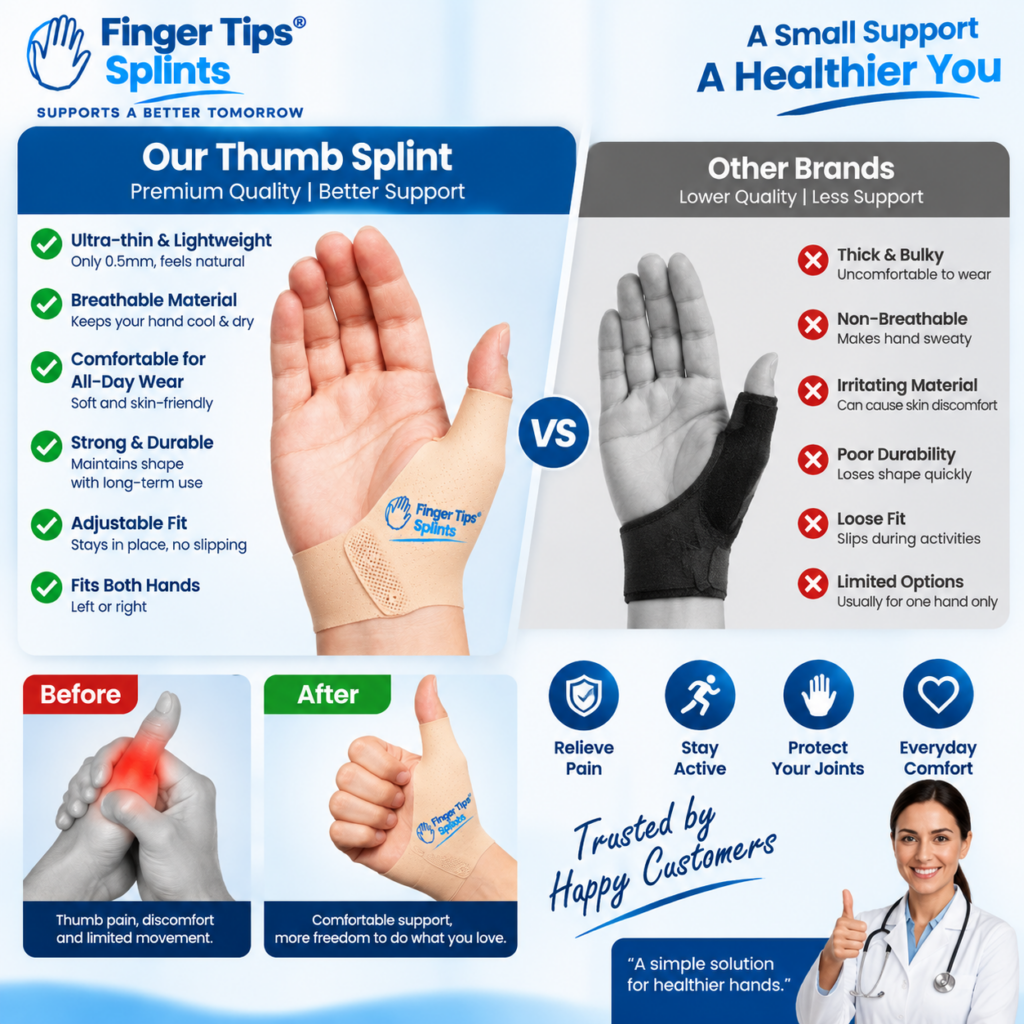
Product Spotlight: FingerTipSplint Thumb Support Sleeve Splint
After understanding the comparison framework, here is a specific product to examine. The Thumb Support Sleeve Splint is one example of a sleeve-style thumb support design. Evaluate it using the comparison framework taught in this guide.
Thumb Support Sleeve Splint
- Sleeve-style construction designed around the thumb
- Thumb-focused coverage and positioning
- Flexible material design
- Full product specifications available on the product page
Evaluating the Product Using the Comparison Framework
Design
Review the sleeve-style construction shown on the product page. Check how the design is structured around the thumb.
Fit
Review the sizing and coverage information provided. Compare your measurements against any stated range.
Everyday Practicality
Consider how the design may fit routine activities based on its documented characteristics.
Who May Be Researching It
People comparing sleeve-style support with more structured designs and looking for a flexible, low-profile option.
For the focused pre-purchase checklist, the reference What to Look for When Choosing a Thumb Support Sleeve Splint covers the selection process. For the complete buying resource, see Thumb Support Sleeve Splint: A Complete Buyer’s Guide.
Common Comparison Mistakes
These mistakes come up frequently when people compare thumb support sleeves and traditional splints. Avoiding them improves the comparison process.
Splints vary in construction. Some are flexible or semi-rigid.
Check: the specific product’s construction and materials.
A flexible design can still provide support. The type and degree vary by construction.
Check: the product’s design characteristics and documented support features.
Construction and fit matter more than appearance alone.
Check: specifications and construction details.
Too much pressure can create discomfort and other problems.
Check: adjust for appropriate fit, not maximum pressure.
A device that restricts movement may be impractical for some activities.
Check: how the product behaves during your intended activity.
Poor sizing can affect comfort and positioning.
Check: measure and compare to the manufacturer’s sizing chart.
The device category should not be used to self-diagnose an injury.
Check: seek professional assessment for significant or persistent symptoms.
A sleeve should not be assumed to replace a professionally prescribed splint.
Check: follow professional guidance if a specific type of support has been recommended.
When Is Professional Guidance Important?
A healthcare professional can determine whether support, immobilization, movement, rehabilitation, or another approach is appropriate for the underlying problem. This is much safer than presenting any product as a universal solution.
Seek appropriate professional guidance for: significant injury, visible deformity, severe or worsening pain, major swelling, persistent numbness or tingling, substantial loss of movement, symptoms that aren’t improving, or uncertainty about whether movement should be restricted.
For authoritative general information about thumb, hand, and wrist conditions, the following resources provide evidence-based content:
- Mayo Clinic for condition overviews and patient education.
- WebMD for general thumb and hand concern overviews.
- Healthline for practical wellness information.
- AAOS OrthoInfo for orthopedic guidance from specialists.
- NHS guide on hand pain for UK-based clinical guidance.
- MedlinePlus hand injuries and disorders for a broad reference library.
- Cleveland Clinic for clear patient-oriented explanations.
- Johns Hopkins Medicine for clinical and research-based perspectives.
- FDA for regulatory context on medical devices.
- NIH for research-based health information.
These resources provide general information and do not replace individualized advice from a qualified healthcare professional.
Recovery Timeline Framework
Recovery varies substantially depending on the underlying issue. A support product does not produce a specific healing outcome on its own. Rather than providing a universal week-by-week timeline, this framework explains general decision stages.
Stage 1 — Identify the Problem
What is causing the thumb issue? Professional assessment may help clarify this.
Stage 2 — Determine Required Support
Does the situation call for flexibility, stabilization, or movement restriction?
Stage 3 — Fit and Use
Follow sizing and professional or manufacturer instructions.
Stage 4 — Reassess
Monitor comfort, symptoms, and function. Note any changes.
Stage 5 — Escalate When Needed
Seek professional assessment if symptoms worsen or concerning signs appear.
The Difference Comes Down to Construction
The right comparison isn’t simply “Which is better?” but “Which design characteristics match the intended use and required level of support?”
Sleeve-Style Design
- Flexible
- Close-fitting
- Potentially lower-profile
- Movement-friendly depending on design
Traditional Splint
- Structured
- Potentially more stabilizing
- Can restrict movement
- May be bulkier depending on construction
The relevant question is whether the design characteristics match the intended use and required level of support. Neither design is universally better.
Frequently Asked Questions
A thumb support sleeve generally uses a sleeve-style, flexible construction for close-fitting support and mobility. A traditional splint commonly uses a more structured support element to control or restrict specific movement. The practical difference depends on construction, coverage, adjustability, and the level of stabilization required. Individual products can differ substantially within each category.
Not necessarily. The terms overlap in product marketing, but they describe different construction approaches. A sleeve is a type of construction — a flexible material that wraps around the thumb. A splint generally describes a device intended to support, stabilize, position, or limit movement. A product called a “sleeve” may function as a type of support, and a product called a “splint” may be more structured. The construction matters more than the label.
No. Traditional splints vary in construction. Some include rigid components; others are semi-rigid or flexible. The term “traditional splint” describes a category, not a single rigidity level. Do not assume a traditional splint is always hard. Check the specific product’s construction and material characteristics.
This often depends on the construction. Sleeve-style designs may permit more movement than structured traditional splints because they are generally more flexible. However, movement characteristics depend on the specific product’s material, thickness, coverage, and structure. Not every sleeve allows more movement, and not every traditional splint restricts movement heavily. Compare the specific products.
Neither is universally more comfortable. Comfort depends on fit, material, pressure, coverage, and individual activity. A well-fitted sleeve may be more comfortable than a poorly fitted traditional splint, and vice versa. Comfort is a result of multiple design and fit factors working together, not a property of the category alone.
Many people can type or write while wearing a thumb support sleeve, provided the product’s position and profile do not interfere with the thumb movements required. However, this depends on thumb coverage, flexibility, fit, and the specific activity. Check the fit and comfort before extended typing or writing. If the product shifts during use or creates discomfort, reassess the fit or consider whether the design suits the activity.
Seek professional advice if you have significant injury, visible deformity, severe or worsening pain, substantial swelling, major loss of movement, persistent numbness or tingling, significant discoloration, or symptoms that are not improving. Also seek advice if a specific type of support has been recommended or if you are uncertain whether movement should be restricted. A consumer thumb support product is not a substitute for professional medical assessment or prescribed medical support.
Construction Determines Support, Movement, and Practicality
A thumb support sleeve and a traditional splint differ primarily in how they are constructed. That construction determines how each design interacts with movement, fits the hand, and performs during everyday activities. The right comparison isn’t “Which is better?” but “Which design characteristics match the intended use and required level of support?” Construction → Support → Movement → Fit → Comfort → Everyday Practicality
The Bottom Line on Thumb Support Sleeve vs Traditional Splint
The difference between a thumb support sleeve and a traditional splint comes down to construction. A sleeve-style design generally uses flexible, close-fitting construction that may allow more movement. A traditional splint commonly uses more structured construction that may control or restrict movement. Neither is universally better — the right choice depends on the intended use and required level of support.
Understanding the design characteristics of each category helps you evaluate specific products more effectively. The framework in this guide — Construction → Support → Movement → Fit → Comfort → Everyday Practicality — works across both designs and helps clarify what each product can and cannot do.
If you want to continue exploring within this cluster, the foundational reference Thumb Support Sleeve Splint: What Is It and How Does It Work? covers the product definition, and the design guide Thumb Sleeve Splints Explained: Design, Fit and Everyday Uses covers sleeve-style design in more depth. For a wider reference, explore the full FingerTipSplint blog library.
This article is for general information only and is not a substitute for professional medical advice. Always consult a qualified healthcare provider for diagnosis and treatment of any medical condition.