
What to Look for When Choosing a Thumb Support Sleeve Splint
Two thumb support sleeves can look almost identical in a product photo but differ in coverage, materials, support structure, adjustability, sizing, fastening, flexibility, profile, intended use, and care requirements. This buyer-focused guide explains exactly what to inspect, compare, and verify before you click Buy.
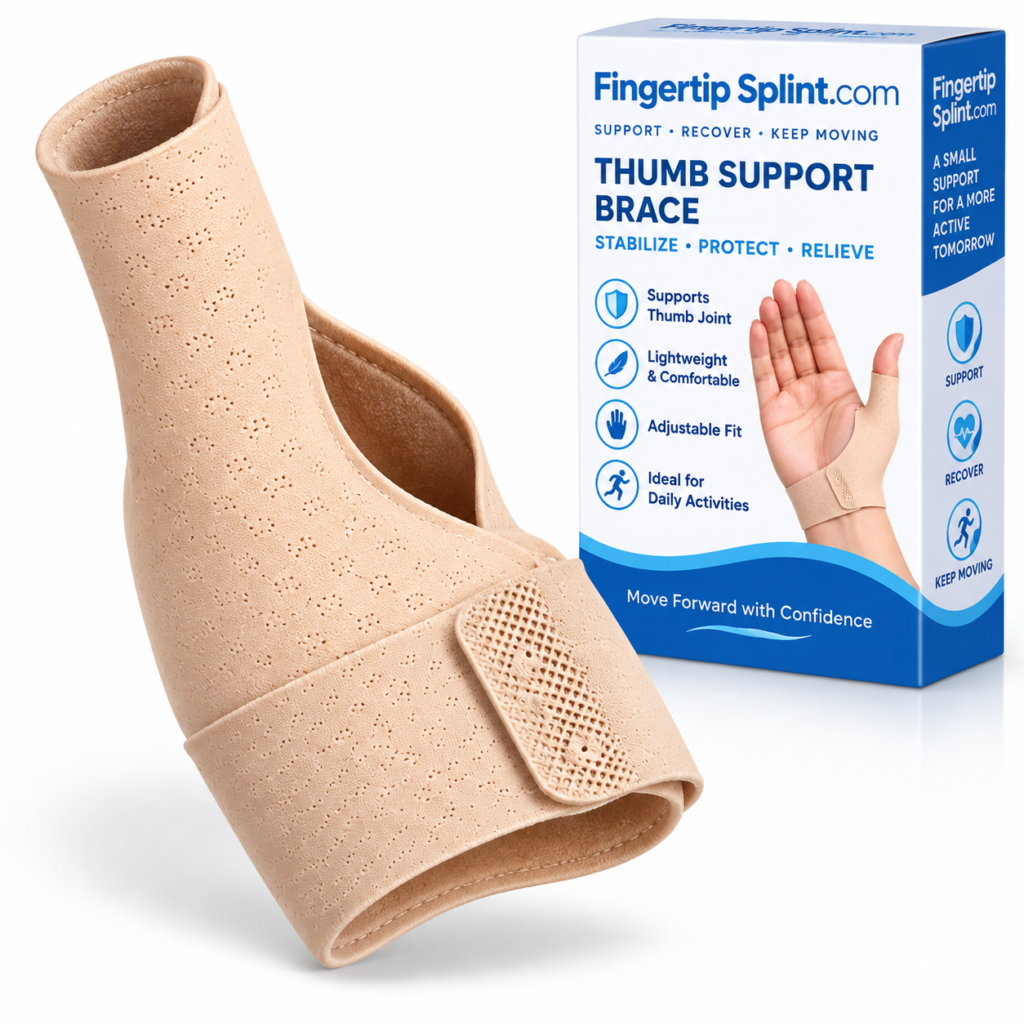
What This Buyer Guide Covers
- Quick Answer
- The 10-Point Buyer Checklist
- Start With Your Purpose
- Support Design — What Does Support Mean?
- Thumb Coverage
- Sizing — A Critical Buying Factor
- Interactive Fit Checker
- Adjustability
- Materials
- Flexibility and Movement
- Fastening and Security
- Comfort
- Everyday Activity Compatibility
- Product Specifications Buyers Should Read
- 3D Interactive: Buyer-Ready Sleeve Anatomy
- Red Flags
- Green Flags
- Compare Two Products Using a Buyer Scorecard
- Price vs Value
- Care and Maintenance
- Product Spotlight
- When Shopping Isn’t the First Step
- Quick Buyer Checklist
- FAQ
- Conclusion
Quick Answer: What Should I Look for in a Thumb Support Sleeve Splint?
Look for the right size, appropriate thumb coverage, suitable support, comfortable materials, secure positioning, useful adjustability, and compatibility with your intended activities. Check the manufacturer’s specifications and fitting instructions rather than choosing solely from appearance, price, or the word “support” in the product name.
If you need the foundational definition of what a thumb support sleeve splint is, the reference Thumb Support Sleeve Splint: What Is It and How Does It Work? covers that ground. This article focuses specifically on what to inspect before purchasing.
The 10-Point Buyer Checklist
This framework organizes the entire buying decision into ten evaluation points. Each is expanded in the sections that follow.
Start With Your Purpose
Before discussing features, identify what you actually need from the product. The purpose shapes every subsequent decision — coverage, support, sizing, and movement requirements all depend on it.
Everyday support
Desk activities
Studying
Writing
Typing
Smartphone use
Travel
Light routine activities
Post-injury use (if recommended)
Important distinction: Everyday support, movement restriction, protection, and post-injury use are not interchangeable. A sleeve designed for flexible everyday support should not automatically be assumed to provide the same movement restriction as a structured medical splint. If a healthcare professional has prescribed a particular type of immobilization or support, that instruction should take priority over general shopping criteria.
Support Design — What Does “Support” Actually Mean?
“Support” can refer to different design characteristics. Understanding what physically provides the support helps you evaluate whether a product matches your needs.
Compression
How the material presses against the thumb. Compression alone does not determine support quality.
Close Contact
How closely the material sits against the hand. Contact affects stability and how the product stays positioned.
Stabilization
How the design reduces unwanted movement. Depends on material, shape, and coverage.
Structured Reinforcement
Whether the product includes rigid or semi-rigid elements. Not all sleeve products have this.
Positioning
Where the product holds the thumb. Positioning affects how the product works during activity.
Movement Limitation
How much the design restricts thumb movement. Depends on construction and intended purpose.
Key buyer question: What physically provides the support? A good product description should make this reasonably clear. If it doesn’t, treat that as a limitation of the listing.
For a deeper look at how support is designed into sleeve-style products, the reference Thumb Sleeve Splints Explained: Design, Fit and Everyday Uses covers this in more detail.
Thumb Coverage
Coverage determines which parts of the thumb and hand are enclosed by the sleeve. Different designs cover different areas, and coverage affects how the product contacts and interacts with the hand.
Thumb-Only Coverage
Focuses on the thumb itself. Potentially lower profile. May allow more hand movement.
Thumb + Hand Coverage
Extends to include part of the hand. May provide a larger contact area.
Thumb + Wrist Coverage
Extends to include the wrist. May involve more of the hand or wrist depending on design.
Important: Do not assume “more coverage = more support.” Coverage affects how the product contacts and interacts with the hand, but greater coverage does not automatically mean greater or more appropriate support. Match coverage to your intended purpose.
Sizing — One of the Most Important Buying Factors
Sizing is the foundation of good fit. A product that is technically adjustable can still be unsuitable if its intended size range doesn’t match your measurements.
What to Check
- Manufacturer’s size chart
- Measurement method
- Thumb circumference or length if specified
- Hand measurements if specified
- Left/right-hand compatibility
- Adjustable range
- Product dimensions
Don’t Guess Your Size
Generic labels like S/M/L/XL aren’t enough without checking the manufacturer’s actual measurements. Different manufacturers may use different sizing systems. Always measure according to the specific product’s instructions.
The detailed fit reference thumb sleeve splint fit and coverage guide covers fitting in more depth.
Interactive Fit Checker
Before ordering, work through this checklist to confirm you have the information you need.
What Should You Check Before Ordering?
Tap each item as you confirm it.
Check items to see your readiness summary.
Adjustability
Adjustability allows the wearer to modify the fit after the product is on the hand. Understanding what adjustability should accomplish helps evaluate specific products.
Straps
Hook-and-loop fastening
Elastic construction
Adjustable closures
Positioning zones
Multiple adjustment points
Important safety point: Adjustability is about positioning — not maximizing tightness. Tighter is not automatically better.
Materials
Material affects comfort, durability, and how the sleeve behaves during wear. But material alone does not determine performance — construction also matters.
Fabric composition
Elasticity
Padding
Contact surface
Breathability
Moisture management
Seam construction
Reinforcement materials
Durability
Evaluation chain: Material → Contact → Flexibility → Comfort → Maintenance. No single material is automatically superior. The material should be evaluated together with the overall construction and intended use.
Flexibility and Movement
Flexibility and movement are key design characteristics. Understanding the different levels of flexibility helps match the product to your purpose.
Flexible Support
Allows some movement. Common in sleeve-style designs. May support natural hand motion.
Semi-Structured Support
Combines flexibility with reinforcement. Provides a balance between movement and positioning.
Structured Support
Provides more deliberate movement control. May include rigid elements depending on design.
Fastening and Security
The fastening system determines how the product stays in position. Evaluate these characteristics before purchase.
What to Evaluate
- Closure type
- Ease of adjustment
- Whether the sleeve shifts during activity
- Whether fastening is easy to operate
- Whether the closure creates pressure points
- Whether it can be adjusted while wearing
Buyer Question
Will the product stay in its intended position during the activities you plan to do? This is more useful than simply checking whether a product has “secure straps.”
Comfort
Comfort depends on multiple design and fit factors. Breaking comfort into measurable concepts makes it easier to evaluate.
Pressure
Should not be excessively tight. Excessive pressure can cause discomfort and concerning symptoms.
Seams
Check whether seams or edges may rub against the skin during wear.
Material
Consider contact feel and breathability. Material affects how the product feels during extended wear.
Movement
The product shouldn’t create unexpected interference with normal activities.
Skin
Monitor for irritation. If irritation develops during wear, reassess the fit and seek appropriate advice if it persists.
Note: “Comfortable” is subjective and depends heavily on fit. A well-designed product that fits poorly may still be uncomfortable.
Everyday Activity Compatibility
Different activities place different demands on a thumb support sleeve. This table helps evaluate compatibility based on your routine.
| Activity | What to Check |
|---|---|
| Typing | Thumb movement and keyboard access |
| Writing | Grip and thumb position |
| Smartphone use | Reach and flexibility |
| Reading | Holding position |
| Travel | Profile and adjustability |
| Light household tasks | Grip and stability |
| Exercise | Activity intensity and product suitability |
For a deeper look at how sleeve-style designs fit into daily routines, the reference How a Sleeve-Style Thumb Splint Fits Into Everyday Activities covers this topic in more depth.
Product Specifications Buyers Should Actually Read
Look beyond marketing phrases. Product specifications tell you what a product actually is. This table translates common marketing language into what to verify.
| Marketing Phrase | What to Verify |
|---|---|
| “Maximum support” | What physically provides the support? |
| “Premium comfort” | What material and construction are described? |
| “Universal fit” | What measurements does it actually cover? |
| “Flexible design” | How much movement is allowed? |
| “Adjustable” | What exactly can be adjusted? |
| “Breathable” | What material or construction provides this? |
Evaluation habit: When you see a general claim, ask for the specific characteristic behind it. Listings that provide specifics are easier to evaluate than listings that rely on general language.
Anatomy of a Buyer-Ready Thumb Sleeve: 3D Interactive
This interactive shows the key components to evaluate in a thumb support sleeve splint. Tap each component to see what to check.
Interactive 3D: Buyer-Ready Sleeve Anatomy
Tap each component to see what to check
1. Thumb Opening
Where the thumb enters the sleeve. Check that the opening matches your thumb dimensions. The thumb opening determines how the product sits around the thumb and how the product is positioned.
Know what each component does before you buy.
Red Flags When Shopping
These are signs that the product listing may not provide enough information to make a confident purchase decision.
Without sizing information, you cannot determine whether the product will fit your hand.
“Maximum support” without explaining what provides the support leaves questions unanswered.
Material affects comfort, durability, and skin contact. Vague material descriptions are harder to evaluate.
Knowing what the product is designed to do helps evaluate whether it matches your needs.
If you cannot see how the product is constructed or secured, it’s harder to evaluate.
Knowing how the product should be positioned affects whether it functions as intended.
A universal fit claim without dimensions leaves you without enough information to evaluate fit.
A support product is not a treatment for every condition. Broad treatment claims are a sign to be cautious.
A consumer product is not a substitute for professional medical evaluation when it is needed.
Knowing how to clean and maintain the product affects its long-term practicality.
Green Flags to Look For
These are signs that a product listing provides enough information to evaluate the product effectively.
Specific measurements, sizing chart, and measurement instructions are provided.
Dimensions, materials, and weight are clearly stated.
Multiple angles, including close-ups of the fastening system and coverage areas.
Material composition and characteristics are described rather than vaguely referenced.
How the product should be positioned and adjusted is clearly explained.
The listing explains which thumb and hand areas the product covers.
How the product adjusts and what range of adjustment is offered.
Cleaning and maintenance requirements are clear and practical.
The product is described in factual terms rather than with exaggerated promises.
The seller or manufacturer provides clear product details and is responsive to questions.
Compare Two Products Using a Buyer Scorecard
Use this scorecard to organize product information when comparing options. It is a shopping tool, not a medical suitability score. Mark each category as clear or unclear based on the product information available.
Product Information Scorecard
For each category, select whether the product information is clear or unclear.
Select options above to see a summary of the product information.
Price vs Value
Price is one factor among many. It doesn’t automatically determine quality, fit, or suitability for your needs.
What Affects Value
- Construction quality
- Materials
- Adjustability range
- Sizing information quality
- Durability indicators
- Usability
- Care requirements
Buyer Question
What are you actually getting for the additional cost? A higher price doesn’t automatically mean better performance, and a lower price doesn’t automatically mean poor quality. Compare features against your requirements.
Care and Maintenance
Care and maintenance are often overlooked, but they affect how practical the product is over time. Improper washing can affect materials, elasticity, closures, or fit.
Hand-washing requirements
Machine-washing compatibility
Drying instructions
Fastening care
Storage
Replacement guidance
Manufacturer instructions
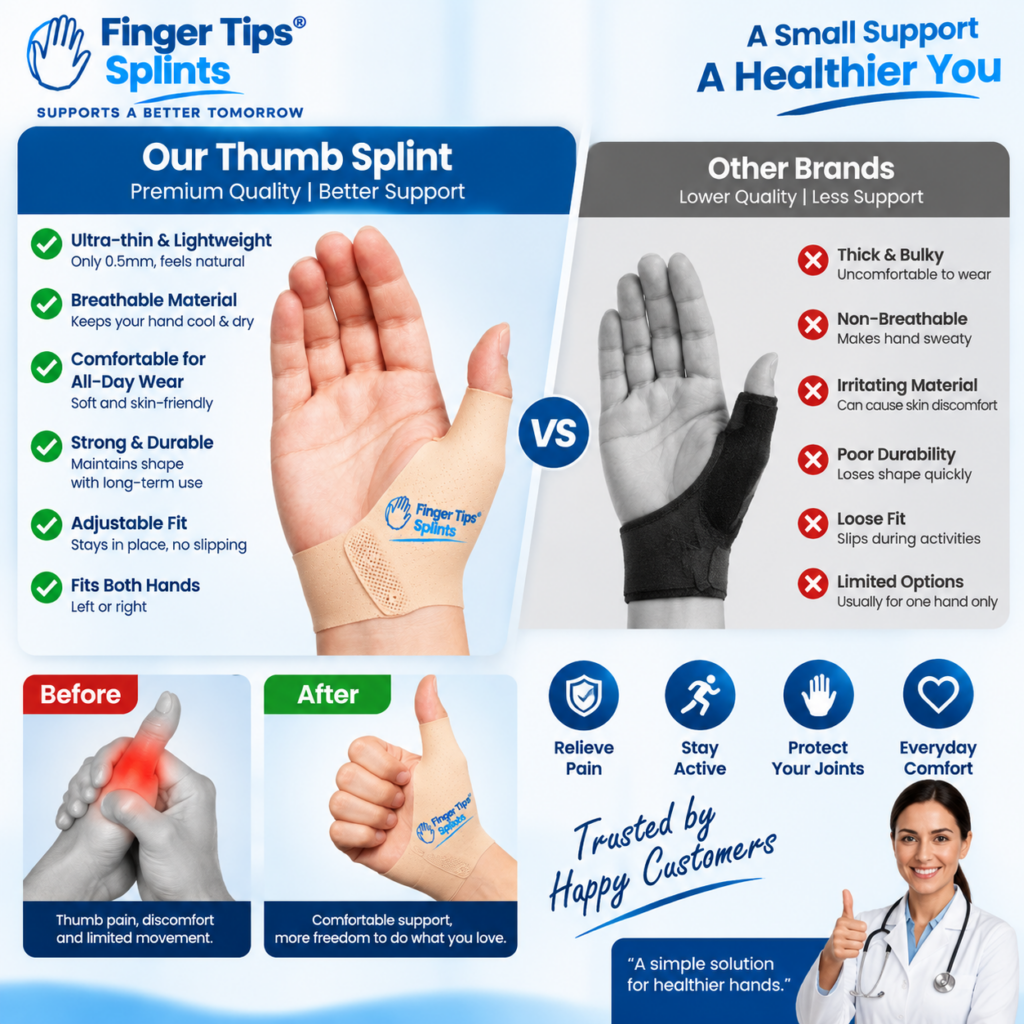
Product Spotlight: FingerTipSplint Thumb Support Sleeve Splint
After understanding the evaluation criteria, here is a specific product to examine. The Thumb Support Sleeve Splint is one example of a sleeve-style thumb support product. Evaluate it using the checklist taught in this guide.
Thumb Support Sleeve Splint
- Sleeve-style construction designed around the thumb
- Thumb-focused coverage and positioning
- Flexible material design
- Full product specifications available on the product page
Evaluating the Product Using the Buyer Checklist
Fit
What sizing information is available? Review the sizing chart or measurement guidance on the product page.
Design
What does the sleeve-style construction provide? Review the visible design features and how the product is structured around the thumb.
Coverage
What areas does the product cover? Confirm which thumb and hand areas are enclosed.
Adjustability
What adjustment mechanism does it actually have? Review how the adjustment works and what it changes.
Material
What is officially specified? Review the material information provided on the product page.
Everyday Use and Care
What activities is the design positioned for? Review the manufacturer’s care recommendations.
For a broader look at how sleeve-style designs compare to other support categories, the reference Thumb Support Sleeve vs Traditional Splint: What’s the Difference? covers the topic. For a complete purchasing process, see Thumb Support Sleeve Splint: A Complete Buyer’s Guide.
When Shopping Isn’t the First Step
Some situations require professional assessment rather than product selection. A consumer product should not be used as a substitute for appropriate evaluation when the underlying situation requires it.
Seek appropriate professional guidance rather than shopping for a support product if you have: significant injury, visible deformity, severe or worsening pain, substantial swelling, persistent numbness or tingling, major movement loss, symptoms that aren’t improving, or uncertainty about whether immobilization is needed.
If a healthcare professional has recommended a specific type of support or immobilization, follow that guidance rather than substituting a different product based on an online buyer’s guide.
For authoritative general information about thumb, hand, and wrist conditions, the following resources provide evidence-based content:
- Mayo Clinic for condition overviews and patient education.
- WebMD for general thumb and hand concern overviews.
- Healthline for practical wellness information.
- AAOS OrthoInfo for orthopedic guidance from specialists.
- NHS guide on hand pain for UK-based clinical guidance.
- MedlinePlus hand injuries and disorders for a broad reference library.
- Cleveland Clinic for clear patient-oriented explanations.
- Johns Hopkins Medicine for clinical and research-based perspectives.
- FDA for regulatory context on medical devices.
- NIH for research-based health information.
These resources provide general information and do not replace individualized advice from a qualified healthcare professional.
Quick Buyer Checklist
Before purchasing, work through this checklist. It compresses the article’s main points into a single practical summary.
Before You Buy
Tap each item as you confirm it.
Frequently Asked Questions
Look for the right size, appropriate thumb coverage, suitable support, comfortable materials, secure positioning, useful adjustability, and compatibility with your intended activities. Check the manufacturer’s specifications and fitting instructions rather than choosing solely from appearance, price, or the word “support” in the product name. Prioritize listings that provide specific details over those that rely on general marketing language.
Use the manufacturer’s measurements rather than guessing from S/M/L labels. Different manufacturers use different sizing systems. Measure according to the specific product’s instructions, checking thumb circumference, hand dimensions where specified, and left/right compatibility. If the size chart is unclear, contact the seller before purchasing. If your measurement is borderline between sizes, check the adjustment range to see if it accommodates your measurement.
No. It should fit securely but not tightly. A secure fit stays in position during intended movement without creating excessive pressure or discomfort. Tightness is not a measure of support. If you experience numbness, tingling, significant discoloration, or persistent discomfort, remove the sleeve and reassess. Adjust for appropriate fit, not maximum pressure.
Neither is universally better. The appropriate design depends on the intended purpose and required movement control. Flexible sleeve-style designs may allow more natural thumb movement and may be more practical for everyday activities. More structured designs may provide more deliberate movement control. The right choice depends on what the product needs to do and, when relevant, professional guidance.
Material selection should be considered alongside fit, flexibility, skin contact, and care requirements. Look for information about fabric composition, elasticity, padding, contact surface, breathability, moisture management, seam construction, and reinforcement. No single material is automatically superior — the material should be evaluated together with the overall construction and intended use.
Compatibility depends on the design and the specific activity. A sleeve with appropriate coverage, comfortable material, secure fit, and enough movement for the activity is more likely to be suitable. Match the product to the activity you do most and check its behavior during that activity before relying on it for extended use. Different activities place different demands on the thumb, so a product that works well for one activity may need reassessment for another.
Seek professional advice if you have significant injury, visible deformity, severe or worsening pain, substantial swelling, major loss of movement, persistent numbness or tingling, significant discoloration, or symptoms that are not improving. Also seek advice if a specific type of support or immobilization has been recommended, or if you are uncertain whether movement restriction is needed. A consumer thumb support product is not a substitute for professional medical assessment or prescribed medical support.
Use a Checklist, Not a Guess
The right thumb support sleeve isn’t simply the one with the most features. It is the one whose purpose, fit, support, coverage, movement, comfort, adjustability, and construction match your intended use and the manufacturer’s stated specifications. Purpose → Support → Coverage → Size → Adjustability → Material → Movement → Comfort → Construction → Care
The Bottom Line on Choosing a Thumb Support Sleeve Splint
Choosing a thumb support sleeve splint comes down to evaluating specific product characteristics rather than relying on the word “support” in the product name. Size, coverage, support design, adjustability, material, movement, comfort, construction, and care all contribute to whether a specific product is appropriate for your situation.
The framework in this guide — Purpose → Support → Coverage → Size → Adjustability → Material → Movement → Comfort → Construction → Care — works across products and listings. Starting with your intended use and systematically evaluating each characteristic produces better outcomes than choosing by appearance or marketing language alone.
If you want to continue exploring within this cluster, the design reference Thumb Sleeve Splints Explained: Design, Fit and Everyday Uses covers design fundamentals, and the fit guide Thumb Sleeve Splint Fit Guide: Understanding Coverage and Comfort covers fit in more depth. For a wider reference, explore the full FingerTipSplint blog library.
This article is for general information only and is not a substitute for professional medical advice. Always consult a qualified healthcare provider for diagnosis and treatment of any medical condition.