
Thumb Support Sleeve Splint: What Is It and How Does It Work?
You keep seeing this product online — but is it a sleeve, a brace, or a splint? Does it restrict movement? Does it simply provide compression or support? This guide explains what a thumb support sleeve splint actually is, how its sleeve-style construction works, how it fits, and what is really happening when you put it on.
What This Guide Covers
- Quick Answer
- What Is a Thumb Support Sleeve Splint?
- Why Is It Called a “Sleeve-Style” Splint?
- How Is It Different From a Traditional Splint?
- Anatomy of a Thumb Support Sleeve Splint
- How Does It Work?
- How Does the Sleeve Provide Support?
- How Does It Affect Thumb Movement?
- How Does Fit Influence Performance?
- Material and Construction
- What Does It Feel Like to Wear?
- Everyday Applications
- Benefits of Sleeve-Style Construction
- Limitations
- Product Spotlight
- Interactive: Explore the Sleeve
- Interactive: Is My Understanding Correct?
- Step-by-Step Basic Fitting Guide
- Common Mistakes
- Recovery Context
- Who Might Consider a Sleeve-Style Product?
- What Would a Healthcare Professional Consider?
- When a Sleeve May Not Be Enough
- FAQ
- Conclusion
Quick Answer: What Is a Thumb Support Sleeve Splint?
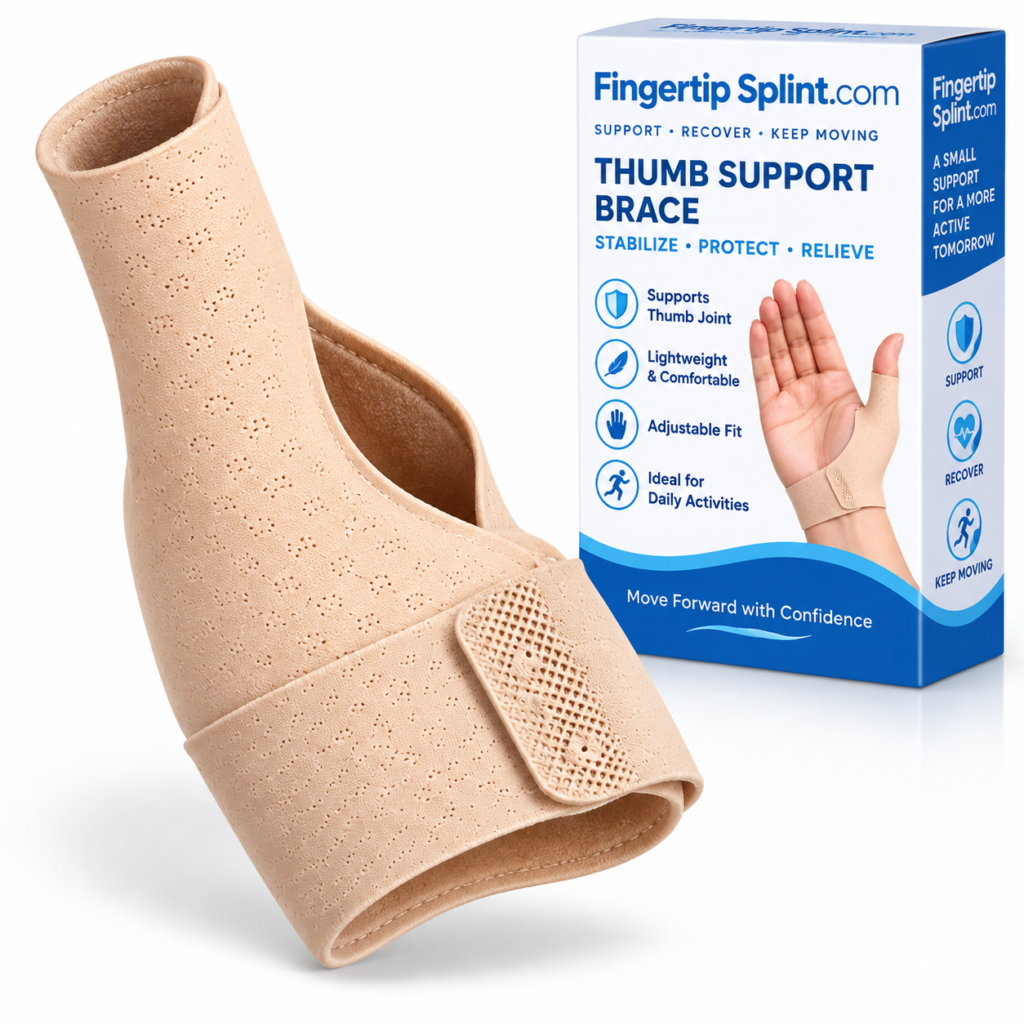
A thumb support sleeve splint is a sleeve-style support product designed around the thumb and surrounding hand area. Its construction, material, coverage, fit, and any fastening characteristics determine how it provides support and how it interacts with thumb movement. The actual effect on movement depends on the specific design, not on the label alone.
If you are looking for the wider range of support products from FingerTipSplint, you can explore the thumb and finger support products available. This article focuses on the foundational question: what is a thumb support sleeve splint and what is actually happening when you wear one?
What Is a Thumb Support Sleeve Splint?
A thumb support sleeve splint is a wearable support product designed to fit around the thumb and surrounding hand area. Its sleeve-style construction means the product wraps around the thumb rather than functioning solely through rigid external structures. The support characteristics come from the interaction between the material, shape, coverage, fit, and any adjustment or fastening features the design includes.
Understanding the terminology helps clarify what the product is. “Thumb support” refers broadly to a product designed to provide support around the thumb. “Sleeve-style” describes a construction that fits around the thumb and hand area. “Splint” can describe a device intended to support, stabilize, position, or limit movement depending on its design.
Thumb Support
A product designed to provide support around the thumb. May include sleeve-style, structured, or adjustable designs.
Sleeve-Style
The product fits around the thumb and hand area. The material contacts a broader surface rather than concentrating contact at a single point.
Splint
A device intended to support, stabilize, position, or limit movement. The specific effect depends on the design and construction.
Important principle: Avoid the simplistic assumption that “a sleeve splint stops thumb movement.” Instead, understand that the actual effect on movement depends on the specific design, material, coverage, fit, and structural components. Two products with the same label can behave very differently.
Why Is It Called a “Sleeve-Style” Splint?
The term “sleeve-style” describes how the product is constructed and how it fits. Unlike a traditional rigid splint that may rely on external hard structures, a sleeve-style product uses a fabric or material sleeve that surrounds the thumb and hand area. This difference in construction affects how the product sits against the hand, how the thumb enters the product, how the material contacts the skin, and how support is distributed.
How It Sits Against the Hand
A sleeve-style product wraps around the thumb and hand area. The material conforms to the shape of the hand more readily than a rigid structure.
How the Thumb Enters
The thumb opening or coverage area determines how the thumb enters the product and how the product positions itself around the thumb.
How the Material Contacts
The material contacts a broader surface area. This broader contact can influence how the product feels and how support is distributed.
How Support Is Distributed
Support comes from the interaction of material, shape, coverage, and fit rather than from a single rigid structural element.
For a deeper comparison of sleeve-style construction versus other support approaches, the reference thumb support sleeve versus a traditional splint covers the differences in more detail.
Anatomy of a Thumb Support Sleeve Splint
Understanding the components of a thumb support sleeve splint helps clarify how it works. This interactive exploded view shows the main design elements. Tap each component to see what it contributes.
Interactive 3D: Inside a Thumb Support Sleeve Splint
Tap each component to see what it contributes
1. Thumb Coverage
Where the product surrounds and supports the thumb. The coverage area determines which part of the thumb interacts with the product. Different designs cover different areas — thumb-only, thumb and base, or thumb and palm. Coverage is a physical property set by the product’s design and cannot be extended by adjustment.
How Does a Thumb Support Sleeve Splint Work?
The mechanism follows a five-stage sequence. Each stage depends on the previous one, and each contributes to how the product performs in practice. This framework explains what is actually happening when you wear the splint.
Each stage matters. If contact is uneven, the fit may not hold. If the fit is wrong, support may not be delivered as intended. If the movement interaction is wrong for your activity, the product may not be practical. Reassessment closes the loop — the wearer should check the fit and comfort periodically.
How Does the Sleeve Provide Support?
Support in a sleeve-style product comes from the interaction of several design elements. Understanding these elements clarifies why different sleeve products can feel and perform differently.
Surface Contact
A sleeve creates a larger area of contact than a very narrow support point. This broader contact can influence how the product sits and how support is distributed.
Material Tension
If the product uses elastic or flexible material, its tension can contribute to the way it sits against the thumb. The material’s elasticity affects how the product conforms and stays in position.
Shape
The product’s contour determines where contact occurs. A shape that follows the thumb’s natural contours is generally more comfortable and stable than one that does not.
Coverage
Coverage determines which areas interact with the product. More coverage may provide more structural contact but can affect movement and profile.
Fastening
If the design includes adjustable fastening, it can influence how securely the product remains positioned. A well-designed fastening keeps the product in place without creating excessive pressure.
Important clarification: Support is not simply a matter of making the product tighter. Excessive tightness can create discomfort and may cause concerning symptoms such as numbness, tingling, or discoloration. The goal is an appropriate fit — secure but comfortable — not maximum pressure.
How Does It Affect Thumb Movement?
Sleeve-style support can interact with movement differently depending on the specific product. The effect on movement depends on material elasticity, thickness, structural components, coverage, fit, fastening, and overall product design.
The Movement Spectrum
This is a conceptual comparison, not a universal medical classification
MORE FLEXIBLE
May allow more movement
BALANCED
Support with practical movement
MORE STRUCTURED
Movement may be reduced
Balanced Design
A balanced design aims to provide support while allowing practical movement. The exact balance depends on material, coverage, structure, and fit. This is a conceptual design position, not a standardized medical classification.
For a deeper exploration of how flexibility interacts with sleeve-style designs, the reference Flexible Thumb Support Splint: What Should Buyers Know? covers the topic in more detail.
How Does Fit Influence Performance?
Fit is part of how the product works. Product design plus correct fit equals the intended interaction. A sleeve can have excellent construction but still feel wrong if its size or placement is inappropriate.
Slipping
The product may move from its intended position. Often related to sizing or adjustment.
Bunching
Material may fold or gather. Often related to placement or material excess.
Excessive Pressure
Concentrated pressure points can cause discomfort. Check positioning and adjustment.
Loose Fit
The product may not provide the intended contact. Check sizing and positioning.
Incorrect Positioning
The product may not sit where intended. Reposition before adjusting.
Uneven Contact
The material may not contact evenly across the covered area. Check fit and shape alignment.
The detailed fit reference thumb sleeve splint fit and coverage guide covers fitting in more depth.
Material and Construction
Material matters, but no single material is universally best. The material should be evaluated together with the overall construction and intended use. Two products made from similar materials can feel very different because of their shape, thickness, and construction.
Elasticity
Thickness
Flexibility
Breathability
Surface texture
Durability
Stitching
Seams
Reinforcement
What Does It Feel Like to Wear?
Understanding what to expect when wearing a thumb support sleeve splint helps you evaluate whether the fit is appropriate. Users may notice contact, pressure, compression, warmth, flexibility, movement, bulk, and strap contact. These sensations are generally expected with a supportive product.
Expected Product Sensation
- Comfortable contact with the skin
- Secure positioning during movement
- Some awareness of the product
- Support that feels appropriate, not painful
Warning Signs
- Persistent numbness or tingling
- Significant discoloration
- Increasing pain or discomfort
- Symptoms that persist after removing the product
If you experience persistent numbness, tingling, significant discoloration, increasing pain, or other concerning symptoms, stop using the product and seek appropriate professional advice.
Everyday Applications
Sleeve-style thumb support products may be used during a variety of everyday activities depending on the product’s design and the individual’s situation. The practical question for each activity is whether the product maintains its intended position without creating unnecessary interference.
| Activity | What to Consider |
|---|---|
| Studying | Writing, reading, and handling books |
| Typing | Repeated keyboard use and positioning |
| Smartphone use | Holding and interacting with a phone |
| Travel | Compact support during routine activities |
| Light everyday tasks | Depends on the product’s design and the individual’s situation |
For a deeper look at how sleeve-style designs fit into daily routines, the reference using a sleeve-style thumb splint during everyday activities covers activity-specific considerations.
Benefits of Sleeve-Style Construction
Organized around design characteristics rather than medical promises, these are potential practical benefits of sleeve-style construction. Each uses language like “may,” “can,” and “depending on design” because actual characteristics vary between products.
Sleeve-Style Coverage
Can provide broad contact around the supported area. This broader contact may distribute support more evenly than a narrow contact point.
Flexible Construction
May allow more natural movement than a highly rigid design, depending on the product. This can be useful for activities requiring fine motor control.
Low-Profile Possibilities
Some sleeve designs can integrate more easily into everyday routines. A lower profile may be less noticeable during daily activities.
Adjustability
Where present, adjustment features can help manage fit within the product’s intended range. Adjustment works within a specific range built around a base size.
Easy Integration
A sleeve-style design may be practical for certain routine activities. The design’s characteristics determine how well it integrates with specific activities.
Comfort Potential
Broader material contact and flexible construction may contribute to wearing comfort, depending on the specific design and fit.
For a deeper look at the daily-wear advantages of sleeve-style designs, the reference Why Choose a Sleeve-Style Thumb Support for Daily Wear? covers the topic in detail.
Limitations
A sleeve-style support is not automatically appropriate for every situation. Understanding the limitations helps match the product to the right context.
Potential Limitations
- Limited structural support compared with more rigid devices
- Insufficient coverage for some purposes
- Incorrect sizing
- Discomfort during wear
- Movement restrictions depending on design
- Inability to address an underlying injury
What a Sleeve Splint Is Not
- Not a universal solution for every thumb problem
- Not automatically equivalent to a prescribed device
- Not a substitute for professional assessment
- Not a treatment for an underlying condition
EEAT note: Understanding what a product cannot do is as important as understanding what it can do. This distinction helps you use the product appropriately and seek professional guidance when it is needed.
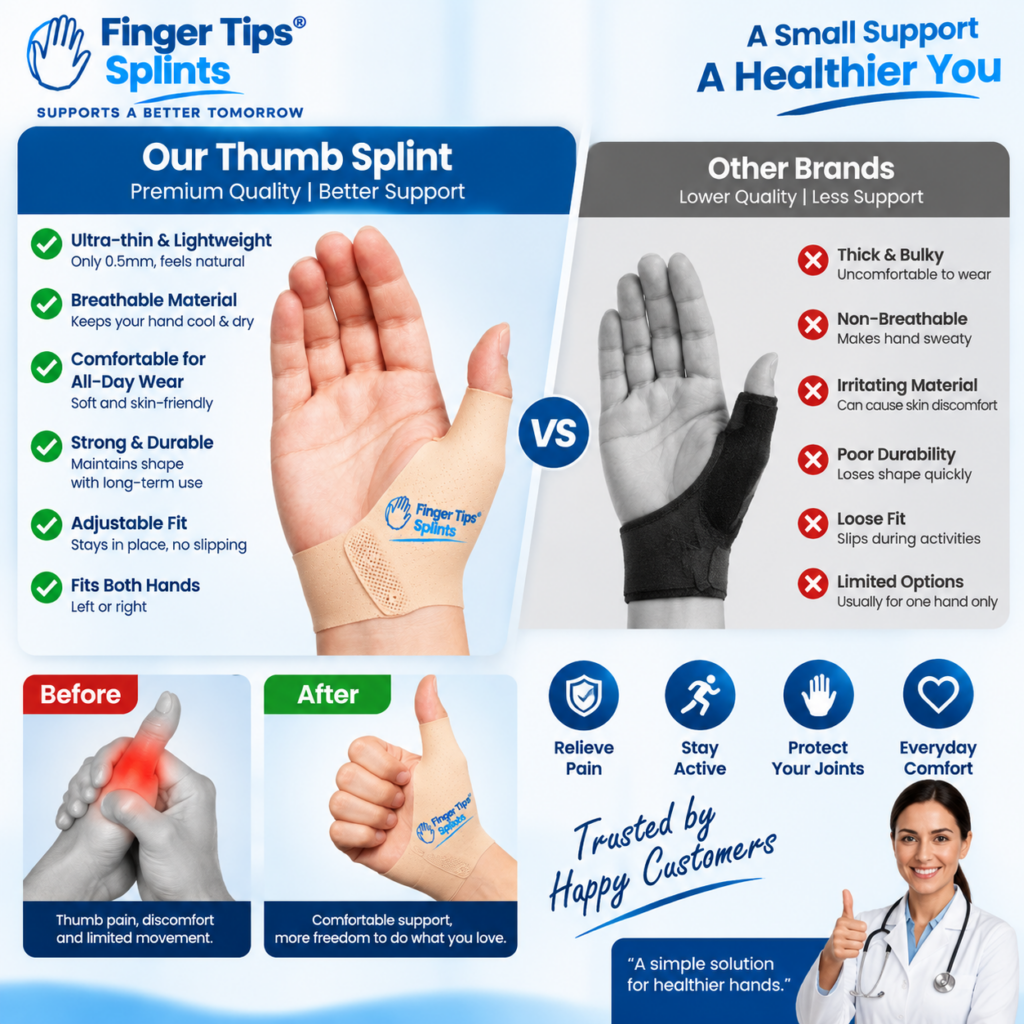
Product Spotlight: FingerTipSplint Thumb Support Sleeve Splint
After understanding the design and mechanism, here is a specific product to examine. The Thumb Support Sleeve Splint is one example of a sleeve-style thumb support product. Evaluate it using the framework taught in this guide.
Thumb Support Sleeve Splint
- Sleeve-style construction designed around the thumb
- Thumb-focused coverage and positioning
- Flexible material design
- Full product specifications available on the product page
Evaluating the Product Using the Framework
Design
Review the sleeve construction shown on the product page. Check the visible design features and how the product is structured around the thumb.
Coverage
Review which areas the product covers. Confirm the coverage area aligns with your intended purpose.
Material
Review the material information provided. Confirm the material characteristics suit your comfort and activity needs.
Fit
Review the sizing and fit information provided. Compare your measurements against any stated range before relying on adjustment.
Support
Review the observable and documented design characteristics. The support comes from the interaction of material, shape, coverage, and construction.
Everyday Use
Consider how the product’s design characteristics match your routine. Review the care instructions and intended use information.
For a complete buying process, the reference complete Thumb Support Sleeve Splint buyer’s guide covers the full buying journey. For design and fit context, see thumb sleeve splints explained by design and fit.
Interactive: Explore the Sleeve
Tap each element to see how it contributes to how the product works. This is educational guidance for product understanding, not a medical recommendation.
Explore the Sleeve
Tap each element to see what it contributes
Contact
What touches the thumb.
Coverage
The supported area.
Material
The role of flexible material.
Fit
Why sizing matters.
Support
How construction contributes.
Movement
How the design interacts with thumb movement.
Contact
Contact is where the sleeve meets the thumb and surrounding area. A sleeve creates a broader contact area than a narrow support point. The quality of contact — how evenly the material sits against the skin — affects how the product feels and how it performs.
Interactive: Is My Understanding Correct?
Test your understanding of common assumptions about thumb support sleeve splints. Tap each card to reveal the answer. This is educational, not diagnostic.
Common Assumptions
Step-by-Step Basic Fitting Guide
This is a concise fitting sequence. Follow the manufacturer’s instructions for the specific product you are using.
For a detailed fitting approach, the reference thumb sleeve splint fit and coverage guide covers the topic in more depth.
Common Mistakes
These mistakes come up frequently when people use thumb support sleeve splints. Avoiding them improves the experience.
Construction varies between products. Two sleeve-style products can behave very differently.
Check: the specific product’s design and documentation.
Adjustability doesn’t eliminate sizing considerations.
Check: measure and compare to the manufacturer’s sizing chart.
More pressure isn’t automatically better. Excessive tightness can cause concerning symptoms.
Check: adjust for appropriate fit, not maximum pressure.
A product should be considered in relation to intended activity.
Check: how the product behaves during the activity you do most.
Different designs can provide different types of support.
Check: whether the product’s design matches your intended purpose.
Persistent concerning symptoms should not be treated as something to push through.
Check: remove the product and seek appropriate advice if symptoms persist.
Support products and medical treatment are not automatically the same thing.
Check: seek professional assessment for significant or persistent symptoms.
Movement may shift the product and change fit.
Check: recheck the fit after activity and after extended wear.
What Does a Thumb Support Sleeve Splint Mean for Recovery?
Recovery varies substantially depending on the underlying issue. A support product does not produce a specific healing outcome on its own. Rather than providing a universal week-by-week timeline, this section explains general considerations.
Early Stage
Focus on understanding the product, fit, and appropriate use. Check the manufacturer’s instructions and confirm the product is positioned correctly. Follow any professional guidance you have received.
Ongoing Use
Monitor comfort, function, and symptoms. Follow professional guidance where applicable. Note how the product behaves during your daily activities.
Reassessment
If symptoms persist, worsen, or new concerning symptoms appear, appropriate professional evaluation may be needed.
Return to Activity
Should depend on the underlying issue, individual circumstances, and professional guidance when relevant.
Important: Recovery depends on the underlying issue. There is no universal timeline that applies to every situation. Follow professional guidance specific to your circumstances.
Who Might Consider a Sleeve-Style Product?
This is framed around use situations, not diagnoses. A sleeve-style thumb support may be considered by people looking for:
Everyday thumb support
A flexible support format
A sleeve-style design
A low-profile option
Adjustable support where offered
A product compatible with routine activities
Whether a sleeve-style product is appropriate for a specific injury or medical condition is a separate question. If a healthcare professional has recommended a specific type of support, follow that guidance.
What Would a Healthcare Professional Consider Before Using a Thumb Splint?
This section presents general principles. It does not claim that a doctor has personally endorsed a specific product.
What May Be Considered
- The underlying cause of symptoms
- Severity of the situation
- Swelling
- Movement limitations
- Sensation changes
- Injury history
- Required support level
- Appropriate duration and use
- Whether a sleeve design is appropriate
Important Note
An online article cannot determine whether a particular product is appropriate for your specific situation. If symptoms are significant or persistent, professional evaluation is important.
For authoritative general information about thumb, hand, and wrist conditions, the following resources provide evidence-based content:
- Mayo Clinic for condition overviews and patient education.
- WebMD for general thumb and hand concern overviews.
- Healthline for practical wellness information.
- AAOS OrthoInfo for orthopedic guidance from specialists.
- NHS guide on hand pain for UK-based clinical guidance.
- MedlinePlus hand injuries and disorders for a broad reference library.
- Cleveland Clinic for clear patient-oriented explanations.
- Johns Hopkins Medicine for clinical and research-based perspectives.
- FDA for regulatory context on medical devices.
- NIH for research-based health information.
These resources provide general information and do not replace individualized advice from a qualified healthcare professional.
When a Sleeve May Not Be Enough
A sleeve-style support product may not be appropriate for every situation. Professional evaluation may be particularly important when there is visible deformity, significant trauma, severe or worsening pain, substantial swelling, persistent numbness or tingling, major loss of movement, concerning discoloration, or symptoms that aren’t improving.
Seek appropriate professional evaluation if you experience any of the above. A support product is not a substitute for medical assessment when the underlying situation requires it.
Frequently Asked Questions
A thumb support sleeve splint is a sleeve-style support product designed around the thumb and surrounding hand area. Its construction, material, coverage, fit, and any fastening characteristics determine how it provides support and how it interacts with thumb movement. The term “sleeve” describes a design approach — the product wraps around the thumb rather than functioning solely through rigid external structures.
The mechanism follows a five-stage sequence: contact (the sleeve establishes contact with the thumb), fit (the product stays positioned according to its size and construction), support (material, shape, coverage, and structural elements influence the support provided), movement interaction (the design interacts with thumb movement), and reassessment (the user checks comfort, fit, and any concerning symptoms). Each stage contributes to how the product performs.
No. Sleeve-style and traditional rigid designs have different construction characteristics. A sleeve-style product wraps around the thumb and hand area with a broader contact surface. A traditional rigid splint may rely on external hard structures. These different designs may provide different types of support. For a detailed comparison, see the reference comparing thumb support sleeves to traditional splints.
The effect on movement depends on the specific design. Material elasticity, thickness, structural components, coverage, fit, fastening, and overall product design all influence how the sleeve interacts with thumb movement. Some designs may allow more natural movement; others may provide more structured positioning. The actual effect depends on the specific product, not on the label alone.
It should fit securely enough to stay in its intended position without creating excessive pressure or unnecessary discomfort. It should maintain the intended coverage, feel comfortable against the skin, and allow the movement appropriate to its design. Always follow the manufacturer’s sizing and fitting instructions for the specific product.
Suitability depends on the product’s design and the specific activity. A sleeve with appropriate coverage, comfortable material, secure fit, and enough movement for the activity is more likely to be suitable. Match the product to the activity you do most and check its behavior during that activity before relying on it for extended use.
Seek professional advice if you have significant injury, visible deformity, severe or worsening pain, substantial swelling, major loss of movement, persistent numbness or tingling, significant discoloration, or symptoms that are not improving. Also seek advice if a specific type of support has been recommended. A consumer thumb support product is not a substitute for professional medical assessment or prescribed medical support.
Looking for a Sleeve-Style Thumb Support?
After understanding what a thumb support sleeve splint is and how it works, you can examine the Thumb Support Sleeve Splint and review its product specifications, sizing, construction, and intended use. Understand the product before you buy it.
The Bottom Line on Thumb Support Sleeve Splints
A thumb support sleeve splint is a sleeve-style support product designed around the thumb and surrounding hand area. Its construction, material, coverage, fit, and any fastening characteristics determine how it provides support and how it interacts with thumb movement. The actual effect on movement depends on the specific design — not on the label alone.
Understanding the product before buying or using it helps you evaluate whether it matches your needs. The framework — what it is, how it is built, how it fits, how it provides support, how it allows movement, how it is used, and what it can and cannot do — gives you a structured way to understand any sleeve-style thumb support product.
If you want to continue exploring within this cluster, the reference Thumb Sleeve Splints Explained: Design, Fit and Everyday Uses covers design and fit considerations, and the reference What to Look for When Choosing a Thumb Support Sleeve Splint covers the selection process. For a wider reference, explore the full FingerTipSplint blog library.
This article is for general information only and is not a substitute for professional medical advice. Always consult a qualified healthcare provider for diagnosis and treatment of any medical condition.