
Thumb Wrist Support Brace Explained: Features, Fit and Uses
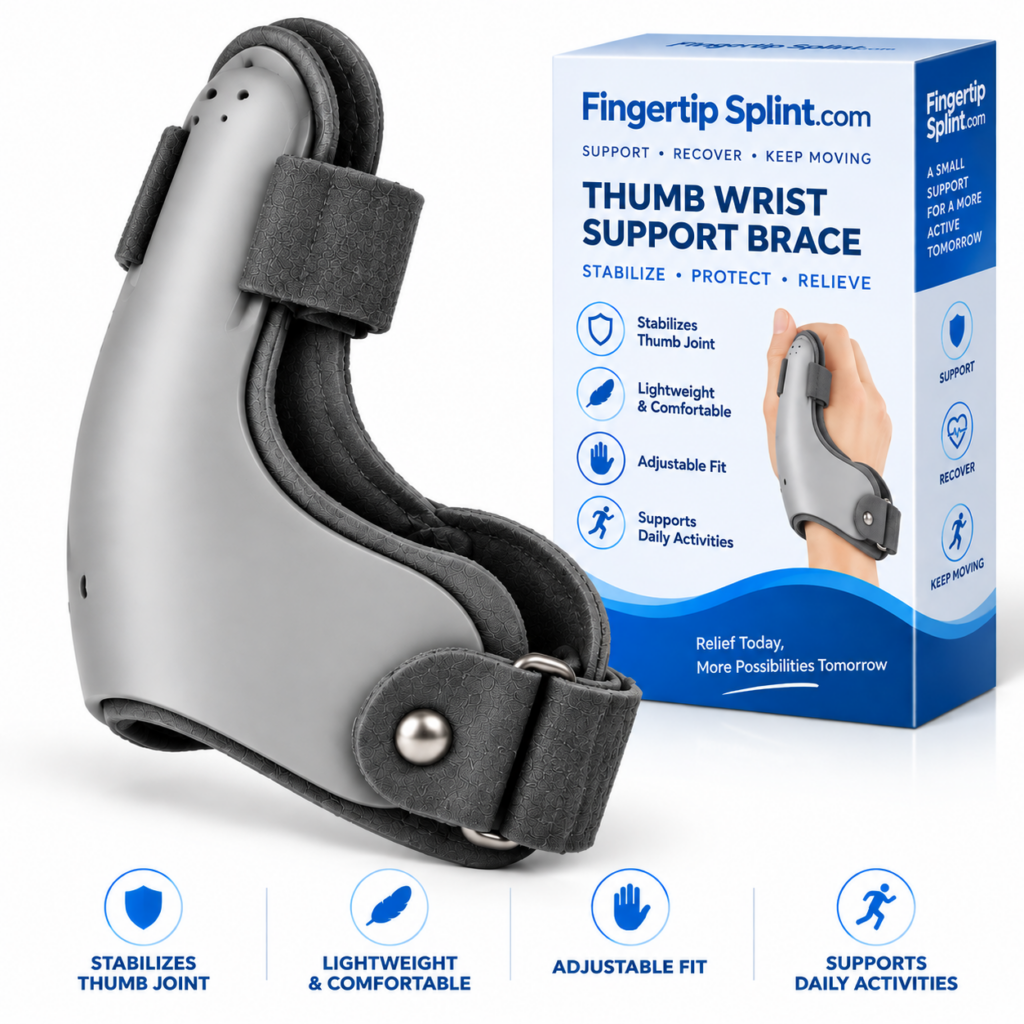
A thumb-wrist support brace is not just a strap around your hand. Its shape, thumb opening, wrist coverage, support material, and adjustment system all influence how it fits and functions. This guide answers three questions: What features does it have? How should it fit? What can it be used for? It is written for readers who have found a thumb-wrist brace online and want to understand what they are looking at before deciding.
What This Guide Covers
- Quick Answer
- What Is a Thumb Wrist Support Brace?
- Anatomy: What Areas Can the Brace Cover?
- Interactive: Explore the Support Areas
- Key Features to Understand
- 3D Interactive: Anatomy of a Thumb Wrist Support Brace
- Interactive: What Does Each Part Do?
- Materials and Construction
- How Should a Thumb Wrist Brace Fit?
- Interactive: Too Loose vs Too Tight
- 5-Point Fit Check
- Common Uses
- Interactive: Where Might This Brace Fit Into Your Day?
- Thumb-Wrist Support and Movement
- Product Spotlight
- Feature Comparison Table
- Common Mistakes
- What Should You Look For?
- When Professional Advice Matters
- Quick Tips
- FAQ
- Conclusion
Quick Answer: What Is a Thumb Wrist Support Brace?
A thumb-wrist support brace is designed to support the thumb and wrist together, with features such as thumb coverage, wrist extension, straps, and varying degrees of flexibility or rigidity. Proper fit means secure positioning without excessive pressure, while actual use depends on the brace design and the user’s situation.
If you want the underlying mechanism first, the reference understanding how a CMC thumb spica splint works covers the anatomy and mechanism in detail. This article focuses on features, fit, and uses.
What Is a Thumb Wrist Support Brace?
The term breaks into three parts. Understanding each part clarifies what the product is.
Thumb
The brace incorporates the thumb into its support structure. The thumb is positioned within the design and supported by the brace’s construction.
Wrist
The design extends toward or around the wrist. The wrist coverage helps anchor the support structure and stabilize the brace during wear.
Support
The construction is intended to provide positioning, stabilization, protection, or movement limitation depending on the design and intended use.
Important distinction: “Thumb wrist support brace” is a broad product description. Different products can vary in thumb coverage, wrist coverage, rigidity, straps, materials, and the degree of movement allowed. The terminology alone does not tell you whether a product matches your needs.
Anatomy: What Areas Can the Brace Cover?
Different thumb-wrist braces provide different coverage. Understanding the possible coverage areas helps you evaluate whether a specific product matches your expectations.
Possible Coverage Areas
- Thumb
- Thumb base (CMC area)
- Palm
- Back of hand
- Wrist
- Support zones (combination of the above)
Why Coverage Varies
Different products are designed around different support goals. Some designs focus on the thumb base; others extend further onto the wrist for additional anchoring. Coverage affects how the brace fits, feels, and functions.
For a broader explanation of how the thumb and wrist are supported together, the reference thumb spica brace thumb and wrist support guide covers the relationship in detail. For general hand anatomy context, the Cleveland Clinic hand anatomy resource provides a clear starting point.
Interactive: Explore the Support Areas
Click each area to understand what it contributes to a thumb-wrist support brace. This is an educational tool, not a medical diagram.
Explore the Support Areas
Click each area to see a short explanation.
Key Features to Understand
This is the largest section of the article. Understanding each feature helps you evaluate a specific product before purchasing. Each feature contributes to how the brace fits, feels, and functions.
Feature 1: Thumb Support
The thumb support section is the part of the brace designed to interact with the thumb. It can help maintain positioning depending on the design. Some designs provide more structured thumb support; others allow more thumb movement.
Feature 2: Wrist Coverage
The wrist coverage extends the brace beyond the thumb into the wrist area. This extension helps anchor the brace and stabilize the support structure. Some designs extend further onto the wrist than others.
Feature 3: Support Material
Different materials provide different combinations of support, flexibility, and comfort. Materials may include flexible fabrics, elastic sections, semi-rigid structures, or rigid components. No single material is universally better — the appropriate material depends on the intended use.
Feature 4: Adjustable Straps
Straps help secure the brace, adjust the fit, and maintain position during wear. The strap system affects how easily the brace can be put on and removed, and whether it stays secure during activity.
Feature 5: Thumb Opening
The thumb opening can differ in size, shape, coverage, and flexibility. The opening determines how the thumb sits within the brace and how much thumb movement is possible.
Feature 6: Breathability
Breathability affects comfort during extended wear. Considerations include ventilation, moisture management, material thickness, and how the design interacts with skin over time.
Feature 7: Edge Construction
Seams and edges matter for comfort and pressure. Rough or bulky edges can create rubbing or pressure points during wear. Smooth, well-finished edges improve comfort.
Feature 8: Overall Coverage
Overall coverage ranges from shorter designs (focused on the thumb base and part of the wrist) to more extensive designs (covering more of the thumb and wrist). Neither is universally better — the appropriate coverage depends on the intended use.
Anatomy of a Thumb Wrist Support Brace: 3D Interactive
This interactive shows the key features of a thumb-wrist support brace. Tap each feature to see what it contributes.
Interactive 3D: Anatomy of a Thumb Wrist Support Brace
Tap each feature to explore its role
1. Thumb Support Zone
The part of the brace designed to interact with the thumb. It can help maintain positioning depending on the design. Some designs provide more structured thumb support; others allow more thumb movement.
Feature → Function → Fit → Everyday use
Interactive: What Does Each Part Do?
Click each part of the brace to understand its role. This is an educational tool, not a medical recommendation.
What Does Each Part of a Thumb-Wrist Brace Do?
Click each part to reveal a short explanation.
Materials and Construction
Materials affect how the brace feels, how long it lasts, and how it should be cared for. Rather than listing materials by name, this section explains what characteristics to consider.
Material Characteristics to Consider
- Flexibility — how much the material bends or stretches
- Rigidity — how much structure the material provides
- Thickness — affects bulk and warmth
- Stretch — affects fit and comfort
- Breathability — affects comfort during extended wear
- Durability — affects how long the brace lasts
- Skin contact — affects how the brace feels against the skin
- Edge finishing — affects comfort and pressure points
- Wash and care requirements — affects maintenance
How to Evaluate Materials
Avoid assuming that one material is universally better. Different materials provide different combinations of flexibility, structure, warmth, breathability, and comfort. The appropriate material depends on the intended use and the user’s preferences. Follow the manufacturer’s care instructions to maintain the brace.
How Should a Thumb Wrist Support Brace Fit?
Fit is one of the most important practical factors. A brace that does not fit correctly may not function as intended, regardless of its design quality.
What Good Fit Means
- The thumb sits naturally within its intended opening or support area
- The wrist section stays positioned without excessive movement
- Straps secure the brace without excessive compression
- The device does not create significant pressure points
- Fingers do not develop concerning changes in sensation or circulation
Signs of a Poor Fit
- Brace shifts or slips during use
- Straps require repeated adjustment
- Persistent pressure or rubbing
- Numbness or tingling
- Significant discoloration
- Persistent pain or increasing discomfort
For a detailed look at fit and coverage, the reference thumb spica splint fit guide covers the topic in more detail.
Interactive: Too Loose vs Too Tight
Move the slider below to understand the conceptual range between too loose and too tight. This is an educational visualization, not a recommendation for any specific device.
5-Point Fit Check
Use this simple checklist to evaluate whether a thumb-wrist support brace is fitting correctly.
1. Position
Is the brace sitting where intended? The thumb should sit naturally within its opening, and the wrist section should be correctly positioned.
2. Stability
Does the brace stay in place? It should remain positioned during normal wear, without repeated slipping or shifting.
3. Pressure
Are there uncomfortable pressure points? The brace should distribute pressure without creating focal discomfort.
4. Sensation
Any numbness or tingling? Concerning changes in sensation should not be dismissed and warrant reassessment.
5. Movement
Is movement affected in the way the device is designed to affect it? Different designs allow different levels of movement. Check whether the brace is functioning as intended for its design.
Common Uses of a Thumb Wrist Support Brace
This section discusses use contexts rather than diagnoses. A thumb-wrist support brace may be used in a variety of situations, depending on the specific design and the user’s circumstances.
Everyday Hand Activities
Some people use thumb-wrist support braces during everyday activities such as typing, writing, phone use, and light household tasks. The brace may provide stabilization during these activities, depending on its design. Comfort and usability vary substantially between people and designs.
Repetitive Hand Tasks
Some people research support options when repetitive thumb or wrist activity makes them look for additional stabilization during certain tasks. A brace can provide support during repetitive activity — but it does not treat the underlying cause. If repetitive activity is causing persistent symptoms, professional assessment may be appropriate.
Activity-Related Support
Some readers want to understand whether a support design can fit around a specific activity. The key question is whether the brace allows the movements required for the activity while providing the intended support. This depends on the specific design and the activity.
Rest or Routine Support
Some designs may be used during rest periods, while others may be intended primarily for active wear. Intended wear schedules vary by product and individual circumstances. Follow the manufacturer’s instructions and professional guidance where applicable. For a discussion of everyday support, the reference thumb wrist brace for daily activities covers the topic in detail.
Interactive: Where Might This Brace Fit Into Your Day?
Select an activity to see what to consider. This is an educational tool, not a medical recommendation.
Activity Compatibility Explorer
Choose an activity to see relevant considerations.
- Potential convenience: The brace may provide stabilization during typing.
- Possible limitations: Bulk or restricted thumb movement may affect keyboard use.
- Movement considerations: Check whether the brace allows the finger and thumb movements required for typing.
Thumb-Wrist Support and Movement
Support does not necessarily mean complete immobilization. Depending on construction, a brace may stabilize, restrict selected movements, guide positioning, permit some thumb movement, or provide different levels of wrist support.
| Design Characteristic | Possible Effect |
|---|---|
| More flexible | Greater movement |
| More structured | Greater positioning support |
| Longer wrist coverage | More extensive wrist contact |
| Open thumb design | More thumb mobility |
| Secure straps | Better positioning when correctly fitted |
Important: These are possible design effects, not universal rules. The actual effect depends on the specific device and how it is fitted. For a comparison of CMC support versus regular thumb splints, the reference CMC thumb support vs regular thumb splints covers the differences in more detail.
Product Spotlight: A CMC-Focused Example
After understanding the features, fit, and uses, here is a specific product to examine. The 1 Pcs Thumb Wrist Support Brace CMC Thumb Spica Splint is one example of a CMC-focused thumb-wrist support design. Readers comparing thumb-wrist support designs can review this product’s specific construction and coverage against their own requirements.
Thumb Wrist Support Brace
- Thumb-wrist configuration
- CMC-oriented design
- Thumb and wrist coverage
- Support structure
- Adjustable components
Evaluating the Product Using the Feature Framework
Thumb-Wrist Configuration
The product is designed as a thumb-wrist configuration. This aligns with the thumb-wrist support brace concept of supporting the thumb while extending onto the wrist area.
CMC-Oriented Design
The design is oriented around CMC support — providing structure around the base of the thumb and the surrounding area.
Coverage
Review the thumb and wrist coverage characteristics described on the product page. Compare the stated coverage against your expectations.
Support Structure
Review the support structure described on the product page. Check whether the structure is flexible, semi-rigid, or rigid.
Adjustment
Review the adjustment system described on the product page. Check how the adjustment works and whether it stays secure during movement.
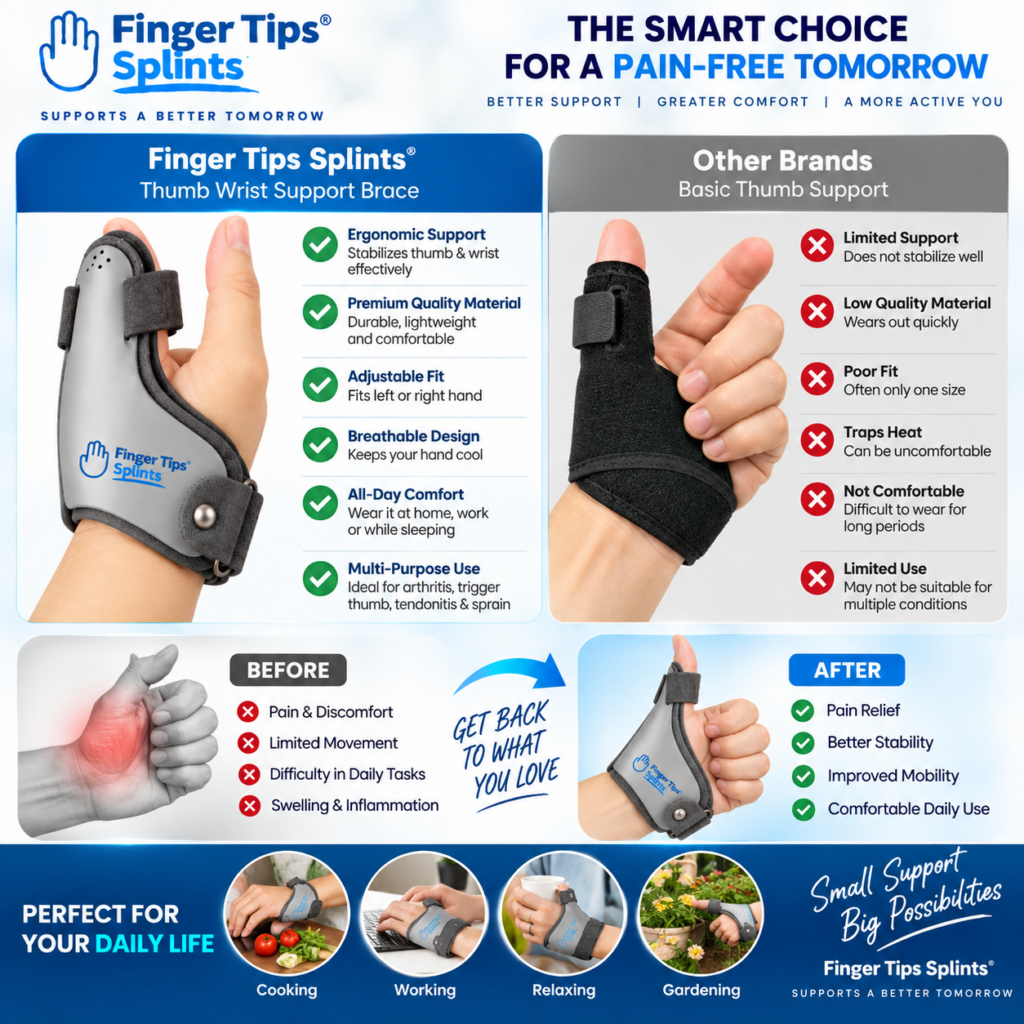
This closer view shows how the brace’s support structure wraps around the thumb and extends onto the wrist. Coverage varies by product design. Always follow the manufacturer’s sizing and adjustment instructions for the specific product.
For a broader product guide, the reference CMC thumb spica splint buyer guide covers the full purchase journey. For buyer criteria, see what to consider when choosing a thumb wrist support brace.
Feature Comparison Table
This checklist can be used to compare any thumb-wrist support brace. It is not a ranking — it is a structured way to review product features.
| Feature | What to Look At |
|---|---|
| Thumb support | Coverage and positioning |
| Wrist coverage | How far the brace extends |
| Material | Flexibility, structure, and comfort |
| Straps | Adjustability and security |
| Thumb opening | Size and freedom of movement |
| Rigidity | Level of structural support |
| Breathability | Ventilation and moisture management |
| Care | Cleaning and maintenance instructions |
| Sizing | Manufacturer’s measurement guidance |
How to use this table: For each product you are considering, review the features against your requirements. The goal is to identify which design best matches your situation — not to find a universally “best” brace.
Common Mistakes
These mistakes come up frequently when people use thumb-wrist support braces. Avoiding them improves the experience.
Visual design does not tell the whole story. A brace that looks right may not fit or function as intended.
Check: the specifications and coverage rather than only the photos.
A brace marketed for thumb support may have very different wrist coverage from another.
Check: how far the brace extends onto the wrist.
More compression does not automatically mean more support. Excessive tightening can cause discomfort and reduce tolerance.
Check: follow the manufacturer’s adjustment instructions.
Sizing systems differ between products. A size that fits in one brand may not fit in another.
Check: measure according to the manufacturer’s sizing chart.
Designs differ. Some support-focused designs allow selected movement.
Check: what movement the specific design is intended to influence.
A thumb-wrist brace is not automatically appropriate for every hand or wrist complaint.
Check: whether professional assessment is appropriate.
Numbness, tingling, significant discoloration, increasing pain, or other concerning changes should not be ignored.
Check: remove the brace and seek appropriate advice if symptoms persist.
The manufacturer’s instructions are specific to the product.
Check: the product documentation before use.
What Should You Look For?
This compact checklist helps you evaluate a thumb-wrist support brace before purchasing or using it.
Coverage
Does it cover the areas you expect? Check the thumb and wrist coverage described on the product page.
Structure
Is it flexible, semi-rigid, or rigid? The structure affects how the brace positions the thumb and wrist.
Adjustment
Can it be secured appropriately? Check the strap system and adjustment range.
Fit
Does the sizing system make sense? Check the manufacturer’s sizing instructions.
Movement
What thumb and wrist movement does the design permit or restrict? Consider whether the movement matches your intended use.
Comfort
Are the materials and edges appropriate for the intended use? Consider skin contact, pressure, and breathability.
Care
Can you maintain it according to the manufacturer’s instructions? Check the care and cleaning requirements.
When Professional Advice Matters
This section is written with an EEAT (Experience, Expertise, Authoritativeness, Trustworthiness) perspective. It does not provide individualized medical advice, but it does explain situations where professional assessment may be appropriate.
Significant Injury
A significant injury warrants professional assessment rather than selecting a support device based on a product description.
Visible Deformity
Visible deformity warrants professional assessment. A brace should not be used to manage a deformity without professional guidance.
Severe or Worsening Pain
Severe or worsening pain is a sign that warrants professional assessment rather than self-selecting a support device.
Substantial Swelling
Significant swelling affects fit and may indicate an underlying problem that requires professional assessment.
Persistent Numbness or Tingling
Numbness or tingling may indicate nerve involvement and should be assessed professionally.
Significant Loss of Movement
Significant loss of movement warrants professional assessment to determine the appropriate approach.
Symptoms That Are Not Improving
If symptoms are not improving or are worsening, do not simply choose a different product. Seek professional guidance.
Uncertainty About Which Type of Support Is Appropriate
If you are unsure whether a thumb-wrist support brace is appropriate, professional assessment can help determine the right approach.
Prescribed or Professionally Fitted Devices
Prescribed or professionally fitted devices may have requirements that differ from general consumer support products. Follow the specific instructions provided by the prescribing professional.
Warning Signs That Warrant Professional Assessment
- Severe or worsening pain
- Significant swelling
- Visible deformity
- Major loss of movement
- Persistent numbness or tingling
- Concerning skin or circulation changes
- Symptoms that are not improving
For general information about thumb and hand conditions, see the Mayo Clinic overview of thumb arthritis. For broader hand anatomy and condition information, the Cleveland Clinic hand anatomy resource provides useful context. For an orthopedic perspective, the AAOS thumb arthritis library is a widely referenced resource. For general public health information, the NHS hand pain guidance offers a practical overview. Additional medical reference information is available through MedlinePlus hand injuries and disorders. For clinical and anatomy-focused context, Johns Hopkins Medicine hand conditions provides further reading. General educational context is also available through WebMD’s overview of thumb arthritis and Healthline’s thumb arthritis information. For peer-reviewed literature, NCBI PubMed Central hosts open-access research where appropriate. For a broader orthopedic reference, Orthobullets provides structured clinical summaries.
Important: This article does not provide individualized medical advice. Always consult an appropriate healthcare professional regarding your specific situation.
Quick Tips
Quick Fit Checklist
Before using a thumb-wrist support brace, check the following. Click each item to mark it as reviewed.
Frequently Asked Questions
A thumb wrist support brace is a support device designed to support the thumb and wrist together. The brace incorporates the thumb into its support structure while extending toward or around the wrist. Its construction is intended to provide positioning, stabilization, protection, or movement limitation depending on the design. “Thumb wrist support brace” is a broad product description — different products can vary significantly in coverage, rigidity, straps, and materials.
Common features include thumb support, wrist coverage, support material, adjustable straps, a thumb opening, breathability considerations, edge construction, and overall coverage. Each feature contributes to how the brace fits, feels, and functions. The specific features vary between products, so comparing the specifications of a specific product is important.
A correctly fitted brace should be secure but not excessively tight. The thumb should sit naturally within its intended opening or support area, and the wrist section should stay positioned without excessive movement. Straps should secure the brace without excessive compression. The device should not create significant pressure points or cause concerning changes in sensation or circulation. Follow the manufacturer’s sizing instructions.
It depends on the brace’s construction and intended purpose. Some designs are support-focused and allow selected movement; others are more rigid and restrict movement more substantially. Support does not necessarily mean complete immobilization. The appropriate level of restriction depends on the specific situation and professional recommendations where applicable.
This depends on the specific design and intended use. Some braces may be compatible with activities like typing, writing, or light tasks; others may not. The key question is whether the activity requires movements the brace allows while providing the intended support. Comfort and usability vary substantially between people and designs. Follow the manufacturer’s instructions and professional guidance where applicable.
The terminology overlaps. A thumb spica splint typically describes a support configuration that includes the thumb and extends onto the hand or wrist. A thumb wrist support brace is a broader description that may describe similar products. However, designs can vary significantly — even products with similar names may have different coverage, rigidity, and intended use. Always evaluate the specific product’s specifications.
Ask a healthcare professional if there is a significant injury, visible deformity, severe or worsening pain, substantial swelling, persistent numbness or tingling, significant loss of movement, or symptoms that are not improving. Also seek guidance if you are uncertain about which type of support is appropriate. A product’s physical features do not by themselves determine whether it is appropriate for a particular injury or medical condition.
Conclusion: Understand the Features Before You Choose
A thumb-wrist support brace is not just a strap around your hand. Its shape, thumb opening, wrist coverage, support material, and adjustment system all influence how it fits and functions. Understanding the features, fit, and uses helps you evaluate a specific product before deciding whether it matches your needs.
This guide has covered what a thumb-wrist support brace is, what areas it can cover, key features, materials and construction, how it should fit, common uses, how it affects movement, and what to look for. The goal has been to provide a clear practical foundation for understanding this product category.
Review a CMC-Focused Thumb-Wrist Support Design
Compare the product’s construction, coverage, and support features against your own requirements. The 1 Pcs Thumb Wrist Support Brace CMC Thumb Spica Splint is one example of a CMC-focused thumb-wrist support design.
View the Thumb Wrist Support BraceNeed information about other thumb and hand support products? Explore the FingerTipSplint shop. For general questions, see the FingerTipSplint FAQ. For B2B inquiries, see the medical finger splint supplier page or request a quote.