
Your finger hurts every time you grip, touch, or bend it. Dry, cracked skin. A painful corn. Thickened callused areas that make ordinary tasks uncomfortable. Bandages slip off fingers, and you want something discreet that can be worn during everyday activities. This guide helps you choose the right silicone finger sleeve for cracks, corns, and calluses — without guessing. For a broader look at the FingerTipSplint ecosystem, start at the FingerTipSplint finger-support solutions.
Table of Contents
- Why Cracks, Corns and Calluses Need Different Protection
- Sleeve vs Bandage vs Protector vs Splint
- How to Choose the Right Sleeve
- Interactive Fit Checker
- 8 Features to Check
- 3D Silicone Sleeve Infographic
- Benefits for Everyday Protection
- How to Use It Correctly
- Sleeves for Different Situations
- Recovery Timeline
- 10 Common Mistakes
- Who Should Consider One
- When a Sleeve Is Not the Right Solution
- Doctor Advice
- Sleeve vs Other Protection Options
- Product Guide
- Buyer Checklist
- 7 Quick Tips
- FAQ
The right silicone finger sleeve for cracks, corns, and calluses should provide comfortable coverage, a secure fit, cushioning, and enough flexibility for normal finger movement. Choose based on the affected finger, the area needing protection, sleeve size, material comfort, and your daily activity rather than price or appearance alone.
Why Cracks, Corns and Calluses Need Different Types of Protection
These three skin problems are often grouped together, but they are not the same. Each develops for different reasons and places different demands on a protective sleeve.
Finger Cracks and Fissured Skin
Finger cracks can become painful during movement because the skin splits and every bend pulls at the opening. Repeated friction can aggravate sensitive skin further. A silicone sleeve can reduce direct contact and cushion the area, making everyday movement more comfortable. However, a sleeve does not heal the crack. Deep, bleeding, infected, or persistent cracks deserve professional attention.
Corns and Pressure Spots
Corns form from localized pressure and repeated rubbing. They are a response to mechanical stress, not a random occurrence. A silicone sleeve can provide cushioning that reduces direct contact and distributes pressure across a wider area. But the underlying source of pressure — a tool handle, an instrument, a grip — should also be considered. If the same pressure keeps returning, addressing the cause matters as much as protecting the area.
Callused Skin
Calluses develop from repeated friction and pressure. They are the skin’s way of protecting itself from mechanical stress. A silicone sleeve can reduce additional irritation during activity, but it is not a treatment for the underlying cause. If the callus becomes painful, bleeds, changes color, or does not improve with protection, professional assessment may be appropriate.
Why One Sleeve Isn’t Automatically Right for Every Problem
Crack → coverage + comfort
Protection from further splitting and cushioning during movement.
Corn → cushioning + pressure reduction
Reducing direct contact and distributing pressure across a wider area.
Callus → friction protection + comfortable coverage
Reducing additional mechanical irritation during activity.
Silicone Finger Sleeve vs Bandage vs Finger Protector vs Finger Splint
| Option | Main Purpose | Coverage | Flexibility | Best Consideration |
|---|---|---|---|---|
| Silicone finger sleeve | Protection and cushioning | Finger-specific | High | Cracks, friction, pressure areas |
| Adhesive bandage | Covering minor skin injuries | Localized | High | Short-term wound coverage |
| Finger protector | Mechanical protection | Varies | Moderate to high | Repeated contact and friction |
| Finger splint | Position and support | More structured | Lower | Movement restriction or support |
When a Silicone Sleeve Makes More Sense
A silicone sleeve is usually the better choice when you need protection and comfort during daily activities, when the problem area needs cushioning from repeated friction, or when you want a low-profile option that does not restrict movement.
When a Sleeve May Not Be Enough
- Severe pain
- Deep or open wounds
- Significant bleeding
- Infection concerns (redness spreading, warmth, pus, fever)
- Major swelling
- Numbness
- Significant loss of movement
- Persistent or worsening symptoms
How to Choose the Right Silicone Finger Sleeve for Cracks, Corns & Calluses
This is one of the most important sections. Follow these seven steps to match the sleeve to your problem, your finger, and your daily activity.
Step 1 — Identify Which Finger Needs Protection
Index, middle, ring, or little finger. Each has a different circumference and a different role in daily movement. A sleeve designed for one finger may not fit another comfortably.
Step 2 — Identify Where the Problem Is Located
Fingertip
Coverage for the very tip, often the first area of contact during typing or handling objects.
Side of finger
Coverage along one side, often where a pen, tool, or instrument presses against the skin.
Finger pad
Coverage on the palmar surface, important for grip, lifting, and repetitive contact.
Near a joint
Coverage around a joint requires flexibility so movement is not restricted.
Step 3 — Measure or Compare Finger Size
Measure finger circumference according to the manufacturer’s instructions and compare with the specific product’s size chart. Do not choose based only on appearance or assume that one size fits every finger.
Step 4 — Check the Sleeve’s Coverage
Does the sleeve actually cover the area that experiences friction? A sleeve that covers the tip but not the side of the finger will not protect a side pressure point.
Step 5 — Check Flexibility
The sleeve should allow appropriate everyday movement unless the product is specifically designed otherwise. If the sleeve restricts finger bending or grip, it will not be worn consistently.
Step 6 — Check Comfort During Real Movement
Test bending, straightening, typing, holding objects, and light gripping. A sleeve that feels fine when stationary may not feel fine during activity.
Step 7 — Inspect the Skin After Wearing
Look for excessive redness, pressure marks, numbness, tingling, discoloration, or increasing discomfort. If these occur, remove the sleeve and reassess the fit or use.
Interactive Silicone Finger Sleeve Fit Checker
Answer a few questions to see what product characteristics to compare. This is a shopping decision tool, not a medical diagnosis.
Complete the three selections above to see what product characteristics to prioritize.
8 Features to Check Before Buying Silicone Finger Sleeves
1. Silicone Quality
Why it matters: The material affects comfort, flexibility, and durability. What to look for: soft, flexible silicone that does not feel overly rigid. Common mistake: assuming thicker always means better. Practical example: a soft sleeve that flexes with the finger is usually more comfortable for typing than a rigid cap.
2. Correct Finger Fit
Why it matters: A sleeve that is too loose slides and does not protect consistently. A sleeve that is too tight creates pressure points. What to look for: correct circumference and length for the intended finger. Common mistake: choosing a size based on appearance rather than measurement.
3. Coverage Area
Why it matters: Coverage should match the area that needs protection. What to look for: sleeves that cover the tip, side, or full finger depending on your problem. Common mistake: assuming every sleeve covers the same area.
4. Cushioning
Why it matters: Cushioning reduces direct contact and distributes pressure. What to look for: sufficient material thickness without bulk that interferes with movement. Common mistake: choosing a sleeve that is too thin to provide meaningful cushioning.
5. Flexibility
Why it matters: Flexibility determines whether the sleeve can be worn during normal activities. What to look for: material that bends and flexes with the finger. Common mistake: choosing a rigid sleeve for a task that requires finger mobility.
6. Edge Comfort
Why it matters: Rough or tight edges can create new pressure points. What to look for: smooth edges that do not dig into the skin. Common mistake: ignoring edge comfort until irritation develops.
7. Easy Application and Removal
Why it matters: If the sleeve is difficult to apply, it will not be used consistently. What to look for: a design that slides on and off without excessive force. Common mistake: choosing a sleeve that requires tools or excessive effort to apply.
8. Cleaning and Reusability
Why it matters: Hygiene affects skin health and product longevity. What to look for: clear manufacturer cleaning instructions and a material that withstands repeated washing. Common mistake: reusing a sleeve without cleaning it between uses.
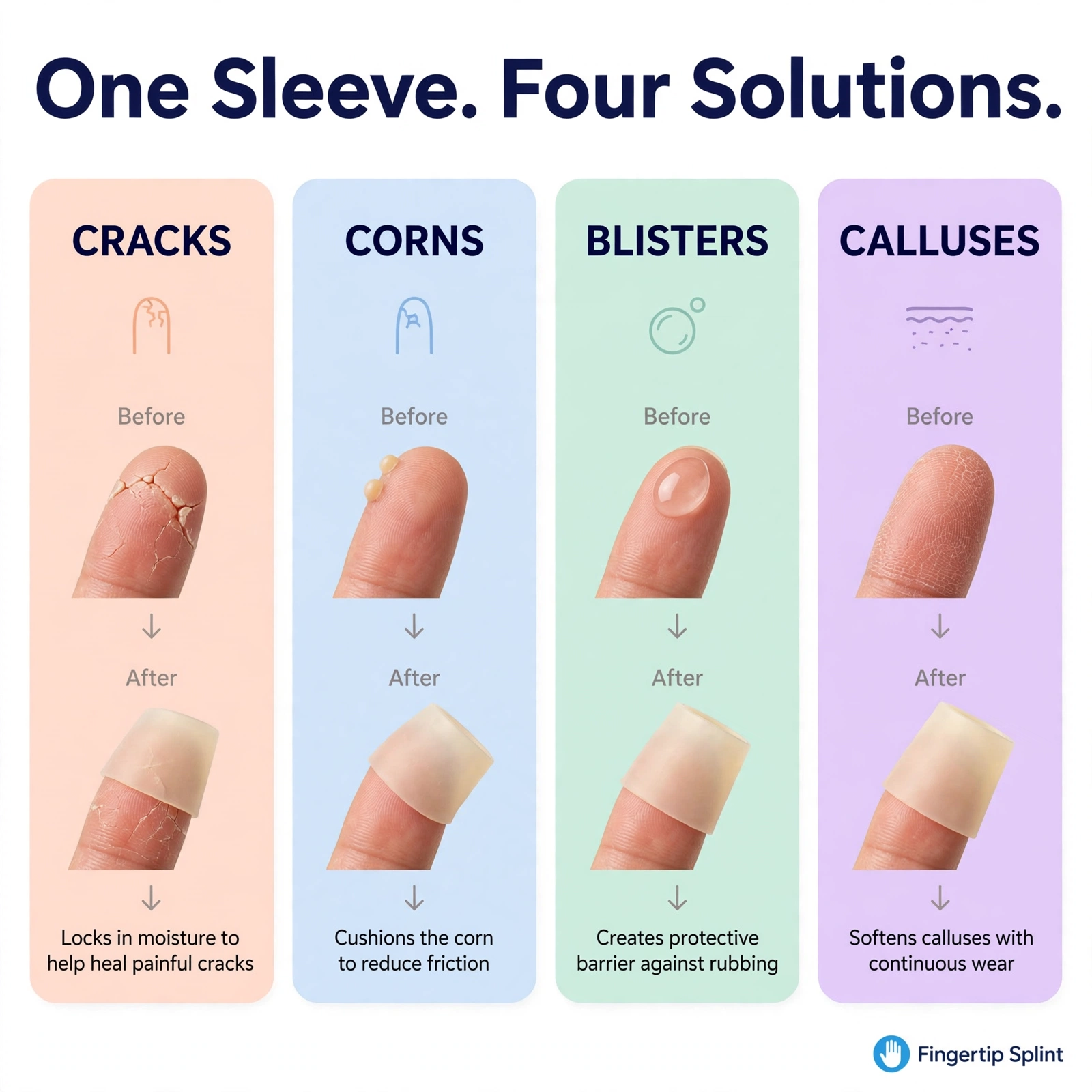
3D Interactive Silicone Finger Sleeve Infographic
The interactive 3D component explorer below breaks down the parts of a silicone finger sleeve. Click each component to see what it does and why it matters.
Silicone Finger Sleeve Component Explorer
Click a component to learn what it does and why it matters when you are buying.
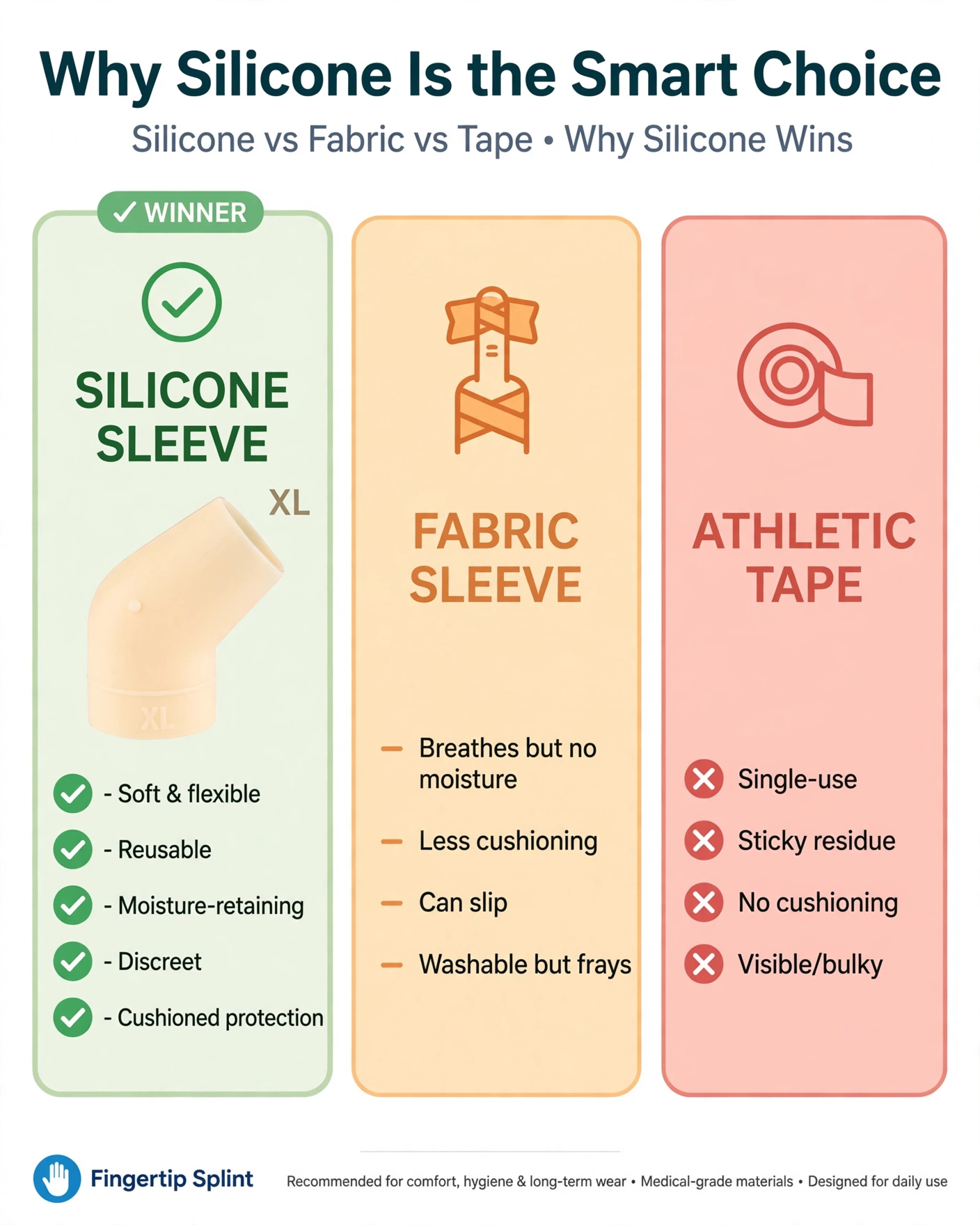
Silicone Finger Sleeve Benefits for Everyday Protection
Helps Create a Protective Barrier
The sleeve creates a barrier between your skin and the surface causing friction or pressure. This reduces direct contact that aggravates the problem area.
Can Reduce Direct Friction
For tasks involving repeated hand movement — typing, writing, gripping tools — reducing friction can make the activity more comfortable and prevent further irritation.
Provides Cushioning Around Pressure Areas
The silicone material cushions pressure points, distributing force over a wider area rather than concentrating it on one spot.
Can Be Less Bulky Than a Traditional Brace
A silicone sleeve is low-profile and flexible. It can be worn under gloves or during tasks where a bulky brace would get in the way.
Supports More Comfortable Everyday Movement
Because silicone flexes with the finger, it allows normal movement while providing protection. This matters for typing, writing, phone use, and household tasks.
Easy to Incorporate Into a Daily Routine
A sleeve that is simple to apply and remove is more likely to be worn consistently. Consistency matters for protection.
How to Use a Silicone Finger Sleeve Correctly
Silicone Finger Sleeves for Different Everyday Situations
Writing and typing
A low-profile sleeve with finger freedom is usually more practical. The sleeve should not interfere with keystrokes or pen grip.
Phone and tablet use
Thumb and finger movement for scrolling, tapping, and swiping. If the sleeve interferes, it will not be worn during phone use.
Household tasks
Cooking, cleaning, and lifting involve moisture and repeated hand use. Choose a design that stays secure and handles moisture.
Craft and hobby activities
Knitting, sewing, painting, or model work involve repetitive finger movement. A flexible sleeve preserves dexterity.
Gym and light exercise
Grip and resistance stress the sleeve. Choose a design that stays in place during light activity.
Repetitive hand work
Assembly, sorting, or repeated gripping. A sleeve that stays secure during repeated movement is essential.
Recovery Timeline: What Should You Expect After Protecting a Cracked, Corned or Callused Finger?
This is a reassessment framework, not a promised healing schedule. Duration depends on the underlying cause and your individual situation.
Stage 1 — Immediate Protection
Focus on reducing unnecessary friction and checking comfort. If the sleeve creates new pressure, adjust or remove it.
Stage 2 — Early Reassessment
Ask whether irritation is decreasing, whether the skin is becoming more comfortable, whether the sleeve is causing new pressure, and whether the original problem is still worsening.
Stage 3 — Activity Reassessment
Consider whether the activity causing repeated friction has changed. If the same friction keeps returning, addressing the cause matters.
Stage 4 — When to Seek Professional Advice
Persistent, worsening, severe, or unexplained symptoms should not simply be covered indefinitely. Seek professional assessment.
10 Common Mistakes People Make When Buying Silicone Finger Sleeves
Price does not tell you whether the sleeve fits or protects the right area.
What to check: fit, coverage, and material comfort.
A sleeve that is too loose or too tight will not provide consistent protection.
What to check: measure and compare with the product’s chart.
Excessive pressure can create new skin problems and reduce circulation.
What to check: secure and comfortable, not tight.
A sleeve that does not cover the irritated area will not help.
What to check: coverage matches the problem location.
Thicker material may restrict movement or reduce comfort.
What to check: appropriate thickness for your activity.
Skin irritation can develop without immediate awareness.
What to check: inspect skin after each wear.
A sleeve is not designed to manage deep wounds, infection, or significant injury.
What to check: seek professional advice for significant problems.
If the same friction keeps returning, the cause needs attention.
What to check: identify what is causing the friction.
A protective sleeve is not a treatment for the underlying skin problem.
What to check: understand what the sleeve is designed to do.
These are warning signs, not signs that the sleeve is working.
What to check: remove the sleeve and seek advice if symptoms persist.
Who Should Consider a Silicone Finger Sleeve?
Buyers looking for everyday finger protection
People who want a simple, low-profile way to protect a finger during daily tasks.
People dealing with repeated friction
Those whose work or hobbies involve repeated contact with tools, instruments, or surfaces.
People who need cushioning around pressure areas
Those with corns or pressure spots that become painful during activity.
People who prefer flexible protection
Those who want protection without the bulk or restriction of a structured splint.
Who Should Not Simply Self-Manage With a Sleeve?
- Deep or significant wounds
- Suspected infection
- Severe or increasing pain
- Significant swelling or deformity
- Numbness, tingling, or circulation changes
- Persistent symptoms with no clear improvement
- Problems that keep returning
When a Silicone Finger Sleeve Is Not the Right Solution
A protective sleeve can reduce friction and cushion pressure, but it does not identify or treat the underlying cause of a skin problem. There are situations where a sleeve should not be the only approach.
Deep or significant wounds
A sleeve is not designed to manage deep wounds or significant tissue damage.
Suspected infection
Signs such as spreading redness, warmth, pus, or fever require professional assessment.
Severe or increasing pain
Pain that worsens despite protection deserves evaluation.
Significant swelling or deformity
These signs suggest a more serious issue than simple skin irritation.
Numbness, tingling, or circulation changes
These symptoms should not be ignored or covered indefinitely.
Persistent or worsening symptoms
If the problem does not improve with protection, seek professional guidance.
Doctor Advice: How to Think About Finger Protection
This section is written in the tone of a practical professional checklist. It is not a diagnosis and does not replace an in-person assessment.
Protection should match the problem
A sleeve designed for cushioning may not be the right choice for a wound, and vice versa.
Fit matters more than maximum compression
A secure, comfortable fit is more useful than excessive tightness.
Skin should be checked regularly
Remove the sleeve periodically and inspect the skin for irritation or pressure marks.
Don’t ignore persistent symptoms
Symptoms that persist or worsen deserve professional assessment.
A protective sleeve is not a medical splint
These are different product categories designed for different purposes.
Consider the cause, not just the symptom
If the same friction keeps returning, addressing the cause matters as much as protecting the area.
Additional trusted resources include the Mayo Clinic corns and calluses overview, the Cleveland Clinic corns and calluses resource, the MedlinePlus corns and calluses page, the American Academy of Dermatology guidance on corns and calluses, the NHS corns and calluses page, the WebMD corns and calluses overview, and the Healthline corns and calluses resource.
Silicone Finger Sleeve vs Other Finger Protection Options
| Situation | Silicone Sleeve | Bandage | Rigid Splint | Finger Protector |
|---|---|---|---|---|
| Friction protection | Strong consideration | Moderate | Usually unnecessary | Strong consideration |
| Flexibility | High | High | Low | Varies |
| Cushioning | Yes, depending on design | Limited | Varies | Varies |
| Movement restriction | Low | None | High | Varies |
| Everyday usability | High | High | Lower | High |
This is a feature comparison, not a medical recommendation. Match the option to your specific problem and needs.
FingerTipSplint Silicone Finger Sleeve Protectors: Product Guide
Use this section as a worked example of how to evaluate a silicone finger sleeve against the criteria in this guide. The product being evaluated is the silicone finger sleeve protectors from FingerTipSplint.
Fingertip Splint Silicone Finger Sleeve Protectors
- Silicone construction: Soft, flexible material designed for comfortable skin contact
- Protective coverage: Designed to cover the finger area that needs protection
- Stretch and fit: Check the product page for specific sizing information
- Cushioning: Material intended to provide a protective barrier and reduce friction
- Flexibility: Designed to flex with the finger during movement
- Low-profile design: Suitable for typing, writing, and daily activities
- Reusable: Follow the manufacturer’s cleaning instructions for ongoing use
What the Product Is Designed to Do
The sleeve is designed to provide a protective barrier over the finger, cushion pressure areas, and reduce direct friction during daily activities. It is not designed to diagnose, treat, or cure the underlying skin condition.
Who May Find This Type of Sleeve Useful
People experiencing repeated finger friction
From tools, instruments, writing, or repetitive tasks.
People needing protective coverage
For cracked skin, corns, or callused areas during daily activities.
People dealing with pressure-sensitive areas
Where cushioning can make activity more comfortable.
Buyers wanting a flexible alternative
A lighter option than a bulky brace or structured splint.
What to Check Before Ordering
Check the correct finger, required coverage, size and fit, intended activity, skin condition, and wearing instructions. For buyers comparing different finger protection options, explore the FingerTipSplint shop. Our guide on the silicone finger protector buying guide for fit, comfort, and coverage covers additional selection factors. For blister and callus-specific protection, see our article on finger guard sleeves for blisters and calluses.
Best Silicone Finger Sleeve Buying Checklist
Click each item to confirm. Aim to check all 8 before buying.
7 Quick Tips for Choosing Silicone Finger Sleeves
Frequently Asked Questions
A silicone finger sleeve can protect cracked skin from further friction and contact during daily activities, which may make movement more comfortable. However, it does not heal the crack itself. A sleeve is a protective barrier, not a treatment for the underlying skin condition.
If the crack is deep, bleeding, infected, or persistent, seek professional assessment. For a broader look at selection, see our guide on the best silicone finger sleeves for cracks, corns, and calluses.
A silicone sleeve can provide cushioning around a corn, which may reduce direct pressure and friction during activity. This can make the area more comfortable. However, it does not remove the corn or address the underlying cause of the pressure.
If the corn is painful, recurring, or not improving with protection, professional assessment may be appropriate. Addressing the source of pressure — a tool, a grip, a shoe or glove — matters as much as protecting the area.
Calluses develop from repeated friction and pressure. A silicone sleeve can reduce additional mechanical irritation during activity and provide a comfortable protective layer. It is not a treatment for the callus itself.
If the callus becomes painful, bleeds, changes color, or does not improve with protection, seek professional guidance. For blister and callus-specific protection, see our article on finger guard sleeves for blisters and calluses.
It should be secure and comfortable, not excessively tight. You should be able to wear it for the intended period without numbness, tingling, significant discoloration, or increasing pain. Excessive tightness is not better protection — it creates new problems.
If concerning symptoms occur, remove the sleeve and reassess the fit rather than tightening it further. If symptoms persist, seek appropriate medical advice.
This depends on the product instructions, your skin condition, and your individual tolerance. A low-profile silicone sleeve may be comfortable for extended wear, but regular skin checks are important. Remove the sleeve periodically, inspect the skin for redness or pressure marks, and follow the manufacturer’s guidance on wear duration.
If you notice skin irritation, numbness, or discomfort, remove the sleeve and reassess.
There is no universal answer. It depends on the product instructions, your skin condition, and whether overnight wear is appropriate for your situation. Some people may find it comfortable; others may experience irritation from prolonged wear.
Follow the manufacturer’s guidance. If overnight wear is not recommended, avoid it. If you choose to wear it overnight, check the skin in the morning for signs of irritation or pressure.
Stop using the sleeve if you experience pain, numbness, tingling, discoloration, worsening irritation, or any other concerning symptoms. These are signs that the sleeve may not be appropriate for your situation, or that the fit needs adjustment.
If symptoms persist after removing the sleeve, seek professional assessment. A protective sleeve is not designed to manage deep wounds, infection, or significant injury.
Protect the Finger Without Overcomplicating the Choice
If you are dealing with repeated friction, a painful pressure point, cracked skin, or a troublesome callus, the goal is not to find the tightest or most complicated support. Start with the area that needs protection, choose the right fit, and select a sleeve designed for comfortable everyday coverage.
Evaluate the FingerTipSplint Silicone Finger Sleeve Protectors against the criteria in this guide. Explore the FingerTipSplint shop for other support options, check the FingerTipSplint FAQ, or use the request-a-quote page for bulk or business purchasing. For medical finger splint supply, see the medical finger splint supplier page.
View the Product Explore Finger ProtectionFinal Takeaway: The Best Sleeve Matches the Problem, Not the Price Tag
The best silicone finger sleeve is not automatically the thickest, tightest, or most expensive one. It should match your problem, coverage needs, finger size, fit, comfort, activity, and protection requirements. Before you buy, identify the affected finger and area, check the sleeve’s coverage, measure for fit, and confirm that the material is comfortable for the intended wear period.
If symptoms persist, worsen, or involve deep wounds, infection, severe pain, numbness, or significant loss of function, do not simply cover the area indefinitely. Seek appropriate medical evaluation. For medical finger splint supply and distribution, see the medical finger splint supplier page and the finger splint distributor page. For the full FingerTipSplint range, visit the FingerTipSplint homepage.