
Finger Protector Sleeves for Everyday Activities: What to Know
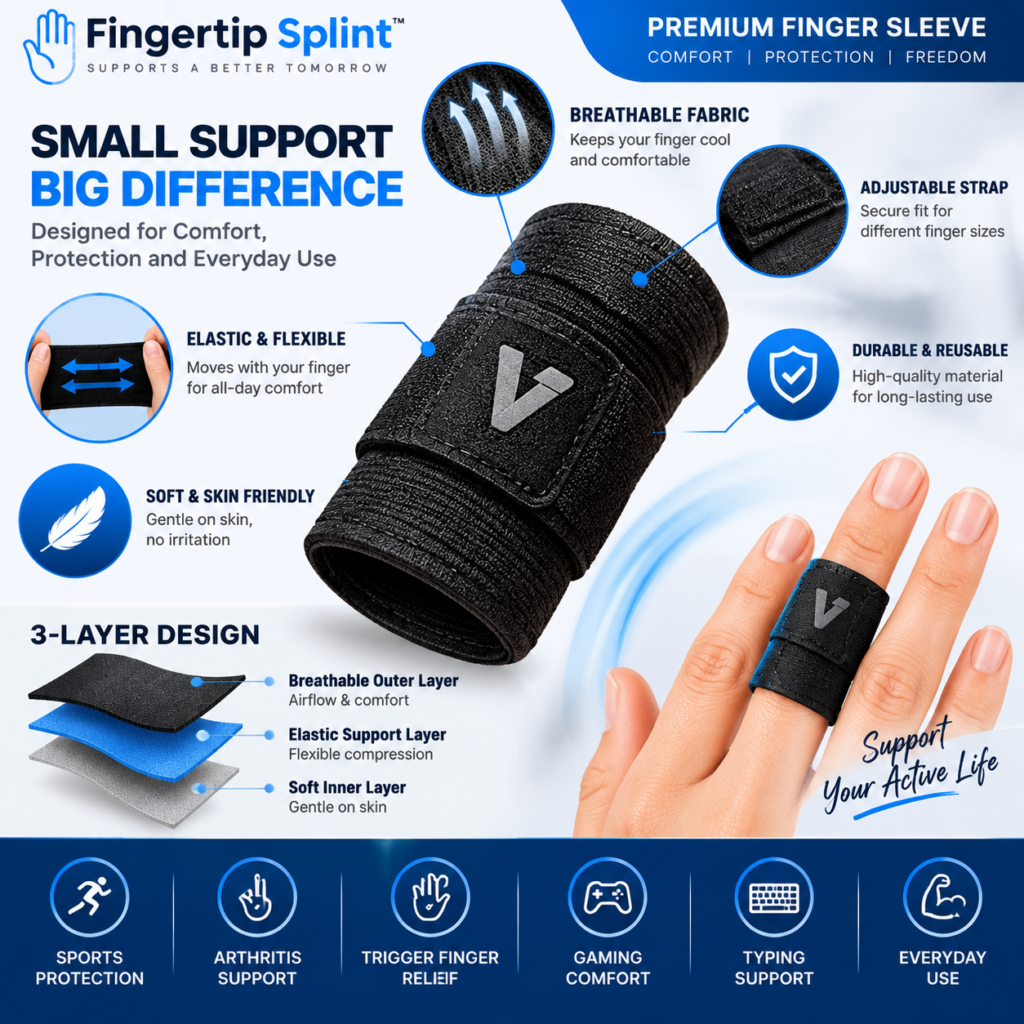
Your finger support should fit your routine, not the other way around. A sleeve that works well for typing may feel different while writing, using a smartphone, studying, working at a desk, traveling, or handling light household tasks. This guide breaks down what finger protector sleeves for everyday activities can realistically do, what to check before each activity, and how to match coverage, fit, movement, and comfort to the way you actually use your hands.
What This Guide Covers
- Quick Answer
- What Makes a Sleeve Suitable
- Activity 1 — Typing
- Activity 2 — Writing
- Activity 3 — Studying
- Activity 4 — Smartphone
- Activity 5 — Office Work
- Activity 6 — Light Household
- Activity 7 — Travel
- Activity 8 — Light Grip Tasks
- Activity Comparison Table
- How Activity Changes the Ideal Fit
- Finger Movement and Design
- 30-Second Activity Check
- Common Everyday-Use Problems
- Adjustable vs Fixed Sleeves
- Sleeve vs Brace
- What Not to Assume Protection Against
- 3D Interactive: A Day With a Sleeve
- Interactive Activity Selector
- Product Spotlight
- Doctor Advice
- Quick Tips
- FAQ
- Conclusion
Quick Answer: Can Finger Protector Sleeves Be Used for Everyday Activities?
Finger protector sleeves can be considered for everyday activities where their design provides appropriate coverage, fit, and movement. The important factors are the activity’s finger demands, the sleeve’s coverage and flexibility, secure positioning, comfort, and the manufacturer’s specified intended use. Suitability depends on matching the sleeve to the specific activity, not on the sleeve alone.
If you are still at the stage of understanding the wider product category, the overview Finger Protector Brace Explained: Features, Fit, and Everyday Uses covers the features and fit considerations across protector-style products. This guide assumes you already understand the basic product category and now want to know how a protector sleeve fits into real daily routines.
The central idea is simple: different activities place different demands on your fingers, so the useful characteristics of a protector sleeve can change from one activity to another. A sleeve that stays in place during typing may bunch while writing. A sleeve that feels comfortable during a phone call may feel too thick during long study sessions. The right approach is to understand what each activity demands, then check whether the sleeve’s coverage, fit, flexibility, profile, and construction match those demands.
What Makes a Finger Protector Sleeve Suitable for Everyday Activities?
Suitability is not a single property. A sleeve is suitable for an activity when several characteristics line up at the same time. If any one of them is off, the sleeve may feel wrong — even if it performs well on the others. This framework explains what to evaluate before you start using a sleeve for a specific task.
1. Appropriate Coverage
Does the sleeve cover the finger area the activity involves? Coverage is physical and cannot be extended by adjustment. Match coverage dimensions to the area in use.
2. Secure Fit
Does it stay positioned during the movement the activity requires? A sleeve that shifts during typing or writing quickly becomes distracting.
3. Movement
Does the design allow the finger movement the activity needs? Movement depends on material, thickness, coverage, and structure — not adjustment alone.
4. Comfort
Can it be worn without unnecessary pressure, seams that dig in, or edges that rub during repeated motion?
5. Profile
Does the sleeve’s thickness interfere with normal tasks? Lower profile designs tend to work better for typing, writing, and smartphone use.
6. Practicality
Is it easy to put on, remove, clean, adjust, and maintain? Practicality matters most for all-day use or travel.
These six characteristics interact. A sleeve with excellent coverage but a thick profile may not work for typing. A sleeve with a low profile and great flexibility may offer less coverage than needed for household handling. The goal is not to find a sleeve that maximizes every characteristic — it is to find one whose balance matches your activity.
Key insight: Suitability is specific to the activity. A sleeve that is appropriate for writing may be less appropriate for typing. That is not a defect — it is simply how coverage, fit, and movement interact with different task demands.
Activity 1 — Typing and Keyboard Use
Typing is one of the most demanding everyday activities for a finger sleeve because it combines repeated movement, sustained finger bending, and continuous contact with a hard surface. Each keystroke requires the finger to flex and extend, and any added thickness or resistance becomes noticeable quickly. This is why profile and flexibility matter more for typing than for many other activities.
The main challenge with typing is that the finger is doing a lot of small, precise movements in a short period. A sleeve that adds bulk at the fingertip can affect key contact. A sleeve that shifts slightly with each keystroke can require constant readjustment. A sleeve whose material bunches as the finger bends can create an uneven surface against the keys.
What Typing Demands
- Repeated finger movement
- Fine key pressing
- Sustained finger bending
- Consistent contact with keyboard surfaces
- Stable positioning over long sessions
What to Check
- Low-profile design
- Flexible material that moves with the finger
- Secure fit that does not shift with each keystroke
- No bunching as the finger bends
- Fingertip coverage appropriate to key contact
A useful rule for typing: the sleeve should feel almost invisible while you type. If you notice it with every keystroke, it is either too thick, too loose, or positioned in a way that interferes with fingertip contact. If you forget you are wearing it after a few minutes, the profile and fit are likely working for typing.
Realistic expectation: A finger protector sleeve is not intended to improve typing performance. The point is to provide coverage or support while allowing typing to continue as normally as possible. If typing becomes more difficult rather than less, the sleeve is not the right match for that activity.
For many users, the best approach is to test the sleeve during a short typing session before committing to a long one. Ten minutes of typing will usually reveal whether the sleeve shifts, bunches, or interferes with key contact. If any of these happen, adjust the position, check the fit, or consider a lower-profile design. The article Choosing an Adjustable Finger Support: What Should You Consider? provides a broader framework for matching a product to specific activity needs.
Activity 2 — Writing and Note-Taking
Writing places different demands on the finger than typing. The writing finger holds a pen, which means the sleeve must accommodate not only finger movement but also grip. A sleeve that works well for typing may feel completely different while writing because the finger is now holding an object, not just pressing a key.
The key question is simple: does the sleeve interfere with how you naturally hold a pen? If the added material changes your grip, creates pressure at the point where the pen rests, or causes the finger to slide, writing becomes harder rather than easier. Grip compatibility is the most important factor for writing, and it is often overlooked.
Coverage matters too. If the sleeve covers the fingertip, the writing finger’s contact with the pen changes. Some users find that a low-profile sleeve with minimal fingertip coverage works best for writing; others find that full-fingertip coverage is comfortable. This depends on individual grip style and the sleeve’s material.
Note-taking adds another dimension: duration. Writing a short note is different from writing for an hour. A sleeve that feels fine for a few lines may become uncomfortable during a long study session or meeting. Check how the material behaves against the pen contact point over time, not just at first touch.
If you write frequently, it is worth testing the sleeve during a realistic writing session before relying on it. Write a paragraph or two. If the sleeve shifts, bunches, or creates pressure at the pen contact, adjust the position or consider a different design. The detail in Finger Brace Fit Guide: Understanding Adjustability and Coverage is useful here for understanding how coverage and adjustment interact with grip.
Activity 3 — Studying and Extended Desk Work
Studying is a mixed activity. It combines writing, typing, textbook handling, smartphone use, and long periods of desk work. This makes studying a good test of a sleeve’s versatility — because the sleeve has to work across multiple demands rather than excelling at just one.
The main challenge with studying is duration. A study session can last hours, and a sleeve that is comfortable for thirty minutes may feel different after ninety. Comfort over time, moisture behavior, and how the material sits against the skin all become more important than peak performance in any single moment.
Study Session Fit Check
Tap each item as you confirm it before starting a study session.
Because studying involves so many activities, it is often the best practical test for a new sleeve. If the sleeve works through a full study session — typing notes, writing by hand, using a phone during breaks, handling textbooks — it is likely a good general-purpose choice. If it fails during one of these activities, you have identified the specific mismatch.
Practical tip: If you study for hours, keep a backup plan. A sleeve that begins to feel uncomfortable after a long session can be removed and reapplied after a short break. This is not a sign the sleeve is wrong — it is a sign that extended wear may require periodic readjustment.
Activity 4 — Smartphone and Touchscreen Use
Smartphone use is a fingertip-heavy activity. Tapping, swiping, scrolling, and holding the phone all involve the fingertip and the joint nearest to it. A finger protector sleeve that covers the fingertip may change how touchscreen interaction feels — sometimes noticeably, sometimes not at all, depending on the material and design.
This is an area where honesty matters. Not all sleeves work well with touchscreens. A thin, close-fitting sleeve made of a material that transmits touch may work fine. A thicker sleeve with padding at the tip may reduce sensitivity or require more pressure to register taps. The correct approach is to check the product description for any mention of touchscreen compatibility and to test the sleeve with your own phone before relying on it.
What Smartphone Use Demands
- Repeated tapping and swiping
- Fingertip contact with a flat surface
- Finger flexion for scrolling
- Grip stability while holding the phone
- Sensitivity at the fingertip
What to Check
- Fingertip coverage dimensions
- Thickness at the tip
- Whether the material allows touchscreen response
- How the sleeve behaves during rapid tapping
- Whether the sleeve slips during long phone use
Important: Do not assume touchscreen compatibility unless the product specifically states it or you have tested it. If the sleeve dulls touch sensitivity noticeably, it may be better suited to activities other than phone use. A sleeve does not have to work for every activity to be useful.
Because fingertip coverage is the primary factor for phone use, this activity is worth checking carefully if the sleeve you are considering covers the fingertip. If it does not cover the tip, sensitivity is generally less affected. If it does, test tapping, swiping, and scrolling before relying on the sleeve during daily phone use.
Activity 5 — Office Work
Office work combines keyboard use, mouse use, writing, document handling, phone use, and repetitive hand movements. It is similar to studying in its mixed nature but places more emphasis on repetitive movement and positioning consistency throughout a workday. A sleeve that stays secure through a full workday is more useful than one that requires frequent readjustment.
Office-Friendly Sleeve Checklist
Tap each item to confirm it for your office use case.
The office environment also includes phone use, which means the same fingertip considerations from Activity 4 apply here. If the sleeve covers the fingertip, check how it behaves during phone calls and screen interaction. If the office role includes writing by hand, the grip considerations from Activity 2 also apply.
Office work is where practicality shows up strongly. A sleeve that works well but is difficult to clean, adjust, or maintain becomes less useful over time. This is why material, care instructions, and adjustment ease matter for office users, even though they may not matter as much for short-duration activities.
Practical insight: Office work rewards consistency. A sleeve that requires readjustment every hour is less useful than one that stays in place through the workday. If frequent readjustment is needed, the fit or size is likely the issue — not the sleeve design itself.
Activity 6 — Light Household Tasks
Light household tasks include organizing items, folding clothes, handling lightweight objects, and everyday routines that involve grip and hand movement but no significant risk or strain. This is one of the most common everyday contexts for a finger protector sleeve, and it is also where the word “protection” is most easily misunderstood.
Important safety distinction: A general finger protector sleeve should not be assumed to protect against sharp tools, knives, high temperatures, flames, chemicals, heavy impact, or industrial hazards unless it is specifically designed and rated for that purpose. The word “protector” in product naming does not imply hazard protection.
Within light household tasks, the main check is stability. The finger changes shape when gripping and handling objects, so the sleeve needs to stay in position through these changes. A sleeve that shifts during light handling may not be a good fit for household use. A sleeve that stays in place and remains comfortable during simple tasks is likely a good match.
Examples of Light Household Tasks
- Organizing and sorting items
- Folding and handling clothes
- Handling lightweight containers
- Opening ordinary packaging
- Everyday picking up and putting down
What to Check
- Does it stay in position when the finger changes shape?
- Does it stay comfortable during simple grip changes?
- Is the coverage appropriate for the handling area?
- Is the material appropriate for the intended use?
It is not necessary or advisable to test the sleeve by performing strenuous tasks. Everyday use should be evaluated through everyday activities. If the sleeve works during normal household routines, it is doing its job. If you need protection from specific hazards, you need a product designed for that purpose — not a general sleeve.
Activity 7 — Travel
Travel places practical demands on a finger protector sleeve. It may be worn for long periods, taken on and off repeatedly, packed and unpacked, and used in different environments. Portability, ease of handling, and care requirements become more important than peak performance in any single activity.
Travel Checklist
Tap each item to confirm it for travel use.
One travel-specific consideration is variability. During travel, you may use your hands in ways you do not at home — carrying luggage, opening containers in unfamiliar environments, handling documents. A sleeve that works at your desk may feel different during travel. This does not mean the sleeve is unsuitable; it means the fit and stability should be checked before and during travel.
Another consideration is care. If the sleeve needs special cleaning or handling, that becomes less convenient while traveling. Products with simple care requirements are more practical for travel. If care instructions are unclear or impractical, that is worth noting before purchase.
Practical insight: Travel is not primarily about performance. It is about reliability and practicality. A sleeve that is easy to wear, easy to adjust, and easy to care for is more useful for travel than one that performs slightly better in one activity but requires more attention.
Activity 8 — Everyday Light Grip Tasks
Light grip tasks include holding lightweight objects, opening ordinary containers, handling personal items, and carrying small objects. These tasks involve the finger changing shape as it grips, which places specific demands on the sleeve’s stability and coverage.
The main question is straightforward: does the sleeve stay in position while the finger changes shape during gripping? If the sleeve shifts each time the finger closes or opens, it will be noticeable during daily use. If it stays in place through these changes, the sleeve is likely working well for this activity.
Coverage matters here too. If the gripping surface is the fingertip, a sleeve without fingertip coverage may not be the best match. If the gripping surface is the middle of the finger, coverage there matters more. Match the sleeve’s coverage to the part of the finger that actually contacts the object during grip.
Do not test with strenuous tasks: There is no need to perform heavy gripping or lifting tasks to test the sleeve. Everyday light grip tasks are sufficient to reveal whether the sleeve stays stable. Do not perform tasks that involve strain, sharp objects, or hazards to test the product.
The stability demonstrated during light grip tasks is usually a good indicator of how the sleeve will behave in other activities. If it stays in place during ordinary gripping, it is likely to stay in place during typing, writing, and phone use. If it shifts during gripping, it may also shift in other activities that involve similar hand movements.
Activity Comparison Table
This table summarizes the primary finger demands of each activity and what to consider when matching a sleeve to it. Use it as a quick reference when comparing products.
| Activity | Main Finger Demand | What to Consider |
|---|---|---|
| Typing | Repeated movement | Flexibility and low profile |
| Writing | Grip and movement | Thickness at pen contact and comfort |
| Studying | Mixed activities | Overall comfort and versatility |
| Smartphone use | Tapping and bending | Fingertip coverage and touchscreen response |
| Office work | Repetitive movement | Secure fit through the workday |
| Travel | Long-term practicality | Portability and care requirements |
| Light household tasks | Grip and handling | Stability and appropriate coverage |
| Light grip tasks | Grip changes | Stability through changes in finger shape |
The table does not rank activities by importance. It simply shows that each activity places slightly different demands on the sleeve, and the characteristics that matter most can shift from one activity to another. If you perform several activities daily, look for a sleeve that balances these demands rather than maximizing one at the expense of others.
How Activity Changes the Ideal Fit
There is no single “perfect” fit that works equally well for every activity. The ideal fit is the one that matches the activity’s demands. This is why some users find that a sleeve that works well for one activity needs adjustment for another.
Desk Work
Movement and low profile may matter most. A sleeve that adds minimal bulk and moves with the finger tends to work best.
Writing
Grip and finger positioning become more important. The sleeve should not change how the pen is held or create pressure at the contact point.
Smartphone Use
Coverage around the fingertip matters more. If the tip is covered, touchscreen response should be checked.
Household Tasks
Stability and coverage may become more important. The sleeve should stay in place during grip changes and handling.
Travel
Comfort and easy handling matter most. Portability, care requirements, and readjustability become more important than peak performance in any single activity.
Because the ideal fit changes with the activity, some users choose sleeves with adjustable features that allow the fit to be fine-tuned between activities. Others prefer to use separate sleeves for different contexts. Neither approach is universally right. The key is to know which characteristics matter most for your daily activities and to choose accordingly.
Finger Movement and Protector Sleeve Design
Different activities involve different kinds of finger movement. Typing and writing involve repeated flexion and extension. Smartphone use involves tapping and swiping. Household tasks involve grip changes. Travel involves a wider range of movements in a shorter period. Understanding these movement types helps explain why the same sleeve can perform differently across activities.
Flexion and extension
Grip and release
Fine motor movement
Repetitive motion
Sustained finger bending
Rapid changes in position
Sleeve characteristics interact with these movement types. Coverage determines which parts of the finger are affected. Material determines how the sleeve responds to movement. Thickness determines how much the sleeve changes the feel of movement. Fit determines whether the sleeve stays in place through movement. Adjustment determines whether the fit can be changed for different activities.
The guide How Adjustable Finger Sleeves Create a More Flexible Fit explains how material flexibility and adjustment work together to accommodate movement. Understanding that distinction makes it easier to evaluate how a specific sleeve will behave during a specific activity.
Key concept: Movement is not simply about whether a sleeve restricts or allows movement. It is about whether the sleeve allows the specific movement your activity requires without slipping, bunching, or creating pressure points. This is why the same sleeve can work well for one activity and less well for another.
How to Check the Sleeve Before an Activity
A short pre-activity check helps catch fit issues before they affect the task. The following 30-second routine can be run before any activity. It is a fit and usability check, not a medical test.
The routine takes less than a minute and can prevent most fit problems from affecting the activity. If step 6 produces concerning signs, the sleeve should be removed and the fit reassessed. Persistent symptoms that do not resolve after removing the sleeve should be assessed appropriately by a qualified professional.
Common Everyday-Use Problems
These six problems come up most often when people use finger protector sleeves during everyday activities. Each has a specific cause and a practical check.
The sleeve moves with each keystroke or slides down the finger.
Check: size, positioning, and adjustment level.
Material folds or gathers as the finger bends around a pen.
Check: material excess and placement on the writing finger.
Tapping and swiping feel less responsive or require more pressure.
Check: fingertip coverage and thickness at the tip.
Holding objects feels bulkier or less natural than before.
Check: whether the sleeve adds bulk around the gripping area.
Movement is limited or the finger feels stiff during use.
Check: whether the product’s construction is appropriate for the required movement.
Comfort decreases noticeably during longer wear.
Check: fit, pressure points, moisture, and material contact.
Most of these problems trace back to one of three causes: incorrect size, incorrect positioning, or a mismatch between the sleeve’s design and the activity’s demands. Addressing the cause is more effective than trying to compensate by tightening or repositioning repeatedly.
Adjustable vs Fixed Protector Sleeves for Everyday Use
Both adjustable and fixed protector sleeves can work for everyday activities. The right choice depends on how much fit flexibility you want and how often your needs change.
| Feature | Adjustable | Fixed |
|---|---|---|
| Fit customization | More flexible | Predetermined |
| Repositioning | Usually easier | More limited |
| Setup | More adjustment | Simpler |
| Sizing | Still important | Especially important |
| Daily handling | Customizable | Straightforward |
If your needs vary across activities, an adjustable sleeve may offer more flexibility. If your needs are consistent, a fixed sleeve may be simpler and equally effective. The detailed comparison Adjustable Finger Brace vs Fixed Support: What’s the Difference? covers the trade-offs in more depth.
Finger Protector Sleeve vs Finger Protector Brace
Sleeves and braces overlap as product categories. Sleeves often emphasize flexible coverage; braces often include additional structure or support. Actual functionality depends on the specific construction of each product rather than on the category name alone.
Sleeve-Style Products
Often emphasize flexible coverage, lower profile, and movement. Suited to activities where finger motion should continue as naturally as possible.
Brace-Style Products
Often include additional structure or support. Suited to activities where more structure is appropriate, but may add bulk for fine-motor activities.
If you are unsure which category fits your needs, the reference Finger Protector Brace Explained: Features, Fit, and Everyday Uses provides the detail. For most everyday activities, sleeve-style designs are common because they prioritize movement and low profile.
What Everyday Activities Should You Avoid Assuming the Sleeve Protects Against?
The word “protector” in product naming can create unrealistic expectations. A general finger protector sleeve is a consumer product designed for everyday use. It is not automatically protective equipment. Understanding this distinction is important for safety and for choosing the right product for the right purpose.
A general finger protector sleeve should not automatically be treated as protection against: sharp objects, cutting tools, heat, flames, chemicals, heavy impact, or industrial hazards — unless the specific product has appropriate specifications or certification for that hazard.
Sharp objects and cutting tools
Heat and flames
Chemicals
Heavy impact
Industrial hazards
Any hazard not stated by the manufacturer
If you need protection from a specific hazard, choose a product designed and rated for that purpose. A general-purpose sleeve is not the right category for those risks, regardless of how the product is marketed. This distinction protects both your safety and your expectations.
A Day With a Finger Protector Sleeve: 3D Interactive
The interactive below shows how a finger protector sleeve moves through a typical day. Tap each activity to see what to check.
Interactive 3D: Activity Explorer
Tap each activity to see what it demands from the sleeve
TYPING
Movement + low profile
WRITING
Grip + flexibility
SMARTPHONE
Tapping + fingertip coverage
STUDYING
Mixed finger movements
OFFICE
Repetitive movement + comfort
TRAVEL
Portability + care
HOUSEHOLD
Grip + secure positioning
LIGHT GRIP
Stability through grip changes
Typing
Main demand: Movement plus low profile.
What to check: Does the sleeve stay positioned through repeated keystrokes? Does it interfere with key contact? Is the material flexible enough to move with the finger without bunching?
Activity → Requirement
This simplified map shows which requirement matters most for each activity.
Which Activity Matters Most to You?
Select the activities you do most, and see what to check. This is educational guidance for product comparison, not a medical recommendation.
Answer all four questions to see your focus areas.
Product Spotlight: Matching the Sleeve to Your Activity
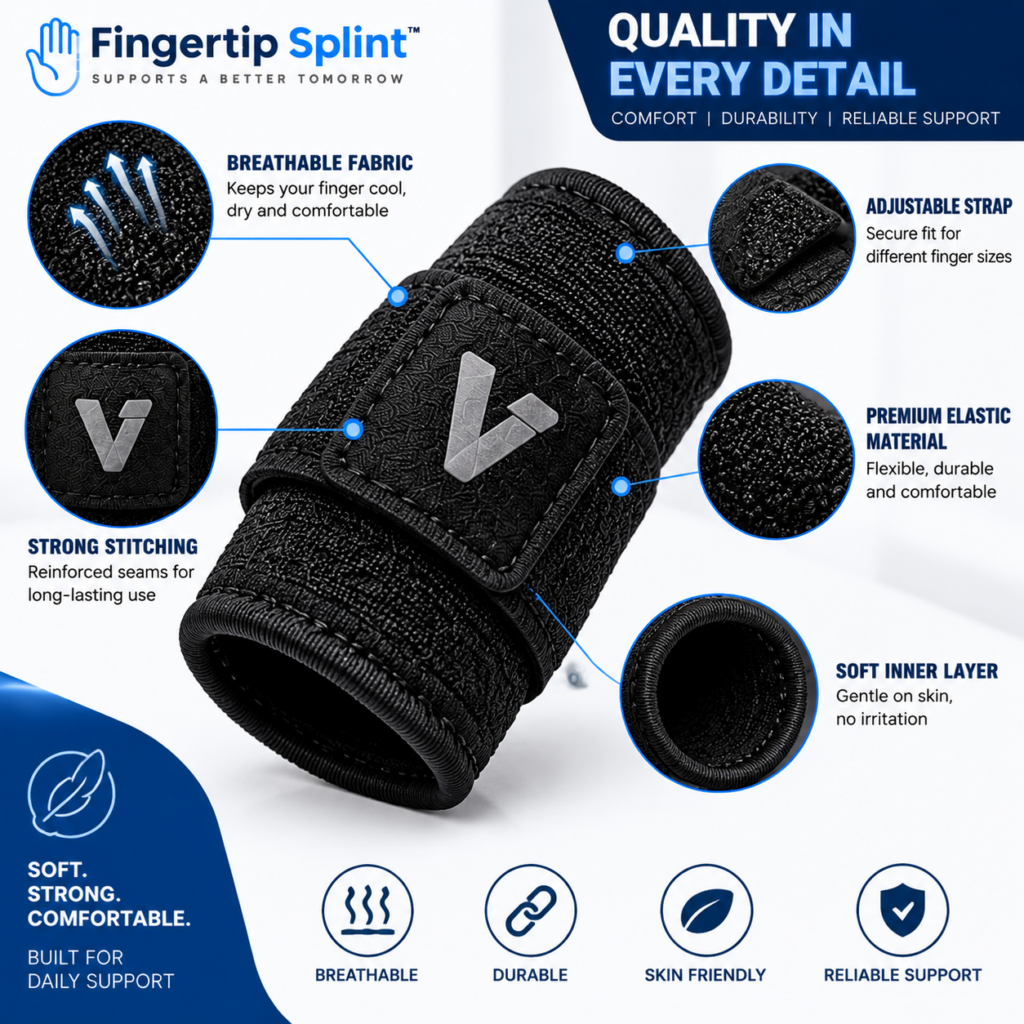
To make the activity framework concrete, here is how it applies to a specific product. The Adjustable Finger Support Sleeve is one option to examine if flexible coverage and adjustable fit are among your priorities. Its suitability for a particular activity depends on the product’s coverage, construction, fit, and the movement that activity requires.
Adjustable Finger Support Sleeve
- Adjustable design for customizable fit
- Flexible sleeve-style construction
- Designed for finger coverage and positioning
- Full product specifications available on the product page
What to Examine for Each Activity
Typing
Check the profile and movement characteristics. The sleeve should not interfere with key contact and should stay positioned through repeated keystrokes.
Writing
Check the thickness at the pen contact point and whether the sleeve changes your natural grip. Grip compatibility is the key factor.
Smartphone Use
Check fingertip coverage and touchscreen response. If the tip is covered, test tapping and swiping before relying on it for phone use.
Household and Grip Tasks
Check stability through grip changes. The sleeve should stay in place when the finger changes shape during handling.
Travel and Extended Use
Check practicality: portability, care requirements, and comfort over long periods. A sleeve that is easy to maintain is more useful for travel and all-day wear.
Doctor Advice: When Everyday Finger Support Isn’t Enough
A general-purpose finger sleeve is not a substitute for professional assessment. There are circumstances where a finger sleeve is the wrong category and professional guidance is appropriate.
Seek professional assessment rather than choosing a sleeve on your own if you have: a significant injury, visible deformity, major swelling, significant loss of movement, persistent or worsening pain, numbness or tingling, concerning discoloration, or other symptoms that concern you.
If a healthcare professional has advised you to use a particular medical support, follow that guidance. A consumer sleeve is not a substitute for a prescribed splint, brace, or immobilization method. The relevant distinction is between a general-purpose consumer support and a medically recommended support — they serve different purposes, and the second takes priority when it has been advised.
Questions About the Activity
- Does the activity require movement or restriction?
- Is flexible coverage appropriate for this use?
- Does the product match the recommended design, if any?
Questions About Symptoms
- Are symptoms changing with or without the sleeve?
- Are there warning signs to monitor during wear?
- Do symptoms warrant professional assessment?
For general information about hand and finger conditions, the following authoritative sources are useful:
- Mayo Clinic for condition overviews and patient education.
- WebMD for general finger and hand concern overviews.
- Healthline for practical wellness information.
- AAOS OrthoInfo for musculoskeletal guidance from orthopedic specialists.
- NHS guide on hand pain for UK-based clinical guidance.
- MedlinePlus hand injuries and disorders for a broad reference library.
- Cleveland Clinic for clear patient-oriented explanations.
- Johns Hopkins Medicine for clinical and research-based perspectives.
- NIH for research-based health information.
- NINDS for neurological resources where relevant.
- FDA for regulatory context on medical devices.
- CDC for public health guidance.
These resources provide general information and do not replace individualized advice from a qualified healthcare professional.
Quick Tips for Everyday Use
These seven tips help you get the most from a finger protector sleeve during daily activities.
Frequently Asked Questions
Yes, finger protector sleeves can be considered for everyday activities where their design provides appropriate coverage, fit, and movement. Suitability depends on matching the sleeve’s characteristics to the specific activity. The main factors are the activity’s finger demands, the sleeve’s coverage and flexibility, secure positioning, comfort, and the manufacturer’s specified intended use. A sleeve that works well for one activity may need adjustment or a different design for another.
Many people can wear a finger protector sleeve while typing, provided the sleeve has a low profile, stays positioned through repeated keystrokes, and does not interfere with key contact. Typing places high demands on finger movement and fingertip contact, so thin, flexible designs tend to work better than thicker ones. If typing becomes more difficult rather than less, the sleeve is likely not the right match for that activity. Test the sleeve during a short typing session before relying on it for longer periods.
Yes, provided the sleeve does not change your natural grip or create pressure at the point where the finger contacts the pen. Writing is a grip activity as well as a movement activity, so grip compatibility is the most important factor. A sleeve that shifts or bunches during writing will be noticeable. If you write frequently, test the sleeve during a realistic writing session before relying on it.
It depends on the sleeve. Smartphone use involves fingertip contact and repeated tapping, so fingertip coverage and material can affect touchscreen response. A thin, close-fitting sleeve may work fine; a thicker sleeve with padding at the tip may reduce sensitivity. Do not assume touchscreen compatibility unless the product specifically states it or you have tested it. Test tapping and swiping before relying on the sleeve for daily phone use.
Movement depends on material, thickness, coverage, structure, and position — not just on whether the sleeve is adjustable. A thin, low-coverage sleeve in a flexible material typically allows significant movement. A thicker, more structured sleeve may restrict movement more. If movement feels restricted during an activity, the sleeve’s construction may not be appropriate for that activity. Match movement characteristics to the activity rather than to a marketing claim.
No, not automatically. A general-purpose finger protector sleeve should not be assumed to protect against sharp objects, cutting tools, heat, flames, chemicals, heavy impact, or industrial hazards unless the specific product is designed and rated for that purpose. The word “protector” in product naming does not imply hazard protection. If you need protection from a specific hazard, choose a product designed and rated for that purpose.
It should feel snug and secure but not tight. The sleeve should stay positioned during the movement the activity requires, allow the intended movement, maintain coverage where intended, and remain comfortable through wear. It should not create unnecessary pressure, numbness, tingling, or concerning discoloration. If any of these occur, loosen or remove the sleeve and reassess the fit. The goal is an appropriate fit, not the tightest possible fit.
Your Finger Support Should Fit Your Routine
Different activities place different demands on your fingers. Matching coverage, fit, flexibility, profile, and construction to the activity you do most is what makes a finger protector sleeve useful in daily life. Check coverage. Check fit. Check movement. Then choose with confidence.
The Bottom Line on Finger Protector Sleeves for Everyday Activities
Finger protector sleeves can be useful across many everyday activities, but their usefulness depends on matching the sleeve to the activity. Typing favors low profile and flexible movement. Writing favors grip compatibility. Smartphone use favors fingertip coverage and touchscreen response. Household tasks favor stability and appropriate coverage. Travel favors portability and easy care. None of these are universal requirements — they are the demands each activity places on the sleeve.
The most common mistake is expecting one sleeve to work perfectly for every activity. A more realistic approach is to identify the activities you do most, then check whether the sleeve’s coverage, fit, flexibility, profile, and construction match those activities. If they do, the sleeve is likely a good match. If they do not, a different design or a different size may serve you better.
If you want to continue exploring within this cluster, the definition and mechanism article Adjustable Finger Support Sleeve: What Is It and How Does It Work? provides the foundational context, and the selection framework Choosing an Adjustable Finger Support: What Should You Consider? covers the buying decision in depth. For a wider reference, explore the full FingertipSplint blog library.
This article is for general information only and is not a substitute for professional medical advice. Always consult a qualified healthcare provider for diagnosis and treatment of any medical condition.