
What to Look for When Buying an Adjustable Thumb Splint
Many products use similar labels: adjustable, supportive, comfortable, flexible, ergonomic, universal. But these words don’t tell you everything you need to know. Before buying an adjustable thumb splint, look beyond the product title and inspect the features that affect fit, support, comfort, movement, and everyday usability.
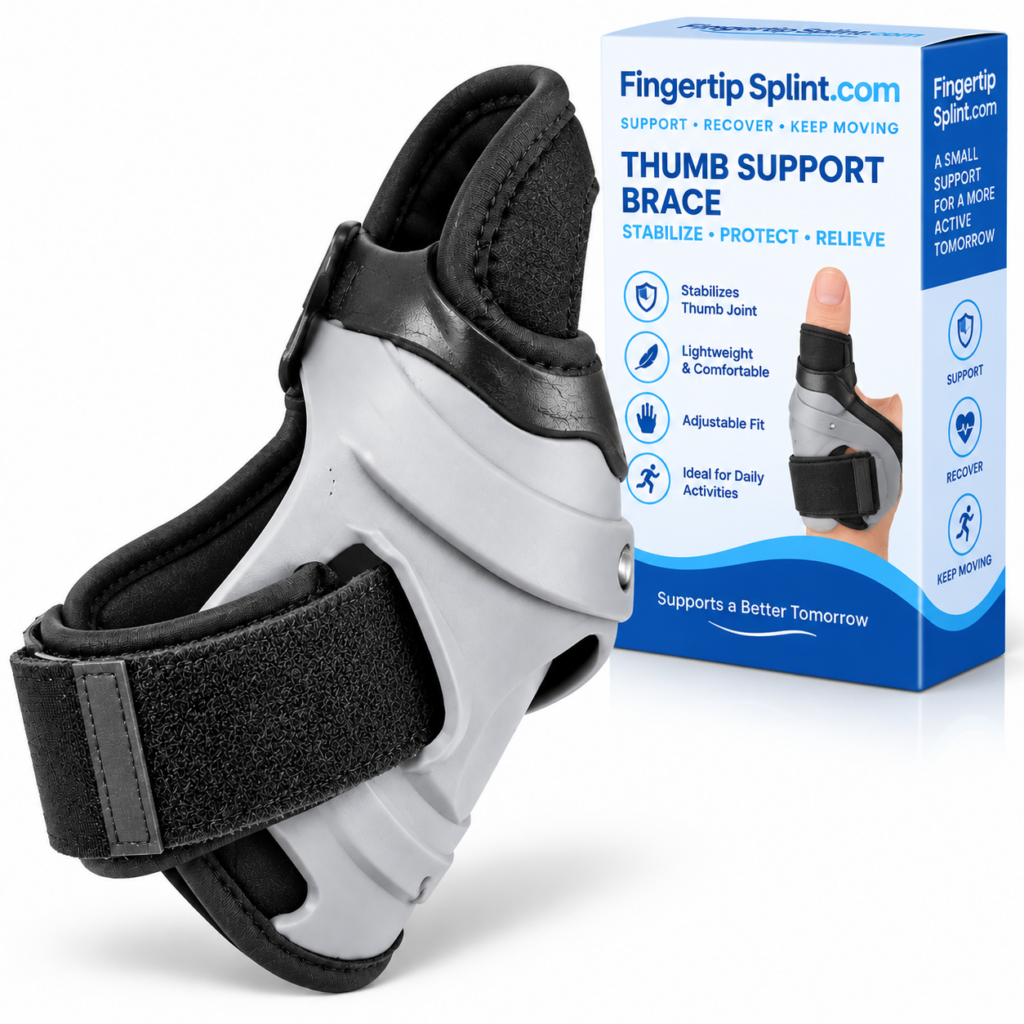
What This Guide Covers
- Quick Answer
- Step 1 — Start With Intended Use
- Step 2 — Check the Size
- Step 3 — What “Adjustable” Actually Means
- Step 4 — Examine Thumb Coverage
- Step 5 — Evaluate Support Structure
- Step 6 — Inspect the Material
- Step 7 — Examine the Fastening System
- Step 8 — Check Flexibility and Movement
- Step 9 — Evaluate Comfort
- Step 10 — Consider the Profile
- Step 11 — Read Product Specifications
- Step 12 — Look at Product Images
- Step 13 — Check Care Requirements
- Step 14 — Check Return/Exchange Info
- Step 15 — Compare Two Products
- 3D Interactive: Buying Checklist
- Red Flags When Shopping
- Green Flags to Look For
- Product Spotlight
- Interactive Buyer Checklist
- Common Buying Mistakes
- What to Consider Beyond Product Features
- 10-Point Buyer Checklist
- 7 Quick Buying Tips
- FAQ
- Conclusion
Quick Answer: What Should You Look for When Buying an Adjustable Thumb Splint?
When buying an adjustable thumb splint, look for correct sizing, intended coverage, a clear adjustment mechanism, suitable materials, appropriate support structure, comfortable design, suitable movement characteristics, secure fastening, care instructions, and clear product specifications. Don’t rely on the word “adjustable” alone — check what actually adjusts and whether the design matches your intended use.
If you still need the foundational explanation of what an adjustable thumb support splint is and how it works, the reference Adjustable Thumb Support Splint: What Is It and How Does It Work? covers that ground. This article focuses specifically on the pre-purchase inspection process.
Step 1 — Start With Your Intended Use
Before looking at product specifications, determine what you expect to do while wearing the splint. The intended activity can influence which characteristics matter most.
| Intended Activity | What May Matter Most |
|---|---|
| Studying / writing | Fine thumb movement and low profile |
| Typing / computer work | Repeated hand positioning and profile |
| Smartphone use | Thumb interaction and fastening stability |
| Reading | Grip and repositioning |
| Travel | Easy adjustment and practical fastening |
| Long periods of wear | Comfort and fit |
| Light daily activities | Stability and movement |
Key principle: Start with the activity, not the product. Your intended use determines which features matter most. Frequent writing may make movement and profile more important. Long periods of wear may make comfort and fit more important. Travel may make easy adjustment and practical fastening more important.
Step 2 — Check the Size Carefully
Sizing is one of the most important factors in a successful purchase. Do not assume “adjustable” means “one size fits all.” Adjustment works within a range built around a base size.
What to Look For
- Actual size range
- Measurement instructions
- Thumb measurements
- Hand measurements if specified
- Manufacturer sizing chart
- Adjustment range if listed
Warning Sign
If a product provides no meaningful sizing information, the buyer has less information with which to evaluate fit. A listing that says “universal fit” without an actual size range makes it difficult to assess whether the product will fit your hand.
For a deeper look at how fit and sizing work, the reference Thumb Splint Fit Guide: Understanding Adjustability and Comfort covers this topic in more detail.
Step 3 — Understand What “Adjustable” Actually Means
This is a critical buyer skill. The word “adjustable” is used broadly, but it can mean different things. Understanding what adjusts — and what does not — helps you evaluate whether a specific product meets your needs.
Adjustable Fastening
The strap can be tightened or loosened. This is the most common meaning of “adjustable” in thumb splint listings.
Adjustable Positioning
The design may allow some positioning changes. The splint can be repositioned along the thumb or hand to some degree.
Adjustable Fit
The product can accommodate variation within its intended size range. This is what most buyers expect, but it is not guaranteed by the word “adjustable” alone.
What “adjustable” does NOT necessarily mean: universal fit, unlimited movement, suitability for every condition, automatic comfort, or automatic higher support. Adjustment works within a specific range built around a base size.
For the mechanism behind adjustability, the reference How an Adjustable Thumb Splint Provides Flexible Support explains how adjustment interacts with support and movement.
Step 4 — Examine Thumb Coverage
Coverage determines exactly where the product provides support. Different designs cover different areas, and the buyer should understand what they are actually purchasing rather than relying on generic “thumb support” terminology.
Thumb
The thumb itself. Check whether the design covers the specific part of the thumb you need supported.
Thumb Base
The area where the thumb connects to the hand. Coverage in this area can affect how the thumb moves.
Palm
Coverage that extends onto the palm. May provide additional stability but increase bulk.
Wrist Transition
Coverage that extends toward the wrist. May provide additional stability but occupy more area.
Partial Coverage
Covers a specific portion of the thumb. May feel less bulky but provide less overall coverage.
Extended Coverage
Covers a larger section of the thumb and hand. May provide more structural contact but affect movement.
Coverage influences contact, profile, movement, and practicality. Match coverage to your intended purpose rather than maximizing it.
Step 5 — Evaluate the Support Structure
Support can come from several design elements working together. Understanding what creates support helps you evaluate whether a product provides what you need.
Where Support Comes From
- Material structure
- Reinforcement
- Strap positioning
- Product shape
- Contact area
Buyer Question
“Maximum support” is not enough information by itself. Ask: what physical design features create the support? A listing that explains the construction is easier to evaluate than one that relies on general terms.
Step 6 — Inspect the Material
Material affects comfort, durability, and how the splint feels during wear. Different materials suit different needs, and no single material is universally superior.
Fabric / material composition
Surface texture
Flexibility
Thickness
Weight
Breathability claims
Skin-contact areas
Cleaning instructions
Durability indicators
Important: Don’t automatically assume a particular material is superior. The important question is whether the material suits the intended use and comfort requirements.
Step 7 — Examine the Fastening System
The fastening system keeps the splint in position. Different designs offer different convenience and security characteristics.
What to Examine
- Strap type
- Closure mechanism
- Number of adjustment points
- Ease of application
- Ease of removal
- Stability during movement
- Strap width
- Contact with skin
Buyer Question
Can you realistically adjust the product correctly without struggling with the fastening? This is particularly relevant for an everyday-use product. A fastening system that is difficult to operate repeatedly may reduce the product’s practicality.
Step 8 — Check Flexibility and Movement
Flexibility affects how the splint behaves during activity. Buyers should consider how much thumb movement the design allows and whether that matches their intended activity.
| Activity | What to Consider |
|---|---|
| Writing | Fine thumb movement |
| Typing | Repeated hand positioning |
| Smartphone use | Thumb interaction |
| Reading | Grip and repositioning |
| Light tasks | Stability and movement |
Note: There is no universal “ideal” movement level. Compare the product’s design with your intended activity. The right balance depends on the product’s intended purpose and your needs.
Step 9 — Evaluate Comfort
Comfort is a result of multiple design elements working together. A poorly sized soft product can still be uncomfortable.
Inner contact surface
Edges
Seams
Padding
Material
Strap pressure
Overall bulk
Pressure distribution
Moisture behavior
The detailed design reference Thumb Support Brace Design: What Makes a Splint Comfortable? covers comfort-related design characteristics in more depth.
Step 10 — Consider the Product Profile
Profile refers to how bulky the splint is. Different profiles suit different activities, and neither is universally superior.
What Profile Affects
- Bulk
- Weight
- Thickness
- Compatibility with clothing
- Everyday activities
- Storage and portability
Buyer Choice
Choose based on what you actually plan to do while wearing it. A lower-profile design may suit fine-motor activities; a more substantial design may be appropriate when more structure is needed.
Step 11 — Read the Product Specifications
The product listing is your primary evidence when buying online. A strong listing provides enough information to evaluate the product against your requirements.
Look For
- Dimensions
- Size range
- Materials
- Weight
- Adjustment mechanism
- Coverage
- Care instructions
- Intended use
- Manufacturer information
Don’t Buy From the Headline Alone
Compare marketing claims with specific product information. If a listing says “adjustable support,” ask: what exactly adjusts? If it says “premium comfort,” ask: what material or construction provides this?
Step 12 — Look at Product Images Carefully
Product images provide visual information about the product design. Look at them carefully and systematically.
Strap placement
Thumb opening
Coverage
Material appearance
Seams
Fastening system
Overall profile
Interior contact area
Product in use
Important: Images cannot replace actual specifications or professional advice. Use images as one source of information alongside the product specifications.
Step 13 — Check Care and Maintenance Requirements
A product that is difficult to maintain may be less practical for your intended routine. Knowing the care requirements before purchase helps avoid surprises.
How it is cleaned
Whether it can be washed
Drying instructions
Storage requirements
Material stretch or deformation
Replacement guidance
Step 14 — Check Return and Exchange Information
This is particularly important for products where fit matters. Check the return and exchange policies before purchasing.
What to Check
- Return policy
- Exchange policy
- Size exchange availability
- Product condition requirements
- Warranty information if offered
Why It Matters
Fit is a key factor in whether a thumb splint works for you. If the product does not fit as expected, a clear return or exchange policy provides a way to correct the issue without losing the purchase entirely.
Step 15 — Compare Two Adjustable Thumb Splints
When comparing specific products, use a consistent framework. This helps you evaluate products objectively rather than being influenced by appearance or marketing language.
| Factor | Product A | Product B |
|---|---|---|
| Size information | ||
| Adjustability | ||
| Coverage | ||
| Material | ||
| Fastening | ||
| Flexibility | ||
| Profile | ||
| Care | ||
| Intended use | ||
| Price / value |
Key principle: The goal isn’t to name a “winner” — it’s to compare products against your specific requirements. A product that performs well on most factors but poorly on one that matters most to you may still be the wrong choice.
Adjustable Thumb Splint Buying Checklist: 3D Interactive
This interactive shows ten key checkpoints for inspecting an adjustable thumb splint. Tap each checkpoint to see what to examine.
Interactive 3D: Buying Checklist
Tap each checkpoint to see what to examine
1. Size
Check that the product provides a clear size range and measurement instructions. Don’t assume “adjustable” means “one size fits all.” Compare your measurements against the manufacturer’s sizing chart.
Check the design — not just the product name.
Red Flags When Shopping
These are signs that the product listing may not provide enough information to make a confident purchase decision.
Without sizing information, you cannot determine whether the product will fit your hand.
A universal fit claim without measurements leaves you guessing.
“Maximum support” or “advanced support” without describing how the support is provided leaves questions unanswered.
Material affects comfort, durability, and skin contact. Without material details, you cannot evaluate these factors.
Knowing how to clean and maintain the product affects its long-term practicality.
If you cannot see how the product is secured, it’s harder to evaluate ease of use.
If a listing makes medical claims that seem disproportionate to the information provided, be cautious.
Understanding what the product is designed to do helps you evaluate whether it matches your needs.
Green Flags to Look For
These are signs that a product listing provides enough information to evaluate the product effectively.
Specific measurements, sizing chart, and measurement instructions are provided.
Dimensions, materials, and weight are clearly stated.
Multiple angles, including close-ups of the fastening system and coverage areas.
Material composition and characteristics are described rather than vaguely referenced.
How the product adjusts is clearly explained.
Cleaning and maintenance requirements are provided.
The listing explains what the product is designed to do.
You know what options are available if the product does not work out.
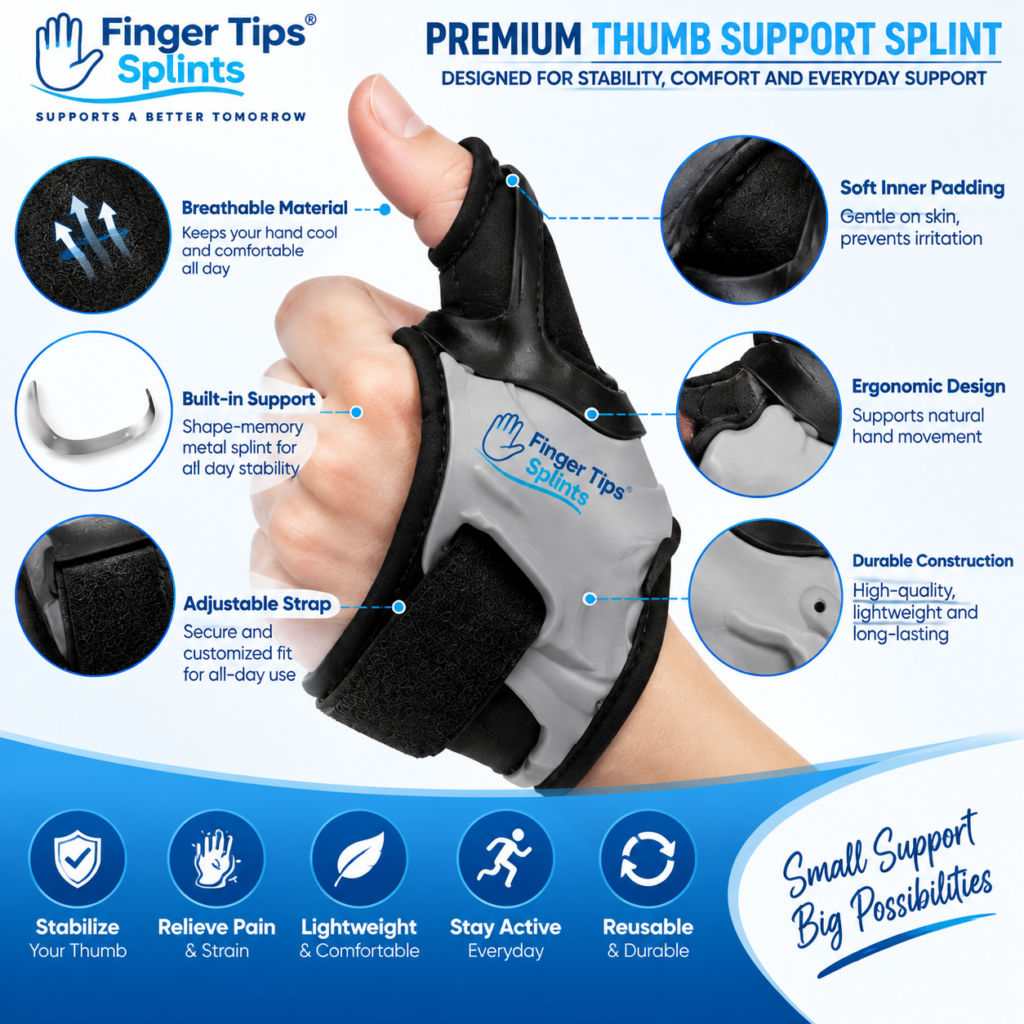
Product Spotlight: Adjustable Thumb Support Splint
After understanding the buying checklist, here is a specific product to examine using the same framework. The Adjustable Thumb Support Splint is one option to evaluate against the checklist taught in this guide.
Adjustable Thumb Support Splint
- Adjustable design for customizable fit
- Thumb-focused support construction
- Designed for thumb coverage and positioning
- Full product specifications available on the product page
Evaluating the Product Using the Buying Checklist
Sizing
Review the sizing information provided on the product page. Check that a sizing chart or measurement guidance is available.
Adjustability
Check what specifically can be adjusted. Review the adjustment mechanism and how it works.
Coverage
Review the coverage area. Confirm which thumb and hand areas the product is designed to cover.
Construction
Review the materials and components described on the product page. Check that specific information is provided.
Fastening
Check how the user secures the product. Review the fastening mechanism and how it is designed.
Comfort and Everyday Use
Consider which design elements contribute to comfort. Review what activities the design may suit based on its characteristics.
For broader buying context, the reference Choosing a Thumb Support Splint: What Should You Consider? covers the general decision framework. For the complete purchasing resource, see Adjustable Thumb Support Splint: A Complete Buyer’s Guide.
Interactive Buyer Checklist
Work through this checklist before purchasing. Tap each item to confirm it for the product you are considering.
Before Buying
Tap each item as you confirm it.
Check items to see your readiness summary.
Common Buying Mistakes
These mistakes come up frequently when buying adjustable thumb splints. Avoiding them improves the likelihood of a successful purchase.
Photos don’t show fit, support characteristics, or how the product behaves in use.
Check: specifications and product details, not just images.
Adjustment works within a range built around a base size.
Check: the size range and whether your measurements fall within it.
Correct size is the foundation of good fit.
Check: measure and compare to the manufacturer’s sizing chart.
Tightness is not a measure of support or comfort.
Check: adjust for appropriate fit, not maximum pressure.
A design that restricts movement you need may not be suitable.
Check: how the product behaves during your intended activity.
Price alone doesn’t tell you about fit, construction, or durability.
Check: compare features against your requirements.
If the product doesn’t work out, a clear return policy provides options.
Check: return and exchange information before ordering.
Marketing language describes product characteristics, not medical outcomes.
Check: what the product is actually designed to do.
What Should You Consider Beyond Product Features?
This section presents general principles. It does not claim that a doctor has personally endorsed a specific product.
A healthcare professional may need to determine whether a particular type of support is appropriate based on the individual’s situation. Product features are one consideration; medical appropriateness is a separate question.
Seek appropriate professional assessment for: significant injury, visible deformity, severe or worsening pain, substantial swelling, persistent numbness or tingling, major movement loss, or symptoms that persist.
For authoritative general information about thumb, hand, and wrist conditions, the following resources provide evidence-based content:
- Mayo Clinic for condition overviews and patient education.
- WebMD for general thumb and hand concern overviews.
- Healthline for practical wellness information.
- AAOS OrthoInfo for orthopedic guidance from specialists.
- NHS guide on hand pain for UK-based clinical guidance.
- MedlinePlus hand injuries and disorders for a broad reference library.
- Cleveland Clinic for clear patient-oriented explanations.
- Johns Hopkins Medicine for clinical and research-based perspectives.
- FDA for regulatory context on medical devices.
- NIH for research-based health information.
These resources provide general information and do not replace individualized advice from a qualified healthcare professional.
10-Point Buyer Checklist
Before purchasing, work through this checklist. It compresses the article’s main points into a single practical summary.
Final Buyer Checklist
Tap each item as you confirm it.
7 Quick Buying Tips
Frequently Asked Questions
Look for correct sizing, intended coverage, a clear adjustment mechanism, suitable materials, appropriate support structure, comfortable design, suitable movement characteristics, secure fastening, care instructions, and clear product specifications. Don’t rely on the word “adjustable” alone — check what actually adjusts and whether the design matches your intended use.
No. Adjustable thumb splints work within a specific range built around a base size. While adjustable designs accommodate small variations in hand size more flexibly than fixed-size products, they still have limits. A hand significantly outside the product’s size and adjustment range will not fit properly. Always check the manufacturer’s sizing information before purchasing.
Sizing is one of the most important factors in a successful purchase. Correct size is the foundation of good fit, and adjustment cannot fully compensate for a fundamentally wrong size. Always check the manufacturer’s sizing chart and measure your hand and thumb according to the supplied instructions before purchasing.
“Adjustable” can mean different things. It might refer to adjustable fastening (the strap can be tightened or loosened), adjustable positioning (the design allows some positioning changes), or adjustable fit (the product accommodates variation within its size range). Understanding what specifically adjusts — and what does not — helps you evaluate whether a product meets your needs.
There is no single “best” material. Consider material composition, surface texture, flexibility, thickness, weight, breathability, skin-contact characteristics, and durability. The important question is whether the material suits your intended use and comfort requirements. Look for specific material information in the product listing rather than general terms.
Neither is universally better. Flexible designs may allow more thumb movement, which can be useful for activities requiring fine motor control. More structured designs may provide more positional resistance, which may be appropriate for situations where more support is needed. The right choice depends on your intended activity and what you need the splint to do.
Check the sizing information, adjustment mechanism, coverage area, materials, fastening system, movement characteristics, care instructions, return policy, and product specifications. Look for specific details rather than relying on general marketing language. If the listing lacks key information, contact the seller or consider a product with more complete specifications.
Check the Design, Not Just the Product Name
When buying an adjustable thumb splint, don’t judge the product by the word “adjustable” alone. Check its size range, coverage, adjustment mechanism, materials, fastening, support structure, movement characteristics, comfort, care requirements, and overall suitability for the activities you expect to perform. Purpose → Size → Coverage → Adjustability → Support → Material → Fastening → Movement → Comfort → Quality → Care → Value
The Bottom Line on Buying an Adjustable Thumb Splint
Buying an adjustable thumb splint comes down to checking the actual product design rather than relying on the word “adjustable.” Size, coverage, adjustment mechanism, material, fastening, support structure, movement characteristics, comfort, care requirements, and overall suitability all contribute to whether a product will work for your situation.
The framework in this guide — Purpose → Size → Coverage → Adjustability → Support → Material → Fastening → Movement → Comfort → Quality → Care → Value — works across products and listings. Starting with your intended use and systematically evaluating each characteristic produces better outcomes than choosing by appearance or marketing language alone.
If you want to continue exploring within this cluster, the general decision framework Choosing a Thumb Support Splint: What Should You Consider? covers the broader selection process, and the fit guide Thumb Splint Fit Guide: Understanding Adjustability and Comfort covers fit in more depth. For a wider reference, explore the full FingerTipSplint blog library.
This article is for general information only and is not a substitute for professional medical advice. Always consult a qualified healthcare provider for diagnosis and treatment of any medical condition.