
CMC Thumb Spica Splint: What Is It and How Does It Work?
If you have been searching for terms like “CMC thumb splint,” “thumb spica splint,” “CMC support brace,” or “thumb wrist support brace,” you may be trying to understand what the product actually does before deciding whether it is relevant to you. This guide explains the CMC joint, what “spica” means, how the support structure works, and how the design influences thumb and wrist movement. It is written as the educational starting point for understanding CMC-focused thumb support.
What This Guide Covers
- Quick Answer
- What Does CMC Mean?
- Why Is the CMC Joint Important?
- Interactive: Explore the Thumb CMC Joint
- What Is a CMC Thumb Spica Splint?
- What Does “Thumb Spica” Actually Mean?
- How Does a CMC Thumb Spica Splint Work?
- 3D Interactive: How It Works
- Interactive: How It Works Explorer
- What Parts of the Thumb and Wrist Does It Support?
- CMC Support vs Complete Immobilization
- How Does the Splint Affect Thumb Movement?
- Interactive: Thumb Movement Explorer
- Everyday Activities
- Product Spotlight
- Fit and Positioning
- Common Mistakes
- What Should You Monitor While Using a CMC Splint?
- Who Might Research a CMC Thumb Spica Splint?
- What Should You Ask a Healthcare Professional?
- Quick Tips
- FAQ
- Conclusion
Quick Answer: What Is a CMC Thumb Spica Splint and How Does It Work?
CMC refers to the carpometacarpal joint at the base of the thumb. A thumb-spica splint is designed to support the thumb while also extending onto the wrist or hand area. Its structure can help limit or guide certain thumb movements depending on its design. Proper fit and intended use matter.
If you want the broad buyer overview first, the reference CMC thumb spica splint guide covers the full purchase journey. This article focuses specifically on the anatomy, terminology, and mechanism behind CMC thumb-spica designs.
What Does CMC Mean?
CMC stands for carpometacarpal. This is the joint at the base of the thumb where the first metacarpal bone connects with the wrist-side structure of the hand. In plain language, the CMC joint is the thumb-base joint — the saddle-shaped joint that gives the thumb its wide range of motion.
Where the CMC Joint Sits
The CMC joint is located at the base of the thumb, near the wrist. It connects the thumb’s first metacarpal to the trapezium bone of the wrist. This position is why a thumb-spica design usually extends onto the hand and wrist — to stabilize the base of the thumb from the structure above it.
Why It Is Called “Saddle”
The CMC joint is often described as saddle-shaped because the surfaces allow the thumb to move in multiple directions: forward, back, side-to-side, and in opposition. This unique structure is what gives the human thumb its dexterity.
Important distinction: The thumb CMC joint is at the base of the thumb. It is different from the MCP joint (middle knuckle) and the IP joint (tip knuckle). Understanding which joint is affected is important because splint designs are often specific to the joint they are intended to support.
For general information about thumb and hand anatomy, the Cleveland Clinic hand anatomy resource provides a clear starting point. For a broader orthopedic perspective, the AAOS hand and wrist conditions library covers hand conditions in detail.
Why Is the CMC Joint Important for Thumb Movement?
The CMC joint is central to nearly every thumb movement. It allows the thumb to combine several directions of motion, which together produce the movements we use in daily life.
Movement
The CMC joint allows the thumb to move in multiple directions — flexion, extension, abduction, adduction, and opposition.
Positioning
The joint positions the thumb relative to the fingers, which is essential for grip and pinch.
Stability
The joint’s stability, supported by ligaments and soft tissues, is important for controlled movement.
Grip
The CMC joint is used whenever you grip an object, from a pen to a jar lid.
Pinch
Pinch movements — thumb against index finger — depend on the CMC joint for precise positioning.
Opposition
Opposition — bringing the thumb across the palm to meet the other fingers — is a hallmark human movement powered by the CMC joint.
Because the CMC joint is central to so many thumb movements, support around the base of the thumb can affect how the thumb moves in daily activities. This is why a CMC-focused splint often extends onto the hand and wrist — to stabilize the base of the thumb while influencing the movements that occur at the CMC joint.
Interactive: Explore the Thumb CMC Joint
Click each label to understand the anatomy around the CMC joint. This is an educational tool, not a medical diagram.
Explore the Thumb CMC Joint
Click each label to see a short explanation.
What Is a CMC Thumb Spica Splint?
Now that we have covered the CMC joint, we can define the actual product category. The term breaks into four parts, and understanding each one clarifies what the product is.
CMC
The area of the thumb being discussed — the carpometacarpal joint at the base of the thumb.
Thumb
The body part being supported. The thumb is the primary focus of the splint’s design.
Spica
A splint design that typically incorporates the thumb into the support structure while extending onto the hand or wrist area.
Splint
A device intended to support, position, protect, or limit movement depending on its construction and intended use.
Buyer insight: Understanding each part of the term helps you evaluate specific products. A splint that says “CMC thumb spica” is describing both the joint area it is designed around (CMC) and the structural configuration (spica). But the exact coverage and design still vary between products.
What Does “Thumb Spica” Actually Mean?
“Spica” is often the most confusing part of the term. A thumb spica generally describes a support configuration that includes the thumb and extends into the hand or wrist region. The word comes from the Latin for “ear of wheat” and, in a medical context, describes a support that crosses the body part in a specific structural pattern.
Important: A thumb spica is not necessarily one identical physical design. Different products can vary in thumb coverage, wrist coverage, rigidity, straps, openings, materials, adjustment, and the degree of movement allowed. “Thumb spica” describes a structural family, not a universal design.
What Thumb Spica Designs Typically Include
- A thumb-support section that holds the thumb
- Extension onto the hand or wrist
- Some form of fastening (straps or closures)
- Materials ranging from flexible to semi-rigid
What Varies Between Products
- How much of the thumb is covered
- How far onto the wrist the support extends
- How rigid the structure is
- How adjustable the straps are
- Whether openings are provided for airflow
- What materials are used
For a deeper look at how the thumb spica design supports both the thumb and wrist together, the reference thumb spica brace support guide covers the topic in detail.
How Does a CMC Thumb Spica Splint Work?
This is the main mechanism section. Understanding the sequence helps clarify how a CMC thumb spica splint supports the thumb and wrist.
Important: Not every CMC splint completely immobilizes the thumb. Different designs influence movement in different ways. The exact effect depends on the specific product’s construction, fit, and intended use.
How a CMC Thumb Spica Splint Works: 3D Interactive
This interactive shows the components of a CMC thumb spica splint and how they work together. Tap each component to see what it contributes.
Interactive 3D: How a CMC Thumb Spica Splint Works
Tap each component to explore its role
1. CMC Joint
The carpometacarpal joint at the base of the thumb. A CMC-focused splint is designed to provide support around this joint area, which is central to thumb movement, grip, pinch, and opposition.
Thumb movement → Support structure → Positioning → Movement limitation or guidance
Interactive: How It Works Explorer
Click each stage to understand how a CMC thumb spica splint works. This is an educational tool, not a medical recommendation.
How It Works Explorer
Click each stage to explore.
What Parts of the Thumb and Wrist Does It Support?
CMC thumb spica splints typically extend across several areas of the thumb, hand, and wrist. Understanding what each area contributes helps clarify how the device works.
| Area | Why It Matters |
|---|---|
| Thumb base | Central CMC region — where support is focused in a CMC-specific design. |
| Thumb | Main supported digit — positioned within the thumb-support section. |
| Hand | Helps anchor the splint — provides a stable base for the support structure. |
| Wrist | Provides structural support depending on the design — extends the anchor area. |
| Straps | Maintain positioning — hold the splint in place during wear. |
| Support surface | Distributes contact — determines how force is spread across the finger. |
Important: The exact coverage varies by product design. Some CMC splints extend further onto the wrist; others are more focused on the thumb base. Comparing the product’s stated coverage against your intended use is essential.
For a broader look at the features and fit of thumb-wrist support braces, the reference thumb wrist support brace guide covers the topic in detail.
CMC Support vs Complete Immobilization
This is an important distinction. Support does not automatically mean complete immobilization. Different designs fall along a spectrum from support-focused to more rigid immobilization.
| Feature | Support-Focused Design | More Rigid Immobilization |
|---|---|---|
| Movement | May allow selected movement | Usually more restricted |
| Structure | Flexible or semi-rigid, depending on product | More rigid |
| Comfort | Often designed around everyday wear | May feel more restrictive |
| Purpose | Positioning and support | Stronger movement restriction |
| Design | Varies considerably | Often more structured |
Important: Neither category is universally superior. Support-focused and more rigid designs serve different purposes. The appropriate choice depends on the specific situation and professional recommendations where applicable.
How Does the Splint Affect Thumb Movement?
To understand how a CMC splint influences movement, it helps to know the basic thumb movements. The thumb is unique in its ability to move in multiple directions, and the CMC joint is central to almost all of them.
Flexion
Bending the thumb toward the palm. Used in gripping and holding objects.
Extension
Straightening the thumb away from the palm. Used in opening the hand and releasing objects.
Abduction
Moving the thumb away from the index finger, out to the side. Used when spreading the hand.
Adduction
Moving the thumb toward the index finger. Used in closing the hand and gripping.
Opposition
Bringing the thumb across the palm to meet the other fingers. This is the movement that allows humans to grip objects with precision — and it is powered by the CMC joint.
A CMC splint can influence these movements depending on where the support sits, the rigidity of the structure, the size of the thumb opening, the strap positioning, the wrist coverage, and the overall design. Some CMC splints allow more movement; others restrict movement more substantially.
Interactive: Thumb Movement Explorer
Click a movement to understand how a CMC thumb spica splint may interact with it. This is an educational tool, not a medical recommendation.
Thumb Movement Explorer
Click each movement to see how a support structure may interact with it.
Everyday Activities
This section explains how a CMC thumb spica splint may interact with everyday activities. It does not claim the splint makes activities painless. Comfort and usability can vary substantially between people and designs.
Writing
Writing involves sustained thumb positioning and grip. Consider whether the splint allows the movement required for pen grip.
Typing
Typing involves repetitive thumb and finger movements. Consider the profile of the splint and whether it interferes with keyboard use.
Phone Use
Phone use requires thumb dexterity. Consider whether the splint allows the movements required for tapping and swiping.
Opening Containers
Opening jars or containers involves significant thumb force and grip. Consider whether the splint supports or restricts this movement.
Carrying Lightweight Objects
Consider whether the splint allows the movements needed for grasping and holding.
Household Activities
Consider whether the device stays securely positioned during light tasks and whether the activity is appropriate for its intended use.
Important: Comfort and usability can vary substantially between people and designs. Not every CMC splint is appropriate for every activity. Follow the manufacturer’s instructions and professional guidance where applicable. For a discussion of everyday support, the reference CMC thumb spica splint for everyday support covers the topic in detail.
Product Spotlight: CMC Thumb-Wrist Support Design
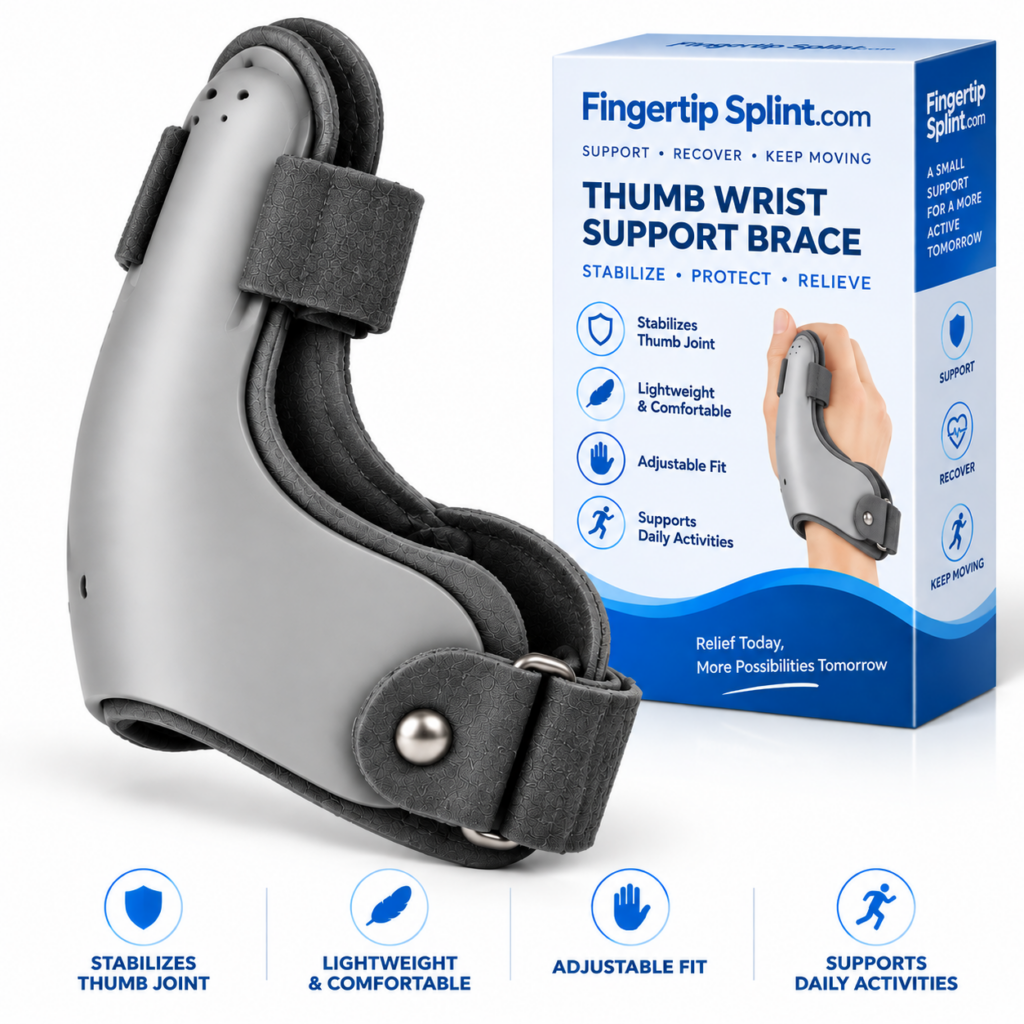
After understanding the mechanism, here is a specific product to examine. The 1 Pcs Thumb Wrist Support Brace CMC Thumb Spica Splint is one example of a CMC-focused thumb and wrist support design. It is presented as a product to examine using the mechanism concepts covered in this guide — not as “the best CMC splint.”
Thumb Wrist Support Brace
- Thumb and wrist support format
- CMC-focused design
- Adjustable components
- Coverage across the thumb base and wrist area
- Full product specifications available on the product page
Evaluating the Product Using the Mechanism Framework
Thumb and Wrist Support Format
The product is designed as a thumb and wrist support format. This aligns with the CMC thumb spica concept of supporting the thumb while extending onto the hand or wrist area.
CMC-Focused Design
The design is oriented around CMC support — providing structure around the base of the thumb and the surrounding area.
Adjustable Components
Review the adjustment system described on the product page. Check how the adjustment works and whether it stays secure during movement.
Coverage
Review the thumb and wrist coverage characteristics described. Compare the stated coverage against your intended use.
Intended Support Configuration
Review the intended support configuration described on the product page. Consider whether the design matches your requirements and follow appropriate professional guidance where applicable.

This view shows how the support structure wraps around the thumb base and extends onto the hand and wrist. Coverage varies by product design. Always follow the manufacturer’s sizing and adjustment instructions for the specific product.
For a comparison of CMC support versus regular thumb splints, the reference CMC thumb support vs regular thumb splints covers the differences in more detail. For buyer criteria, see what to consider when choosing a thumb wrist support brace.
Fit and Positioning
This is a concise mechanism-oriented explanation of fit. For the full fit guide, see the reference linked below.
What Good Fit Means
- Thumb sits correctly within the support
- Support does not create excessive pressure
- Straps secure rather than aggressively compress
- Circulation and sensation are monitored
- Manufacturer’s sizing instructions are followed
Signs to Reassess Fit
- Numbness or tingling
- Significant discoloration
- Persistent pain or increasing discomfort
- Pressure points
- Device slipping or shifting
For a detailed look at fit and coverage, the reference thumb spica splint fit guide covers the topic in more detail.
Common Mistakes
These mistakes come up frequently when people use CMC thumb spica splints. Avoiding them improves the experience.
Different products use different structures, coverage, and levels of support.
Check: the specific product’s design and coverage.
Sizing systems differ between products. A size that fits in one brand may not fit in another.
Check: measure according to the manufacturer’s sizing chart.
More tension is not automatically better. Excessive tightening can cause discomfort and reduce tolerance.
Check: follow the manufacturer’s adjustment instructions.
A more restrictive design may not be more appropriate for every situation.
Check: whether the support level matches the intended purpose.
Significant injury, deformity, or severe symptoms warrant professional assessment rather than self-selecting a splint.
Check: whether professional assessment is appropriate.
These symptoms should not be dismissed as normal.
Check: remove the splint and seek appropriate guidance if symptoms persist.
Different thumb problems can have different management requirements.
Check: whether a CMC splint is appropriate for your specific situation.
The manufacturer’s instructions are specific to the product.
Check: the product documentation before use.
What Should You Monitor While Using a CMC Thumb Spica Splint?
Because recovery depends on the underlying problem, this section provides a staged reassessment framework rather than a week-by-week healing timeline. There is no universal timeline for everyone using a CMC thumb spica splint.
Initial Use
Check comfort, positioning, and tolerance. Confirm the splint is positioned correctly and does not create excessive pressure. Follow the manufacturer’s fitting instructions.
Ongoing Use
Monitor whether the device remains appropriately positioned and comfortable. Check for slipping, pressure points, or changes in sensation.
Reassessment
If symptoms persist, worsen, or new symptoms develop, seek appropriate professional guidance. Do not simply increase tension or adjust the device repeatedly.
Remember: Recovery depends on the underlying issue, severity, treatment plan, and individual response. There is no universal week-by-week timeline for everyone using a CMC thumb spica splint.
Who Might Research a CMC Thumb Spica Splint?
This section is informational rather than diagnostic. Different people come to this topic for different reasons.
CMC Joint Support
Some people are researching support specifically around the CMC joint at the base of the thumb.
Thumb-Base Support
Others are looking for support around the base of the thumb during everyday activities.
Thumb and Wrist Stabilization
Some readers are interested in stabilization that includes both the thumb and wrist.
Thumb Spica Designs
Others are comparing different thumb spica designs to understand what each type is intended to do.
Hand Support Options
Some people are researching general hand support options and want to understand the CMC category.
Support During Everyday Activities
Others are looking for support they can use during daily activities.
Important: This section does not diagnose the reader. Suitability depends on the person’s specific situation and professional guidance where applicable.
What Should You Ask a Healthcare Professional?
This section is written with an EEAT (Experience, Expertise, Authoritativeness, Trustworthiness) perspective. It does not provide individualized medical advice, but it does explain what to discuss with a healthcare professional.
What is causing my thumb symptoms?
A CMC splint is a support device, not a diagnosis. Understanding the underlying cause is an important first step.
Is a thumb-spica design appropriate?
Different thumb problems may require different approaches. A professional can help determine whether a thumb-spica design is appropriate.
How much movement should be restricted?
The appropriate level of restriction depends on the underlying problem and treatment plan.
How long should I use the device?
The duration of use depends on the underlying problem and treatment plan.
Should I wear it during specific activities?
Some activities may benefit from support; others may not. Professional guidance can help determine what is appropriate.
What symptoms mean I should stop using it?
Numbness, tingling, significant discoloration, persistent pain, or increasing discomfort warrant reassessment.
Do I need a professionally fitted device?
Some situations may benefit from professional fitting. A professional can help determine what is appropriate for the specific situation.
Warning Signs That Warrant Professional Assessment
- Severe or worsening pain
- Significant swelling
- Visible deformity
- Major loss of movement
- Persistent numbness or tingling
- Concerning skin or circulation changes
- Symptoms that are not improving
For general information about thumb and hand conditions, see the Mayo Clinic overview of thumb arthritis. For broader hand anatomy and condition information, the Cleveland Clinic hand anatomy resource provides useful context. For an orthopedic perspective, the AAOS thumb arthritis library is a widely referenced resource. For general public health information, the NHS hand pain guidance offers a practical overview. Additional medical reference information is available through MedlinePlus hand injuries and disorders. For clinical and anatomy-focused context, Johns Hopkins Medicine hand conditions provides further reading. General educational context is also available through WebMD’s overview of thumb arthritis and Healthline’s thumb arthritis information. For peer-reviewed literature, NCBI PubMed Central hosts open-access research where appropriate. For a broader orthopedic reference, Orthobullets provides structured clinical summaries.
Important: This article does not provide individualized medical advice. Always consult an appropriate healthcare professional regarding your specific situation.
CMC Thumb-Spica Quick Checklist
Quick Fit Checklist
Before using a CMC thumb spica splint, check the following. Click each item to mark it as reviewed.
Frequently Asked Questions
A CMC thumb spica splint is a support device designed around the carpometacarpal joint at the base of the thumb. It typically incorporates the thumb into the support structure while extending onto the hand or wrist area. The word “spica” describes a structural configuration, and “CMC” indicates that the design is oriented around the thumb-base joint. Not every CMC thumb spica splint is designed the same way — coverage, rigidity, and adjustment vary between products.
CMC stands for carpometacarpal — the joint at the base of the thumb where the first metacarpal bone connects with the wrist-side structure of the hand. This saddle-shaped joint allows the thumb to move in multiple directions and is central to grip, pinch, and opposition. A CMC-focused splint is designed to provide support around this joint area.
A CMC thumb spica splint works by creating a support structure around the thumb and hand/wrist area. The thumb is positioned within the support, and the structure around the thumb base provides support. The wrist or hand extension acts as an anchor for the support structure, and straps help maintain positioning. Movement is influenced rather than simply “stopped” — different designs restrict, guide, or stabilize movement in different ways. The exact effect depends on the specific device.
Not necessarily. Different thumb-spica designs provide different levels of restriction. Some designs are support-focused and allow selected movement; others are more rigid and restrict movement more substantially. Support does not automatically mean complete immobilization. The appropriate level of restriction depends on the underlying problem, the treatment plan, and professional recommendations where applicable.
Many thumb-spica designs extend into the wrist or hand area to help stabilize the support structure. However, exact coverage varies by product design. Some CMC splints extend further onto the wrist; others are more focused on the thumb base. Review the product’s stated coverage and compare it against your intended use.
Movement depends on the design, fit, and intended use of the specific splint. Some CMC splints allow more movement; others restrict movement more substantially. A support structure can influence thumb movements such as flexion, extension, abduction, adduction, and opposition. The exact amount of movement permitted depends on the device. Follow the manufacturer’s instructions and professional guidance where applicable.
Seek professional advice if there is a significant injury, visible deformity, severe or worsening pain, major swelling, persistent numbness or tingling, substantial loss of movement, or symptoms that are not improving. Also seek guidance if you are uncertain whether a CMC splint is appropriate for your specific situation. A CMC splint is a support device, not a diagnosis. Professional assessment can help determine the appropriate approach.
Conclusion: Understanding the CMC Joint Helps You Evaluate Any Thumb Spica Design
A CMC thumb spica splint is defined less by the words on the label and more by where the structure sits, what it contacts, and how it influences thumb movement. Understanding the CMC joint — the saddle-shaped joint at the base of the thumb — helps clarify why a thumb-spica design typically extends onto the hand and wrist. Understanding what “spica” means helps clarify that this describes a structural family, not one universal design.
This guide has covered what CMC means, why the CMC joint is important for thumb movement, what a CMC thumb spica splint is, what “thumb spica” actually means, how the mechanism works, what parts of the thumb and wrist it supports, how it compares to more rigid immobilization, how it affects thumb movement, and what to monitor during use. The goal has been to provide a clear educational foundation for understanding CMC-focused thumb support.
Looking for a CMC-Focused Thumb and Wrist Support Design?
Review the CMC Thumb Spica Splint and compare its design, coverage, and support features with your needs. The 1 Pcs Thumb Wrist Support Brace CMC Thumb Spica Splint is one example of a CMC-focused thumb and wrist support design.
View the Thumb Wrist Support BraceNeed information about other thumb and hand support products? Explore the FingerTipSplint shop. For general questions, see the FingerTipSplint FAQ. For B2B inquiries, see the medical finger splint supplier page or request a quote.