Sports Recovery Guide
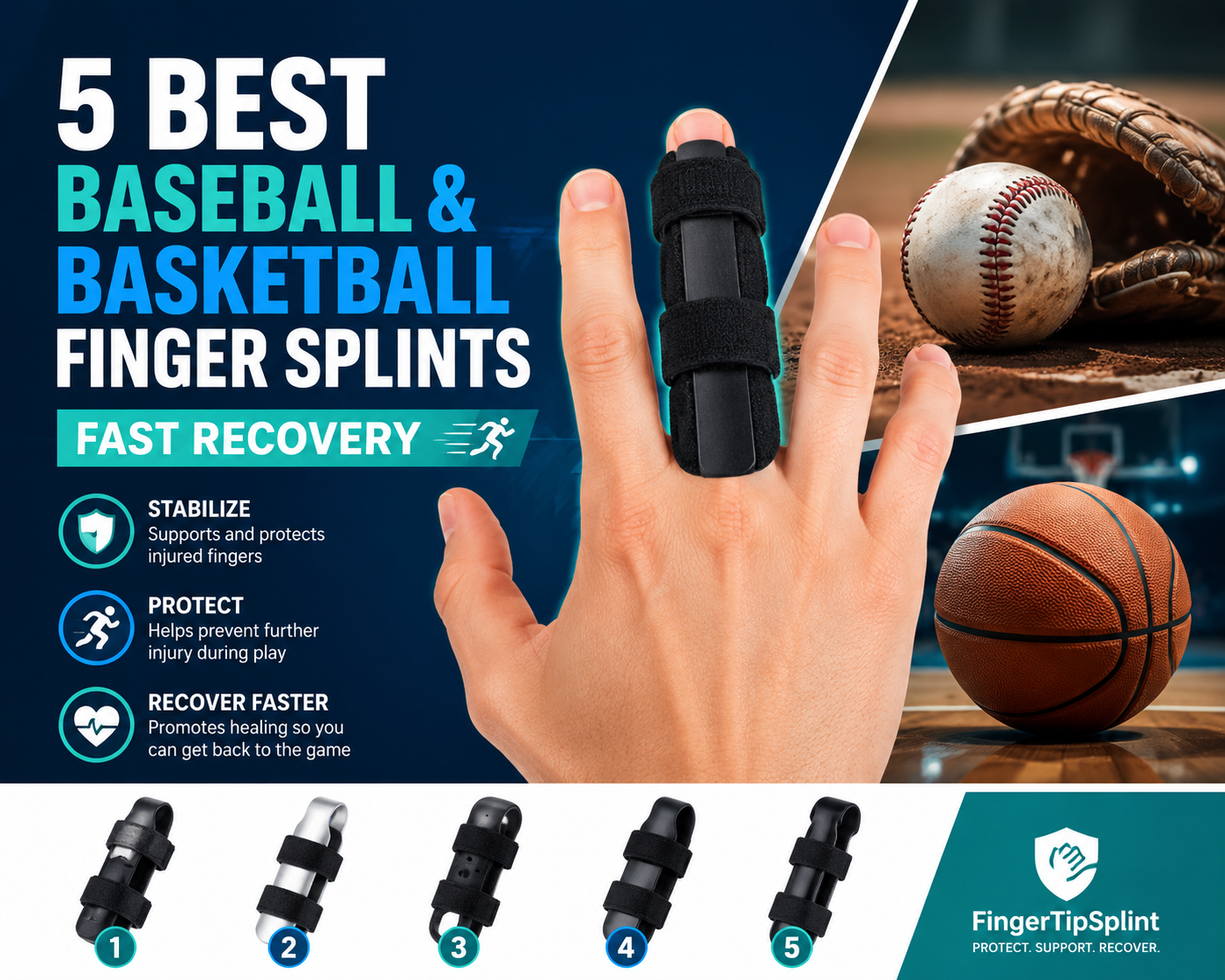
5 Best Baseball & Basketball Finger Splints for Fast Recovery
A baseball finger splint or basketball finger splint can protect your injured finger, reduce pain, and get you back in the game faster — if you choose the right one.

Finger & Fingertip Splints for Mallet, Pinky & More
Sports Recovery Guide
A baseball finger splint or basketball finger splint can protect your injured finger, reduce pain, and get you back in the game faster — if you choose the right one.
A baseball finger splint can be the difference between a quick return to the game and weeks on the sideline. Whether you took a ball off the tip of your finger in the outfield or jammed a finger going up for a rebound, getting the right support immediately matters. This guide breaks down the 5 best types of sports finger splints, how to choose between them, exactly how to wear one, and the warning signs that mean you need to see a doctor first.
Quick Answer
A baseball finger splint (also used for basketball injuries) is a supportive brace that holds an injured finger stable while it heals. It reduces pain, prevents further damage, and supports recovery from jammed fingers, sprains, minor fractures, and tendon injuries. The right type depends on your specific injury.
Both sports expose your fingers to repeated, high-force impacts. A poorly timed catch or an awkward rebound can leave a finger swollen, stiff, and painful within seconds. A baseball finger splint or basketball finger splint is most useful when:
Athletes, coaches, and hand therapists working with sports players are among the most frequent users of finger splints. The earlier you apply support, the better the healing environment.
The mechanism of injury differs significantly between these two sports — and understanding that helps you choose the right baseball finger splint or basketball splint.
Primary mechanism: Ball impact at fingertip
Primary mechanism: Lateral force at PIP joint
Both injuries can look similar — swollen, painful, hard to move. An X-ray is the only reliable way to rule out a fracture. If the finger looks deformed or cannot move at all, seek medical care before applying any splint.
Not all finger splints are the same. Choosing the right baseball finger splint or basketball splint depends entirely on the injury type. Here are the five main options and when each works best.
Tape the injured finger to the one beside it. Allows natural movement while reducing side-to-side stress. Most popular for in-game protection.
A firm brace that holds the finger straight. Provides maximum immobilization. Best for rest periods between training sessions, not during play.
Wrap-style with adjustable straps. Balances support and comfort. Good for athletes who need to continue light daily activity during recovery.
Holds the fingertip flat while the extensor tendon heals. The gold-standard treatment for mallet finger. Must be worn continuously — removing it even once resets the clock.
Allows controlled movement while supporting the healing structure. Used in later recovery stages and post-surgical rehabilitation under therapist guidance.
Wearing a baseball finger splint correctly is just as important as choosing the right type. Incorrect application can slow healing or cause skin irritation.
If the splint causes numbness, worsening pain, skin breakdown, or discoloration, remove it and seek medical advice. A properly fitting splint should feel supportive and comfortable throughout the day.
One of the most common mistakes athletes make is removing a finger splint too early. The general rule: let pain-free movement and your clinician guide your return — not the calendar. Below are rough starting estimates only.
For mallet finger — the classic baseball finger injury — the tendon must be held completely straight for the full 6–8 weeks. Removing the splint even briefly can require restarting the treatment period from day one. The American Society for Surgery of the Hand (ASSH) provides detailed guidance on mallet finger splinting protocols that your doctor may follow.
A sports finger injury can look like “just a jam” but sometimes involves a fracture, dislocation, or complete tendon rupture that needs professional assessment before any splinting. Never self-splint if any of the following are present.
These signs suggest that something more serious than a sprain may be present. Early professional assessment gives you the best chance of full recovery. Don’t wait.
Our sports finger splint range covers every injury type — from mild jammed fingers to serious mallet finger requiring a stack splint. Browse by injury type below.
Adjustable, lightweight, and designed for athletes. Provides firm support for jammed fingers, sprains, and minor fractures during recovery.
For mallet finger (drooping fingertip after a ball impact), the stack splint is the more appropriate choice. For pinky-specific injuries, see the pinky finger splint page. Always consult a doctor before purchasing if unsure of your injury type.
Playing through a jammed finger risks making the injury significantly worse — especially if there is an underlying fracture or ligament tear that hasn’t been diagnosed yet. Buddy-taping and a short rest period are safer options. You should stop play completely if the finger is visibly deformed, cannot bend at all, or is numb. Always get it professionally assessed if you are unsure of the severity.
Both cause swelling, pain, and stiffness — which is why they are so easy to confuse on the field. A fracture is a crack or break in the bone and typically causes more severe pain and greater difficulty moving the finger. The problem is you cannot reliably tell the difference without an X-ray. If there is any doubt, treat the injury as a potential fracture and have it assessed by a healthcare professional before applying a splint.
A baseball finger splint should feel snug and supportive — not tight enough to restrict blood flow. The test: you should be able to slide the tip of another finger under the edge of the splint. If the injured finger goes numb, turns white or blue, or tingles, the splint is too tight and must be loosened immediately. Swelling changes through the day, so check fit regularly.
Many players use buddy taping or a low-profile adjustable brace to protect a recovering finger during play. Whether this is safe for you depends entirely on the injury type and severity — not every injury allows return to contact sport with just a splint. Your doctor or physiotherapist is best placed to advise on when it is safe to return to play and what level of protection is appropriate for your specific injury.
The majority of finger sprains and simple fractures heal well with splinting and do not require surgery. Surgery is typically considered for complex fractures, complete ligament tears, dislocations that cannot be properly reduced, or injuries that fail to respond after weeks of conservative splint treatment. A hand surgeon or orthopedic specialist will assess your injury with imaging and recommend the right approach for your specific case.
Mallet finger (also called “baseball finger”) happens when a ball strikes the tip of an outstretched finger, tearing the extensor tendon that lifts the fingertip. The result is a fingertip that droops and cannot straighten on its own. Treatment is continuous splinting with a stack splint for 6–8 weeks. The tendon must be kept straight the entire time — removing the splint even briefly can restart the healing clock.
Yes — FingerTipSplint ships across all 50 US states with fast domestic shipping. We also ship to Canada, the UK, and Australia. Check the individual product page for current shipping timelines, rates, and availability for your location.
A baseball finger splint or basketball finger splint can meaningfully support your recovery — but only if you choose the right type for your injury, apply it correctly, and wear it for long enough.
Explore our full range of sports finger splints, or visit the recovery blog for more condition-specific guides.
This article is for general educational purposes only and is not medical advice. FingerTipSplint does not diagnose, treat, or prescribe. For any serious, worsening, or persistent injury, please consult a qualified healthcare professional.