
Finger Sleeves for Finger Support: What Are They and How Do They Work?
If your finger has been aching, feeling unstable, or simply uncomfortable during everyday tasks, you have probably searched for answers and encountered a wall of confusing product names: finger sleeves, finger splints, finger braces, wraps, guards, joint supports. This guide cuts through that confusion. By the end, you will know exactly what a finger sleeve is, how its design provides support, how it differs from more structured options, and what to check before choosing one.
What This Guide Covers
- Quick Answer
- What Is a Finger Support Sleeve?
- How Finger Sleeves Work
- 3D Mechanism Infographic
- Materials and Construction
- Flexibility and Movement
- Fit and Positioning
- Sleeves vs Splints
- Everyday Uses
- What Sleeves Provide
- What They Don’t Do
- When a Sleeve Isn’t Enough
- How to Put One On
- Common Mistakes
- Comfort Basics
- Support Spectrum
- Buyer Decision Tool
- Product Spotlight
- FAQ
Quick Answer: What Are Finger Sleeves for Finger Support?
A finger support sleeve is a flexible, sleeve-style wearable that fits around part or all of a finger. Depending on its material and construction, it may provide coverage, light support, cushioning, or compression while allowing more natural finger movement than rigid supports. A sleeve is not automatically the same as a medical splint.
Understanding that single distinction — flexible sleeve versus structured splint — is often the difference between buying the right product and buying something that never quite works for your situation. For readers who want to explore the full range of flexible support options, the finger support products collection at FingertipSplint is a good starting point.
To truly understand why a sleeve feels and functions differently from a splint, it helps to look at how the sleeve is constructed.
What Exactly Is a Finger Support Sleeve?
A finger support sleeve is a wearable covering designed to sit around the finger. It is not a device, not an appliance, and not typically a rigid structure. It is closer to a second layer of fabric — shaped, sized, and constructed to wrap a portion of the finger in a way that provides support, coverage, or cushioning.
The concept is simple, but the details matter. Let’s break down what a sleeve actually is by looking at its four defining attributes:
Shape
Most finger sleeves are tubular or finger-shaped. Some are open at both ends, others closed at the fingertip, and some are shaped specifically around a joint. The shape directly affects which portion of the finger the sleeve covers and how it sits during movement.
Material
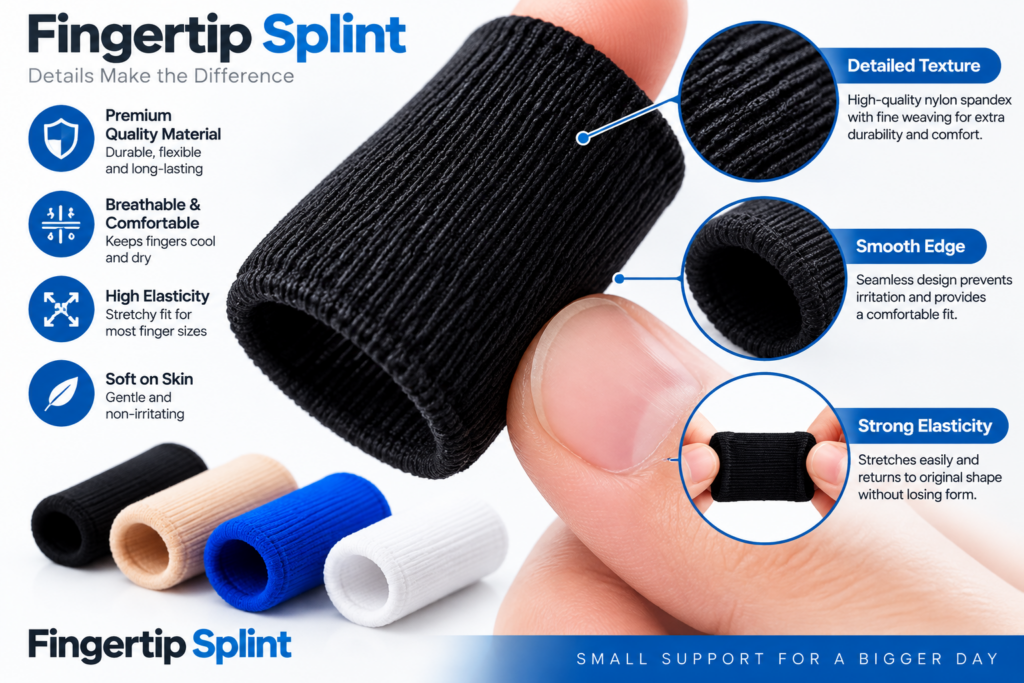
Sleeves may be made from flexible textile, elastic fabric, foam-containing constructions, silicone, or composite materials. Each material brings different properties — stretch, softness, durability, moisture handling, recovery after stretching — and the material choice significantly influences how the sleeve feels and functions.
Coverage
Sleeve coverage varies widely. Some cover only the fingertip. Others extend across the middle of the finger, wrap around a specific joint, or surround most of the finger. Coverage is a design choice, not a quality marker — the right coverage depends entirely on what you need the sleeve to do. The complete guide to fit, comfort, and coverage explores this in depth.
Support Characteristics
The support a sleeve provides depends on the interaction of material, thickness, elasticity, construction, coverage, and fit. A thin, highly elastic sleeve provides very different support than a thicker, more structured one. This is why “finger sleeve” is a category, not a single specification.
Important: Don’t assume every finger sleeve provides the same type or level of support. Two sleeves can look nearly identical online but behave very differently when worn — because material, thickness, and construction vary significantly between products.
How Do Finger Support Sleeves Work?
This is the heart of the article. Understanding the mechanism helps you evaluate any sleeve you encounter — not just the one you’re considering today.
A finger sleeve works through five interacting principles. None of them acts alone. When a sleeve feels right, all five are working together. When a sleeve feels wrong, one or more of them is out of balance.
A. Material Tension
Elastic or flexible materials conform around the finger. When stretched into position, they maintain a gentle, consistent contact with the skin. This contact is what allows the sleeve to stay in place and provide its intended effect. The tension shouldn’t be so tight that it causes discomfort, and not so loose that the sleeve slips.
B. Coverage
Coverage creates a consistent layer around the targeted area. Whether the sleeve covers the fingertip, the middle of the finger, a joint, or a larger portion of the finger, its coverage defines where the support is actually delivered. For a full explanation of how coverage interacts with everyday use, see the everyday activities guide.
C. Contact and Fit
A properly sized sleeve remains positioned around the finger during ordinary movement. This is where fit becomes critical. A sleeve that fits correctly provides predictable coverage. One that doesn’t fit correctly either slips (too loose) or causes pressure (too tight).
D. Flexibility
Unlike many rigid support products, flexible sleeves can move with the finger depending on their construction. This is what allows users to type, write, and handle objects while wearing one. The trade-off is that flexible sleeves generally do not restrict movement the way structured supports do.
E. Cushioning or Surface Layer
Some designs provide a layer between the finger and external surfaces. This is useful when you want a physical barrier between the finger and everyday contact. Be careful not to assume a general-purpose sleeve protects against hazards like heat, sharp objects, or impact — those require equipment specifically designed and rated for the hazard.
Interactive 3D: How a Finger Sleeve Works
Tap each layer to see how it contributes to the sleeve’s function
Outer Material
Provides the sleeve’s physical structure and surface. This is the layer that comes into contact with the outside world and determines much of the sleeve’s durability, feel, and appearance.
These components work together. No single layer defines how a sleeve performs on your finger.
What Materials Are Finger Support Sleeves Made From?
Materials vary significantly across products. Different materials are chosen for different reasons — some prioritize stretch, others durability, others skin comfort. Here are the common material categories you’ll encounter:
Elastic Textiles
Stretchy woven or knitted fabrics. Common for flexible, movement-friendly sleeves. Comfortable against skin and breathable.
Stretch Fabrics
Fabric blends with higher elasticity. Often used when a sleeve needs to conform tightly to finger shape without slipping.
Silicone-Based Materials
Grippy, elastic, and often used for cushioning. Can provide more structure than fabric while remaining flexible.
Foam-Containing Constructions
Fabric combined with foam for added cushioning. Used when a sleeve needs more protective bulk.
Composite Materials
Layered constructions combining multiple materials to balance stretch, structure, durability, and comfort. Often used in higher-quality sleeves.
Don’t assume one material is universally superior. Material properties influence stretch, thickness, softness, durability, moisture handling, skin contact, and recovery after stretching. The right material depends on your activity, wear duration, and comfort preferences. For a full breakdown of material and design, see Finger Support Sleeves Explained: Features, Uses and Design.
How Flexible Are Finger Sleeves?
Flexibility is the defining characteristic of a finger sleeve. That’s what separates it from structured supports and splints. But “flexible” doesn’t mean every sleeve behaves the same way.
A flexible sleeve may accommodate bending, straightening, typing, writing, smartphone use, and light routine activities. But the actual range of movement depends on product design and fit. A thicker sleeve with more structure will naturally allow less movement than a thin, highly elastic one.
Interactive: Finger Movement Range
Tap each movement to see what a flexible sleeve allows.
STRAIGHT
BENT
GRIP
The baseline position. A sleeve that fits correctly should sit comfortably around the finger without slipping, bunching, or creating pressure. This is the starting check before evaluating any movement.
Why Fit Matters to How a Sleeve Works
Fit is not a cosmetic detail — it directly determines whether a sleeve provides its intended support. The relationship is simple: material plus size plus finger shape plus coverage equals actual wearing experience.
Too Loose
- Slipping during movement
- Bunching
- Inconsistent coverage
- Frequent adjustment needed
Appropriate Fit
- Stable positioning
- Better comfort
- Predictable coverage
- Minimal adjustment needed
Too Tight
- Excessive pressure
- Discomfort
- Numbness or tingling
- Discoloration
Stop and reassess: If the sleeve causes numbness, tingling, discoloration, or persistent discomfort, remove it and reassess the fit. If symptoms continue after removal, seek appropriate professional advice. The NHS guide on hand pain and MedlinePlus hand injuries and disorders offer reliable starting information.
The complete fit framework — including measurement, sizing systems, and coverage matching — is covered in Finger Sleeves for Support: A Guide to Fit, Comfort and Coverage.
Finger Sleeves vs Finger Splints
This is the comparison that trips up most buyers. Both products fit on a finger. Both are called “finger supports.” But they’re built for different purposes.
| Feature | Finger Sleeve | Finger Splint |
|---|---|---|
| Construction | Flexible, sleeve-style | Structured, rigid or semi-rigid |
| Flexibility | Generally higher | Generally lower |
| Movement | Preserved to a greater degree | Often intentionally limited |
| Bulk | Often lower | Can be higher |
| Main design focus | Coverage, comfort, light support | Stabilization, positioning, restriction |
| Everyday usability | Often convenient | Depends on design |
If you’re deciding specifically between these two support approaches, the article Finger Support Sleeve vs Finger Splint: What’s the Difference? walks through the design, fit, comfort, and movement differences in full detail.
What Can Finger Support Sleeves Be Used For?
Finger sleeves are used across a wide range of everyday activities. The common contexts include:
✍️ Writing
⌨️ Typing
📚 Studying
📱 Smartphone use
💼 Office work
🏠 Light routine tasks
✈️ Travel
These aren’t medical treatments — they’re contexts where flexible support might be useful. Don’t assume a sleeve will resolve a specific condition. For a deeper activity-by-activity look, see Understanding Finger Support Sleeves for Everyday Activities.
What Does a Finger Sleeve Actually Provide?
Here’s a precise list of what a finger sleeve is designed to provide. These are product-design characteristics — not guarantees of a particular medical outcome.
Coverage
A sleeve surrounds a portion of the finger. Which portion depends on its design.
Flexibility
The material may move with the finger, allowing natural movement during use.
Surface Layer
The sleeve creates a physical layer around the covered area, adding a barrier between your finger and surrounding surfaces.
Fit and Positioning
Stretch and sizing help keep the sleeve positioned where intended during normal movement.
Low-Profile Design
Many sleeve-style products are less structurally bulky than rigid supports, making them easier to integrate into daily life.
What Finger Sleeves Do NOT Automatically Do
This section matters. A generic finger sleeve is a support product — not a medical device, not a treatment, and not a replacement for professional evaluation. Here’s what a sleeve does not automatically do:
❌ Diagnose an injury
❌ Treat every finger condition
❌ Immobilize a finger
❌ Replace professional evaluation
❌ Provide certified protection against workplace hazards
❌ Replace a prescribed splint
❌ Guarantee pain relief
The honest positioning: A finger sleeve is a flexible support and coverage product. It can be useful for everyday comfort and light support. It is not a substitute for professional assessment when something is genuinely wrong.
When a Finger Sleeve May Not Be Enough
This is one of the most important sections in the guide. If any of the following applies to your situation, a consumer sleeve should not be your first line of response — professional assessment should be.
🩹 Significant injury
🦴 Visible deformity
📈 Severe or worsening pain
💧 Major swelling
⚡ Persistent numbness or tingling
🚫 Major loss of movement
⏳ Symptoms that aren’t improving
For trusted guidance on hand and finger conditions, see the AAOS OrthoInfo hand and wrist conditions library, Mayo Clinic, and Cleveland Clinic. For general health information, the NIH and CDC are reliable resources. If a neurological component is involved, NINDS offers specialist information.
How to Put on a Finger Support Sleeve
A quick practical sequence for applying a sleeve correctly:
Don’t follow a universal wearing schedule — duration depends on the specific product’s design and your individual circumstances. Always check the manufacturer’s instructions.
Common Mistakes When Using Finger Sleeves
These eight mistakes cause most of the frustration in this category. Each is easy to avoid once you know what to look for.
Size determines everything. A sleeve that doesn’t fit correctly can’t provide its intended support. Measure and check the manufacturer’s sizing chart.
Over-stretching during application can distort the sleeve, weaken the material, and cause it to lose shape. Apply gently.
Bunching creates pressure points and reduces coverage consistency. Smooth out folds after application and after movement.
Tighter doesn’t mean more supportive. Excessive tightness causes discomfort, restricts circulation, and can cause numbness. Snug is the goal.
Tears, stretched-out elastic, or frayed edges compromise both function and comfort. Inspect regularly and replace when worn.
These are warning signs, not “getting used to it.” Remove the sleeve and reassess. If symptoms persist, seek appropriate advice.
Sleeves and splints serve different purposes. A sleeve doesn’t immobilize. Don’t expect it to do what a splint is designed for.
Sleeves aren’t rated for hazard protection. For sharp objects, heat, chemicals, or impact, use appropriate protective equipment.
How to Know Whether a Sleeve Is Comfortable
Comfort is a critical indicator of whether a sleeve is working for you. Here are the basic positive signals:
✅ No excessive pressure
✅ No persistent irritation
✅ No problematic bunching
✅ Doesn’t constantly slip
✅ Allows intended movement
✅ Feels appropriate for its intended use
For a full comfort-focused guide, see How to Choose a Comfortable Finger Sleeve for Support.
How Finger Sleeves Fit Into the Wider Support Product Category
Finger support isn’t one thing — it’s a spectrum. Understanding where sleeves sit on that spectrum helps you see the full range of options and pick the right category for your need.
Interactive: Support Product Spectrum
Tap each level to see how it differs
Finger Sleeve
Flexible, low-profile, movement-friendly. Designed for support, coverage, and comfort during everyday use. Preserves natural finger movement to a greater degree than more structured options.
This is a conceptual spectrum, not a standardized medical classification. Actual products vary significantly within each category.
For the full category landscape, see Finger Support Products Explained: Where Do Sleeves Fit In? The category overview gives you the wider map so you can understand where a sleeve fits relative to braces, wraps, guards, and splints.
If convenience is what draws you toward a sleeve, Why Choose Finger Sleeves for Convenient Finger Support? explains the practicality side in more depth.
Quick Buyer Decision Tool: Is a Sleeve the Right Category?
This is a general product-navigation tool, not a medical diagnostic quiz. Select the answer that matches your situation.
Select your priority above to see a category recommendation.
Product Spotlight: Finger Sleeves for Finger Support
For readers whose needs point toward a flexible, everyday support option, FingertipSplint offers a specific product worth examining: Finger Sleeves for Finger Support. Rather than making broad claims, here’s what to check on the product page and match against your own requirements.
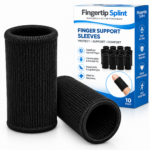
Finger Sleeves for Finger Support
- Flexible sleeve-style design
- Intended for everyday finger support
- Product specifications available on the product page
- Designed for finger coverage and comfort
- Available to explore with current product details
For readers who want to compare the wider range of support options, the full shop is a useful next step. If you’re a clinic, distributor, or retailer looking at bulk purchasing, the medical finger splint supplier page and finger splint distributor page provide relevant information. For specific pricing or partnership inquiries, the request a quote page is the place to start.
Frequently Asked Questions
Finger sleeves for finger support are flexible, sleeve-style wearable products designed to fit around part or all of a finger. Depending on their material and construction, they may provide coverage, light support, cushioning, or gentle compression while allowing more natural finger movement than structured supports. They are generally not the same as medical splints, which are designed to stabilize or restrict movement. The exact characteristics depend on the individual product, which is why checking specifications before buying matters.
Finger support sleeves work through five interacting principles: material tension (elastic materials conform around the finger), coverage (the sleeve surrounds a targeted area), contact and fit (a properly sized sleeve stays positioned during movement), flexibility (the material moves with the finger), and cushioning or a surface layer (some designs add a physical barrier). None of these acts alone — they work together to create the sleeve’s wearing experience. When one is out of balance (too tight, too loose, wrong coverage), the sleeve doesn’t perform its intended function well.
No. Finger sleeves are typically soft, flexible, and designed for coverage, light support, and everyday comfort with preserved finger movement. Finger splints are structured and often designed to stabilize, position, or restrict movement. They serve different purposes. A flexible sleeve is not a substitute for a splint when stabilization or movement restriction is needed. If you’re deciding between the two, the dedicated comparison on this site covers design, fit, comfort, and movement differences in full detail.
Generally, no — finger sleeves are designed to preserve natural finger movement. That’s their distinguishing feature compared to more structured supports. However, the actual range of movement depends on the sleeve’s specific design and fit. A thicker sleeve with more structure will naturally allow less movement than a thin, highly elastic one. If your priority is movement restriction or stabilization, a sleeve is usually not the right category — a structured support is designed for that purpose.
Finger support sleeves are made from a variety of materials depending on their intended use: elastic textiles, stretch fabrics, silicone-based materials, foam-containing constructions, and composite materials that combine multiple layers. Each material brings different properties — stretch, softness, durability, moisture handling, skin contact, and recovery after stretching. No single material is universally best. The right material depends on your activity, wear duration, and comfort preferences. Always check the manufacturer’s specifications rather than assuming based on the product category.
A finger support sleeve should feel snug, not tight. A snug fit means the sleeve stays in place comfortably without slipping or bunching. A tight fit means you feel pressure, experience numbness or tingling, or see deep marks on the skin after removal. Tightness doesn’t equal better support. If a sleeve feels too tight, remove it and consider a larger size or a different design. If numbness, tingling, or discoloration persists after removal, seek appropriate medical advice.
Yes — many people use finger sleeves during everyday activities like typing, writing, smartphone use, office work, light household tasks, and travel. Their flexibility and low-profile design make them practical for daily life. However, a sleeve that feels comfortable while resting may behave differently during activity. Evaluate the sleeve during the specific movements your daily routine involves, not just at rest. Also remember that a support sleeve is not protective equipment — don’t use it as a substitute for safety gear during hazardous tasks.
Seek professional advice if you have a significant injury, visible deformity, severe or worsening pain, major swelling, persistent numbness or tingling, substantial loss of movement, or symptoms that aren’t improving. A finger sleeve is a consumer support product — it can’t diagnose or treat a medical condition. Trusted resources include the AAOS OrthoInfo, NHS, MedlinePlus, Mayo Clinic, and Cleveland Clinic. If in doubt, err on the side of professional assessment rather than relying on a product to resolve a symptom that may need proper evaluation.
Now You Know How Finger Sleeves Work — Ready to Explore?
Understanding the design, materials, and mechanism is the first step. The next step is matching a specific product to your actual needs. Support → Coverage → Fit → Comfort → Everyday Use
The Bottom Line on Finger Sleeves for Finger Support
A finger support sleeve is a flexible, sleeve-style product designed to provide coverage, light support, cushioning, or gentle compression around part or all of a finger. It is not a splint. It is not a treatment. It is a practical, wearable product for people who want support without losing natural finger movement during everyday activities.
The key to choosing well is understanding three things: what the sleeve is designed to do, how its construction supports its purpose, and whether your actual need matches what a sleeve can provide. If you need flexible everyday support with preserved movement, a sleeve may be a good match. If you need stabilization, restriction, or protection from hazards, a different category is probably better suited.
For readers who want to compare specific products and match them to their situation, the Finger Sleeves for Finger Support product page is the natural next step. For deeper guidance across every aspect of finger support, explore the full FingertipSplint blog library.
This article is for general information only and is not a substitute for professional medical advice. Always consult a qualified healthcare provider for diagnosis and treatment of any medical condition.