
Finger Support Sleeve vs Finger Splint: What’s the Difference?
You need finger support. But should you look at a sleeve or a splint? They can look like similar solutions — both fit around a finger, both are called “supports” — but they serve different design purposes. A sleeve generally provides flexible support around the finger, while a splint uses a more structured design to limit or control movement. This guide breaks down the practical differences so you can compare them clearly without the confusion.
What This Guide Covers
- Quick Answer
- Quick Comparison Table
- What Is a Finger Support Sleeve?
- What Is a Finger Splint?
- Flexibility vs Structure
- 3D Split-Screen Comparison
- Movement: What Changes?
- Support Level: More Isn’t Better
- Comfort Comparison
- Fit & Sizing
- Coverage Differences
- Everyday Activity Comparison
- When a Sleeve May Be Considered
- When Structured Support May Be Relevant
- Common Misconceptions
- Which Design Matches Your Priority?
- Decision Matrix
- Product Spotlight
- FAQ
Quick Answer: What Is the Difference?
A finger support sleeve is generally a flexible, low-profile support that surrounds part or all of a finger, while a finger splint typically uses a more structured design to stabilize or limit movement. The right choice depends on the desired level of movement, support, fit, activity, and individual circumstances.
This is the honest, practical version of the comparison. It’s not about which is “better” — it’s about which matches your specific need. If you’re still understanding the broader world of finger support products, the finger support products collection at FingertipSplint offers a useful overview. But let’s start with the direct comparison, because that’s what most readers actually want.
Quick Comparison: Sleeve vs Splint
Here’s the side-by-side. Read this slowly — the “primary consideration” row is the one most buyers overlook.
| Feature | Finger Support Sleeve | Finger Splint |
|---|---|---|
| Basic design | Flexible sleeve | Structured support |
| Main characteristic | Flexibility | Stability |
| Movement | Generally allows more movement | Often limits movement more |
| Profile | Often low-profile | Can be more noticeable |
| Coverage | Depends on design | Depends on design |
| Adjustability | Often limited | May be adjustable |
| Everyday activities | Often designed with mobility in mind | Depends on design |
| Movement control | Generally lower | Generally higher |
| Fit | Usually size-based | May use straps/adjustments |
| Primary consideration | Comfort + flexibility | Stabilization + control |
Note: These are general design differences, not universal rules. Individual products can vary considerably — a “sleeve” may have more structure than expected, and a “splint” may be semi-flexible. Always check the specific product’s construction and intended use rather than relying on the category name.
What Is a Finger Support Sleeve?
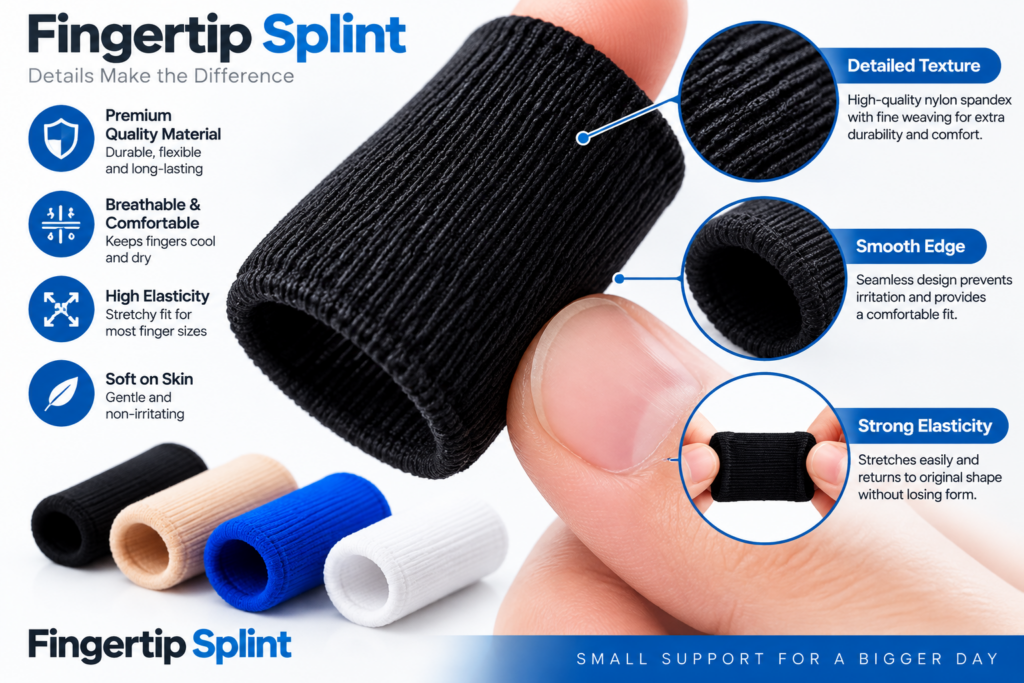
A finger support sleeve is a flexible, sleeve-style wearable that fits around part or all of a finger. Its defining characteristic is flexibility — it moves with the finger rather than restricting movement. Depending on its construction, it may provide coverage, light support, cushioning, or gentle compression.
Key Design Elements
- Flexible materials (elastic fabric, stretch textile)
- Finger-shaped or tubular construction
- Slip-on application (usually no straps)
- Coverage varies by design
- Low-profile appearance in most cases
- Movement preserved to a greater degree
What It Generally Prioritizes
- Coverage of the target area
- Comfort during wear
- Flexibility for everyday use
- Low-profile form
- Everyday usability
If you want the foundational explanation of what a sleeve is and how it works, see Finger Sleeves for Finger Support: What Are They and How Do They Work? For a deeper design-focused look, see Finger Support Sleeves Explained: Features, Uses and Design.
What Is a Finger Splint?
A finger splint is a support product designed around structure rather than flexibility. Its purpose is typically to stabilize, position, or limit movement of a specific part of the finger. Depending on the design, a splint may include rigid or semi-rigid components, shaped support structures, and straps or fastening mechanisms.
Key Design Elements
- Structured components (rigid or semi-rigid)
- Shaped support structures
- Straps, closures, or fastening systems
- Specific positioning features
- Greater movement restriction
- Often more noticeable than a sleeve
What It Generally Prioritizes
- Stabilization of a specific area
- Positioning or alignment
- Movement control
- Structural support
- Consistent positioning during wear
Important: Don’t define every finger splint as rigid. Some splints use semi-rigid or semi-flexible materials. Some allow controlled movement; others restrict movement more significantly. The actual level of restriction depends on the specific design and its intended purpose.
The Biggest Difference: Flexibility vs Structure
If you remember nothing else from this comparison, remember this: the core difference between a sleeve and a splint is what each is designed to do with movement.
Sleeve — Usually Prioritizes
- Movement
- Flexibility
- Coverage
- Low profile
- Everyday usability
Splint — Often Prioritizes
- Positioning
- Stabilization
- Movement control
- Structural support
- Consistent restriction or alignment
Interactive: Flexibility vs Structure Spectrum
Tap each position to see how it differs
Finger Sleeve
Flexible, low-profile design. Prioritizes coverage, comfort, and light support while preserving natural finger movement. Suited for everyday activities where flexibility remains important.
This is a conceptual spectrum, not a universal medical classification. Actual products vary significantly.
Interactive 3D: Sleeve vs Splint Side-by-Side
Tap each hotspot to see what makes each design different
Finger Support Sleeve
A flexible, fabric-based layer wrapping the finger.
Finger Splint
A structured support with rigid or semi-rigid elements.
🧵 Flexible Construction
Designed to sit around the finger while generally allowing more movement than a rigid support. Sleeves are typically made from stretchy fabric or elastic materials.
This illustration is conceptual. Actual sleeve and splint construction varies by product. Always check the manufacturer’s specifications.
Interactive: Flexibility Slider
Tap each position to see what each level of flexibility means.
Movement: What Changes?
Movement is where a sleeve and a splint most clearly diverge. Here’s the practical difference:
Finger Sleeve
Depending on construction, may allow:
- Bending
- Straightening
- Gripping
- Typing
- Writing
- Phone use
Finger Splint
May intentionally reduce:
- Bending
- Straightening
- Certain joint movements
- Specific motion ranges
Actual restriction depends on the splint’s design.
Interactive: Movement Comparison
Tap each position to see how each design responds
STRAIGHT
PARTIALLY BENT
GRIP
RESTRICTED
Straight — Baseline Position
Both a sleeve and a splint sit around the finger in this position. The difference isn’t visible at rest — it becomes obvious during movement. This is why understanding the movement question matters more than the appearance of the product.
Support Level: More Isn’t Automatically Better
This is an important expert insight: a higher level of movement restriction isn’t automatically better for every situation. The right amount of support depends entirely on what you need the support to accomplish.
Support Requirement
Movement Requirement
Appropriate Product Design
If Everyday Movement Matters
Someone who prioritizes everyday movement may look at flexible support designs. A sleeve can provide coverage and light support without restricting the finger during daily tasks.
If Restriction Has Been Recommended
Someone who has been specifically instructed to restrict a joint’s movement may require a different type of support. A flexible sleeve isn’t designed for that purpose — following the professional recommendation matters more than product preference.
Important: If a healthcare professional has recommended immobilization or a specific positioning device, follow that recommendation rather than substituting a general-purpose sleeve. A sleeve and a splint serve different purposes — they aren’t interchangeable when a specific type of support has been prescribed.
Comfort Comparison
Comfort isn’t universal — it depends on the person, the activity, the fit, the product design, and the required level of support. Here’s how comfort factors differ between the two categories:
Sleeve Comfort Factors
- Material softness and texture
- Elasticity and recovery
- Fit and sizing
- Thickness
- Edge construction
- Coverage area
- Moisture handling
- Movement compatibility
Splint Comfort Factors
- Structural rigidity
- Strap placement and pressure
- Padding and cushioning
- Finger positioning
- Bulk and profile
- Adjustability
- Interaction with movement
- Skin contact over time
For a dedicated comfort-focused guide on the sleeve side, see How to Choose a Comfortable Finger Sleeve for Support.
Fit and Sizing: How They Differ
Fit works differently depending on the product category. Understanding this distinction helps you evaluate products more accurately.
Sleeve Fitting Considerations
- Finger circumference
- Length and coverage
- Elasticity behavior
- Slipping risk
- Excessive tightness
- Material stretch recovery
Splint Fitting Considerations
- Finger length
- Joint positioning
- Finger width at specific points
- Strap placement and tension
- Adjustment range
- Alignment with the affected area
For both categories, following the manufacturer’s sizing instructions is essential. Don’t assume that a size that works for one product works for another, or that sleeve sizing and splint sizing use the same method. For a full sleeve fit framework, see Finger Sleeves for Support: A Guide to Fit, Comfort and Coverage.
Coverage Differences
Coverage varies by product design. Here’s how coverage tends to differ between the two categories:
Sleeve Coverage Patterns
- Partial finger (selected segment)
- Joint area focus
- Larger finger coverage (extended)
- Fingertip-specific
Splint Coverage Patterns
- Targeted joint focus
- Finger segment (specific bone area)
- Multiple support points
- Extended positioning across joints
Coverage matters because it determines where support is delivered, how movement is affected, and how the product interacts with daily activities. For a deeper look at coverage matching, see Finger Sleeves for Support: A Guide to Fit, Comfort and Coverage.
Everyday Activity Comparison
How each product type affects different everyday activities varies. Here’s the practical breakdown:
| Activity | Sleeve Consideration | Splint Consideration |
|---|---|---|
| ⌨️ Typing | Finger mobility preserved | May interfere depending on design |
| ✍️ Writing | Grip and flexibility maintained | May affect finger positioning |
| 📱 Smartphone | Movement and low profile | Structure may affect tapping |
| 📚 Studying | Comfort and mobility | Depends on support requirement |
| 💼 Office work | Low profile, secure fit | Depends on design and restriction level |
| 🏠 Household tasks | Flexibility and durability | Movement restriction may matter |
| 🛏️ Rest / positioning | Depends on purpose | Structure may be relevant |
Important: Don’t perform activities while injured just because a sleeve allows movement. Movement preservation doesn’t mean activity safety. If you’ve been advised to rest or restrict activity, follow that guidance regardless of which product you’re using.
When a Sleeve May Be Considered
A flexible sleeve may be considered when the user’s priority is:
🔄 Flexible support
🏃 Everyday usability
📦 Low-profile coverage
☁️ Comfort during wear
✋ Maintaining natural movement
But suitability depends on the individual’s situation. A flexible sleeve isn’t a substitute for structured support when restriction or stabilization is required. For a deeper look at everyday sleeve use, see How Finger Sleeves Provide Everyday Finger Support and Comfort.
When Structured Support May Be More Relevant
Structured support can be relevant when:
🦴 Movement control is specifically required
⚕️ A healthcare professional has recommended immobilization
🎯 A joint needs positioning or alignment
🏗️ Greater stabilization is needed
Important: If a healthcare professional has recommended immobilization or a specific positioning device, follow that recommendation rather than substituting a general-purpose sleeve. Structured support isn’t just “more support” — it serves a specific functional purpose that a flexible sleeve doesn’t replicate.
Common Misconceptions
These five myths cause a lot of wrong purchases. Tap each card to reveal the reality.
“A tighter sleeve provides better support.”
“A finger splint should never allow movement.”
“A sleeve and splint are basically the same.”
“If I can move my finger, I don’t need professional advice.”
“A splint is always better because it provides more support.”
Interactive: Which Design Matches Your Priority?
A general product-navigation tool, not a medical diagnostic quiz.
Answer the questions above to see your focus areas.
Sleeve vs Splint: Decision Matrix
Match your priority to what to investigate. This is the fastest way to cut through the noise:
| Your Priority | Characteristics to Investigate |
|---|---|
| Everyday flexibility | Flexible sleeve construction |
| Low profile | Thickness and overall profile |
| Coverage | Sleeve length and coverage area |
| Comfort | Material, fit, and edges |
| Movement control | Structured support |
| Positioning | Splint design and alignment |
| Adjustability | Straps and fastening systems |
| Portability | Size, weight, and construction |
Exploring a Finger Sleeve for Flexible Everyday Support
If your priority points toward flexible, low-profile everyday support, FingertipSplint offers a specific product to examine: Finger Sleeves for Finger Support. Here’s what to check against your own requirements.
Finger Sleeves for Finger Support
- Flexible sleeve-style design
- Intended for everyday finger support
- Product specifications available on the product page
- Designed for finger coverage and comfort
- Available to explore with current product details
Quick Decision Checklist
Walk through each item before choosing. Tap to mark complete.
When Professional Advice Matters
This comparison is educational. It’s not a diagnosis, and it can’t determine which product is medically appropriate for you. Consider professional assessment if you have:
🩹 Significant injury
🦴 Visible deformity
📈 Severe or worsening pain
💧 Major swelling
⚡ Persistent numbness or tingling
🚫 Significant loss of movement
⏳ Symptoms that aren’t improving
For trusted guidance, see the AAOS OrthoInfo hand and wrist conditions library, NHS guide on hand pain, and MedlinePlus hand injuries and disorders. Additional clinical perspectives are available from Mayo Clinic, Cleveland Clinic, and Johns Hopkins Medicine. The NIH provides research-based information, and if a neurological component is involved, NINDS is the specialist resource. For regulatory context on medical devices, the FDA is authoritative, and for general public health information, the CDC is a trusted source.
Frequently Asked Questions
The main difference is how the support is constructed and how much movement it’s designed to allow or restrict. A finger sleeve is typically flexible and focuses on support, coverage, cushioning, and comfort — often allowing more natural finger movement. A finger splint is generally more structured and may be designed to stabilize or restrict movement in a specific area. The exact function depends on the individual product’s construction, so product names alone shouldn’t be treated as a medical classification. Always check the specific product’s design and intended use.
Generally, yes — but it depends on the specific products. Sleeves are typically made from flexible, stretch-based materials that preserve finger movement. Splints often include rigid or semi-rigid components designed to control movement. That said, some splints may use semi-flexible materials, and some sleeves may have more structured zones. Always check the individual product’s construction rather than relying on the category name.
Not necessarily. Some splints are designed to restrict movement significantly, while others allow controlled movement or partial mobility. The degree of restriction depends on the specific design and its intended purpose. Some splints use semi-rigid materials; others use fully rigid components. This is why the category name alone doesn’t tell you everything — the actual construction and the professional recommendation (if any) matter most.
Yes, many people use finger sleeves during everyday activities like typing, writing, smartphone use, office work, and household tasks. Their flexibility and low-profile design make them practical for daily wear. However, comfort during rest may differ from comfort during movement, so it’s worth evaluating the sleeve during the specific activities you do most. Also remember that a support sleeve is not protective equipment — don’t use it as a substitute for safety gear during hazardous tasks.
Splints generally provide more movement control than sleeves. Splints are designed to stabilize, position, or restrict movement, while sleeves are designed to preserve natural finger movement. However, “more control” isn’t automatically better — it depends on what you need. If flexibility and everyday usability are your priorities, a sleeve may be more appropriate. If movement restriction has been recommended for a specific reason, a splint is generally the right category.
Neither is universally more comfortable. Comfort depends on fit, construction, intended use, and individual preference. A well-fitted sleeve in a breathable material may be comfortable for extended wear. A poorly fitted splint with pressure points can be uncomfortable. Conversely, a sleeve that’s too tight can be uncomfortable, and a well-designed splint that matches your needs may be more comfortable than a poorly fitting sleeve. Match the product to your priority rather than assuming a category is universally better.
Many people type with finger sleeves. For typing, prioritize low bulk, flexibility, secure fit, and comfort during repeated movement. A thick or loose sleeve can interfere with typing rhythm and accuracy. A thin, well-fitted sleeve designed for everyday use is usually a better match for keyboard work. A splint may or may not allow typing depending on its design and the reason it was recommended — if a splint was specifically advised, follow the professional guidance on whether typing is appropriate during use.
A properly fitting sleeve should stay reasonably in place without constant adjustment. It should feel snug — comfortable, not painful. It shouldn’t leave deep marks, cause numbness or tingling, or require you to push through discomfort. Follow the manufacturer’s sizing instructions carefully. If it slips, bunches, or feels excessively tight, the fit is wrong. For the complete fit framework, see the fit, comfort, and coverage guide on this site.
No, not generally. A sleeve and a splint serve different purposes. If a medical professional has recommended a splint for immobilization, protection, or stabilization of an injury, a flexible sleeve is not a substitute. Always follow professional advice if you have a diagnosed condition or injury. A sleeve is designed for support, coverage, and comfort — not for movement restriction or stabilization. Substituting a different product for a professionally recommended one can delay appropriate care.
Seek professional advice if you have a significant injury, visible deformity, severe or worsening pain, major swelling, persistent numbness or tingling, substantial loss of movement, or symptoms that aren’t improving. Also seek advice if you’re unsure whether a sleeve or splint is appropriate for your situation, or if immobilization has been recommended. A comparison article can help you understand product differences, but it can’t diagnose what’s causing your symptoms. Trusted resources include AAOS OrthoInfo, NHS, MedlinePlus, Mayo Clinic, and Cleveland Clinic.
Sleeve or Splint? Now You Know What to Compare.
The right choice depends on what you need the support to accomplish. If flexibility and everyday usability are your priorities, explore the sleeve option. If movement restriction has been recommended, follow professional guidance. Flexibility → Structure → Movement → Fit → Choice
The Bottom Line on Sleeve vs Splint
A finger support sleeve and a finger splint serve different design purposes. Sleeves prioritize flexibility, coverage, and everyday usability. Splints prioritize structure, stabilization, and movement control. Neither is universally better — the right choice depends on what you actually need the support to accomplish.
If your priority is everyday flexibility and low-profile support, a flexible sleeve may be appropriate. If movement restriction or stabilization has been recommended, a structured support is generally the right category. If you’re unsure, professional assessment is more valuable than product comparison alone.
For readers whose priorities point toward flexible everyday support, the Finger Sleeves for Finger Support product page is the natural next step. For deeper context, see What Makes a Good Finger Support Sleeve for Daily Use? and Finger Support Products Explained: Where Do Sleeves Fit In? For the full picture, explore the FingertipSplint blog library.
This article is for general information only and is not a substitute for professional medical advice. Always consult a qualified healthcare provider for diagnosis and treatment of any medical condition.