
Finger Support Sleeves Explained: Features, Uses and Design
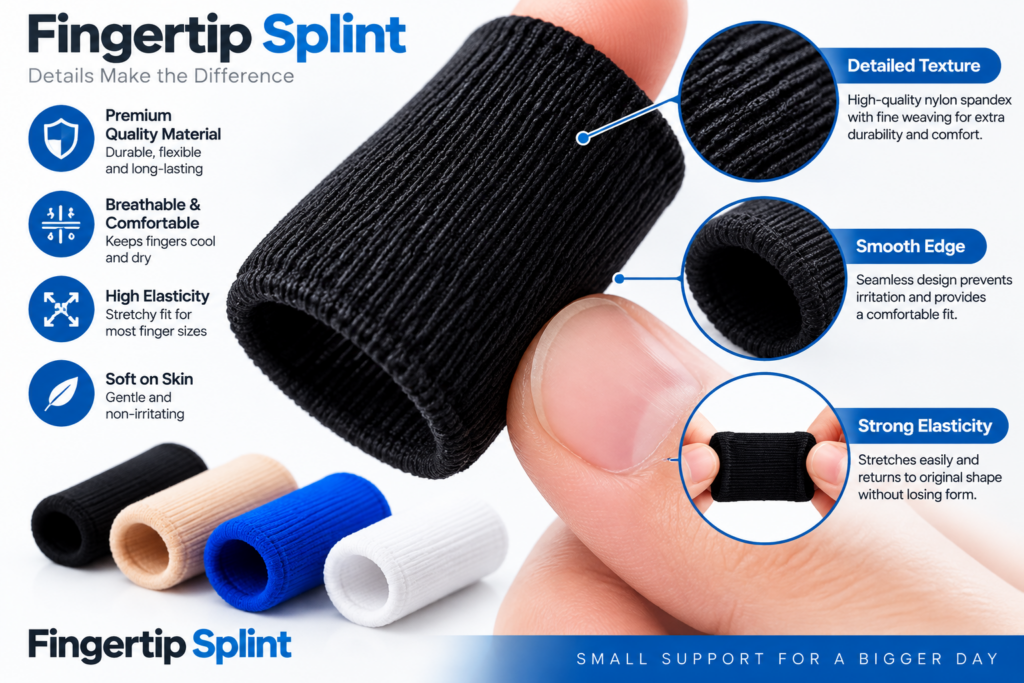
A finger sleeve is more than just a piece of stretchy fabric. Two sleeves can look nearly identical online but behave completely differently when worn — because material, elasticity, thickness, coverage, seams, edges, and construction all interact to shape the experience. This guide examines the actual design decisions behind a finger support sleeve and how each one affects everyday use.
What This Guide Covers
- Quick Answer
- Anatomy of a Sleeve
- 3D Exploded View
- Material
- Elasticity
- Thickness
- Coverage
- Flexibility & Movement
- Seams & Edges
- Fit & Positioning
- Comfort & Usability
- Everyday Uses
- Daily-Use Suitability
- Overlooked Features
- Sleeve vs Structured Support
- Feature Wheel
- Build Your Ideal Sleeve
- Product Spotlight
- Buyer Checklist
- FAQ
Quick Answer: What Features Do Finger Support Sleeves Have?
Finger support sleeves typically feature a flexible finger-shaped construction, an elastic or stretch-based material, a defined coverage area, an inner skin-contact surface, an outer protective surface, finished edges, and seams or construction points that influence durability and comfort. The combination of these features determines how the sleeve fits, feels, and performs during everyday use.
But why do these features matter? The answer becomes clearer when you look at how a sleeve is actually designed — and how each design decision shapes the wearing experience. For readers who want to see the range of flexible support products available, the finger support products collection at FingertipSplint is a good starting point.
Anatomy of a Finger Support Sleeve
A finger support sleeve isn’t a single element — it’s a layered product built from several components, each contributing to how the sleeve functions. Understanding these components makes it much easier to evaluate any specific product.
1. Outer Material
The external surface. Determines much of the sleeve’s durability, appearance, and how it interacts with surrounding objects.
2. Inner Surface
The part that contacts the finger. Smoothness and softness here affect comfort during extended wear.
3. Stretch Zone
Allows the product to conform to finger dimensions. Balanced elasticity keeps the sleeve in place without restricting.
4. Support Area
The region designed to provide the product’s intended support characteristics. Depends on material, thickness, and construction.
5. Coverage Area
Determines which part of the finger is surrounded. Coverage drives contact and mobility.
6. Edge
Influences how the sleeve terminates around the finger. Edge construction affects friction and comfort.
7. Seam or Construction Point
Where the sleeve is joined or formed. May affect flexibility, durability, and comfort depending on placement and quality.
Interactive 3D: Exploded View of a Finger Support Sleeve
Tap each layer to see how it contributes to the sleeve’s design
Edge
Where the sleeve ends around the finger. Edge construction affects how the sleeve sits, whether it folds or rolls, and whether it creates friction during wear. A well-finished edge supports long-wear comfort.
These components work together. No single layer defines how a sleeve performs on your finger.
Material: What Is a Finger Sleeve Made From?
Material is the foundation of a sleeve’s design. Different materials are chosen for different reasons — some prioritize stretch, others durability, others skin comfort. Here are the common material categories:
Elastic Textiles
Stretchy woven or knitted fabrics. Common for flexible, movement-friendly sleeves.
Stretch Fabrics
Blends with higher elasticity. Used when the sleeve needs to conform tightly to finger shape.
Silicone-Based Materials
Grippy, elastic, often used for cushioning. Provide more structure than fabric while remaining flexible.
Foam-Containing Constructions
Fabric combined with foam for added cushioning. Used when more protective bulk is needed.
Composite Materials
Layered constructions combining multiple materials to balance stretch, structure, durability, and comfort. Often used in higher-quality sleeves.
What Material Properties Actually Affect
Elasticity
How much the material can stretch.
Recovery
How well it returns toward its original shape after stretching.
Softness
How the surface feels against the skin.
Thickness
Influences bulk and physical feel.
Durability
How the material handles repeated use.
Moisture Behavior
How the material interacts with sweat or moisture.
Important: No material is universally superior. The right material depends on your activity, wear duration, and comfort preferences. For a broader view of construction and design, see Finger Support Sleeves: A Complete Guide to Features and Uses.
Elasticity: Why Does a Finger Sleeve Stretch?
Elasticity is what allows a sleeve to conform to a finger without slipping or creating pressure. But more stretch isn’t automatically better. Too much stretch can affect stability, fit, coverage, and shape retention — the sleeve may slip or lose positioning during use. Too little stretch can make application difficult or create excessive pressure.
Interactive: Elasticity Balance
Tap each position to see what it means for the sleeve.
Thickness: Does a Thicker Sleeve Mean More Support?
This is one of the most common misconceptions in this category. The answer is no — thickness alone doesn’t determine how effective or appropriate a sleeve is.
Thickness does influence several practical characteristics:
📦 Bulk
🔄 Flexibility
🤲 Grip
⌨️ Typing ability
✍️ Writing ability
📱 Smartphone use
🧤 Layering under gloves
Coverage: Why Does Coverage Area Matter?
Different sleeves cover different parts of the finger. Coverage determines what area is actually surrounded, contacted, and supported by the sleeve. Here are the common coverage designs:
Fingertip-Focused
Covers the tip. Useful for fingertip protection and precision tasks. Preserves maximum dexterity.
Partial Finger
Covers a middle section. Balance between coverage and mobility.
Joint-Area
Focuses around a joint. Localized support for a specific movement area.
Longer Finger Coverage
Extends across most of the finger. Broader coverage but may feel more noticeable.
Broader Coverage
Covers the finger and possibly adjacent areas. Useful when support needs extend beyond a single zone.
Coverage affects mobility, contact, comfort, bulk, and positioning. Don’t assume more coverage automatically provides more medical benefit — coverage should match your intended purpose. For a detailed look at coverage selection, see Finger Sleeves for Support: A Guide to Fit, Comfort and Coverage.
Flexibility and Movement
Flexible design is what distinguishes a finger sleeve from a structured splint. But flexibility isn’t a simple “more is better” quality — it interacts with every other design feature.
Interactive: Finger Movement Through a Sleeve
Tap each movement stage to see how a flexible sleeve responds.
STRAIGHT
BENDING
GRIPPING
RELEASING
The baseline position. A sleeve that fits correctly sits comfortably around the finger without slipping, bunching, or creating pressure. This is the starting check before evaluating any movement.
This is where a sleeve and a splint clearly diverge. A flexible sleeve moves with the finger; a structured splint restricts movement to control positioning. If you’re deciding specifically between these two approaches, see Finger Support Sleeve vs Finger Splint: What’s the Difference?
Seams and Edges: Small Details That Matter
Seams and edges are often overlooked when evaluating a sleeve — but they’re frequently what separates a comfortable sleeve from an irritating one.
Seams
- Placement affects friction during movement
- Quality affects durability
- Thickness affects how noticeable they feel
- Position relative to joints matters most
Edges
- Determines how the sleeve terminates
- Smooth edges reduce irritation
- Poorly finished edges may roll or fold
- Edge construction affects positioning
What to inspect: Look at where seams sit, how edges are finished, whether stitching is consistent, and whether reinforced areas align with where the sleeve needs durability. These details don’t show up in product photos easily — but they often determine how the sleeve feels after an hour of wear.
Fit and Positioning: How Design Interacts With Your Finger
Even a well-designed sleeve may not feel right if it doesn’t fit your finger properly. Fit is where design meets reality.
Too Loose
- Slipping
- Bunching
- Inconsistent coverage
Appropriate
- Secure positioning
- Compatible with intended use
- Comfortable during movement
Too Tight
- Excessive pressure
- Discomfort
- Possible numbness or tingling
If symptoms occur: Remove the sleeve and reassess the fit. If numbness, tingling, discoloration, or persistent discomfort continues after removal, seek appropriate professional advice. The NHS guide on hand pain and MedlinePlus hand injuries and disorders are reliable starting points.
Comfort and Usability: The Outcome of Design
Comfort isn’t a single feature — it’s the result of several design decisions working together. Here’s how the components interact:
Material + Fit
Determines how the sleeve feels during extended wear. Wrong material or wrong fit undermines comfort regardless of other features.
Thickness + Edges
Affects whether the sleeve feels bulky or smooth. Rough edges create friction; excessive thickness reduces dexterity.
Seams + Coverage
Determines how the sleeve behaves during movement. Poorly placed seams or coverage that doesn’t match the activity reduces comfort.
Movement Compatibility
A sleeve that fits well at rest but restricts movement during activity isn’t comfortable in the way that matters most.
For a dedicated comfort-focused guide, see How to Choose a Comfortable Finger Sleeve for Support.
What Are Finger Support Sleeves Used For?
Finger support sleeves fit into a wide range of everyday activities. The specific feature priorities shift depending on the activity:
| Activity | Design Feature Priority |
|---|---|
| ⌨️ Typing | Flexibility + low bulk |
| ✍️ Writing | Grip + finger movement |
| 📱 Smartphone use | Mobility + fingertip access |
| 📚 Studying | Comfort + usability |
| 💼 Office work | Low profile + secure fit |
| 🏠 Light household tasks | Fit + flexibility |
| ✈️ Travel | Portability + easy application |
For a detailed activity-specific breakdown, see Understanding Finger Support Sleeves for Everyday Activities.
What Makes a Sleeve Suitable for Daily Use?
Based on the design features covered above, here’s what to look for in a daily-use sleeve:
✅ Appropriate material
✅ Reasonable elasticity
✅ Suitable coverage
✅ Secure fit
✅ Comfortable edges
✅ Appropriate thickness
✅ Durable construction
✅ Easy application
✅ Clear care instructions
✅ Appropriate intended use
For a full daily-use quality framework, see What Makes a Good Finger Support Sleeve for Daily Use?
Interactive: Finger Sleeve Feature Wheel
Tap each feature to see how it affects the sleeve’s performance
🧵 Material
The foundation of the sleeve. Material affects feel, flexibility, durability, moisture behavior, and how the sleeve performs during wear. Different materials suit different activities.
What Buyers Often Overlook
These six overlooked factors cause most of the mismatches between buyer expectations and actual product experience:
Price doesn’t tell you how a sleeve will perform. Examine construction and specifications instead.
Thickness alone isn’t enough. Material and construction determine actual performance.
Fit dramatically affects usability. A premium sleeve that doesn’t fit is worse than a basic sleeve that does.
A product designed for everyday support isn’t automatically protective equipment. Match the product to your actual need.
Material and construction vary significantly between products. Read the specifications.
A visually attractive product may not match your needs. Focus on features over aesthetics.
Flexible Sleeve vs Structured Support
These are two different design approaches — not a good-versus-bad comparison. Each has a purpose:
Sleeve-Style Support
- Flexible, low-profile design
- Movement-friendly depending on construction
- Focuses on coverage, comfort, light support
- Preserves natural finger movement
Structured Support
- More structured design
- May provide greater movement control
- Focuses on stabilization or positioning
- Restricts movement in specific ways
Neither is “better” — the right approach depends on what you actually need. For a comprehensive comparison, see Finger Sleeves vs Traditional Finger Supports: Key Differences.
Interactive: Design Feature Spectrum
Tap each design approach to see how it differs
Flexible Sleeve
Low-profile, movement-friendly design. Prioritizes coverage, comfort, and light support. Preserves natural finger movement. Suited for everyday activities where flexibility matters.
This is a conceptual design spectrum, not an official medical classification. Actual products vary within each category.
Interactive: Build Your Ideal Sleeve Priority
Select your priorities. This is a comparison guide, not a medical recommendation.
Select your priorities above to see what to focus on.
What Finger Support Sleeves Do Not Automatically Provide
This section is important for setting accurate expectations. A finger sleeve doesn’t automatically mean:
❌ Immobilization
❌ Injury treatment
❌ Protection from sharp objects
❌ Heat protection
❌ Chemical protection
❌ Guaranteed pain relief
❌ Guaranteed recovery
❌ Replacement for professional evaluation
If you have a significant injury, visible deformity, severe or worsening pain, major swelling, persistent numbness or tingling, or substantial loss of movement, appropriate professional evaluation is more important than choosing a product based on an online guide. Trusted sources include AAOS OrthoInfo, Mayo Clinic, Cleveland Clinic, Johns Hopkins Medicine, and the NIH. If a neurological component is involved, NINDS offers specialist resources. For general public health guidance, the CDC is authoritative, and for regulatory context on medical devices, the FDA is the relevant resource.
Product Spotlight: Finger Sleeves for Finger Support
For readers whose priorities point toward a flexible, everyday support option, FingertipSplint offers a specific product: Finger Sleeves for Finger Support. Here’s what to examine using the same design framework covered in this guide.
Finger Sleeves for Finger Support
- Flexible sleeve-style design
- Intended for everyday finger support
- Product specifications available on the product page
- Designed for finger coverage and comfort
- Available to explore with current product details
For readers who want to compare the wider range of support products, the FingertipSplint shop is a useful next step. If you’re a clinic, distributor, or retailer looking at bulk purchasing, the medical finger splint supplier page and finger splint distributor page provide relevant information. For specific pricing or partnership inquiries, the request a quote page is the place to start.
Quick Buyer Checklist
Walk through each item before buying. Tap to mark complete.
When Another Support Category May Be Appropriate
Don’t automatically choose a sleeve if your actual requirement is:
🦴 Significant movement control
🏗️ Structured stabilization
🛡️ Specialized protection
⚕️ Professional treatment
For the full product category landscape, see Finger Support Products Explained: Where Do Sleeves Fit In?
Frequently Asked Questions
Finger support sleeves are made from a variety of materials depending on their intended use. Common categories include elastic textiles, stretch fabrics, silicone-based materials, foam-containing constructions, and composite materials that combine multiple layers. Each material brings different properties — stretch, softness, durability, moisture handling, skin contact, and recovery after stretching. There is no single “best” material; the right choice depends on your activity, wear duration, and comfort preferences. Always check the manufacturer’s material specifications rather than assuming based on the product category.
Finger support sleeves provide support through a combination of material tension, coverage, contact and fit, flexibility, and construction. The elastic material conforms around the finger, maintaining consistent contact with the skin. The coverage area defines which part of the finger receives support. The fit determines whether the sleeve stays in position during movement. The flexibility allows the sleeve to move with the finger rather than restricting it. The construction — including thickness, seams, and edges — influences how all of these features interact. No single element determines support characteristics; they work together.
Yes — flexibility is the defining characteristic of finger support sleeves. They are designed to allow natural finger movement while providing coverage, light support, or comfort. However, the actual degree of flexibility depends on the specific design and material. A thin, highly elastic sleeve allows near-normal finger movement, while a thicker or more structured sleeve may reduce movement to some degree. If you need movement restriction or stabilization, a sleeve is usually not the right product category — a more structured support may be more appropriate.
No — thickness alone doesn’t determine how effective or appropriate a sleeve is. Thickness influences bulk, flexibility, grip, typing ability, writing ability, smartphone use, and whether the sleeve can be layered under gloves. A thicker sleeve may feel more substantial, but that doesn’t automatically mean it provides better support. Material quality, elasticity, coverage, and construction all matter — often more than thickness. What matters is whether the sleeve’s overall design matches your specific need.
Coverage determines which part of the finger is actually surrounded by the sleeve — and therefore what area receives support or protection. A fingertip sleeve covers only the tip; a partial-finger sleeve covers a middle section; a longer sleeve covers most of the finger. Coverage affects mobility, contact, comfort, bulk, and positioning. More coverage isn’t automatically better — it can add bulk and reduce dexterity. The right coverage matches your intended purpose, not the maximum available.
A properly fitting finger support sleeve should feel snug, not tight. It should stay positioned during normal movement without slipping or bunching, allow your intended finger movement, and remain comfortable during wear. It shouldn’t leave deep marks after removal, cause numbness or tingling, or require constant adjustment. If the sleeve feels too tight, remove it and consider a larger size or different design. If it feels too loose, it may not provide the coverage or positioning you need. Always follow the manufacturer’s sizing instructions.
Yes — many people use finger support sleeves during everyday activities like typing, writing, smartphone use, office work, light household tasks, and travel. Their flexibility and low-profile design make them practical for daily wear. However, comfort during rest may differ from comfort during active movement, so it’s worth evaluating the sleeve during the specific activities you do most. Remember that a support sleeve is not protective equipment — don’t use it as a substitute for safety gear during hazardous tasks.
Finger sleeves are typically soft, flexible, and designed for coverage, light support, and everyday comfort with preserved finger movement. Finger splints are structured and often designed to stabilize, position, or restrict movement. They serve different purposes. A flexible sleeve is not a substitute for a splint when stabilization or movement restriction is needed. The design focus differs — sleeves prioritize flexibility and comfort, while splints prioritize structure and stability. If you’re deciding between these two approaches, a detailed comparison can help clarify which matches your needs.
No — a flexible sleeve is not a replacement for structured support when stabilization or movement restriction is needed. Sleeves and structured supports serve different purposes. If a healthcare professional has recommended a specific type of support for your situation, follow that guidance. A sleeve is designed for flexible support, coverage, and comfort, not for restriction or stabilization. Choosing the wrong category for your need can lead to frustration and could delay appropriate assessment.
Always follow the manufacturer’s specific cleaning instructions for your sleeve. Some are hand-wash only; others may be machine washable. Avoid harsh detergents and high heat unless the manufacturer recommends them, as these can damage the material and reduce its lifespan. Allow the sleeve to dry properly before wearing it again. Proper cleaning helps maintain hygiene and extends the product’s usable life. Don’t assume generic washing instructions apply to every product.
Seek professional advice if you have a significant injury, visible deformity, severe or worsening pain, major swelling, persistent numbness or tingling, substantial loss of movement, or symptoms that aren’t improving. A finger sleeve is a consumer support product — it can’t diagnose or treat a medical condition. Trusted resources include the AAOS OrthoInfo, NHS, MedlinePlus, Mayo Clinic, and Cleveland Clinic. If in doubt, err on the side of professional assessment rather than relying on a product to resolve a symptom that may need proper evaluation.
Design Features Understood. Now Match a Product to Your Needs.
You now know how material, elasticity, thickness, coverage, seams, edges, and fit interact. The next step is matching those design features to your actual requirements. Material → Coverage → Fit → Flexibility → Comfort → Everyday Use
The Bottom Line on Finger Support Sleeve Design
A finger support sleeve is the result of several design decisions working together. Material determines feel and durability. Elasticity determines fit and stability. Thickness determines bulk and usability. Coverage determines what area is supported. Seams and edges determine comfort during extended wear. Fit determines whether any of these features actually work for your finger.
Understanding these features gives you a much better framework for evaluating any sleeve you encounter — not just the one you’re considering today. When you know what to look for, you can compare products based on their actual design rather than their marketing language.
For readers who want to explore a specific product using this framework, the Finger Sleeves for Finger Support product page is the natural next step. For deeper guidance across every aspect of finger support, explore the full FingertipSplint blog library and the FAQ page.
This article is for general information only and is not a substitute for professional medical advice. Always consult a qualified healthcare provider for diagnosis and treatment of any medical condition.