
What Makes a Good Finger Support Sleeve for Daily Use?
Many finger sleeves look similar in product photos, but daily use exposes differences that aren’t obvious at first glance. Does it stay in place? Is the fit consistent? Does it bunch? Is it comfortable over time? Does it handle repeated use? This guide teaches you how to evaluate sleeve quality for regular everyday wear — by looking at what actually matters, not just what the product page says.
What This Guide Covers
- Quick Answer
- Define “Good”
- The 10 Signs of Quality
- Material Quality
- Construction Quality
- Fit: Foundation of Daily Use
- Flexibility vs Support
- Coverage: Is More Always Better?
- Comfort During Repeated Use
- Durability
- Easy Care and Maintenance
- Daily Activity Compatibility
- Marketing Claims vs Reality
- More Support Isn’t Automatically Better
- 3D Anatomy of Quality
- Interactive Quality Scorecard
- Good vs Poor Characteristics
- How to Evaluate a Product Page
- Product Spotlight
- When a Good Sleeve Still May Not Fit
- Daily-Use Quality Checklist
- FAQ
Quick Answer: What Makes a Good Finger Support Sleeve for Daily Use?
A good daily-use finger support sleeve should have an appropriate fit, suitable coverage, comfortable materials, useful flexibility, secure positioning, and construction suited to its intended use. Durability, ease of care, and compatibility with everyday activities also matter. The right features depend on the specific product and the user’s intended application.
That’s the practical summary. But “good” isn’t a universal standard — and evaluating quality requires looking at several factors that work together. If you’re new to the category, the Finger Support Sleeves Explained article covers the fundamentals. Below, we focus specifically on quality evaluation for daily use.
Define “Good” Before You Evaluate It
“Good” doesn’t mean the same thing for every person. A sleeve that’s perfect for one user’s daily routine may not suit another’s — not because one product is better, but because the requirements are different.
📚 A Student May Prioritize
Comfort + flexibility across a range of activities including writing, typing, and reading.
💼 An Office Worker May Prioritize
Low bulk + movement for keyboard, mouse, and document handling.
✈️ A Traveler May Prioritize
Portability + convenience — easy to pack, apply, and maintain away from home.
🦴 Someone Needing Structure May Prioritize
Stability + movement control — though this may point toward a different category entirely.
This is why “good quality” isn’t a universal rating — it’s a match between product design and user requirements. The rest of this guide teaches you how to evaluate that match.
The 10 Signs of a Well-Designed Finger Support Sleeve
This is the main evaluation framework. Each sign contributes to overall quality, and a well-designed sleeve typically shows strength across most of them.
Clear material information with characteristics relevant to the intended use.
Coherent design with appropriate edges, seams, and material transitions.
Stays positioned without excessive pressure during intended use.
Provides the movement required for its intended activity.
Coverage matches the product’s stated purpose.
Material and construction feel suitable for the expected wearing experience.
Doesn’t constantly shift or bunch during normal intended activity.
Profile makes sense for the intended activity.
Construction appropriate for expected frequency of use and care requirements.
Sizing, material, intended use, care, and limitations are clearly explained.
Material Quality: What Should You Look For?
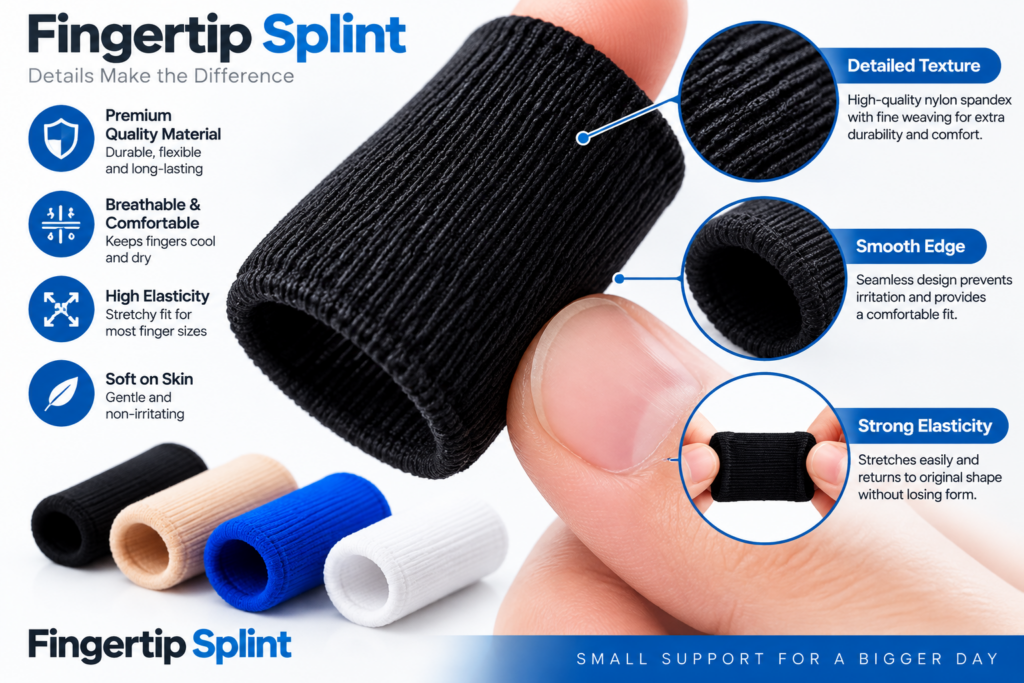
Rather than looking for “premium” material, look for clear material information and characteristics that match your intended use. Here’s what to evaluate:
Material Composition
What is the sleeve made from? Specifics are more useful than vague descriptors.
Stretch
How does the material stretch and return to shape?
Flexibility
How does the material accommodate finger movement?
Thickness
How much material surrounds the finger?
Surface Characteristics
How does the surface feel against skin and objects?
Care Requirements
What maintenance does the material need?
Important: A more expensive or softer material isn’t automatically better for every user or activity. Match material characteristics to your intended use.
Construction Quality
Construction is often what separates a sleeve that holds up from one that doesn’t. Here’s what to examine:
Edges
Do they appear designed to remain comfortable during movement? Smooth, well-finished edges reduce friction.
Seams
Where are they located? Seams positioned over joint creases may become noticeable during movement.
Stretch
Does the material appear designed to accommodate the intended finger shape without losing structure?
Thickness
Does the profile match the intended activity? Consistent thickness prevents pressure points.
Shape
Does the sleeve design correspond to the area it’s intended to cover? An appropriate shape supports consistent fit.
Fit: The Foundation of Daily Use
Fit determines whether the sleeve actually works for daily use. Here’s the practical framework:
Too Loose
Movement and slipping. Coverage becomes inconsistent. Frequent adjustment needed.
Suitable
Secure and comfortable. Stays positioned. Allows intended movement.
Too Tight
Excessive pressure. Discomfort. Possible numbness or tingling.
Important: Don’t rely on arbitrary sizing numbers. Always use the manufacturer’s sizing chart. For the complete fit framework, see Finger Sleeves for Support: A Guide to Fit, Comfort and Coverage.
Flexibility vs Support
Flexibility and support aren’t opposites. A well-designed sleeve can provide both — some support while still allowing natural movement. The balance depends on the product’s intended use.
Flexible Sleeve Design
Generally prioritizes coverage, comfort, and preserved movement. Suited for activities where the finger needs to move frequently.
More Structured Design
May provide more stability or movement control. If you need this level of support, a different product category may be more appropriate.
If you’re deciding specifically between flexible and structured approaches, see Finger Support Sleeve vs Finger Splint: What’s the Difference?
Coverage: Is More Always Better?
Maximum coverage isn’t automatically ideal. Here’s how to think about it:
More Coverage
May increase the covered area, but can affect movement depending on the design. Can add bulk and feel more noticeable during wear.
Less Coverage
May provide greater freedom and dexterity, but might not cover the area you expect. Support may be limited to a smaller region.
The important question: Does the coverage match the intended use? Coverage is about appropriateness, not maximization.
Comfort During Repeated Daily Use
Comfort isn’t only about first impressions. Consistency over time is what matters for daily use. A sleeve may feel comfortable initially but become inconvenient if:
🔄 It shifts during movement
🧵 It bunches
⚖️ It creates pressure
💧 Moisture accumulates
🤲 Movement becomes awkward
🧵 Material isn’t suitable for the activity
For a dedicated comfort-focused guide, see How to Choose a Comfortable Finger Sleeve for Support.
Durability: What Does “Daily Use” Really Mean?
“Daily use” can mean several different things. Understanding your frequency of use helps you evaluate durability more accurately.
Patterns of Daily Use
- Every day — continuous wear
- Several times per week
- Short periods
- Extended periods
- Repeated activities
Durability Factors
- Material resilience
- Construction quality
- Care practices
- Washing instructions
- Storage conditions
- Frequency of use
Don’t assume a specific lifespan unless the manufacturer provides one. Follow care instructions to extend usable life, and replace when material loses shape or construction fails.
Easy Care and Maintenance
A good daily-use product should have understandable care instructions. Here’s what to look for:
🧼 Cleaning method
☀️ Drying
📦 Storage
📋 Manufacturer instructions
🚫 Avoiding unsuitable methods
🔍 Periodic wear checks
Important: Don’t invent washing temperatures or cleaning chemicals unless the manufacturer provides them. Follow the specific care instructions that come with your sleeve.
Daily Activity Compatibility
How a sleeve’s quality translates to daily use depends on the activity. Here’s the practical evaluation framework:
| Activity | What to Evaluate |
|---|---|
| ⌨️ Typing | Flexibility + low bulk |
| ✍️ Writing | Grip + movement |
| 📚 Studying | Comfort + repeated use |
| 📱 Smartphone | Mobility + coverage |
| 💼 Office work | Fit + flexibility |
| ✈️ Travel | Portability + secure positioning |
| 🏠 Light household activities | Fit + intended use |
For the activity-specific guide, see Understanding Finger Support Sleeves for Everyday Activities.
Marketing Claims vs Actual Product Characteristics
This is where quality evaluation becomes practical. Learn to distinguish between marketing language and actual information:
Marketing Language
- “Premium”
- “Maximum support”
- “Ultimate comfort”
- “Advanced design”
- “Professional grade”
These phrases don’t tell you anything specific about the product.
Actual Information
- Material composition
- Sizing details
- Construction specifics
- Coverage area
- Flexibility description
- Care instructions
- Intended use
“More Support” Doesn’t Automatically Mean Better
This is worth stating clearly, because it’s a common misconception:
❌ More compression ≠ automatically better
Tighter doesn’t mean more supportive. Excessive pressure causes discomfort.
❌ More structure ≠ automatically better
Structure often means less movement. Match to your activity, not to the maximum available.
❌ More coverage ≠ automatically better
Coverage should match intended use. More can add bulk and reduce dexterity.
❌ Thicker ≠ automatically better
Thickness affects bulk, flexibility, and dexterity. The right thickness depends on your activity.
The appropriate characteristics depend on the user’s intended activity and the product’s purpose — not on maximizing any single feature.
Interactive 3D: Anatomy of a Good Finger Support Sleeve
Tap each component to see what to evaluate
Material
What is the sleeve made from? Look for clear material composition and characteristics relevant to your intended use. Specific information matters more than descriptive language.
Interactive: How Well Does This Sleeve Match Your Daily Use?
Select the information available for each factor. This is an educational comparison tool — not a medical assessment.
Select the information available for each factor to see an evaluation summary.
Good vs Poor Daily-Use Characteristics
Here’s a side-by-side comparison of what to look for and what to avoid:
✓ Good Daily-Use Characteristics
- Clear sizing information
- Appropriate fit
- Suitable flexibility
- Clear material information
- Appropriate coverage
- Clear care instructions
- Stable positioning
- Intended use clearly stated
⚠️ Potential Concerns
- No sizing guidance
- Frequent slipping
- Unwanted restriction
- Unclear construction
- Excessive or unnecessary coverage
- No care information
- Frequent bunching
- Vague product claims
This comparison is a framework, not a verdict on any specific product. Evaluate actual product information rather than generalizing.
How to Evaluate a Product Page Before Buying
Here’s a practical buyer workflow:
What Should Buyers Examine in a Finger Support Sleeve?
After working through the quality framework, here’s how to apply it to a specific product. Examine the FingertipSplint option using the same evaluation criteria:
Finger Sleeves for Finger Support
- Flexible sleeve-style design
- Intended for everyday finger support
- Product specifications available on the product page
- Designed for finger coverage and comfort
- Available to explore with current product details
Check the product page for material, sizing, coverage, construction, care instructions, and intended use — the same factors covered in this quality framework. For the broader buying framework, see What to Consider When Choosing Finger Support Sleeves. For selection, see Select Finger Sleeves for Support.
When a “Good” Sleeve Still May Not Be Appropriate
Even a well-designed sleeve may not be appropriate for every situation. Consider professional evaluation when there is:
🩹 Significant injury
🦴 Visible deformity
📈 Severe or worsening pain
💧 Major swelling
⚡ Persistent numbness or tingling
🚫 Significant movement loss
⏳ Symptoms that aren’t improving
Important: Ordinary finger sleeves shouldn’t automatically be treated as protective equipment, a prescribed splint, or a replacement for professional evaluation.
For trusted guidance, see the AAOS OrthoInfo hand and wrist conditions library, NHS guide on hand pain, and MedlinePlus hand injuries and disorders. Additional perspectives are available from Mayo Clinic, Cleveland Clinic, and Johns Hopkins Medicine. The NIH provides research-based information, and if a neurological component is involved, NINDS is the specialist resource. For regulatory context on medical devices, the FDA is authoritative, and for general public health information, the CDC is a trusted source.
Daily-Use Quality Checklist
Walk through each item before choosing. Tap to mark complete.
Frequently Asked Questions
A good finger support sleeve combines appropriate material, consistent construction, suitable fit, useful flexibility, appropriate coverage, comfortable contact, secure positioning, practical thickness, durability, and clear manufacturer information. No single feature determines quality — it’s how they work together for your intended use. A good daily-use sleeve isn’t necessarily the thickest, tightest, or most structured. Quality means appropriate design for the intended purpose.
Look for clear material information, sizing guidance, coverage details, intended use, flexibility description, and care instructions. A good daily-use sleeve should stay in position during your normal activities, feel comfortable over extended wear, and match the movements your daily routine requires. Also check whether the product is designed for everyday use or for a specific purpose — the design should match your needs.
There’s no universally “best” material. The right material depends on your activity, wear duration, and comfort preferences. Look for clear material information and characteristics relevant to your use. A more expensive or softer material isn’t automatically better for every user. Check stretch, thickness, surface characteristics, and care requirements — all affect how the sleeve performs for your specific situation.
A properly fitting sleeve should stay reasonably in place without constant adjustment. It should feel snug, not painful. It shouldn’t leave deep marks after removal, cause numbness or tingling, or require pushing through discomfort. It should allow your intended finger movement and match the manufacturer’s sizing guidance. If it slips, bunches, or feels excessively tight, the fit is wrong.
No — it should feel snug, not tight. Tightness doesn’t equal better support. Excessive tightness causes discomfort, restricts circulation, and can cause numbness or tingling. If a sleeve feels too tight, remove it and reconsider the size or design. Persistent numbness or tingling warrants professional advice.
Flexibility matters more during activities that require frequent finger movement — typing, writing, phone use. A flexible sleeve accommodates natural movement, which improves comfort and usability. However, the right level of flexibility depends on your activity. If you need movement restriction or stabilization, a flexible sleeve may not be the right product — a more structured support may be more appropriate.
Not automatically. Coverage should match the intended use. More coverage can add bulk, reduce dexterity, and feel more noticeable during wear. It doesn’t automatically provide more support. The right coverage is the one that matches your actual purpose — not the maximum available.
Look at edges, seams, thickness consistency, and overall shape. Well-finished edges reduce friction. Seams positioned away from high-friction areas support comfort. Consistent thickness prevents pressure points. The shape should match the area it’s designed to cover. If the product page provides construction details, examine them. If construction isn’t explained, that’s a signal that more information may be needed.
Durability depends on material resilience, construction quality, care practices, and frequency of use. Don’t assume a specific lifespan unless the manufacturer provides one. Follow care instructions carefully to extend usable life. Replace the sleeve if the material loses shape, seams fray, or the fit no longer feels secure. A well-cared-for quality sleeve typically lasts longer than a poorly maintained one.
Always follow the manufacturer’s specific cleaning instructions. Some are hand-wash only; others may be machine washable. Avoid harsh detergents and high heat unless the manufacturer recommends them. Allow the sleeve to dry properly before wearing it again. Inspect periodically for signs of wear. Don’t assume generic washing methods apply — check the specific product’s care instructions.
Many flexible sleeves are designed for daily use. However, whether one is appropriate for you depends on the specific product, your activity, and your individual circumstances. Follow the manufacturer’s guidance on wear duration and care. If you experience persistent discomfort, numbness, tingling, or skin irritation, stop using the sleeve and consider appropriate advice. Daily use doesn’t mean continuous wear.
Comfort over repeated use depends on material softness and breathability, appropriate fit, manageable pressure, suitable flexibility, and edges that don’t rub. A sleeve that feels comfortable initially may become less comfortable if it shifts, bunches, or accumulates moisture over time. Focus on consistency — not just the first five minutes of wear.
Compare based on the factors that matter for your use: material, construction, fit, flexibility, coverage, comfort, durability, and care requirements. Look for clear product information rather than relying on marketing language. Match the product’s characteristics to your actual activity and daily routine. There’s no universal “best” — the right product is the one that matches your specific requirements.
No. A flexible sleeve is designed for everyday support with preserved movement. If you need movement restriction, stabilization, or protection from specific hazards, a different product category may be more appropriate. If a healthcare professional has recommended a specific type of support, follow that guidance rather than choosing based on flexibility preference alone.
Consider a more structured support if you specifically need stabilization, positioning, or movement restriction. A flexible sleeve isn’t designed for those purposes. If a healthcare professional has recommended a specific level of support or restriction, follow that recommendation. For the wider comparison, see the sleeve vs splint article on this site.
Evaluate Quality by Design, Not by Marketing
A good daily-use sleeve is defined by how well its material, construction, fit, flexibility, coverage, and durability match your actual needs. Inspect → Compare → Evaluate → Match to Activity
The Bottom Line on Finger Sleeve Quality for Daily Use
Evaluating a finger sleeve for daily use isn’t about finding the product with the most features or the thickest material. It’s about understanding which characteristics actually matter for your routine and checking whether the product delivers them. Material, construction, fit, flexibility, coverage, comfort, durability, and care all contribute to quality — and the right balance depends on your activity and needs.
The most useful approach is to evaluate products based on actual product information rather than marketing language. When you know what to look for, you can judge quality with confidence and choose a sleeve that genuinely fits your daily life.
For readers ready to apply this framework to a specific product, the Finger Sleeves for Finger Support product page is the natural next step. For the category landscape, see Finger Support Products Explained: Where Do Sleeves Fit In? And for convenience considerations, see Why Choose Finger Sleeves for Convenient Finger Support? Explore the full FingertipSplint blog library for more guides.
This article is for general information only and is not a substitute for professional medical advice. Always consult a qualified healthcare provider for diagnosis and treatment of any medical condition.