
Finger Sleeves vs Traditional Finger Supports: What Really Changes?
Two finger support products can look very different while serving overlapping everyday purposes. This guide compares the design philosophy behind flexible sleeve-style support and broader traditional support approaches — including wraps, braces, and splints — so you can understand what actually changes and which characteristics matter for your situation.
What This Guide Covers
- Quick Answer
- What “Traditional” Means
- At-a-Glance Comparison
- 3D Split-Screen Comparison
- Construction Differences
- Flexibility vs Structure
- Movement & Everyday Use
- Bulk & Profile
- Fit & Sizing
- Comfort
- Coverage Differences
- Application & Ease of Use
- Adjustability
- Everyday Activities
- When Flexibility Matters
- When Structure Matters
- Myth vs Fact
- Which Design Matters Most?
- Decision Matrix
- Common Mistakes
- Product Spotlight
- FAQ
Quick Answer: What’s the Difference?
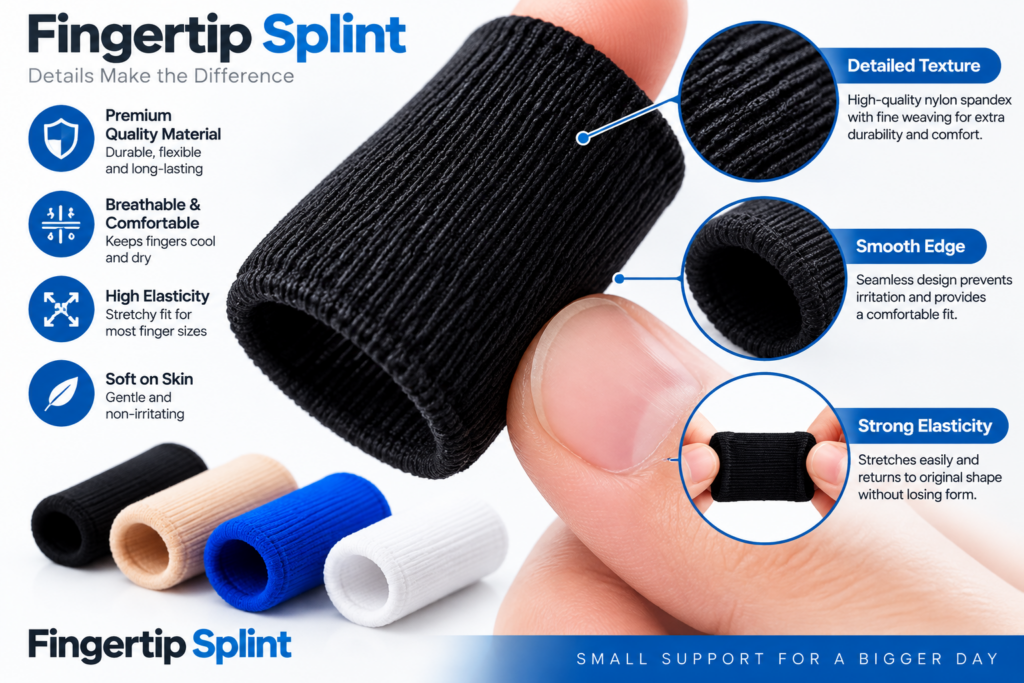
Finger sleeves generally emphasize flexibility, continuous coverage, and low-profile everyday usability. Traditional supports — including wraps, braces, and splints — may emphasize structure, adjustability, stabilization, or movement control. The appropriate design depends on the intended use, required movement, fit, and level of support.
If you’re specifically deciding between a sleeve and a splint, the detailed Finger Support Sleeve vs Finger Splint comparison covers that narrower question. This article compares the broader design approaches — flexible sleeve-style support vs traditional support approaches like wraps, braces, and structured splints. For the foundational understanding of what a sleeve is and how it works, see Finger Sleeves for Finger Support: What Are They and How Do They Work?
What Does “Traditional Finger Support” Mean?
“Traditional” isn’t a single design — it covers several categories of support products. Some are soft and adjustable; others are structured. Understanding these categories helps you compare like with like.
| Support Type | General Design Characteristic |
|---|---|
| 🧵 Finger Sleeve | Flexible, fabric or elastic-style coverage |
| 🌀 Wrap Support | Wrap-around adjustable construction |
| 🩹 Brace | May combine support with adjustable structure |
| 🦴 Splint | Often provides greater structural control |
| 👥 Buddy Support | Uses an adjacent finger for support |
| 🛡️ Protective Support | May prioritize coverage or protection |
Important: These are general design categories, not strict medical classifications. Terminology varies between manufacturers. Always check the specific product’s construction and intended use.
Finger Sleeves vs Traditional Supports: At-a-Glance
Here’s the practical comparison. The words “often,” “may,” and “depends on the design” matter — these aren’t universal rules.
| Feature | Finger Sleeve | Traditional Support |
|---|---|---|
| Construction | Flexible | Often more structured |
| Movement | Usually allows more natural movement | May limit movement depending on design |
| Profile | Generally low-profile | Can be bulkier |
| Fit | Usually based heavily on sizing | May use straps or adjustments |
| Adjustability | Often limited | Often greater |
| Coverage | Continuous sleeve-style coverage | Depends on design |
| Everyday use | Often convenient | Depends on structure and purpose |
| Movement control | Usually limited | May provide greater control |
Interactive 3D: Sleeve vs Traditional Support
Tap each hotspot to see what makes each design different
Finger Sleeve
A flexible, fabric-based layer wrapping the finger.
Traditional Support
A structured or adjustable product with external components.
🧵 Flexible Material
Sleeves are typically made from stretchy fabric or elastic materials that conform to the finger. This flexibility allows natural movement and makes the sleeve low-profile during wear.
This illustration is conceptual. Actual sleeve and traditional support construction varies by product. Always check the manufacturer’s specifications.
Construction: How the Designs Differ
The physical construction of a support product reveals its design philosophy. Here’s how the two approaches differ:
🧵 Finger Sleeve Construction
- Flexible material construction
- Stretch-based fit
- Continuous coverage around the finger
- Low-profile design
- Fewer rigid components
- Slip-on application typical
🩹 Traditional Support Construction
- May include straps or fasteners
- May include rigid or semi-rigid components
- Wraparound or molded structures
- Adjustment mechanisms
- Often more external components
- Application may require more setup
Careful wording: Not every traditional support is rigid or complex. Some are soft wraps; others are semi-structured. Construction varies significantly within the category. For a closer look at sleeve construction specifically, see Finger Support Sleeves Explained: Features, Uses and Design.
Flexibility vs Structure
This is the central concept of the comparison. The design spectrum runs from flexible to structured — and different products sit at different points along it.
Interactive: Design Spectrum
Tap each position to see how it differs
🧵 Finger Sleeve
Flexible, low-profile design. Prioritizes coverage, comfort, and everyday usability while preserving natural finger movement. Suited for activities where flexibility remains important.
This is a conceptual design spectrum, not a universal classification. Actual products vary significantly within each category.
Movement and Everyday Use
How design affects movement is the most practical difference between these approaches. Here’s the framework: Design → Movement → Activity.
Flexible Design in Action
A low-profile flexible design may be easier to integrate into activities requiring frequent finger movement — typing, writing, phone use. The sleeve moves with the finger rather than resisting it.
Structured Design in Action
A more structured design may prioritize support or movement control over unrestricted motion. It may limit certain movements to stabilize a specific area.
For a deeper look at how movement requirements change by activity, see Understanding Finger Support Sleeves for Everyday Activities.
Bulk and Profile
Bulk affects usability, especially during activities involving small objects or fine movement.
How Much Space Does the Support Take?
Tap each level to see the practical implications
📦 Low Profile
Minimal external material. Easier to use with keyboards, pens, and small objects. Less noticeable during wear. This is typical of sleeve-style products.
Fit and Sizing Differences
Fitting works differently across these categories. Understanding this helps you evaluate products more accurately.
🧵 Sleeve Fitting
- Finger circumference
- Finger length
- Stretch behavior
- Appropriate sizing
- Correct positioning
Relies heavily on accurate size selection.
🩹 Traditional Support Fitting
- Adjustable straps
- Positioning during application
- Fasteners and closures
- Multiple adjustment points
- Shape-specific fitting
May allow more customization during application.
Important: Adjustability doesn’t automatically mean better fit. A sleeve can be simple but still require accurate sizing. For the complete sleeve fit framework, see Finger Sleeves for Support: A Guide to Fit, Comfort and Coverage.
Comfort: Flexible Doesn’t Automatically Mean Comfortable
This is important because it prevents exaggerated claims. A flexible support can still become uncomfortable if the sizing or positioning is inappropriate.
🧵 Sleeve Comfort Factors
- Pressure
- Tightness
- Material feel
- Seams and edges
- Moisture handling
- Bunching or slipping
- Duration of use
- Finger shape match
🩹 Traditional Support Comfort Factors
- Strap placement and tension
- Pressure points
- Padding
- Structural rigidity
- Bulk
- Positioning accuracy
- Adjustability
- Duration of use
For a comfort-focused guide, see How to Choose a Comfortable Finger Sleeve for Support.
Coverage Differences
Coverage varies significantly between these design approaches. Tap each option to see the difference.
Interactive: Coverage Patterns
Tap each coverage type to see how it works
🧵 Whole Finger Coverage
Continuous coverage around a section or most of the finger. Common with sleeve-style products. Provides a consistent layer around the covered area.
Application and Ease of Use
How a product is applied affects its everyday usability. Here’s the typical difference:
🧵 Sleeve Application
Open → Stretch → Position → Adjust
Usually simple and quick. Slip-on design with no complex fastening. This simplicity contributes to everyday convenience.
🩹 Traditional Support Application
Position → Wrap → Fasten → Adjust
May require more steps. The additional steps allow adjustability and positioning but add setup time and complexity.
Actual application varies by product. For the convenience angle, see Why Choose Finger Sleeves for Convenient Finger Support?
Adjustability
Adjustability is one of the clearest design differences between these approaches. Here’s the practical trade-off:
Fixed-Size Sleeves
- Simpler to use
- Low profile
- Slip-on application
- Fewer components to manage
Adjustable Traditional Supports
- More customization possible
- Straps and closures allow fine-tuning
- Multiple adjustment points
- Potentially more setup
- Additional components add bulk
More adjustment doesn’t automatically mean better. It depends on whether you actually need that level of customization for your situation. If a sleeve fits correctly, adjustability may add unnecessary complexity.
Everyday Activities: What to Consider
How design affects different everyday activities:
| Activity | Design Consideration |
|---|---|
| ⌨️ Typing | Finger movement + low profile |
| ✍️ Writing | Grip + flexibility |
| 📱 Smartphone use | Dexterity + coverage |
| 💼 Office work | Comfort + movement |
| 📚 Studying | Long-duration comfort considerations |
| ✈️ Travel | Portability + easy application |
| 🏠 Light household tasks | Secure fit + appropriate coverage |
When Flexibility Is an Important Consideration
Flexibility matters most in situations involving frequent or ongoing finger movement. Here are examples where users often value it:
🔄 Frequent finger movement
💼 Everyday desk activities
✋ Activities requiring dexterity
📦 Low-profile preferences
👋 Simple application
When Structure or Adjustability May Matter More
Structured designs may be more relevant when the priority is:
🏗️ Movement control
🎯 Positioning
⚙️ Adjustable fit
🎯 More targeted support
🦴 Structured construction
Important: If you have a significant injury, deformity, severe or worsening pain, substantial swelling, numbness or tingling, or major loss of movement, product comparison alone should not replace appropriate professional assessment. See the NHS guide on hand pain and MedlinePlus hand injuries and disorders for reliable starting information.
Myth vs Fact
These four misconceptions cause a lot of confusion. Tap each card to reveal the reality.
“Traditional support always means rigid.”
“A sleeve provides no support.”
“Tighter means more supportive.”
“More structure is always better.”
Interactive: Which Design Characteristics Matter Most to You?
This is educational guidance for product comparison — not a medical recommendation.
Answer the questions above to see which design characteristics to compare.
Finger Sleeve vs Traditional Support: Decision Matrix
Match your priority to what to compare. This is a neutral framework — not a “winner” table.
| If your priority is… | Compare… |
|---|---|
| Finger movement | Flexibility |
| Low profile | Sleeve-style designs |
| Adjustability | Strap or wrap-based designs |
| Structural support | Structured support designs |
| Continuous coverage | Sleeve construction |
| Easy application | Simpler designs |
| Targeted positioning | Structured or adjustable designs |
Common Mistakes When Comparing Finger Supports
These ten mistakes are easy to make when comparing products. Avoid them:
A visually appealing product may not match your functional needs.
Excessive tightness causes discomfort and doesn’t automatically provide better support.
Fit determines whether the product actually works. Always check the manufacturer’s sizing.
A product suited to one activity may not work for another. Match to your routine.
Flexibility is a design characteristic, not a weakness. A sleeve can still provide support through material, fit, and coverage.
Splint designs vary. Some use semi-rigid components; others are more flexible.
Sleeve materials, thickness, and construction vary significantly.
Match the design to the movement your activity actually requires.
Sizing systems vary between products. Don’t guess.
When symptoms warrant evaluation, product comparison isn’t a substitute for professional guidance.
Explore Finger Sleeves for Finger Support
After understanding the design differences between flexible sleeve-style support and traditional support approaches, here’s what to examine on the FingertipSplint product page:
Finger Sleeves for Finger Support
- Flexible sleeve-style design
- Intended for everyday finger support
- Product specifications available on the product page
- Designed for finger coverage and comfort
- Available to explore with current product details
Check the product page for design characteristics, material, sizing, coverage, and intended use. For quality considerations, see What Makes a Good Finger Support Sleeve for Daily Use? For the broader product landscape, see Finger Support Products Explained: Where Do Sleeves Fit In?
Frequently Asked Questions
Finger sleeves generally emphasize flexibility, continuous coverage, and low-profile everyday usability. Traditional finger supports — including wraps, braces, and splints — may emphasize structure, adjustability, stabilization, or movement control. These are general design differences, not universal rules. The appropriate design depends on the intended use, required movement, fit, and level of support. Individual products vary significantly within each category.
Generally, yes — but it depends on the specific products. Sleeves are typically made from flexible, stretch-based materials that preserve finger movement. Traditional supports often include more structured components designed to control movement. That said, some traditional designs may be semi-flexible, and some sleeves may have more structured zones. Always check the individual product’s construction rather than relying on the category name.
No. Traditional supports vary significantly in design. Some allow significant movement, while others are designed to restrict movement. Wrap-style supports may allow more movement than rigid splints. The degree of movement restriction depends on the specific design and its intended purpose. Don’t assume every traditional support is rigid — check the actual product specifications.
Yes — many people use finger sleeves during everyday activities like typing, writing, smartphone use, office work, and household tasks. Their flexibility and low-profile design make them practical for daily wear. However, comfort during rest may differ from comfort during movement, so it’s worth evaluating the sleeve during the specific activities you do most. A support sleeve is not protective equipment.
Sleeves typically rely heavily on accurate finger measurements — circumference and sometimes length — because they’re designed to fit based on size and material stretch. Braces may allow more adjustment through straps, closures, or adjustable sections. However, adjustability doesn’t automatically mean better fit. Both approaches require attention to sizing instructions. Always follow the specific manufacturer’s guidance.
Yes. A sleeve can provide support through its material, fit, coverage, and construction, even without rigid components. The support is generally gentler and more flexible than a structured splint, but it’s still real support. The amount and type of support depend on the specific product’s design. For a deeper look, see the sleeve features and design article on this site.
Generally, yes. Sleeves are typically designed around a low-profile form with minimal external components. Traditional supports may include straps, buckles, rigid inserts, or additional padding, which can increase bulk. However, bulk varies significantly between products in both categories. Some sleeves may be thicker than expected, and some traditional supports may be relatively slim. Check the specific product’s profile.
Flexible sleeve designs generally allow more natural finger movement than structured supports. That’s their defining characteristic. However, the actual range of movement depends on the specific product’s design and fit. A thicker or more structured sleeve may reduce movement to some degree. If movement restriction has been recommended for your situation, follow professional guidance rather than choosing based on flexibility preference alone.
Often, yes — but not universally. Traditional supports like wraps and braces often include straps, closures, or adjustable sections that allow customization. Sleeves typically rely on sizing and material stretch. However, more adjustability doesn’t automatically mean better fit. It depends on whether you actually need customization for your situation. If a sleeve fits correctly, adjustability may add unnecessary complexity.
No. Tightness doesn’t equal support. A tight sleeve or support can cause discomfort, restrict circulation, and lead to numbness or tingling. Appropriate support comes from correct fit and design, not from squeezing harder. If a product feels too tight, remove it and reconsider the size or design. Persistent symptoms warrant professional advice.
A properly fitting sleeve should stay reasonably in place without constant adjustment. It should feel snug, not painful. It shouldn’t leave deep marks after removal, cause numbness or tingling, or require pushing through discomfort. It should allow your intended finger movement and match the manufacturer’s sizing guidance. For the complete fit framework, see the fit, comfort, and coverage guide on this site.
Seek professional advice if you have a significant injury, visible deformity, severe or worsening pain, major swelling, persistent numbness or tingling, substantial loss of movement, or symptoms that aren’t improving. Also seek advice if a healthcare professional has prescribed or recommended a specific support device. A comparison article can help you understand product differences, but it can’t diagnose what’s causing your symptoms. Trusted resources include AAOS OrthoInfo, NHS, MedlinePlus, Mayo Clinic, and Cleveland Clinic.
Understand the Design. Choose With Clarity.
Flexible sleeves and traditional supports serve different design purposes. The right choice depends on what you need the support to accomplish. Flexibility → Structure → Movement → Fit → Intended Use
The Bottom Line on Finger Sleeves vs Traditional Supports
Finger sleeves and traditional finger supports are built around different design priorities. Sleeves prioritize flexibility, continuous coverage, low profile, and everyday usability. Traditional supports — wraps, braces, and splints — may prioritize structure, adjustability, stabilization, or movement control. Neither is universally better. The right choice depends on what you need the support to accomplish.
Understanding the design differences helps you evaluate products more accurately. When you know whether flexibility, structure, adjustability, or movement control matters most for your situation, you can compare products with confidence — and avoid the confusion that comes from category names alone.
For readers ready to evaluate a specific product using this framework, the Finger Sleeves for Finger Support product page is the natural next step. For the narrower sleeve vs splint comparison, see Finger Support Sleeve vs Finger Splint: What’s the Difference? And for the wider landscape, see Finger Support Products Explained: Where Do Sleeves Fit In? Explore the full FingertipSplint blog library for more guides.
This article is for general information only and is not a substitute for professional medical advice. Always consult a qualified healthcare provider for diagnosis and treatment of any medical condition.