
How Finger Sleeves Provide Everyday Finger Support and Comfort
Your finger doesn’t stop moving just because it feels uncomfortable. You still need to type, write, use your phone, cook, work, and get through the day. This guide explains how a finger sleeve can add a flexible layer of support around the finger while maintaining a low-profile form that fits into everyday activities. The four things that matter most are support, comfort, movement, and fit — and this is where the experience lives.
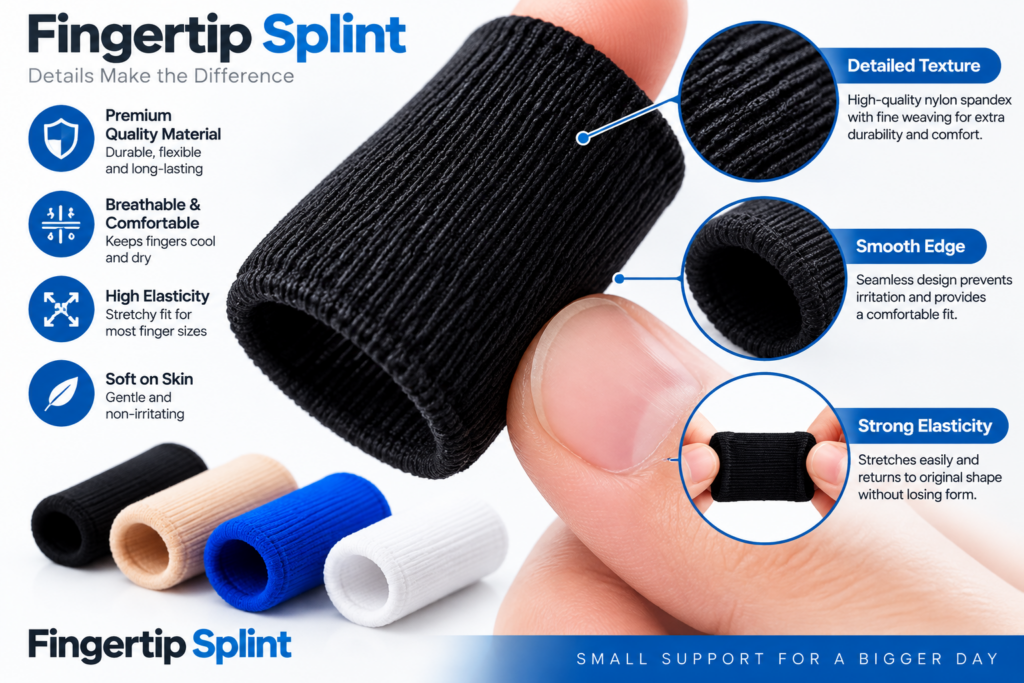
What This Guide Covers
- Quick Answer
- Why Everyday Support Is Different
- How Finger Sleeves Provide Support
- 3D Support Anatomy
- Comfort: Why Fit Matters
- Support vs Freedom of Movement
- Everyday Activities
- 3D Day-in-the-Life
- How Fit Affects Comfort
- Material and Comfort
- Movement and Flexibility
- When Comfort & Support Conflict
- What Sleeves Can & Cannot Do
- Common Everyday Mistakes
- Is a Sleeve Right for You?
- Sleeve vs Other Support Options
- Product Spotlight
- Buyer Checklist
- When a Sleeve Isn’t Enough
- FAQ
Quick Answer: How Do Finger Sleeves Provide Support?
A finger sleeve surrounds the finger with a flexible layer that can provide gentle support, coverage, and a more secure feeling while allowing more movement than rigid support designs. The exact level of support depends on the sleeve’s construction, material, fit, and intended use. Not every sleeve provides the same amount of compression or stabilization.
This is the practical, everyday version of what a finger sleeve does. If you’re comparing flexible support options for daily use, the finger support products collection at FingertipSplint is a useful reference point. But before choosing anything, it helps to understand why everyday support is a different problem from occasional or activity-specific support.
Why Everyday Finger Support Is Different
When someone thinks about finger support, they often picture a specific moment — an injury, a strain, a single episode. But for most people searching for finger sleeves, the reality is different. The need is ongoing, low-level, and woven into a hundred small interactions throughout the day.
Consider what your fingers actually do between waking up and going to bed:
⌨️ Typing
✍️ Writing
📱 Using a phone
🫙 Opening containers
📚 Studying
💼 Office work
🏠 Household activities
🎒 Carrying small objects
✈️ Travel
None of these activities is a one-time event. They repeat — often hundreds of times per day. This is what makes everyday support different from clinical or activity-restricted support. A support product designed for everyday use may need to balance support with freedom of movement in a way that a rigid support doesn’t.
For a detailed activity-by-activity breakdown, see Understanding Finger Support Sleeves for Everyday Activities. For the fit and coverage side, Finger Sleeves for Support: A Guide to Fit, Comfort and Coverage covers the mechanics in depth.
How Finger Sleeves Provide Support
Rather than repeating the basic definition of what a sleeve is, this section focuses on how support actually feels during everyday activity — the practical experience, not the theory.
1. Surrounding Support
A sleeve creates contact around the finger rather than supporting it from a single point. This distributed contact is what makes the support feel “gentle” rather than “structural.” It’s a different experience from a splint that applies pressure at specific points to control movement.
2. Flexible Support
Depending on the material and design, the sleeve may move with the finger rather than resisting it. This is what allows you to continue typing, writing, and using your hands while wearing one. The trade-off is that flexible support generally doesn’t restrict movement the way structured support does.
3. Coverage
The amount of finger covered affects how the sleeve feels during activity. A fingertip sleeve feels different from a mid-finger sleeve, which feels different from one that extends nearly to the base. Coverage is a design decision, not a quality marker.
4. Fit
A sleeve needs appropriate contact with the finger to stay in position without becoming excessively tight. Fit determines whether the sleeve behaves consistently throughout the day or requires constant adjustment.
5. Low-Profile Design
A thinner design may interfere less with ordinary activities. This is one of the reasons sleeves are often chosen over bulkier supports for daily use — they don’t get in the way.
Important: The exact level of support depends on the sleeve’s construction, material, fit, and intended use. A finger sleeve isn’t a category with a single specification — it’s a design approach, and each product within it varies.
Interactive 3D: Where Does the Support Come From?
Tap each component to see how it contributes to everyday support
Material
The flexible layer that surrounds the finger. Material determines how the sleeve feels, moves, and holds up during wear. Different materials provide different combinations of stretch, softness, and durability.
These components work together. No single element defines the support a sleeve provides.
Comfort: Why Fit Matters So Much
Comfort isn’t simply about whether the material feels soft. A soft sleeve can still feel uncomfortable if its size, coverage, or pressure doesn’t suit your finger. Here’s the real breakdown of what comfort depends on:
📏 Appropriate Size
The single biggest factor. Wrong size undermines comfort regardless of material quality.
🧵 Material
Softness, texture, and how it feels against the skin.
↔️ Elasticity
How the material responds to finger movement.
📦 Thickness
Bulk versus dexterity — a trade-off.
🎯 Coverage
How much of the finger is surrounded.
✂️ Edge Construction
Rough edges cause friction and irritation.
💧 Moisture / Heat
Matters for extended wear.
🔄 Movement Compatibility
Comfort during activity matters more than comfort at rest.
⏳ Duration of Use
Comfort that holds up over hours, not minutes.
For a dedicated comfort-focused guide, see How to Choose a Comfortable Finger Sleeve for Support.
Support vs Freedom of Movement
This is one of the most important distinctions in this category. Different products occupy different points on a spectrum between flexibility and structure — and neither end is universally better.
Interactive: Support vs Movement Spectrum
Tap each position to see how it differs
Finger Sleeve
Flexible, low-profile design. Prioritizes coverage, comfort, and light support while preserving natural finger movement. Suited for everyday activities where flexibility remains important.
This is a conceptual spectrum, not a medical classification. Individual products vary significantly.
Flexible sleeves may suit activities where movement remains important. Structured supports may be designed for situations where greater movement control is needed. A sleeve should not automatically be treated as a substitute for a prescribed splint. For a detailed comparison, see Finger Support Sleeve vs Finger Splint: What’s the Difference?
Finger Sleeves During Common Everyday Activities
What you’re doing with your hands shapes what matters most in a sleeve. Here’s the practical breakdown by activity — tap each to see the specific considerations.
Interactive: Everyday Activity Explorer
Tap each activity to see what matters most
TYPING
Repeated movement
WRITING
Grip & movement
SMARTPHONE
Tapping & swiping
STUDYING
Prolonged activity
OFFICE WORK
Keyboard & mouse
HOUSEHOLD
Gripping objects
TRAVEL
Portability
Typing
Repeated finger movement and keyboard contact. A flexible, low-profile design usually works best because it preserves typing rhythm. Excessive bulk or looseness can interfere with key accuracy. Secure fit matters — a sleeve that slips mid-sentence is a distraction.
Interactive: A Day With Your Finger Sleeve
Tap each moment to see the activity and useful sleeve characteristic
🌅 Morning — Getting Started
Finger demand: Light activity — preparing for the day.
Useful sleeve characteristic: Easy application, comfortable fit that doesn’t require adjustment. A sleeve that’s easy to put on and stays put supports a smooth start to the day.
How Fit Affects Support and Comfort
Fit is the single most practical variable in the everyday-use experience. Here’s how it plays out:
Too Loose
- Slipping during activity
- Bunching
- Inconsistent coverage
- Distraction during work
Appropriate Fit
- Stays positioned
- Comfortable contact
- Doesn’t unnecessarily restrict
- Consistent throughout the day
Too Tight
- Discomfort
- Pressure points
- Numbness or tingling
- Discoloration
If symptoms occur: Remove the sleeve and reassess the fit. If numbness, tingling, discoloration, or persistent discomfort continues after removal, seek appropriate professional advice. The NHS guide on hand pain and MedlinePlus hand injuries and disorders are reliable starting points.
Always follow the manufacturer’s sizing instructions. For the complete framework, see Finger Sleeves for Support: A Guide to Fit, Comfort and Coverage.
How Material Affects Everyday Comfort
Material plays a significant role in whether a sleeve feels comfortable over hours, not just minutes. Here’s what different material characteristics affect:
Stretch
How much the material conforms to finger shape.
Recovery
Whether it returns to shape after stretching.
Thickness
Bulk vs dexterity.
Texture
How the surface feels against skin.
Breathability
Air flow during extended wear.
Moisture Handling
How the material deals with sweat.
Skin Contact
Softness against sensitive areas.
Durability
How the material holds up over repeated use and washing.
Important: Material alone doesn’t determine quality. A well-designed sleeve needs the material and construction to work together. A premium fabric with poor construction won’t outperform a simpler fabric with excellent construction.
Finger Movement and Sleeve Flexibility
Your finger isn’t static — it moves through a range of positions throughout the day. Here’s how a flexible sleeve interacts with that movement:
Interactive: Finger Positions Through the Day
Tap each position to see how a flexible sleeve responds
STRAIGHT
PARTIALLY BENT
GRIP
RELAXED
Straight — Baseline Position
The starting position. A properly fitted sleeve sits comfortably around the finger without pressure or bunching. This is where you check basic fit before evaluating any movement.
The purpose of this section isn’t to claim that every sleeve permits unrestricted movement. It’s to show why flexibility is an important design consideration for everyday use — especially when the finger needs to move frequently.
When Comfort and Support Can Conflict
This is where buyer education becomes important. Sometimes the feature that improves support makes comfort worse — and vice versa. Here’s how to think about the trade-offs:
More Coverage
May provide a different support experience but could affect mobility. A longer sleeve covers more but may feel more noticeable.
Thicker Material
May feel more substantial but can add bulk. Fine for some activities, disruptive for others.
Tighter Fit
May feel more secure but isn’t automatically more comfortable or appropriate. Tightness doesn’t equal support.
More Structure
May provide greater movement control but can reduce flexibility. The right balance depends on your activity.
There’s no universal “best” combination — the right answer depends on what you’re actually doing and what matters most to you. For a broader product framework, see What to Consider When Choosing Finger Support Sleeves.
What Finger Sleeves Can and Cannot Do
Setting accurate expectations is essential for choosing well. Here’s the honest breakdown:
They May Provide
- Flexible support
- Coverage
- A secure feeling
- Low-profile support
- Everyday convenience
- Support while maintaining some movement
They Should Not Be Assumed to Provide
- Rigid immobilization
- Protection from sharp objects
- Protection from chemicals
- Protection from high heat
- Treatment for a specific medical condition
- The same stabilization as a prescribed splint
Only claim protective properties if the specific product is actually rated for them. A general-purpose finger sleeve is a support product, not protective equipment.
Common Everyday Mistakes
These seven mistakes cause most of the frustration with finger sleeves. Each is easy to avoid once you know what to look for.
Fit determines everything. A sleeve that doesn’t fit correctly can’t provide its intended support. Measure and check the manufacturer’s sizing chart.
Tighter doesn’t mean more supportive. Excessive tightness causes discomfort, restricts circulation, and can cause numbness. Snug is the goal.
Persistent discomfort isn’t something to “push through.” It’s a signal that the fit, size, or design needs reconsideration.
A sleeve comfortable for typing may not work for household tasks. Match the sleeve to your primary activity.
A sleeve that constantly slips isn’t providing consistent coverage. Check the size, elasticity, and length.
Significant injury, deformity, or worsening symptoms need professional evaluation, not a consumer product.
Sleeves and splints serve different purposes. A sleeve preserves movement; a splint controls it. Match the product type to your need.
Interactive: Is a Finger Sleeve Suitable for My Routine?
A general product-navigation tool, not a medical diagnostic quiz.
Answer both questions to see your focus areas.
Finger Sleeves vs Other Support Options
Here’s a quick comparison. For full detail, see the linked articles.
| Feature | Finger Sleeve | Structured Support |
|---|---|---|
| Flexibility | Generally higher | Generally lower |
| Bulk | Often lower | Often higher |
| Movement | More preserved | More controlled |
| Coverage | Depends on design | Depends on design |
| Everyday convenience | Often useful | Depends on design |
| Adjustment | Usually limited | May be adjustable |
| Movement control | Usually limited | Potentially greater |
For the full product landscape, see Finger Support Products Explained: Where Do Sleeves Fit In? and Finger Support Sleeve vs Finger Splint: What’s the Difference?
Finger Sleeves for Finger Support: A Practical Everyday Option
If your needs point toward flexible, low-profile everyday support, FingertipSplint offers a specific product to examine: Finger Sleeves for Finger Support. Here’s what to check against your own requirements.
Finger Sleeves for Finger Support
- Flexible sleeve-style design
- Intended for everyday finger support
- Product specifications available on the product page
- Designed for finger coverage and comfort
- Available to explore with current product details
Quick Buyer Checklist
Walk through each item before buying. Tap to mark complete.
When a Finger Sleeve May Not Be Enough
A general support sleeve isn’t automatically the right option in every situation. Consider professional evaluation when there is:
🩹 Significant injury
🦴 Visible deformity
📈 Severe or worsening pain
💧 Major swelling
⚡ Persistent numbness or tingling
🚫 Significant loss of movement
⏳ Symptoms that aren’t improving
⚕️ Immobilization specifically recommended
For trusted guidance, see the AAOS OrthoInfo hand and wrist conditions library, Mayo Clinic, and Cleveland Clinic. For broader health information, the Johns Hopkins Medicine and NIH provide reliable resources. If a neurological component is involved, NINDS is authoritative. For regulatory context on medical devices, the FDA is the relevant resource, and for general public health guidance, the CDC is a trusted source.
Frequently Asked Questions
Finger sleeves provide everyday support by surrounding the finger with a flexible layer that maintains gentle, consistent contact. Rather than applying pressure from a single point (like a splint), a sleeve distributes contact around the covered area. This provides a supportive feeling while allowing natural movement. The exact level of support depends on the sleeve’s material, elasticity, coverage, and fit. A sleeve isn’t designed to immobilize — it’s designed to add a flexible layer of support that fits into daily activities without disrupting them.
Comfort depends on several factors working together: appropriate sizing, suitable material, appropriate thickness, comfortable edge construction, and movement compatibility. A well-fitted sleeve in a breathable material can be comfortable for hours of wear. A poorly fitting sleeve — whether too tight or too loose — can become uncomfortable quickly. Fit is usually the biggest factor. If you experience persistent discomfort, numbness, or skin irritation, remove the sleeve and reassess the fit or consider a different design.
Many people type with finger sleeves. For typing, prioritize low bulk, flexibility, secure fit, and comfort during repeated movement. A thick or loose sleeve can interfere with typing rhythm and accuracy. A thin, well-fitted sleeve designed for everyday use is usually a better match for keyboard work. Test the sleeve during actual typing before committing to long work sessions — comfort at rest is different from comfort during active typing.
Yes, but consider grip and dexterity. A sleeve that’s too thick may interfere with pen control. A thin, flexible sleeve that allows natural finger movement is usually a better choice. If you write for extended periods, breathability and comfort during repeated movement become especially important. Test during actual writing — a sleeve that feels fine while resting may feel different after 30 minutes of note-taking.
A finger support sleeve should feel snug, not tight. Snug means it stays in place comfortably. Tight means you feel pressure, experience numbness or tingling, or see deep marks after removal. Tightness doesn’t equal better support. If the sleeve feels too tight, remove it and consider a larger size or different design. Follow the manufacturer’s sizing instructions rather than guessing based on feel alone.
Flexible sleeves are generally designed to preserve natural finger movement — that’s their distinguishing characteristic compared to structured supports. However, some sleeves with more structure or thicker material may reduce movement to some degree. If you need movement restriction or stabilization, a flexible sleeve isn’t the right product category — a structured support may be more appropriate. Match the level of movement control to your actual need.
No. Finger sleeves are typically soft, flexible, and designed for coverage, light support, and everyday comfort with preserved finger movement. Finger splints are structured and designed to stabilize, position, or restrict movement. They serve different purposes. A sleeve doesn’t substitute for a splint when stabilization is needed. If you’re unsure whether a sleeve or splint is more appropriate for your situation, the dedicated comparison article on this site walks through the differences.
It depends on the specific product, material, and fit. Breathable, soft, well-fitting sleeves are generally more comfortable for extended wear. If a sleeve is too tight, made from non-breathable material, or doesn’t fit properly, it may become uncomfortable quickly. Always follow the manufacturer’s recommendations for wear duration, and inspect your skin regularly for irritation. If you notice persistent redness, numbness, or discomfort, remove the sleeve and reassess.
Remove it. A sleeve that feels too tight can restrict circulation and cause numbness, tingling, or skin irritation. Don’t try to “break it in” if it’s painful. Check whether you have the correct size and consider trying a larger size or different design. If you experience persistent numbness, tingling, or skin changes after removal, consult a healthcare professional. A sleeve that causes pain isn’t doing its job — regardless of how well-designed it is in other respects.
Seek professional advice if you have a significant injury, visible deformity, severe or worsening pain, major swelling, persistent numbness or tingling, substantial loss of movement, or symptoms that aren’t improving. Also seek advice if immobilization has been specifically recommended — a flexible sleeve isn’t designed for that purpose. A finger sleeve is a consumer support product and cannot diagnose or treat a medical condition. Trusted resources include AAOS OrthoInfo, NHS, MedlinePlus, Mayo Clinic, and Cleveland Clinic.
Everyday Support That Fits Your Routine
If you’re looking for a flexible, low-profile way to add finger support during daily activities, explore the FingertipSplint finger sleeve and compare its design, fit, and intended use with your own requirements. Support → Comfort → Fit → Movement → Everyday Use
The Bottom Line on Everyday Finger Support
Finger sleeves work best when they’re matched to the reality of everyday use — not just the theory of support. The right sleeve for you balances support, comfort, movement, and fit in a way that matches your daily activities. It doesn’t try to be everything. It doesn’t try to replace a structured splint. It provides a flexible layer of support that fits into your routine without disrupting it.
Understanding how everyday support differs from clinical or activity-specific support is the key to choosing well. When you know what matters — fit, comfort, coverage, material, and movement compatibility — you can evaluate any sleeve with confidence.
For readers ready to explore a specific product using this framework, the Finger Sleeves for Finger Support product page is the natural next step. For a broader view of quality and daily-use frameworks, see What Makes a Good Finger Support Sleeve for Daily Use? And for convenience-focused buyers, Why Choose Finger Sleeves for Convenient Finger Support? explains the practical advantages in more depth. For the full picture, explore the FingertipSplint blog library.
This article is for general information only and is not a substitute for professional medical advice. Always consult a qualified healthcare provider for diagnosis and treatment of any medical condition.